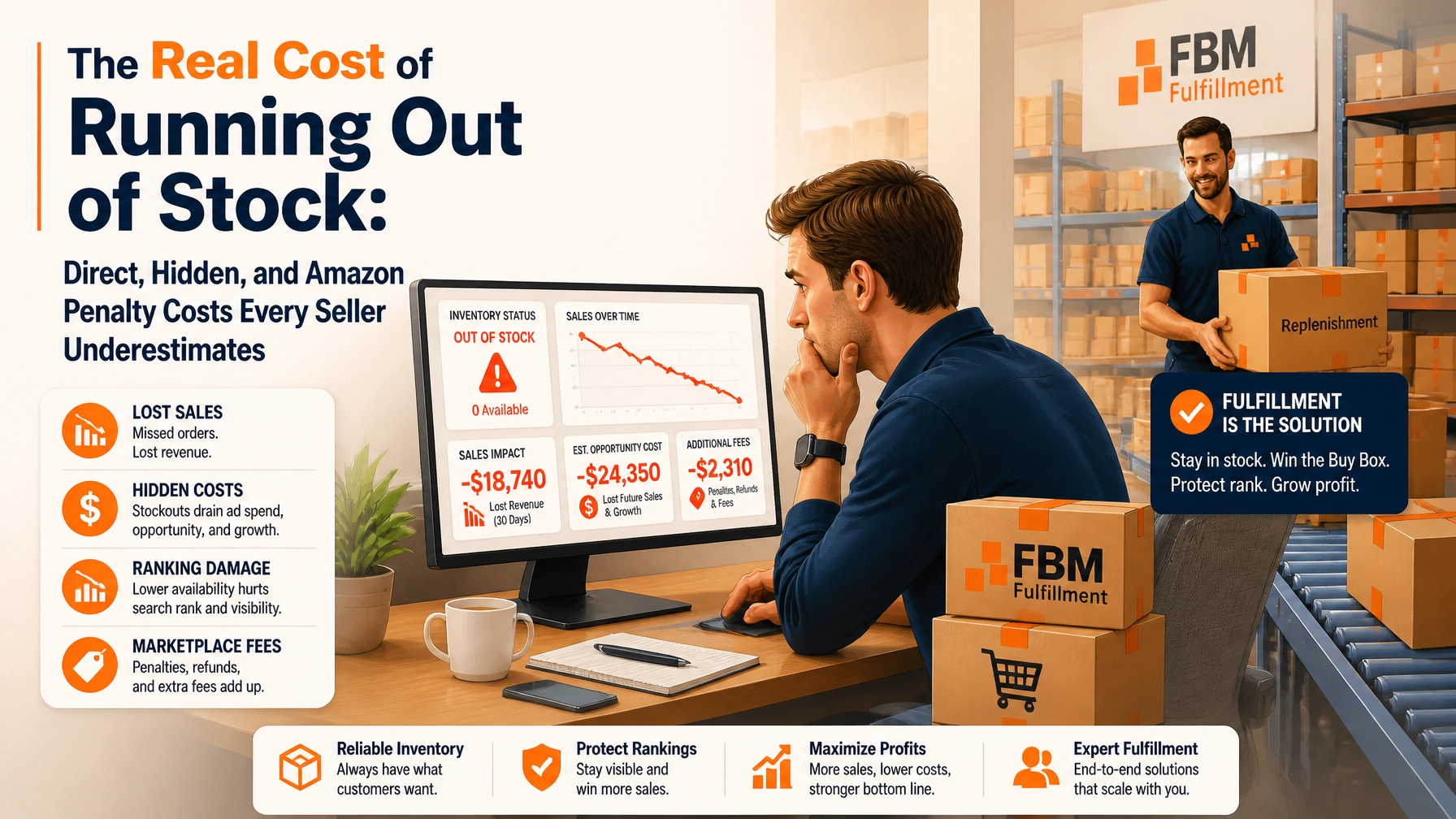
You look at your inventory dashboard and see zero units. Then you tell yourself, “It is just a few days of lost sales.”
It is not.
Market research in 2026 places the true cost of stockout at 2 to 5 times the value of direct lost sales. The damage spreads through lower Best Seller Rank, lost customers, disrupted subscriptions, wasted advertising, Amazon fees, and an expensive recovery climb.
A stockout is not one event. It is a chain reaction.
1. What Are the Direct Costs of a Stockout?
The direct costs are the visible layer. They are easy to calculate, but they are only the beginning.
Lost revenue and gross profit
The basic formula is simple:
Units demanded × selling price = lost revenue
If you normally sell 50 units per day at $40 and remain out of stock for 10 days:
- 500 units cannot be sold
- $20,000 in direct revenue disappears
- At a 40% gross margin, $8,000 in gross profit disappears
That $8,000 is the number most sellers put into their postmortem. It is also the number that causes them to underestimate the damage.
Lost attached purchases
Customers rarely buy only one item because of a single listing. They may have added accessories, bundles, replacement parts, or another product from your catalog.
When your main product is unavailable, the entire shopping session can disappear. You lose the primary sale and every attached purchase that would have followed it.
Marketplace commission you never earn
Amazon, Walmart, and other marketplaces generally charge commissions when a sale occurs. You do not pay commission on a sale that never happens.
That sounds positive until you remember that the commission is deducted from revenue, not profit. The larger loss is the contribution margin you would have kept after product cost, fulfillment, and advertising.
Buyer disappointment and support costs
Customers who find your listing unavailable may contact support, cancel planned purchases, or leave negative feedback on other products. Some buyers also purchase from a competitor and never return.
You may then spend money on refunds, reimbursement disputes, customer service, and goodwill offers. The sale is gone, but the operational work remains.
Emergency restocking
A stockout often forces you to choose between expensive transportation and a longer period of lost sales.
You may pay for:
- Air freight instead of ocean freight
- Rush production
- Emergency carrier charges
- Premium receiving
- Expedited shipment into Amazon
- Additional labor to rework or relabel inventory
That emergency cost is not theoretical. It is the price of having no domestic buffer stock.
2. Where Do Opportunity Costs Become the Real Problem?
The opportunity costs are invisible on your daily sales report. This is where the cost of stockout compounds.
Customers permanently switch to competitors
A buyer who wanted your product will not always wait. If a competing listing is available, the customer can switch in seconds.
That competitor now owns the order history, the product experience, and the chance to earn the next purchase. Winning that customer back requires new traffic, stronger offers, and additional advertising.
Lost customer lifetime value
A customer lost today is not just one missed order. It can represent months or years of future purchases.
For example, if a customer would have placed four $40 orders per year for three years, the lost gross revenue is $480 before considering referrals or attached products. A stockout can destroy that entire future relationship.
Subscribe and Save disruption
For subscription products, an out of stock event creates a particularly damaging interruption. Subscribers may cancel, skip future orders, or replace your product permanently.
Reacquiring those customers requires renewed promotions and advertising. You are paying to rebuild a relationship you already earned.
Traffic and ranking decay
Listings that were generating organic traffic begin losing momentum when sales velocity falls to zero. Market research indicates that meaningful BSR and keyword ranking decay can begin within 24 to 72 hours.
A page one position can slide to page two or worse within about a week, depending on category competition and sales velocity.
Wasted marketing spend
If your PPC campaigns continue sending traffic to an unavailable listing, clicks produce no orders. The advertising budget is spent, but conversion is zero.
Pause campaigns too quickly and you lose traffic momentum. Leave them active and you pay for frustrated shoppers. Neither option is attractive.
Founder and team time
A stockout consumes time that should be spent on growth.
You are checking shipments, calling suppliers, requesting Amazon updates, changing advertising budgets, answering customer questions, and calculating whether to use air freight. Your team is firefighting instead of launching products, improving conversion, or expanding channels.
The recovery period
Restocking does not instantly restore your previous performance. Research indicates that recovery typically takes 2 to 8 weeks after the inventory becomes available again.
During that period, sellers often pay a recovery ad tax. ACOS can run 30% to 100% higher while you rebuild sales velocity, keyword position, and customer confidence.
3. Which Amazon Penalties Make Stockouts More Expensive?
Amazon adds another layer of financial pressure.
Amazon Low Inventory Level fee
The amazon low inventory fee, officially called the Low Inventory Level fee, applies at the individual FNSKU level when Amazon calculates less than 28 days of supply in both its 30 day and 90 day historical demand windows.
Amazon’s Seller Central guidance states that the fee does not apply when either historical metric is at least 28 days. The calculation is based on each FNSKU, not an average across the parent ASIN.
That distinction matters. A well stocked parent listing does not protect a fast selling color, size, or variation.
Track every top FNSKU separately and keep a planning buffer above the fee line.
In stock rate and account performance
Chronic availability problems weaken your operational performance signals. They can also make Buy Box access, promotional eligibility, and holiday badge eligibility less predictable.
Review the current requirements in Seller Central because Amazon changes performance programs and criteria. The practical lesson remains the same: repeated stockouts create account risk in addition to lost sales.
Lost Buy Box share
An unavailable listing cannot win the customer. When your offer disappears or becomes unreliable, competing offers collect the sales velocity and conversion data.
Regaining Buy Box share is not automatic after restocking. You must rebuild traffic, conversion, price competitiveness, and sales history.
The aged inventory squeeze
The opposite mistake creates another penalty stack. Amazon’s U.S. aged inventory surcharge begins at 181 days, increases at 271 days, and becomes more severe after 365 days, according to Amazon’s inventory fee guidance.
You are squeezed from both directions:
- Too little inventory creates lost sales and a low inventory level fee.
- Too much inventory creates storage costs and aged inventory surcharges.
The answer is not blindly buying more. The answer is better inventory positioning.

4. How Does a Stockout Damage BSR?
Amazon’s ranking systems reward sales velocity. When your listing reaches zero, your velocity signal collapses.
Market research findings indicate:
- BSR and keyword rankings can begin degrading within 24 to 72 hours
- A one to three day stockout may recover in days
- A four to 30 day stockout commonly requires 2 to 8 weeks of active recovery
- A stockout lasting more than 30 days can effectively reset the listing’s recent sales history and require months of rebuilding
Your ranking is an asset. You built it through sales, reviews, conversion, and advertising.
A stockout spends that asset down.
5. What Is the Cost of Stockout in a Real Example?
Consider a product selling:
- 50 units per day
- $40 selling price
- 40% gross margin
- 10 day stockout
The direct impact is:
- 500 lost units
- $20,000 lost revenue
- $8,000 lost gross profit
Now calculate a conservative recovery impact.
Assume 60% of normal sales were organic before the stockout. That equals 30 organic units per day. If organic conversion falls by 50% for four weeks after restocking:
- 30 units × 50% reduction × 28 days = 420 missed units
- 420 units × $40 × 40% margin = $6,720 additional lost gross profit
Now add the recovery and penalty costs:
- Extra recovery advertising: $4,500
- Example low inventory level fees before and around the gap: $300
- Emergency expedited restocking: $1,500
The estimated economic impact becomes:
**$8,000 direct gross profit loss
- $6,720 recovery gross profit loss
- $4,500 recovery advertising
- $300 Amazon fee impact
- $1,500 emergency freight
= $21,020 total impact**
The direct gross profit loss was $8,000. The modeled impact is more than 2.6 times higher.
This calculation still excludes lost lifetime value, permanently lost customers, attached purchases, and the compounding gains you would have earned by keeping your ranking during a growth period.
That is the real cost of stockout.
6. Why Is “Buy More Inventory” the Wrong Answer?
Buying more inventory can prevent one stockout while creating another problem.
If you send too much inventory into Amazon, you expose yourself to:
- Monthly storage fees
- Aged inventory surcharges after 181 days
- Larger cash commitments
- Slower inventory turns
- Higher risk from weak variations
- Less flexibility across Shopify, TikTok Shop, Walmart, eBay, and Etsy
The real issue is inventory positioning.
You need enough stock close enough to the customer and Amazon fulfillment network to respond to demand without placing every unit inside Amazon’s system. That is where a domestic 3PL buffer changes the economics.
7. How Does FBMFulfillment Reduce the Cost of Stockout?
FBMFulfillment uses a US based replenishment model to reduce lead time and keep your inventory positioned where it can respond.
The FBA Replenishment Module supports predictable replenishment cycles, often in the seven to 10 day range, helping you keep FNSKUs above the 28 day fee threshold.
The model also provides:
- Domestic staging in Jacksonville, Florida
- Replenishment measured in days instead of a 30 to 45 day ocean cycle
- Direct shipping to multiple Amazon distribution centers
- Same day fulfillment for eligible orders
- One inventory pool across Amazon, Shopify, TikTok Shop, Walmart, eBay, and Etsy
- No onboarding fees, minimums, or long term contracts
If you are comparing a fulfillment center in Florida, a 3PL Jacksonville provider, or searching for ecommerce fulfillment near me, focus on actual lead times, inventory visibility, and replenishment control.
The goal is not to eliminate every demand surprise. The goal is to make a demand surprise manageable.
8. Which Five Numbers Should You Audit This Week?
Review these numbers for every important FNSKU:
- Days of supply: Target 35 to 55 days, staying above the 28 day fee line.
- Restock lead time: Measure factory to US warehouse to Amazon, not just factory transit time.
- Weekly sales velocity: Track the trend, not only the 30 day average.
- ACOS: Record your baseline so you can measure the recovery ad tax.
- BSR trend: Review the last 14 days for early ranking deterioration.
Assign ownership clearly. [Eva] can organize forecast inputs, [Stan] can track supplier lead times and MOQs, [Sonny] can monitor promotions and channel demand, [Penny] can compile the weekly audit, [Linda] can review fee and service terms, and [Rachel] can maintain customer issue records. Automation does not replace inventory judgment, but it can make warning signals harder to miss.
You Have a Stockout Problem. We Have a Solution.
The cost of stockout is not limited to the units you could not sell. It includes lost margin, lost customers, ranking decay, wasted PPC, emergency freight, Amazon fees, and weeks of expensive recovery.
The solution is not simply more inventory inside FBA. It is better positioning: domestic buffer stock, controlled fba replenishment, reliable receiving, and rapid movement into the channels where demand is occurring.
FBMFulfillment provides 3pl fulfillment services built from an ecommerce seller’s perspective. If stockouts are damaging your margins, contact FBMFulfillment at +1 (904) 530-9694 or sales@fbmfulfillment.com. We will be glad to review your current inventory position and show you where the risk is hiding.
Key Takeaways
- The cost of stockout includes direct losses like lost revenue, gross profit, and emergency restocking fees.
- Opportunity costs arise from lost customer lifetime value, market position, and wasted marketing spend.
- Amazon penalties, such as low inventory fees and lost Buy Box share, further increase the cost of stockout.
- Buying more inventory does not solve the issue; proper inventory positioning mitigates stockouts effectively.
- Utilizing FBMFulfillment for better inventory management and replenishment can reduce the overall cost of stockout.