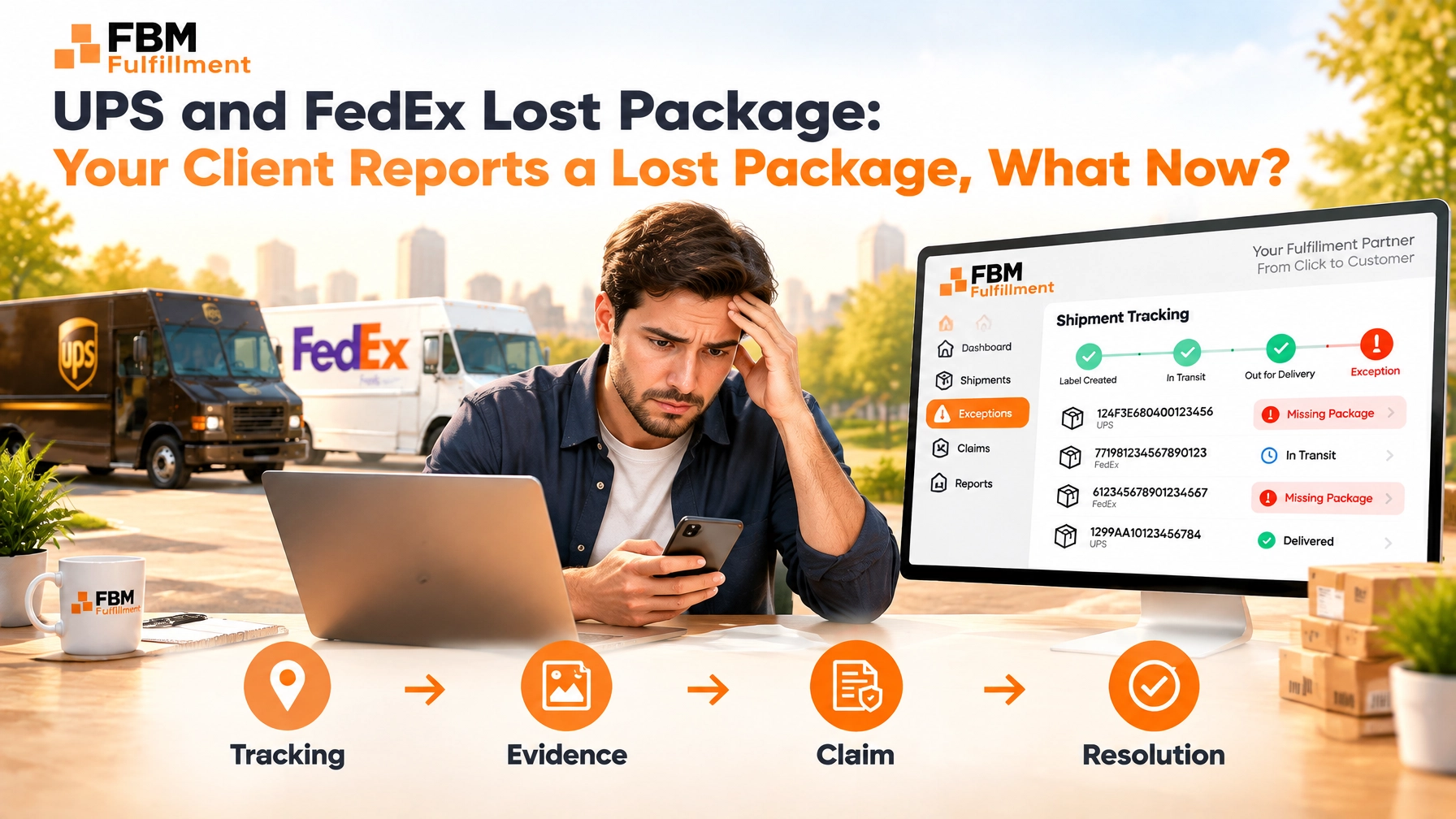
A client reports a missing shipment and now you need answers fast. If you are frantically searching “lost parcel UPS”, “FedEx missing package,” or “UPS lost package,” stop and diagnose the event before filing anything.
UPS and FedEx generally provide better shipment-location evidence than USPS. Account holders can often access delivery details, proof of delivery, and tracking data without visiting a local station. However, standing rules and claim windows still control the outcome.
A missing shipment usually falls into one of three categories:
- Lost in transit, tracking stalls and no delivery scan appears.
- Misdelivery: the carrier marks the shipment delivered, but the location evidence does not match the address.
- Post-delivery theft or a false claim: the carrier delivered correctly, but the package was stolen or the buyer’s report is unsupported.
This article focuses on UPS and FedEx. For the broader three-cause framework and 48-hour response playbook, return to the FBMFulfillment DNR strategy hub. USPS-specific procedures belong in the companion USPS/DHL guide because the evidence and station-visit process differ.
What happened to the UPS lost package or FedEx shipment?
No initial Scan
UPS drivers do not scan at pickup per UPS policy. FedEx drivers, on the otherhand, are supposed to scan each package at pickup. If the package does not receive the intial scan do the following:
- Check the dock and warehouse to insure it was physically picked up.
- Check security footage to verify pickup and in the case of FedEx, that the driver scanned per policy. Contact representive or terminal.
No delivery scan and stalled tracking
If tracking has not updated and the expected delivery window has passed, you may have a lost parcel UPS situation, a delay, or a package held at a facility.
Do not immediately promise a replacement. First, confirm:
- The last physical scan.
- The scheduled delivery date.
- Whether an exception or address issue appears.
- Whether the package entered the carrier network.
- Whether a trace is already open.
A search for package lost UPS usually describes this exact scenario: the shipment has not been delivered, but the carrier has not formally declared it lost.
Delivered scan but no package
A delivery scan changes the investigation. It may indicate:
- Misdelivery to a neighboring address.
- Placement at an alternate entrance, mailroom, or leasing office.
- Porch piracy.
- A fraudulent buyer claim.
- A delivery scan recorded before the package was physically placed.
This follows the delivered not received path, not the ordinary lost-in-transit path. Preserve the scan time, delivery photo, signature record, and any available location evidence before escalating. Tell your client to check all entrances, the mailroom, leasing office, nearby neighbors, and any available camera footage before you move to the next step.
Partial delivery or visible damage
If only part of the order arrived, or the carton arrived damaged, this is a damage or shortage claim, not a total-loss claim.
Keep the packaging, photographs, commercial invoice, packing record, and product documentation. Filing under the wrong category can waste valuable time and create unnecessary disputes.

Who can file a UPS lost package or FedEx claim?
This is the rule sellers repeatedly misunderstand:
Only two parties generally have standing to file a carrier claim: the sender or shipper that purchased the label, and the receiver or addressee. A third party without that relationship generally cannot file directly.
| Party or label arrangement | Who normally files or controls the claim? |
|---|---|
| Sender or shipper | The label purchaser is the primary claimant and the party the carrier usually contacts for documentation and payment. |
| Receiver or addressee | The named recipient may have standing under applicable carrier terms, particularly for damage or non-delivery issues. |
| Unrelated third party | Generally cannot file directly without authorization or the required shipment relationship. |
| Amazon Buy Shipping | The seller must pursue the matter through Amazon because Amazon purchased or controlled the label relationship. |
| TikTok Buy Shipping | The seller must pursue the matter through TikTok for the same reason. |
| 3PL-purchased label | The 3PL is the shipper of record and must file or authorize the claim, even though the seller owns the goods. |
| Freight forwarder or intermediary | Confirm who actually purchased the parcel label before promising a customer that you can file. |
This is why a package missing UPS report from a merchant may not be enough if Amazon purchased the label. The merchant owns the inventory, but the platform controls the carrier relationship.
Likewise, if a 3PL purchased the label, the 3PL must submit the UPS claim lost package request or authorize the seller to participate. Document this before giving the customer a deadline or replacement commitment.

How do you report a missing package to UPS?
Follow this sequence for a UPS parcel lost in transit:
- Confirm the shipment is genuinely overdue. Check the scheduled delivery date, last scan, service level, and exception messages.
- Open a trace or claim through the shipping account. Use the official UPS claims page, the UPS claims dashboard, or call 1-800-PICK-UPS.
- Provide the tracking number, shipment date, and goods description.
- Attach proof of value, such as an invoice, order record, or commercial invoice. Include the declared value where relevant.
- Give notice within 60 days of the scheduled delivery date for a lost or damaged package under UPS’s published U.S. guidance.
- Submit any formal claim documentation required by your account or shipment terms. Some UPS arrangements distinguish timely notice from the later written claim and reference a nine-month period from shipment. Do not rely on that longer period without verifying the applicable terms.
- Save every claim number, email, invoice, photograph, and carrier message.
UPS states that claims must be submitted electronically or in writing. A shipper should also monitor the claims dashboard because the carrier may request additional proof of value or a more detailed merchandise description.
For an electronics claim, record the model and serial number. For a multi-unit order, identify the exact SKU and quantity missing.
How do you report a missing package to FedEx?
For a FedEx missing package, use the following process:
- Confirm that the shipment is genuinely overdue rather than experiencing a routine delay.
- Open a claim through the FedEx account that shipped the parcel or through the FedEx claims portal.
- Provide the tracking number, shipment date, recipient address, product description, and proof of value.
- For standard lost or non-delivery claims, file generally within nine months of the shipment date.
- Check the service-specific terms. FedEx Ground Economy and international services can have different requirements, while damage or missing-content claims often have shorter deadlines.
- Keep the claim reference number and all supporting correspondence.
A FedEx report missing package request should clearly state whether the package never received a delivery scan or was marked delivered but not received. Those are different investigations.
If the issue is a FedEx missing delivery, do not describe it simply as theft. State the facts: the delivery scan, address, time, photo, signature status, and what your client confirmed after checking entrances, mailroom, neighbors, and any available camera footage.
What are the UPS and FedEx lost-package claim windows?
The following table is practical general guidance, not a substitute for the current terms governing your account and service.
| Carrier | Lost or non-delivery timing | Important qualification |
|---|---|---|
| UPS | Notice generally within 60 days of the scheduled delivery date; some applicable terms may distinguish a formal claim period of up to nine months from shipment. | UPS’s public claims page emphasizes starting the claim within 60 days. Verify your account and service terms. |
| FedEx | Lost or undelivered claims generally within nine months of the shipment date. | Special services, Ground Economy, international shipments, and damage claims can differ. |
| Both | Damage, shortage, concealed damage, and service guarantees have separate rules. | Do not use a lost-package deadline for a damage or missing-content claim. |
Carrier terms change. Service contracts change. File immediately, even when you believe a longer formal period may apply.

How does delivery-location data help?
FedEx Advanced Shipment Tracking can provide account-level visibility into shipment status, proof-of-delivery details, documents, images, and, for eligible shipments, the nearest coordinates associated with the delivery event. Review FedEx Advanced Shipment Tracking to understand the available tools.
Do not assume every account exposes identical information. Access depends on the account, shipment, service, and tracking configuration.
UPS access also varies by account and volume. A UPS Capital or specialized high-volume merchant account may provide backend delivery geocode tools or a delivery-confidence review. Smaller accounts may receive less detailed location information.
This is one operational advantage over the USPS PTR path, which generally requires the recipient to visit the destination post office for additional delivery investigation while you manage the broader seller-side case.
If the location data shows the scan outside the expected delivery radius, preserve it as documentary support for a misdelivery position. If the data confirms delivery at the correct address, the loss is generally post-delivery. Move to insurance, seller policy, marketplace protection, or theft documentation.
If you use shipment research tools, Claude can serve as an entry point for organizing tracking events, claim documents, and customer correspondence. It does not replace the carrier portal, carrier terms, or human review.
What if UPS or FedEx denies the claim?
Misdelivery
Preserve:
- Delivery coordinates or confidence data.
- Proof-of-delivery images.
- Scan time and address.
- Customer statements.
- Address-validation records.
- Any driver or carrier correspondence.
The party with standing must escalate. If Amazon or TikTok purchased the label, work through that platform. If a 3PL purchased it, the 3PL must file or authorize the claim.
Correct delivery and porch piracy
If the carrier confirms delivery at the correct address, carrier liability generally ends. Porch piracy is not automatically a carrier loss.
Possible protection includes:
- Third-party shipping insurance.
- A seller replacement policy.
- Signature required service for higher-value orders.
- Address-risk tools such as UPS Delivery Defense.
- A police report or payment-dispute process where appropriate.
Direct Signature Required offers stronger delivery control but can increase missed deliveries and Return-to-Sender rates. Indirect Signature Required can reduce missed deliveries but provides less control. Select the service based on order value, product risk, customer location, and margin.
Fraudulent buyer claims
Do not accuse a buyer without evidence. Document:
- Tracking and delivery scans.
- Delivery address and account history.
- Order value and SKU.
- Customer communication.
- Repeated claim patterns.
- Marketplace case records.
- Signature or delivery-photo data.
Use the marketplace dispute process and keep the language factual. The full protection-tier framework belongs in the DNR strategy hub.
What should sellers and 3PLs change operationally?
A repeatable process prevents a single missing parcel from becoming a margin problem:
- Validate addresses before labels are purchased.
- Require clean pick, pack, label, and carrier-scan discipline.
- Retain label records, invoices, proof of value, and product descriptions.
- Document who purchased each label.
- Track claims by carrier, SKU, ZIP code, service, channel, and outcome.
- Configure signature options for products where replacement cost exceeds delivery friction.
- Give customer service a factual script: “We are reviewing the scan, delivery evidence, and label ownership before determining the next step.”
- Set internal reminders before carrier deadlines expire.
FBMFulfillment sellers can centralize shipment records through their fulfillment workflow and work with the party that purchased the label. That distinction matters when a seller, marketplace, freight intermediary, or 3PL controls the carrier relationship.
For broader inventory and channel-control considerations, see the multichannel inventory control guide. For packaging and damage prevention, review reducing damaged shipment claims.
Key Takeaways
- Diagnose the event before filing: lost in transit, misdelivery, theft, or damage.
- Only the sender or label purchaser and the receiver or addressee generally have standing.
- Amazon Buy Shipping claims must be pursued through Amazon.
- TikTok Buy Shipping claims must be pursued through TikTok.
- If a 3PL purchased the label, the 3PL is the shipper of record.
- UPS notice is generally due within 60 days of scheduled delivery; verify any separate formal-claim terms.
- FedEx lost or non-delivery claims are generally due within nine months of shipment.
- FedEx and UPS location evidence is usually easier to access than the USPS PTR path.
- Correct delivery followed by porch piracy usually requires insurance or a seller protection policy.
- Use signature services selectively for higher-value orders.
- Document who bought the label before promising a customer a claim outcome.
Related Links
Frequently Asked Questions
Confirm the package is overdue, then use the UPS claims portal or call 1-800-PICK-UPS. Provide the tracking number, shipment date, detailed goods description, proof of value, and any declared-value information. Start within the applicable 60-day UPS notice period.
Use the FedEx claims portal associated with the shipping account. Provide tracking, shipment date, proof of value, product details, and delivery evidence. Standard lost or non-delivery claims generally have a nine-month filing window.
For a lost or damaged package, UPS publicly states that you should start within 60 days of the scheduled delivery date. Some account or shipment terms may distinguish notice from a later formal claim, so verify the governing terms immediately.
FedEx generally requires lost and undelivered shipment claims within nine months of the shipment date. Damage and missing-content claims can have shorter deadlines.
The sender or shipper that purchased the label and the receiver or addressee generally have standing. An unrelated third party generally cannot file directly.
You must work through Amazon because Amazon purchased or controlled the label relationship. You may own the goods, but Amazon controls the carrier claim path.
You must pursue the claim through TikTok. Confirm the label purchaser and preserve all TikTok order and shipment records.
Yes, when the 3PL purchased the label. In that case, the 3PL is the shipper of record and must file or authorize the claim. Ownership of the inventory does not automatically create carrier standing.
Treat it as a DNR investigation. Check the address, delivery photo, signature status, coordinates, alternate delivery locations, and customer history. Ask your client to check entrances, mailroom, neighbors, and any available camera footage. If the scan matches the address, evaluate porch piracy or fraud protections instead of treating the parcel as lost in transit.
A correct delivery followed by theft is generally not covered as a carrier loss. Review third-party shipping insurance, seller policies, signature options, marketplace procedures, and any applicable payment or property-insurance process.