The amazon bundle policy change is the most consequential catalogue rule since FBA commingling ended, and most sellers are treating it like a labeling update.
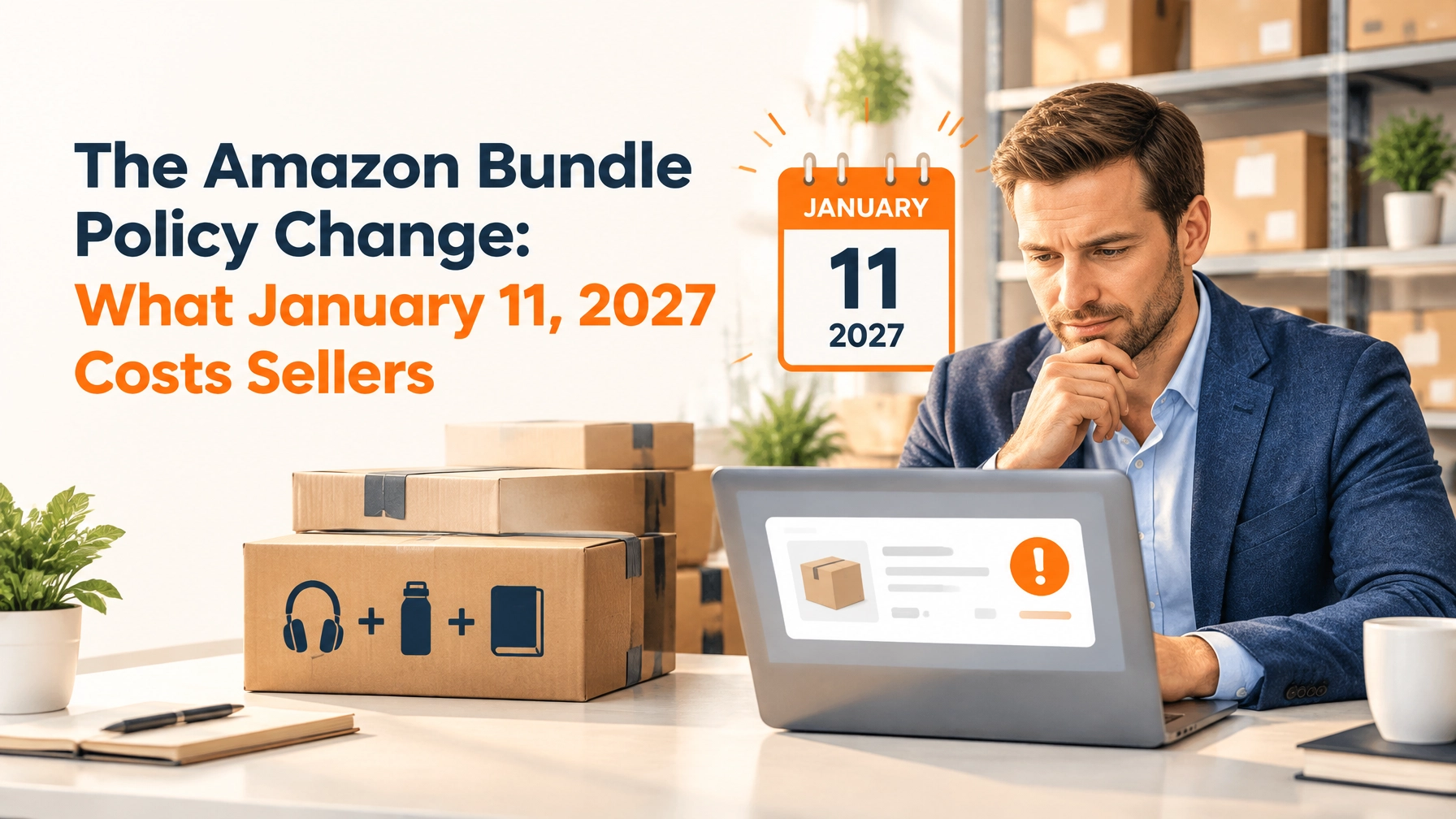
It is not. From January 11, 2027, physical bundling done by the seller, by a prep service, or by a 3PL is banned for most bundles listed as a single ASIN, unless you hold a Letter of Authorization that may be difficult, often impossible, to obtain. You can no longer take branded items and combine them into a custom physical package at your own warehouse, at a prep center, or at a fulfillment partner.
The only exceptions are a Letter of Authorization from every brand in the bundle, or a listing in an exempt category (gifting browse nodes such as holiday gift baskets, or camera product types). When you are without a LOA in hand or being in an exempt category, the listing comes down, the violation lands on your Account Health record, and any assembled stock sitting in a fulfillment center becomes a removal order. None of those consequences can be undone with a support ticket.
Read that date again. It falls eleven days after the fourth quarter closes. You get all of Q4 to sell, then the cliff.
Amazon posted the update in its Seller Forums news channel during the week of September 7, 2026. Four months. That is the entire runway. Amazon says the change protects authenticity and customer trust, and it offered no counterfeit statistics, complaint rates, or enforcement data to support that claim.
If your highest-margin ASIN is a two-pack, a three-pack, a five-pack, or a combination of products no single manufacturer sells together, this policy was written about you. The composition is permitted. The assembly is what is in question.
1. What changed, and why is this bigger than a packaging rule?
Seller-assembled physical bundling is banned without a LOA that may be difficult to obtain. That is the rule, stated without cushioning: from January 11, 2027, you cannot assemble a physical bundle at your warehouse, at a prep center, or at a 3PL and list it as a single ASIN. The only way back in is a Letter of Authorization from every brand in the pack — and section 2 explains why most sellers will never get one.
This is not a manufacturer story. A bundle built by the original brand is a different product with its own unique GTIN, its own catalogue identity, and its own barcode. It was never the format most independent sellers use, and it is not what this article is about. The bundles at risk here are the ones sellers build themselves from existing branded inventory, and those are the ones the policy targets.
The measure is who assembled the pack. Manufacturer-packaged, with a unique GTIN: permitted. Seller, prep service, or 3PL assembled: prohibited unless you clear one of the exceptions below.
Two ways to keep a physical bundle, plus one way to avoid physical packaging entirely:
- Letters of Authorization. You hold an official LoA from every brand in the bundle, giving you explicit permission to repackage and reconfigure their items together. The letter has to cover all included brands.
- Exempt categories. The bundle is listed under gifting browse nodes, such as gift baskets, or camera product types. Those remain entirely exempt from the manufacturer-packaging rule.
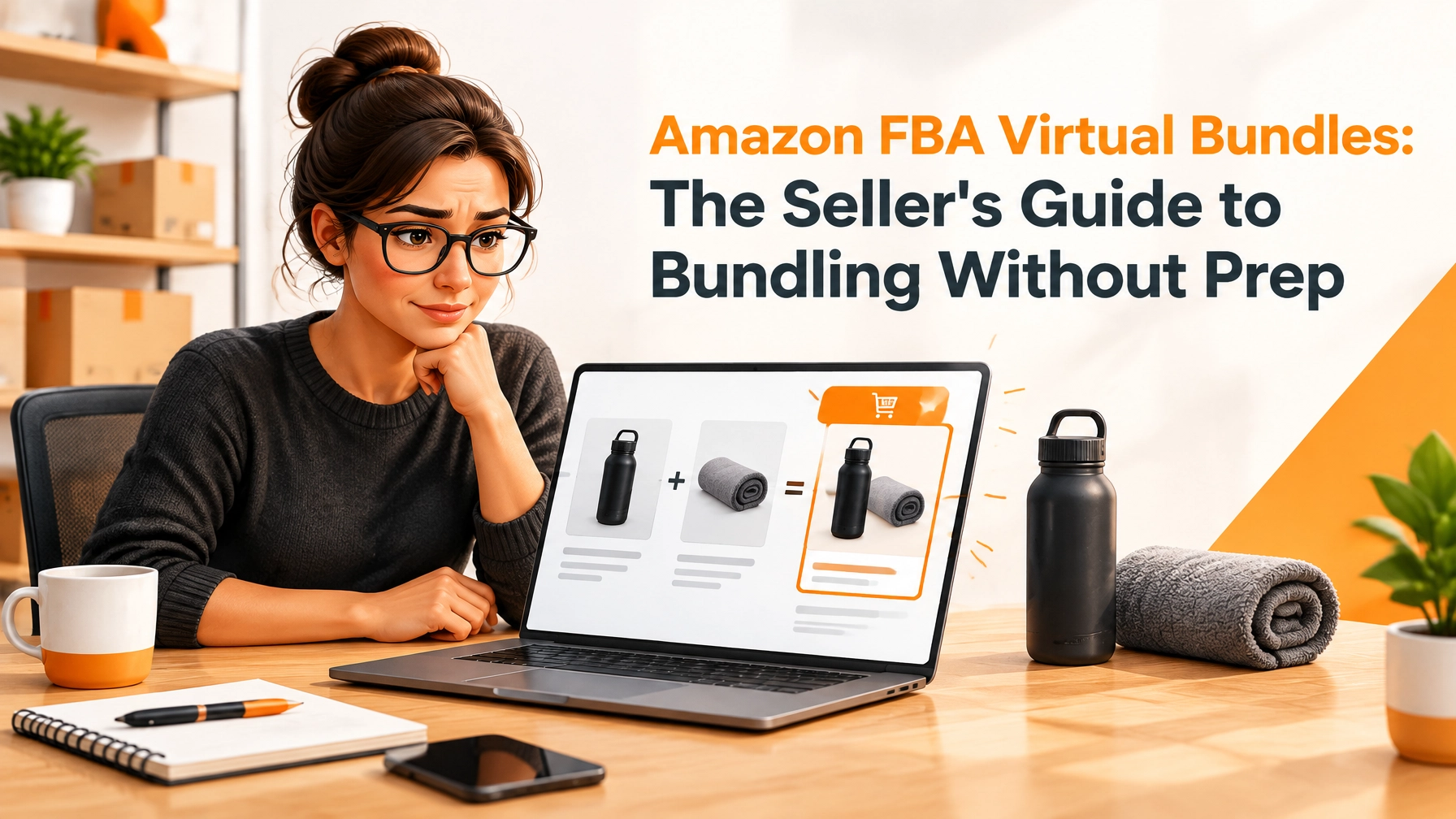
- Virtual Bundles. Not a way to assemble a physical pack, but a way to avoid one: Amazon’s Virtual Bundles tool ships the components as separate picks inside a single order, so nothing is ever combined into a physical package.
The escape route is narrower than it looks. Amazon’s notice describes submitting the LoA through Account Health after a listing is flagged. There is no pre-clearance process described. You cannot get ahead of this by filing paperwork early. You wait to be accused, then defend yourself, then hope the appeal lands.
And the letter itself is the hard part, not the upload. Section 2 walks through why a conglomerate brand will almost never sign one, and why most wholesale and arbitrage sellers will never get the letters they need.
For a multi-brand kit, one uncooperative brand out of five does not create a partial problem. It kills the listing.
What counts as a compliant bundle?
Combining different SKUs is permitted, and it is what defines a bundle on Amazon. A compliant bundle consists of a primary item plus complementary secondary items that are different SKUs. The composition was never the problem — the packaging is. If you sell that multi-SKU combination as a single physical ASIN, the exact combination must either arrive pre-packaged from the manufacturer or be covered by a brand LoA. Note what the first option actually requires: a brand that already sells that combination. It is not a door you can knock on and ask a manufacturer to build a custom pack for you.
The update also loosens restrictions in the other direction, which is easy to miss under the packaging requirement. Bundles may now include Books, Music, Video, DVD, Video Games, gift cards, and service plans as primary or secondary items. Secondary generic products are permitted. And multi-brand Consumables bundles return as a documented pathway when letters of authorization are in place.
Are multi-brand physical bundles still allowed?
Yes, and they face the highest compliance bar of any format. Combining products from two or more distinct brand entities into one physical package is precisely what this update targets.
To sell a custom multi-brand physical bundle after January 2027, you need a valid Letter of Authorization from every single brand in the kit. If Amazon’s automated systems flag the multi-brand ASIN as an unauthorized custom repackage, you upload those LoAs to your Account Health dashboard to keep the listing from being permanently deactivated.
So the ban is not on bundles. It is on you assembling one. A brand-packaged bundle with its own GTIN continues untouched, which is why this rule lands entirely on independent sellers — and, as section 6 shows, on the economics that made bundling worth doing in the first place.
2. How hard is it actually to get a Letter of Authorization?
This is the section that decides whether the LoA route is a plan or a hope, and most coverage of the policy skips it entirely.
Understand what you are asking for. You are not asking a brand to let you sell its standard catalogue item. You are asking it to sign off on your own custom configuration — a combination it did not design, did not test, and will now be associated with publicly. That is a commercial request wrapped in a legal one, and the difficulty depends almost entirely on your existing relationship with the brand.
High difficulty: major global brands
If you are bundling products from large conglomerates — Nike, Procter & Gamble, Unilever, and companies of that scale — treat the LoA as effectively unavailable.
Corporate policy. These companies operate strict, non-negotiable brand guidelines covering how their products are presented. A third-party custom pack is a violation of those guidelines by default.
Liability and warranty. They do not want to be responsible for product defects or returns caused by a seller tape-wrapping their item to a competitor’s product. Once they authorize the combination, the boundary between their product’s failure and your assembly’s failure gets harder to defend.
Bureaucracy. Standard wholesale sales reps lack the legal authority to sign custom licensing or repackaging agreements for an Amazon merchant. Even a willing rep usually has no route to paper.
If your best bundle depends on two or more conglomerate brands, the LoA route is not a four-month project. It is not a project at all.
Moderate difficulty: small to mid-sized brands
Sourcing directly from smaller manufacturers or mid-tier brands makes an LoA feasible, but it requires actual negotiation rather than a request.
The grey-area fear. Brands are terrified of losing control of their Amazon listings to unauthorized sellers. Ask for permission to create a new ASIN containing their product and the first legal instinct is to say no, because a new ASIN looks like another surface they cannot police.
The incentive. This is where the conversation has to go. Present the bundle as a win for the brand, not a favour to you. Show them how pairing their slower-moving item with a high-demand item clears stagnant inventory, or how the bundle raises your total order volume from them. A brand that sees its own benefit has a reason to find the paperwork. A brand asked to do you a favour has every reason to stall until February.
Low difficulty: private label or exclusive distribution
If you are bundling your own registered brand, or you hold an exclusive distribution agreement with a manufacturer, this is close to a formality. You write the authorization yourself, or your manufacturing partner signs a standard template. The constraint essentially does not apply.
A Brand Registry role is not permission
One more thing that gets confused with an LoA, and it matters because sellers treat the two as interchangeable.
A Brand Representative or Authorized Reseller role is a technical gate on Amazon’s side. It grants access to tools and brand functions inside Seller Central. It does not grant the brand’s consent to repackage their items, and it does not mean the brand will sign a letter of authorization either. A role on a brand’s registry is not a signed authorization covering your specific combination.
A seller can hold the Brand Representative role and still be refused by the brand. The role is a permission from Amazon, not a relationship with the manufacturer.
And the sellers who cannot get the role at all — arbitrage, wholesale, anyone selling brands they are not registered under — have no Brand Registry route to anything. For them, “just use Amazon virtual bundles” is not a workaround. It is a door they cannot open.
What this means for the four-month runway
Sort your catalogue by this tiering before you send a single email. A multipack of your own private label is a same-week fix. A three-pack of a mid-tier brand is a negotiation that needs to start now. A kit assembled from conglomerate products is a dead ASIN that needs a plan, not a letter.
Most wholesale and retail arbitrage sellers sit in the first and second tiers, which means most of them will not get the letters they need. That is the underreported half of this policy: the LoA route exists on paper for everyone, and in practice it is available to a small slice of sellers — the ones who already own the brand or already hold the distribution rights.
3. Why is January 11 the worst date on the calendar?
The deadline arrives eleven days after Q4 closes. That is not a scheduling accident, and it is not a favor.
Amazon says noncompliant inventory can keep selling until January 11. So Q4 is untouched, you take the peak-season revenue, and then the rule lands exactly when your January ad campaigns are running, your post-holiday returns are processing, and your remaining assembled stock sits in a fulfillment center with nowhere to go. Every cost of this change is deferred into the quarter where you can least afford it.
The generous reading is that peak-season trading is protected and the compliance cliff is not. The cynical reading is that the bill arrives after the money is spent. Either way the operational reality is identical: you have four months to prevent it, and nobody is going to prevent it for you.
The 2024 precedent moved quickly. Amazon announced a Consumables restriction on October 14, 2024, and began enforcing it against existing listings on January 1, 2025-about eleven weeks later. The 2027 change allows roughly four months. More notice helps, but it does not eliminate the operational shock if many ASINs are affected at once.

4. Who is actually in the blast radius?
Everyone who assembles a physical pack while holding branded inventory. Most coverage focuses on the obvious case: sellers combining products that no single manufacturer sells together. Cross-brand snack packs. Grocery assortments. First-aid kits. Medical kits. Convenience bundles.
That may be the smaller half of the exposure. The larger half is the multipack — and it comes with a definitional wrinkle worth understanding before you plan around it.
Amazon defines a bundle around different SKUs: a primary item plus complementary secondary items. A two-pack or three-pack of the same product does not fit that definition neatly. That does not make it safe. If you take individual units, combine them, and list the combination as one ASIN, you have repackaged a manufacturer’s product, which is exactly the behavior this update targets. Same brand and same UPC do not obviously protect you.
So treat single-SKU multipacks as a grey zone and resolve it rather than guess. Confirm your specific listing’s classification with Seller Support before January. If Amazon treats your three-pack as a bundle, you need manufacturer packaging or a letter of authorization. If it is treated under separate multipack rules, the requirement may differ — but the direction of travel across Amazon’s 2026 policy changes is uniform: accountability is moving to the individual listing, and seller-assembled configurations are the target.
Either way, this is a much broader population than multi-brand assemblers. Resellers who buy single units and shrink-wrap them into multipacks. Sellers building three-packs from retail or wholesale supply. Anyone whose catalogue is built on pack-size variants rather than SKU variety. For many of them, the highest-margin ASIN in the catalogue is a multipack, precisely because the pack size raises order value without a matching rise in unit cost. Those sellers need an answer before January, not an assumption.
Then there is the multi-brand case, which carries an extra problem. A multi-brand assembler may need separate permission from every brand in the bundle, and one uncooperative brand can block the entire combination. A three-pack of one brand needs one letter. A five-brand kit needs five, and the weakest link decides.
The asymmetry is consequential: brand owners and authorized resellers retain the virtual bundle route, while other sellers may need brand approval to keep a physical multi-brand bundle listed. That shifts catalogue control toward the brands whose products are combined.
There is also a basic definitional problem. Generic products may have no brand and little or no packaging. Sellers have asked which brand should authorize a bundle of unbranded items. The notice does not settle that question.

5. What does this cost beyond a lost listing?
Losing a listing is the smallest of the four costs. Here is the full bill.
One: the advertising. Advertising attaches to ASINs, not to a seller’s account. Ranking, conversion history, reviews, and campaign learning built around an ASIN do not transfer when its offer disappears. A January deactivation removes a Sponsored Products target at the exact moment returns, gift-card redemption, and new-year shopping are still generating traffic. If the bundle was your strongest performer, that budget has no equivalent home. Move it to components and you trade relevance for volume. Pause it and you surrender the traffic the bundle earned. Either way, the spend that built the listing’s position stops compounding overnight.
Two: the inventory. Stock assembled specifically for a bundle that can no longer be listed as one ASIN is not inventory anymore. It is a removal order with a freight invoice attached, plus physical handling and a new selling plan you did not budget for. January 12 is the date that risk crystallizes.
Three: the account record. A deactivation removes the offer. A listing violation is an account-level mark, and those marks feed the record that governs your selling privileges. A catalogue with 100 affected bundle ASINs does not produce one problem to resolve. It produces 100 deactivations and a matching set of dashboard entries, each requiring its own appeal.
Four: the appeal capacity. Amazon’s Seller Challenge mechanism, opened October 11, 2025 for Account Health Assurance participants, allocates three disputes per six-month period. Three. If bundle violations arrive in volume, that allocation is exhausted before you have worked through a fraction of your catalogue.

6. Why does this break the AOV math that physical bundling exists for?
Strip away the packaging language and ask why sellers bundle at all. Not because a customer asked for a box. Because a bundle raises average order value without raising the cost of acquiring the customer. The same logic drives multipacks: a three-pack sells more units per order for one click, one shipping label, and one acquisition cost.
That is the entire mechanism. Say an order is worth $40 with $10 of PPC behind it: acquisition cost is 25% of revenue. Bundle that same customer up to $55 and the acquisition cost does not move. Same click, same campaign, same $10. PPC drops to roughly 18% of revenue, and nothing about your advertising improved. The bundle did that.
This policy attacks that ratio from both directions at once.
Route one: the bundle dies. If you cannot obtain letters, the multi-brand combination cannot be listed as a single ASIN. The AOV lift disappears, the customer buys one component instead of the kit, and your PPC cost as a percentage of revenue climbs straight back to where it was before you built the bundle. Your campaign did not get worse. You lost the margin leverage that justified the spend in the first place.
Route two: the bundle survives as a virtual bundle, and the fees multiply. Virtual bundles are the exemption, and they are genuinely available to brand owners and authorized resellers. They also fulfill each component separately, so every component pays its own FBA fulfillment fee. A three-component virtual bundle carries roughly $9.00 to $22.50 in FBA fees where one packed physical kit carries one fee. During the same promotion that lets you keep your listing, the cost per order of your best bundle triples at the low end and can rise more than fivefold at the high end.
Put the two routes together and the strategy collapses either way. Kill the bundle and you lose the AOV advantage. Virtualize it and the added fulfillment cost can outrun the AOV lift — you are now paying a premium to sell more, which is the precise inverse of why the bundle existed. A seller who built a kit to cut PPC as a percentage of price can end up with a higher percentage than if they had never bundled at all.
The policy bans the assembler, not the bundle. It removes the economics that made seller-assembled bundling worth doing. For the independent assembler, the choice is between losing the AOV strategy and paying for it a second time in fulfillment fees.
And notice who is left whole. A brand owner selling a manufacturer-packaged bundle keeps the AOV lift and pays one fulfillment fee. The assembler who built the same combination gets neither benefit. That is the asymmetry from section 3, priced out in margin terms rather than policy language.
7. 3PL bundling vs Amazon virtual bundling: which one solves your problem?
Virtual bundling works the same way at Amazon and at a 3PL. The mechanic is identical: a single SKU — one ASIN — that generates multiple picks. The customer buys one listing; the system pulls the components. Nothing is pre-assembled, no bundle inventory sits on a shelf, and the combination exists as a data relationship rather than a box.
The mechanics are the same. The compliance outcome is not. Section 8 covers what that gap means for your Amazon listings.
The pick fee is not the FBA fee, and the gap is the story
Yes, both models generate multiple picks. But a pick does not cost what an FBA fulfillment fee costs, and that single distinction is where this policy does its real damage.
A pick fee at a 3PL runs in the range of $.50 per unit. A standard-sized FBA fulfillment fee typically runs between $3.00 and $7.50 per unit. Put those together on a three-pack and the arithmetic stops being subtle:
| Three-pack fulfillment | What the seller pays |
|---|---|
| Virtual bundle, 3 components on FBA | 3 x FBA fee ≈ $9.00 to $22.50 |
| Virtual bundle, 3 picks at a 3PL | 3 x pick fee ≈ $1.50 |
| Difference on one order | ≈ $7.50 to $21.00 |
That is a six-to-one ratio at the bottom of the FBA range and fifteen-to-one at the top, on the same sale of the same three products, compounding across every order for the life of the listing.
One clarification, because it changes how you should read the table. A 3PL does not eliminate per-component cost. It prices the same pick at a fraction of the FBA rate, consolidates those picks into one box and one label, and skips the prep entirely. Run your own numbers against current rates before you decide — but run them, because the ratio is large enough to change what you do in January.
The outbound difference is what customers feel
A component-by-component shipment can arrive across multiple days. A single consolidated box arrives once, in one delivery, with everything inside. For a gift, a kit, or anything bought as a set, that is the difference between the product working as intended and the customer filing a complaint about a partial delivery.
That is a customer-experience gain, not a fee saving, and it is worth pricing separately.
The control problem nobody prices
Amazon’s virtual bundle exemption exists because Amazon wrote it into this notice. It can be narrowed, gated, or removed in the next one. Anyone whose bundle strategy depends on it is depending on a policy that changed on them once already, and assuming it will not change again.
A kit assembled at a 3PL does not sit inside that policy at all. The constraint is where you list it, not how it is packed.
What the 3PL route actually buys you
- One box. The picks are consolidated, so the kit arrives together. For anything giftable, this alone can decide the sale.
- No eligibility gate. No Brand Registry role, no brand permission, no LoA — on the channels where this policy does not apply.
- Channel reach. The same kit sells on Shopify, TikTok Shop, Walmart, eBay, and Etsy from a single inventory pool, alongside Amazon FBM.
- One outbound label and one delivery promise instead of separate parcels.
- A pick fee near $0.50 per unit instead of an FBA fee of $3.00 to $7.50 per unit.
The honest costs of the 3PL route
- No Prime badge. You are outside FBA, and some buyers screen for it.
- You own customer service and returns. No Amazon-funded resolution when something goes wrong.
- You carry the inventory. Components sit in your pool until they sell.
- It is not automatic on Amazon. An FBM offer of the same single-ASIN bundle does not automatically escape the packaging rule. Verify the listing requirements before assuming.
- Kitting is labor. Each component still gets picked, so the pick cost does not disappear.
The decision rule
- Brand owner, registry role intact, single channel, light components, no gift requirement: Amazon virtual bundles may be entirely adequate. Run the fee math before dismissing it.
- Multi-brand kit, or any seller without the role: Amazon virtual bundles are unavailable. Your real choice is an LoA or a change of listing and channel.
- Gift-driven, multi-channel, or high component count: 3PL assembly usually wins on both cost and control.
The two are not mutually exclusive. Some sellers list the virtual bundle on Amazon where eligible and run a physical kit through the 3PL for everything else. That is often the cleanest answer: keep the Amazon listing alive, and build the bundle you actually control on the channels where nobody is rewriting the rules.
8. Does FBM escape the bundling rule?
No. Fulfilled by Merchant bundles are bound by the same rule as Fulfilled by Amazon bundles, and this is where most sellers get the policy wrong in their own favour.
Amazon’s language does not distinguish between fulfillment methods. The requirement is stated against the listing, not the warehouse: most product bundles listed as a single ASIN must be packaged by the original manufacturer or brand. An FBM seller who kits items together in their own warehouse is assembling a physical bundle by Amazon’s definition, and that listing is exposed from January 11, 2027 unless it clears an LoA, an exempt category, or manufacturer packaging.
Amazon’s notice describes the consequences as deactivation, a listing violation on Account Health, and — for inventory in fulfillment centers — the removal-order process. The Account Health entry does not care who shipped the box.
The two things called “virtual”
Here is the distinction that matters, and it is the one that trips up sellers running their own warehouse.
Amazon’s Virtual Bundles tool is FBA-only in practice. It requires active FBA inventory because Amazon performs the separate picks inside its own network. Amazon can see every component in the order, knows no unauthorized physical repackaging happened, and exempts the listing on that basis.
Warehouse-side virtual kitting is not the same thing. Using inventory software to map individual SKUs into a kit on the backend keeps your own stock accurate and your picking clean. It does nothing on Amazon’s side. If that combination is listed as a single ASIN — a custom ASIN you created, sold as one unit, picked as components and packed into one box — Amazon’s system sees a single listing with a bundle it did not assemble, and no signal that the packing was authorized.
The warehouse is virtual. The listing is physical.
For the seller this produces a genuinely frustrating outcome: an efficient, clean fulfillment model — components held separately, kitted at pick time, shipped in one box, no assembled inventory sitting idle — gets treated with the same suspicion as low-quality arbitrage bundling, because Amazon’s systems cannot distinguish the two from the catalogue side alone.
What that actually means operationally
- Your kit on Amazon needs an LoA or manufacturer packaging, regardless of who picks it.
- Your kit everywhere else does not. The same warehouse-side kitting on Shopify, TikTok Shop, Walmart, eBay, or Etsy is untouched by this policy, because the policy governs Amazon’s catalogue, not your packing bench.
- The channel becomes the constraint, not the fulfillment method. That is the real lesson of the FBM question, and it is the one most sellers miss while looking for a fulfillment workaround.
Why sellers call this anti-competitive
That gap — a clean digital kit being permitted when Amazon performs the picks and flagged when an independent merchant does — is why this policy has drawn an antitrust argument, not just a compliance complaint.
We should be precise about what that argument is and is not. It is not an FTC allegation about bundling. The FTC’s tying theory in its September 2023 case concerns Amazon conditioning Prime eligibility on use of FBA, and the bundling rule does not appear in that case. Section 10 covers this in full.
What sellers and some lawyers argue is narrower and structural: the rule lets Amazon’s own fulfillment service satisfy the requirement automatically while an independent merchant must obtain third-party permission, and that this asymmetric burden funnels sellers toward FBA. And the price of that funnel is not small — roughly $9.00 to $22.50 in FBA fees against $1.50 in 3PL picks on the same three-component sale. That fee gap, not the paperwork, is the crux of the antitrust argument. Section 10 works through it.
9. Does the appeal process actually work?
The design assumes you get flagged, submit a letter, and move on. Sellers describe something considerably worse.
To be clear about the evidence: these are seller accounts from Amazon’s own forums, not audited findings. We are reporting what sellers say happened to them, with the specifics they provided.
One seller said a letter cleared one violation, only for another to appear the next day. That report conflicts with appeal-email wording the seller quoted: authorization “only needs to be provided once per brand and will be applied for all your affected ASINs.”
Another seller reported submitting the same letter 24 times for 24 violations. After Amazon added a website to the letter-content requirements alongside signature and address, that seller said 48 violation notices arrived, leading to 48 appeals: 46 approvals and two rejections citing a brand the seller said was not in dispute. The seller described the process as exhausting.
Sellers have also asked whether they can submit letters before a listing is flagged. The notice does not describe a pre-clearance path. Nor does it answer whether one seller’s authorization clears a shared listing for every seller or only for the letter holder. That gap matters enormously: if authorization is per-holder rather than per-listing, a shared bundle can be forced down repeatedly by whichever seller holds the paperwork, and there is no stated process for the others to rely on it.

Not every seller opposes the change. One forum participant called it “long overdue,” pointing to years of listings allegedly hijacked by other sellers. The friction is real: the amazon bundle policy may address a genuine seller concern while making compliance burdensome for legitimate assemblers.
10. What is the antitrust connection, and what is not?
The FTC and a group of state attorneys general sued Amazon in September 2023, alleging illegal monopolization. Among the claims are anti-discounting measures, degraded search quality, and tying. The allegation that Amazon conditioned Prime eligibility on using its own fulfillment service, FBA. Amazon contests the case; the allegations have not been adjudicated.
Fact discovery has closed. A bench trial before Judge John H. Chun is scheduled for March 29, 2027. In October 2026, the judge rejected Amazon’s request to move the trial to June. The pending amazon antitrust lawsuit does not allege that Amazon’s bundle rule is anticompetitive. These are separate matters.
Some observers draw a structural analogy: the FTC’s tying theory concerns conditioning access to a benefit on use of Amazon’s service; the bundle rule can make listing survival depend on a brand owner’s permission. That analogy is not an FTC allegation about bundling, and it is not a finding of wrongdoing.
The fee gap is the crux of the argument
Here is where the antitrust question stops being abstract and becomes arithmetic.
Virtual bundling is the one format that survives the packaging rule without anyone’s permission. Run it inside Amazon’s network, where Amazon performs the picks, and the listing is exempt. Run the identical logic from a 3PL and the same combination is judged a physical bundle.
So the exemption is not attached to the format. It is attached to whose warehouse performs the picks.
Now price the two routes. Three components on FBA carries three fulfillment fees, which at $3.00 to $7.50 per unit runs roughly $9.00 to $22.50. Three picks at a 3PL carries roughly $1.50. Same sale, same three products, same single-ASIN listing. The compliant route costs six to fifteen times more per order than the route the policy blocks.
That is the crux. A rule that is neutral on its face — everyone must use manufacturer packaging or an LoA — produces a market outcome where the only compliant path at scale is the one where your fulfillment runs through Amazon’s own service, priced at several times the independent alternative. The seller is not choosing between good and bad fulfillment. They are choosing between Amazon’s fulfillment at Amazon’s price, and an independent fulfillment that has been made non-compliant by definition.
Three things follow from that, and they are what sellers and some lawyers are actually arguing:
One: the compliance penalty falls on the cheaper option. If a 3PL can pick the same units for a sixth of the fee and consolidate them into one box, the rule’s practical effect is to close that option off for Amazon listings while leaving the expensive one open and pre-approved.
Two: the manufacturer route is not really an alternative. This is where the policy’s own logic breaks down. “Packaged by the original manufacturer or brand” only helps if the brand already sells that exact combination. A brand is not going to build a custom bundle to order for one seller, and no LoA, no prep labor and no purchase order changes that. There is no bespoke combination that a manufacturer will assemble because you asked. So for the seller whose combination does not exist on a factory shelf, the stated alternative is not available at all. The real options are an LoA, an exempt category, or losing the listing.
Three: the asymmetry is structural, not incidental. The exemption exists because Amazon can see its own picks and confirm nothing was repackaged. That is a real operational justification on Amazon’s side, and it is also exactly the mechanism that makes Amazon’s fulfillment the path of least resistance. Both things are true at once, which is why this argument resists a clean answer.
To be precise about what this does and does not establish: a large fee differential created by a compliance rule is not, by itself, proof of unlawful tying. Tying requires market power, a distinct tied product, and anticompetitive effect, and courts weigh procompetitive justifications — authenticity and packaging consistency are the ones Amazon has stated. What the fee gap shows is effect, not intent, and the effect is that the seller pays a premium for the privilege of staying compliant. That is the argument being made. Whether it is a legal violation is for regulators and courts, and the FTC’s bundling position is not the one in its current complaint.
The policy also arrives amid debate over Amazon’s approval gates and letters of authorization. In May 2026, sellers and lawyers argued that brand-protection rules can operate as vertical distribution control through a private marketplace. One compliance manager said legitimate invoices were being characterized as digitally manipulated. Those are reported concerns, not established findings.
11. Is this a packaging rule or distribution control?
Amazon frames the amazon product bundling policy as authenticity protection. Read the rule from the seller’s side and a different description fits: a brand owner now holds a veto over whether your combination of its products can exist at all.
That is the uncomfortable part. Consider what a manufacturer-packaging rule actually does to a catalogue. Competing bundle ASINs fragment reviews, search relevance, and pricing across a product family. Require the brand to pack the bundle, and those competing listings disappear. The brand controls which configurations exist, who may build them, and on what terms. Brand owners and authorized resellers also keep the one clean workaround, the virtual bundle tool, which the independent assembler does not get.
That is not an argument that Amazon broke a law. It is an observation about where decision-making power now sits, and it is the reason this rule reads as more than a packaging standard to the sellers most exposed to it. Both readings can be true at once: the authenticity goal may be genuine, and the commercial effect may still consolidate control.
What cannot be settled from the announcement is proportionality. Amazon published no enforcement statistics, and the seller appeal experiences are not independently verified. The controversy is about the stated goal and the mechanics of applying it, in equal measure.
12. What should you do before January 11?
Four months. Seven moves. Start with the money.
- Find every ASIN that meets Amazon’s bundle definition. Sellers often have more than they remember.
- Rank them by revenue, margin, and ad investment — then by LoA feasibility. Own private label first, direct mid-tier relationships second, conglomerate brands dead last.
- Request authorization now — and only where it has a chance. Brand owners move slowly, Q4 is a poor time to begin, and a conglomerate-brand kit is not worth the email. Sort by tier first.
- Check the letter requirements before submitting. A reported change to required contents triggered a second wave of seller violations.
- Plan an inventory exit for bundles that cannot obtain permission. If appropriate, sell through before Q4 ends rather than carry uncertain stock into 2027.
- Review Sponsored Products targets. Know which campaigns point to bundle ASINs before the deadline.
- Put your evidence in front of the people who can act on it. File an antitrust complaint with the FTC at antitrust@ftc.gov. You do not need a lawyer or a legal theory — you need specifics: which listings, what the fee difference per order actually is on your own catalogue, and what happened to your campaigns when a bundle came down. Include your daytime phone number, your role in the business, and the entity involved. An AI tool can help you draft the letter, but check every figure against your own records before you send it, because a complaint built on rounded estimates is easy to dismiss. Email is not secure, so leave out anything sensitive you would not want intercepted. Complaints are reviewed, not adjudicated, so treat this as documenting a pattern rather than filing a lawsuit.
13. What if you cannot get letters for your best bundle?
You have a problem. We have a solution, but fulfillment method alone is not a policy exemption. Amazon’s notice concerns physical bundles listed as one ASIN. Do not assume an FBM offer for that same single-ASIN bundle escapes the packaging rule; confirm the applicable listing requirements.
Be honest with yourself about the position you are in. If one brand in a five-brand kit will not sign a letter, you do not have a compliance problem. You have a dead ASIN, a pallet of components, and four months. Building that kit somewhere Amazon’s catalogue rule does not reach is a real option, and it is worth pricing before January rather than after.
A broader alternative is to build kits from a single inventory pool and sell them through channels and listing formats where this Amazon catalogue restriction does not apply. FBMFulfillment can assemble and pack kits in its Jacksonville warehouse, with custom SKUs and case labels, for multichannel fulfillment. Operations include same-day shipping before cutoff, FedEx 2Day outbound, ShipHero WMS visibility, and a shared inventory pool for Amazon FBM, Shopify, TikTok Shop, Walmart, eBay, and Etsy. The team also supports FBA prep and relabeling, plus an FBA Replenishment Module with 7–10 day cycles and direct-to-DC shipping.
There are no brokers or middlemen. Returned units can be inspected and quarantined; the FDA-registered facility supports lot and expiration tracking, FEFO picking, and climate-controlled storage. For startups, terms include waived minimums for 12 months, no onboarding fees, month-to-month contracts, enterprise-level pricing and shipping rates, post-pay invoicing, and free Ecommerce Academy coaching and in-person coaching. Contracts can close in 24 hours, with same-day references available. FBMFulfillment invests in long-term partnerships and expects a well-thought-out plan and reasonable expectations.
14. What do we still not know?
The notice does not name a marketplace; the 2024 predecessor was scoped to the US store. Sellers outside the US should not assume they are clear.
Amazon has not published enforcement data or explained whether action will be a catalogue-wide sweep or a gradual stream of flags. That single unknown decides how concentrated the damage is. A sweep in the second week of January takes hundreds of listings down at once and buries the appeal queue. A trickle gives sellers time to recover one ASIN at a time. Amazon has not said which it will be, and sellers who plan on the gentler version are taking an unpriced risk.
Forum reports are individual seller accounts, not audited findings. Amazon says noncompliant inventory can sell until the deadline, but has not described how deactivations will be sequenced across a catalogue. Until those details exist, plan against the deadline itself, not against an assumption that enforcement will be gradual.
Key Takeaways
- The rule takes effect January 11, 2027, eleven days after Q4 closes.
- Most physical bundles listed as one ASIN must be packaged by the original manufacturer or brand. The default is now that you cannot build it yourself.
- A letter of authorization must cover every brand in the bundle. One refusal ends the combination.
- LoA difficulty depends on your relationship with the brand, and most arbitrage and wholesale sellers will not get one.
- From conglomerate brands the LoA is effectively unavailable: brand guidelines, liability exposure, and reps with no signing authority.
- From small and mid-tier brands it is negotiable, but only if you frame the bundle as their win.
- For your own private label or an exclusive distribution deal, it is close to a formality.
- Amazon’s notice describes submitting letters after a listing is flagged. No pre-clearance path is described.
- Physical bundling exists to raise AOV and cut PPC as a percentage of revenue. This rule attacks that ratio from both directions.
- Lose the bundle and the AOV lift goes with it, so PPC climbs back to its unbundled percentage.
- Keep it as a virtual bundle on FBA and every component pays its own fulfillment fee, so a three-item kit carries about $9.00 to $22.50 against one fee for a packed physical bundle.
- Meanwhile three picks at a 3PL run about $1.50. The FBA route is priced six to fifteen times higher per order.
- The assembler ends up choosing between losing the AOV strategy and paying for it a second time in fulfillment fees.
- Brand owners selling manufacturer-packed bundles keep the AOV lift and pay one fee. That asymmetry is the real story.
- Physical bundling assembled by the seller, a prep service, or a 3PL is banned for most bundles listed as a single ASIN, absent a Letter of Authorization that may be difficult to obtain.
- A manufacturer-packaged bundle with its own unique GTIN is a different product and was never the format at issue.
- Manufacturers do not custom-build bundles to order, so that route only exists when the brand already sells the exact combination.
- Two routes keep a physical bundle alive: a Letter of Authorization from every brand, or an exempt category (gifting browse nodes, camera product types).
- Virtual Bundles is not a way to assemble a physical pack. It avoids physical packaging by shipping components as separate picks in one order.
- A Brand Registry role is not a brand’s permission. It unlocks Amazon’s tool; it does not mean the brand will sign an LoA.
- Virtual bundling is the same mechanic at Amazon and at a 3PL: one SKU generating multiple picks.
- The pick fee is not the FBA fee: about $0.50 per unit at a 3PL versus $3.00 to $7.50 per unit for a standard-sized item on FBA.
- A three-component bundle costs roughly $1.50 in 3PL picks against about $9.00 to $22.50 on FBA. Same sale, same products.
- Additional picks are often cheaper than the prep, labels and inbound freight a physical bundle would require.
- A brand will not build a custom bundle to order for one seller, so manufacturer packaging only helps if that exact combination already exists.
- What differs is visibility: Amazon sees its own picks and exempts them; it sees your 3PL picks not at all.
- Amazon’s exemption is a policy Amazon wrote and can rewrite. A 3PL-assembled kit sits outside that policy.
- FBM bundles face the identical rule. The policy is stated against the listing, not the fulfillment method.
- Amazon’s Virtual Bundles tool is FBA-only in practice. Warehouse-side virtual kitting is not exempt.
- The warehouse is virtual; the listing is physical. Amazon’s system cannot see your packing bench.
- The same kit sold on Shopify, TikTok, Walmart, eBay or Etsy is outside this policy entirely.
- Multi-SKU bundles are permitted; the composition was never the problem. The packaging is.
- Multi-brand physical bundles are the most targeted format and need an LoA from every brand involved.
- Single-SKU multipacks sit in a grey zone: Amazon defines bundles around different SKUs, but assembling packs is the behavior the rule targets. Confirm your listing’s classification before January.
- Multipack resellers are a far larger exposed group than multi-brand assemblers, and packs are often their highest-margin ASINs.
- Multi-brand kits, snack packs, and first-aid kits are also exposed, and they need a letter from every brand in the box.
- A deactivation removes the Sponsored Products target that took months of spend to build.
- Assembled stock becomes removal-order freight, not inventory.
- 100 affected ASINs means 100 deactivations and 100 Account Health entries. Seller Challenge allows three disputes per six months.
- Seller accounts describe repeated appeals and a letter-requirement change that triggered a second violation wave. These are reports, not findings.
- The FTC case concerns alleged monopolization and tying; it does not allege bundling. The trial is set for March 29, 2027.
- The crux of the antitrust argument is the fee gap: roughly $9.00 to $22.50 on FBA versus $1.50 at a 3PL for the same three-component sale.
- The exemption attaches to whose warehouse performs the picks, not to the format itself. That is what funnels sellers to FBA.
- A large fee differential is effect, not proof of unlawful tying. Courts weigh market power and procompetitive justification.
- Audit every bundle ASIN, rank by revenue and margin, request letters immediately, and plan an exit for the ones that fail.
- Document your fee gap per order and file an antitrust complaint at antitrust@ftc.gov. Specifics beat outrage.
Related Links
Frequently Asked Questions
From January 11, 2027, physical bundles assembled by the seller, a prep service, or a 3PL cannot be listed as a single ASIN unless the seller holds a letter of authorization from every brand in the bundle or the listing falls in an exempt category. Bundles packaged by the original manufacturer are unaffected.
Very likely, and this is the exposure most sellers have not counted. If you assemble individual units into a pack and list that combination as one ASIN, you have repackaged a manufacturer’s product, which is the behavior the rule targets. Same brand and same UPC do not obviously exempt it.
Yes. A compliant bundle is a primary item plus complementary secondary items of different SKUs. Combining different SKUs is permitted and is what defines a bundle on Amazon. What you cannot do is assemble that combination into one physical package without manufacturer packaging or a brand authorization letter from each manufacturer.
Physical bundling by the seller, by a prep service, or by a 3PL. You can no longer assemble branded items into a custom physical pack at your own warehouse, at a prep center, or at a fulfillment partner and list it as a single ASIN, unless you hold a letter of authorization from every brand or the listing sits in an exempt category. Bundles packaged by the original manufacturer are unaffected — that is a different product with its own unique GTIN. Virtual Bundles is separate again: it avoids physical packaging by shipping components as individual picks.
January 11, 2027
Amazon identifies gifting browse nodes, camera product types
It depends on the brand. Major global brands treat it as effectively unavailable because of brand guidelines, liability exposure and sales reps who lack signing authority. Small and mid-tier brands will negotiate if you can show the bundle benefits them. If you own the brand or hold exclusive distribution rights, it is close to a formality.
Most wholesale and retail arbitrage sellers will not. The LoA route is technically open to everyone, but in practice it is realistic for sellers who already own the brand or already hold distribution rights. Sellers assembling conglomerate-brand kits should plan an exit rather than a letter.
The notice describes uploading a letter through Account Health after a listing is identified as noncompliant. It does not describe pre-clearance.
Amazon points sellers to the removal-order process for inventory in fulfillment centers. Inventory may sell through before the deadline. Fire-Sale?
After the deadline, Amazon says noncompliant listings may be deactivated and recorded as listing violations, with email notification.
It is an Account Health entry, separate from the offer deactivation. Multiple affected ASINs can mean multiple entries requiring resolution.
The FTC and state attorneys general allege that Amazon illegally monopolized markets, including through anti-discounting practices, degraded search, and tying. Amazon contests the allegations.
No, not at the moment. The bundling controversy is a recent development. It is possible that the bundling issue will be included as it is another recent example of the same anti-trust allegations.
The fee gap. Virtual bundling is exempt when Amazon performs the picks and treated as a physical bundle when a 3PL does. Standard-sized FBA fulfillment fees typically run $3.00 to $7.50 per unit, so three components cost roughly $9.00 to $22.50; three picks at a 3PL cost roughly $1.50. The rule leaves the expensive route pre-approved and the cheaper one blocked, which is the effect sellers are pointing to. Courts would weigh that effect against Amazon’s stated authenticity justification.
Yes. The FTC’s Bureau of Competition takes antitrust complaints by email at antitrust@ftc.gov, or through its antitrust complaint intake form. Include your daytime phone number and your role in the business, the entity involved, and the nature of the harm — for a bundle complaint that means the listings affected, your per-order fee difference, and what the deactivation cost you. Email is not secure, so avoid sending sensitive material that way. A complaint documents a pattern; it does not start a lawsuit or produce an individual remedy.
The bench trial is scheduled for March 29, 2027.
Yes. Amazon’s policy is stated against the listing, not the fulfillment method, so an FBM seller who kits items together in their own warehouse is deemed as assembling a physical bundle and faces the same January 11, 2027 deadline. How is a 3PL virtual bundle any different than an order with a quantity greater than 1 of a given item? It is not. If Amazon does it, it is allowed.
No, not at them moment. Amazon’s tool requires active FBA inventory because Amazon performs the picks inside its own network and can see that nothing was physically repackaged. Mapping SKUs into a kit in your own warehouse system keeps your inventory accurate, but the listing still looks like a single-ASIN physical bundle to Amazon. The warehouse is virtual; the listing is physical.
Yes. The policy governs Amazon’s catalogue. The same kit assembled at pick time on Shopify, TikTok Shop, Walmart, eBay, or Etsy is outside this rule entirely, which is why the selling channel matters more than the fulfillment method here.
Audit your bundle ASINs, rank them by revenue and margin, and request authorization for your most valuable combinations now. Reduce your inventory of physically kitted product at FBA to minimize your January 11th exposure.
Mechanically, none. Both are a single SKU generating multiple picks, with nothing pre-assembled. The difference is who runs the picks and whether Amazon can verify them: Amazon’s tool runs inside Amazon’s network and is explicitly exempt from the packaging rule, while the same logic in a 3PL warehouse is invisible to Amazon and gets judged as a physical bundle if listed as one ASIN. The 3PL version also consolidates the picks into one box and works across Shopify, TikTok Shop, Walmart, eBay and Etsy from the same inventory. The biggest difference is the cost to the seller!
Substantially, because the pick fee is far below the FBA fee. A pick at a 3PL runs around $.50 per unit, against $3.00 to $7.50 per unit for a standard-sized FBA item. A three-component bundle therefore costs about $1.50 in picks at a 3PL versus roughly $9.00 to $22.50 on FBA. The 3PL also consolidates those picks into one box and one label. The added pick cost is often below what physical bundle prep would have cost.
No, unless you are the Brand owner. A Brand Representative or Authorized Reseller role is a technical gate that grants access to Amazon’s tool. It is not the brand’s consent to repackage their products, and it does not mean they will sign a letter of authorization for your specific combination. Those are separate, and a seller can hold the role and still be refused.
No. It protects the listing, not the margin. Virtual bundles fulfill each component separately, so each one carries its own FBA fee. A five-component bundle pays five fees where a physically packed kit pays one, which can wipe out the AOV advantage the bundle was built to create and multiply the costs.