A customer orders a starter set with three SKUs, a branded insert, and a free sample. If your warehouse picks those items separately every time, that single order creates multiple touches, more locations to visit, and more chances to ship the wrong item. What is kitting fulfillment? It is the process of combining individual products into a ready-to-ship unit before an order is placed or as part of a controlled fulfillment workflow.
For ecommerce sellers, kitting is not just a packaging decision. It affects labor costs, inventory accuracy, shipping speed, marketplace compliance, and how easily you can sell the same inventory across Amazon, Shopify, Walmart, TikTok Shop, and wholesale channels.
What Is Kitting Fulfillment?
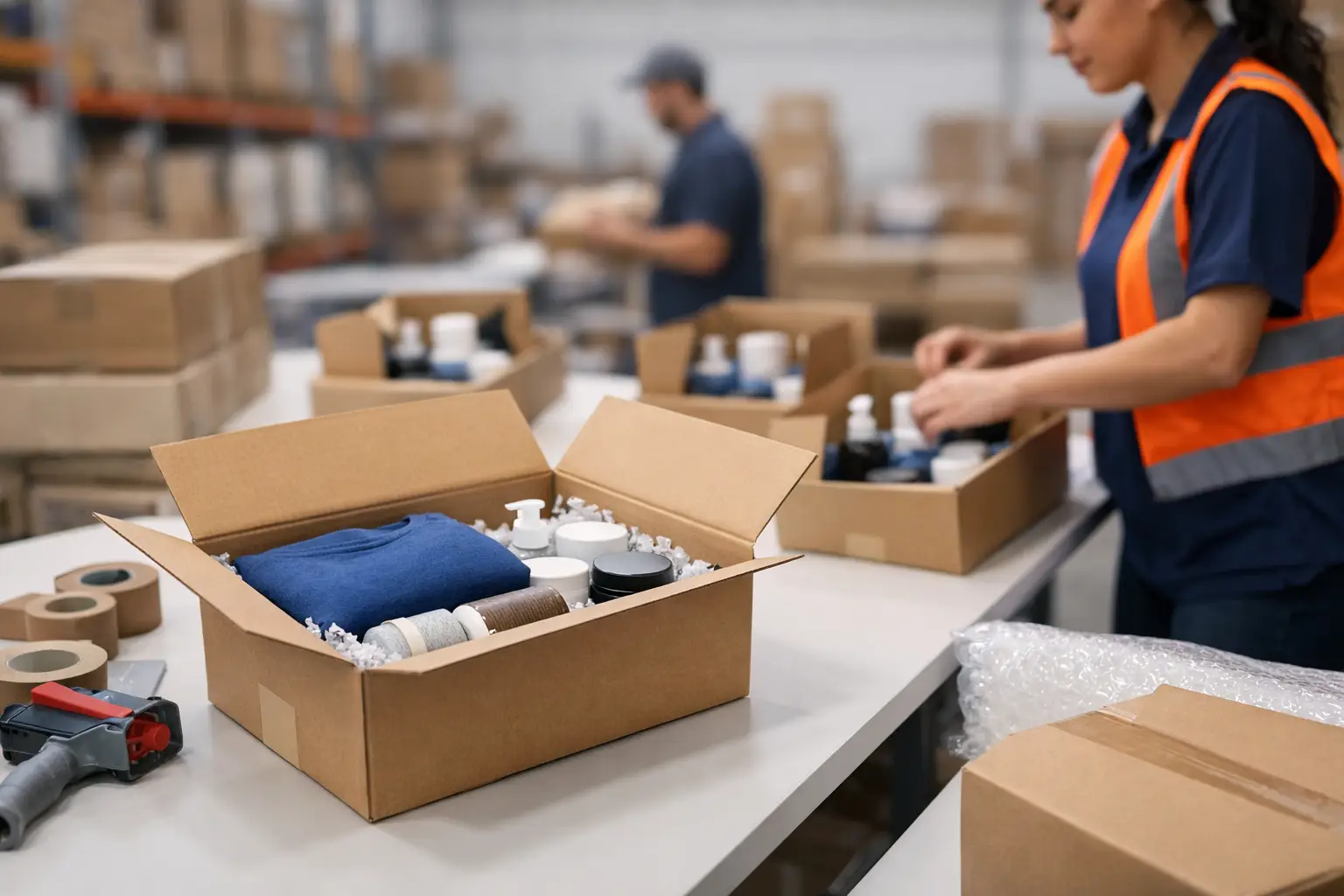
Kitting fulfillment means assembling two or more separate inventory items into one kit that is stored, tracked, and shipped as a single sellable unit. A kit may be as simple as a supplement bottle paired with a shaker cup, or as involved as a subscription box containing several products, custom packaging, inserts, samples, and promotional materials.
Once assembled, the kit receives its own SKU and inventory count. The warehouse can then pick one completed unit instead of collecting every component after each customer order arrives. That distinction matters when volume rises. Picking one kit from one location is usually faster and easier to control than picking five components from five locations hundreds of times per day.
Kitting is often confused with bundling. A bundle is the customer-facing offer: “Buy the complete skincare routine” or “Get the grill tool set.” Kitting is the warehouse work that makes that offer operationally practical. You can sell a bundle without pre-kitting it, but your fulfillment team may need to assemble it order by order. For consistent, high-volume offers, pre-kitting is usually the more efficient model.
How the Kitting Process Works
The process starts with a defined bill of materials. This is the exact list of components required for one finished kit, including quantities, packaging requirements, labels, inserts, and any quality checks. If a holiday gift box needs two full-size products, one travel-size item, tissue paper, and a specific branded carton, every one of those details should be documented before assembly begins.
Inventory is then received and counted as individual components. The fulfillment team assembles the units according to the approved instructions, performs a quality check, labels each finished kit with its own SKU or barcode, and moves it into the pickable inventory location. From that point forward, an order for the kit is fulfilled as one item.
The inventory system must also account for the relationship between the kit and its components. If you build 500 kits using one unit of Product A and two units of Product B per kit, the available inventory of both components needs to decrease correctly. Without that control, sellers can appear to have stock available when the components needed to build or replenish the kit are already committed elsewhere.
For made-to-order kits, assembly happens after the order imports. That can make sense for low-volume combinations, personalized orders, or offers that change frequently. The trade-off is that the order takes more labor and time to process, especially during peak periods.
Why Kitting Can Improve Fulfillment Economics
The clearest benefit is fewer touches per order. A warehouse associate picking a finished kit scans one location and one SKU. A pick-and-pack order assembled from individual products requires multiple scans, travel between locations, and additional verification. Those seconds become meaningful labor costs at scale.
Kitting can also reduce order errors. Every separate component is another opportunity for a picker to grab the wrong variation, miss an item, or use the wrong insert. A properly assembled and quality-checked kit moves that verification upstream, where the warehouse can inspect multiple units in a controlled batch instead of rushing through one-off assembly at the packing station.
Shipping performance can improve too. Standardized kits are easier to pack in the right carton, easier to weigh accurately, and less likely to trigger last-minute packaging decisions. That is valuable for Amazon FBM sellers protecting late shipment rate and valid tracking performance, as well as direct-to-consumer brands trying to keep the unboxing experience consistent.
There is also a margin angle. Sellers often create kits to raise average order value without relying on a broad discount. A “new customer kit” can combine slower-moving accessories with a proven hero SKU. A refill pack can encourage repeat purchases while using a shipping carton more efficiently than several separate orders would.
None of this means every combination should be pre-kitted. A kit adds assembly labor, consumes storage space, and ties up components in a specific configuration. The economics depend on order frequency, component availability, warehouse handling rates, and the likelihood that the offer will change.
When Pre-Kitting Makes Sense
Pre-kitting works best when an offer has predictable demand and a stable product configuration. Examples include subscription boxes, influencer campaign sets, gift sets, replenishment packs, onboarding kits, and marketplace multipacks. If the same set ships every day, there is little value in rebuilding it from scratch for every order. [FBA]
It is particularly useful during known demand spikes. A brand preparing for Prime Day, Q4, a product launch, or a retail promotion can have kits assembled before order volume hits. That gives the operation more capacity when speed matters most and reduces the risk that a busy packing station becomes the bottleneck.
Amazon sellers should be careful with channel-specific requirements. A kit sold through FBM may need different labeling or packaging than inventory sent to FBA. Wholesale orders may require case packs, retailer-specific labels, or routing compliance. One product combination can support multiple channels, but it should not be treated as one identical fulfillment workflow without confirming the requirements first.
When Order-by-Order Assembly Is Better
Pre-kitting can create its own inventory problem when demand is uncertain. Say you have 1,000 units each of a moisturizer, cleanser, and serum. If you turn 800 of each into a three-piece kit and the kit underperforms, you have limited your ability to sell those products individually unless the warehouse breaks the kits back down. That rework costs time and can damage packaging. [Any D2C like FBM, Shopify, Ebay, Etsy, Woo]
Order-by-order assembly is often smarter for new offers, seasonal tests, personalized kits, and long-tail combinations. It preserves component flexibility. It may also be the only realistic option when a customer chooses from multiple colors, flavors, or add-ons.
A practical middle ground is to pre-kit the highest-volume version while assembling less common variations on demand. For example, a brand might build its top-selling “Starter Kit” in advance but fulfill custom color combinations individually. This approach keeps labor efficient without overcommitting inventory.
Inventory Control Is the Hard Part
The physical assembly is straightforward. The harder issue is inventory visibility. A seller needs to know how many complete kits are ready to ship, how many components remain available, and how many more kits can be built without starving individual-SKU sales or another channel.
This gets more complicated in a multichannel operation. A Shopify promotion can drain a component that is also needed for Walmart orders, Amazon FBM listings, and FBA replenishment. If inventory feeds are delayed or kits are not mapped correctly, overselling follows quickly. Then the business is dealing with canceled orders, late shipments, customer complaints, and possibly marketplace performance consequences.
Strong kitting operations set clear allocation rules. They determine which inventory is reserved for finished kits, which remains available for individual sales, and when a kit should be replenished. They also use component-level reporting, not just finished-goods counts. Seeing 100 kits on hand is useful. Knowing that only 40 more can be built because one key component is running low is what prevents stockouts.
Questions to Settle Before You Launch a Kit
Before sending components to a warehouse or asking a 3PL to build kits, define the offer as an operating process, not a marketing concept. Four details need to be clear:
- The exact components, quantities, packaging, inserts, and finished-kit SKU.
- Whether the kit is assembled in advance, on demand, or through a hybrid model.
- How component inventory will be deducted, replenished, and allocated across sales channels.
- What happens when a customer returns a kit, including whether it can be restocked, broken down, or must be discarded.
Returns deserve more attention than many sellers give them. A sealed, sellable kit may return directly to finished inventory after inspection. An opened beauty, food, or personal-care kit may not be eligible for restock. A kit with a missing component cannot simply be counted as a complete unit. Those rules affect both margins and customer service decisions.
For brands scaling across channels, the right fulfillment partner should be able to execute the assembly instructions consistently, track component and finished-goods inventory accurately, and adjust when an offer changes. FBMFulfillment approaches this work from the seller side of the operation: the goal is not merely to put items in a box, but to protect inventory control and order performance while the brand grows.
The best kits make the customer offer easier to buy and the warehouse operation easier to run. Start with combinations that customers already purchase together, validate the demand, and build only enough finished inventory to support the sales pattern you can see.
Key Takeaways
- Kitting fulfillment [Bundles] combines separate products into one ready-to-ship unit, improving efficiency in ecommerce.
- The process starts with a defined bill of materials, ensuring accurate assembly and inventory tracking.
- Pre-kitting reduces order errors and handling time, but may not suit every product combination or demand fluctuation. [Good for FBA only]
- Order-by-order assembly offers flexibility for new or seasonal products while preserving individual SKU sales.
- Clear inventory control and operational processes are crucial for successful kitting fulfillment.
Related Links
- 5 Steps to Scale Your Shopify Store: How to Automate Pick & Pack Fulfillment for 7‑Figure Growth
- Best 3PL Fulfillment Companies for Small Businesses in the US
- Walmart: Human vs. The Robot Supply Chain
- FBMFulfillment FAQ
- How to Choose the Best Fulfillment 3PL for Shopify Stores