Scaling a Shopify store to seven figures is a dream for many, but for those currently drowning in bubble wrap and packing tape, it often feels more like a nightmare. As your order volume climbs from 10 to 100 or 500 orders a day, the manual “garage” model breaks down. If you want to sustain growth without losing your mind: or your customer’s trust: you need a reliable shopify fulfillment company that understands the mechanics of high-volume logistics. Automating your operations isn’t just about saving time; it’s about building a foundation that can handle a 200% spike in sales during Black Friday without breaking a sweat.
1. AUDIT YOUR CURRENT FULFILLMENT BOTTLENECK?
Before you can fix the problem, you have to find it. Most sellers realize they need help only when they are already in the “red zone.” Are you spending four hours a day just printing labels? Is your “mis-pick” rate climbing because you’re rushing to meet carrier cutoffs? Or perhaps you’re realizing that searching for “ecommerce fulfillment near me” yields options that don’t actually integrate with your tech stack.
Here are key metrics you need to track immediately:
- Order-to-Ship Time: How long does it take from the moment a customer clicks “buy” to the moment the carrier scans the package?
- Pick Accuracy: What percentage of orders are shipped with the wrong item or quantity? (In 7-figure scaling, even a 1% error rate is catastrophic).
- Total Fulfillment Cost per Order: This includes your time, packing materials, storage, and shipping labels.
Unfortunately, many sellers underestimate the cost of their own labor. If you are the CEO and you are still the one handling pick and pack fulfillment services in your basement, you are costing your company hundreds of dollars an hour. You have fallen into the garage trap, and it’s the biggest barrier to your next level of growth.

2. CONNECT SHOPIFY TO A 3PL FOR AUTOMATED ROUTING?
Once you’ve identified that you are the bottleneck, the next step is moving your inventory into a professional warehouse environment. But wait: don’t just ship your stock to the first warehouse that answers the phone. You need a shopify fulfillment company that offers deep, native integration with the Shopify API.
A professional integration should handle three things automatically:
- Order Transmission: As soon as a customer pays, the order should appear in the warehouse management system (WMS) without you touching a button.
- Inventory Syncing: When an item sells, the “available” stock on your Shopify store must decrement instantly across all locations.
- Tracking Write-Back: When the shipping label is printed at the warehouse, the tracking number should automatically push back to Shopify and trigger the customer notification email.
If your fulfillment provider asks you to “upload a CSV” every morning, run. That is not automation; that is a recipe for errors and delays. At FBMFulfillment, we focus on operational excellence, ensuring that your Shopify store stays perfectly synced with our physical shelves.
3. STANDARDIZE PACKAGING AND KITTING FOR EFFICIENCY?
Efficiency at scale is born from predictability. If every order requires a unique, custom-handwritten note and three layers of decorative tissue paper, your fulfillment costs will skyrocket as you grow. To reach 7-figures, you must standardize.
How to optimize your packaging strategy:
- The “One Box” Rule: Try to fit 80% of your orders into 2 or 3 standard box sizes. This allows for faster packing and better dimensional weight pricing from carriers.
- Pre-Kitting: If you frequently sell “Bundle A” (Item X + Item Y), don’t have the picker grab them separately every time. Have your shopify fulfillment company pre-kit these into a single SKU. This turns a multi-item pick into a single-unit pick, slashing your labor costs.
- Barcode Everything: Every SKU must have a unique barcode. This is the only way to ensure 99.9% accuracy in pick and pack fulfillment services.
4. USE MULTI-CHANNEL INVENTORY SYNC?
If you are scaling, you probably aren’t just on Shopify. You’re likely eyeing TikTok Shop, Walmart, or Amazon FBM. This is where most brands fail: they “silo” their inventory. They have 100 units for Shopify and 100 for Amazon, but Shopify sells out while the Amazon stock sits idle.
The solution is a single inventory pool. By using a sophisticated shopify fulfillment company, you can point all your sales channels to one warehouse. Whether an order comes from TikTok or your Shopify site, it pulls from the same pile of stock. This prevents overselling and ensures your capital isn’t tied up in “dead” inventory across multiple platforms.
Given the significant risks of stockouts on marketplaces like Amazon, having this level of control is precarious. You need a partner that can handle multi-channel fulfillment from a unified dashboard, giving you a total “birds-eye view” of your business.
5. SCALE WITH DATA-DRIVEN INVENTORY FORECASTING?
The final step to 7-figure growth is moving from reactive to proactive. You shouldn’t be ordering more stock because the shelf looks empty; you should be ordering because your data tells you that you’ll be out of stock in 22 days.
A high-tier shopify fulfillment company provides more than just boxes; they provide data. You need to know your “burn rate” per SKU and account for lead times from your manufacturers. If it takes 30 days for your stock to arrive, and you only have 15 days of inventory left, you’ve already lost.
Key steps for inventory forecasting:
- Analyze Historical Peaks: Look at your sales velocity from the previous quarter.
- Factor in Marketing: If you’re planning a massive influencer campaign, your historical data is useless. You must manually adjust your “safety stock” levels.
- B2B Integration: If you are also doing wholesale, ensure your partner offers b2b order fulfillment services so your retail orders don’t cannibalize your DTC stock unexpectedly.

THE PATH TO 7-FIGURES
Scaling a Shopify store is a transition from being a “maker” to being a “manager.” You cannot manage what you are physically doing yourself. By offloading the heavy lifting to a professional shopify fulfillment company, you reclaim your time to focus on what actually grows the business: product development and marketing.
Whether you are looking for ecommerce fulfillment near me or a national partner that can reach any customer in 2 days, the goal is the same: total control and total automation. Avoid the trap of “cheap” fulfillment centers that don’t answer the phone. You need a partner built by sellers, for sellers.
Contact us at FBMFulfillment.com and we will be glad to help you audit your current workflow and build a scalable roadmap for your 7-figure journey.
Scaling Your Shopify Store for Success – It’s very different from Amazon.
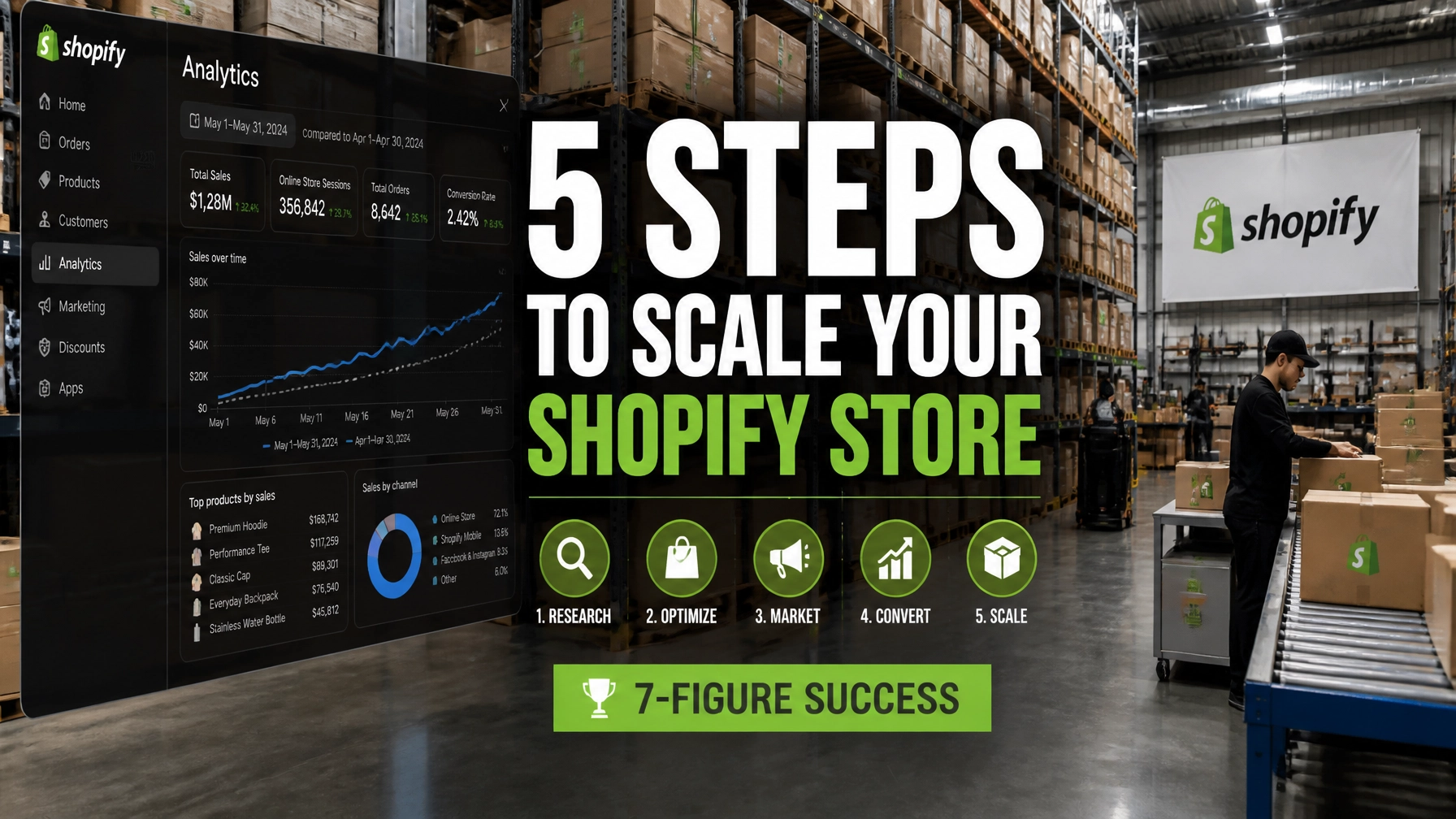
5 Steps to Scale Your Shopify Store: How to Automate Pick & Pack Fulfillment for 7‑Figure Growth
Key Takeaways
- Scaling a Shopify store to seven figures requires a reliable shopify fulfillment company to handle logistics efficiently.
- Audit your fulfillment bottlenecks by tracking order-to-ship time, pick accuracy, and fulfillment costs per order.
- Connect Shopify to a 3PL for automated order transmission, inventory syncing, and tracking write-back to streamline operations.
- Standardize your packaging and kitting processes to optimize efficiency and reduce costs.
- Utilize multi-channel inventory sync and data-driven inventory forecasting to prevent stockouts and improve growth strategies.
Related Links
Frequently Asked Questions
A manual ‘garage’ fulfillment model that works fine at 10 orders a day starts to break down as volume climbs toward 25+ orders daily. Without automation, a spike like a 200% jump in Black Friday sales can overwhelm the process entirely and erode the customer trust a growing brand depends on.
hree in particular: order-to-ship time (from the purchase click to the carrier scan), pick accuracy rate (even a 1% error rate becomes a serious problem at 7-figure order volume), and cost per order, which should combine labor, materials, storage, and shipping labels into one number rather than looking at them separately.
Three things:
1. Orders transmit automatically to the warehouse management system the moment payment clears
2. Inventory decrements (Synchronized) instantly across every sales channel when an item sells. This must include the ability to allocate inventory to orders received and not yet shipped.
3. Tracking numbers auto-populate in Shopify and trigger customer notification emails on their own.
A provider that asks for daily CSV uploads instead of a live integration isn’t offering real automation — the article calls that ‘a recipe for errors and delays.’
Siloing means splitting stock by platform — say, 100 units allocated to Shopify and 100 to Amazon — which causes one channel to stock out while units sit idle on another. A single, unified inventory pool shared across Shopify, TikTok Shop, Walmart, or Amazon FBM prevents both overselling and that kind of dead, misallocated stock.
They need to be accounted for explicitly so that wholesale orders don’t unexpectedly cannibalize the stock earmarked for direct-to-consumer sales — treating both channels as pulling from the same forecast rather than planning DTC in isolation. Advanced WMS system account for Master Carton inventory as well as each inventory, allowing you to sell by the case or by the each.
Moving from being the ‘maker’ doing pick-and-pack yourself to being the ‘manager’ who oversees an automated system, freeing time for product development and marketing — the activities that actually drive revenue growth. The article frames the right fulfillment partner as one offering total control and total automation, built by sellers for sellers, rather than the cheapest option available.