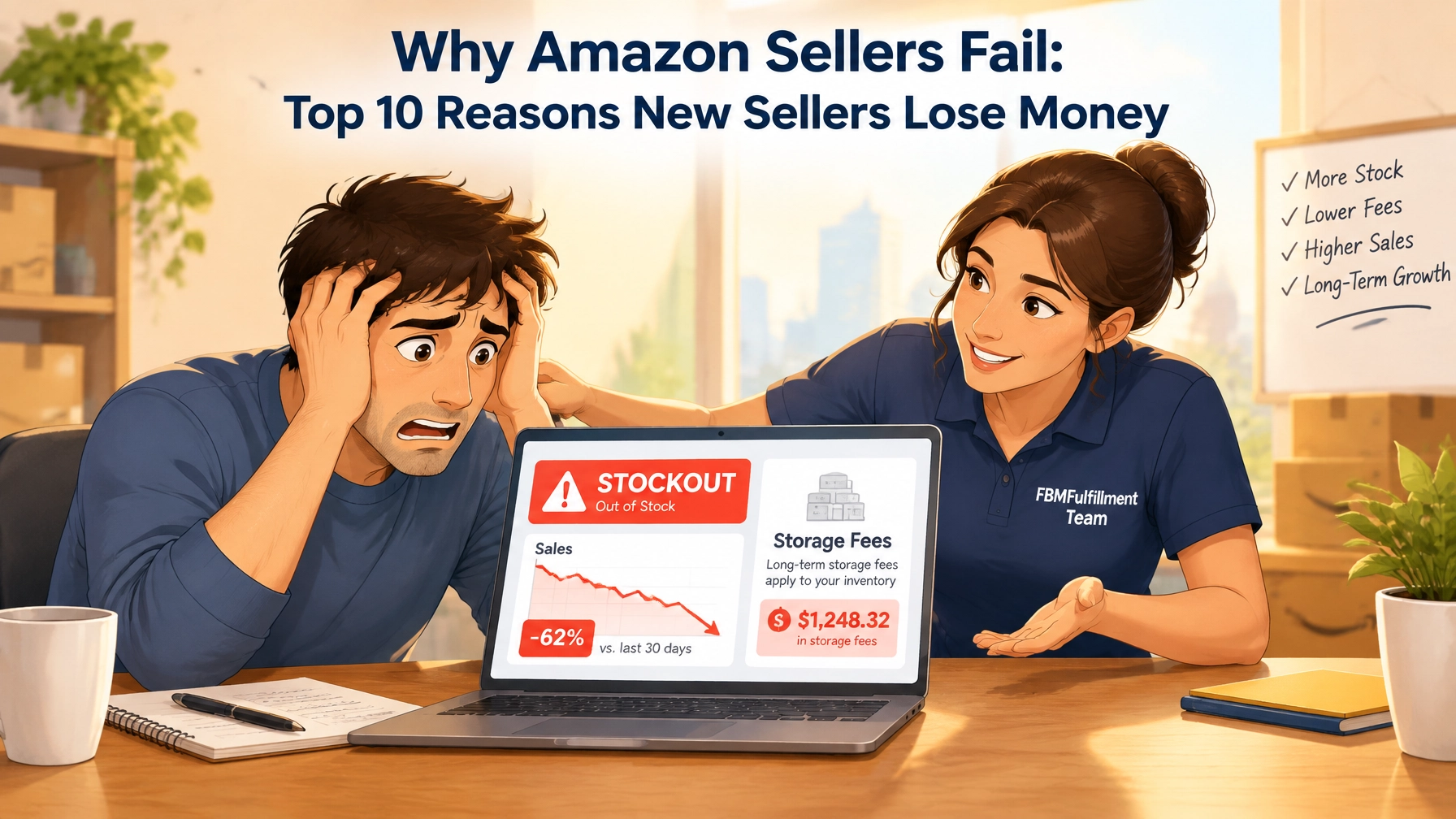
AMAZON STORAGE FEES OUT OF CONTROL?
Let’s be honest: selling on Amazon is getting more expensive by the minute. Are your storage fees getting out of hand? Is that dreaded Long-Term Storage Fee (LTSF) killing your margins every month? Perhaps you’re struggling with Amazon Inventory Performance Index (IPI) issues, or you’re facing replenishment restrictions on your best-selling items because you have too much slow-moving stock taking up space.
FBA STOCKOUT PROBLEMS?
If you’ve been selling on Amazon for more than a minute, you’ve likely dealt with the frustration of “FBA Stockout Problems.” You want to send in 500 units, but Amazon only allows 100. Or worse, you send your shipment, and it sits in “Receiving” for three weeks while your listing goes inactive and your keyword rankings plummet.
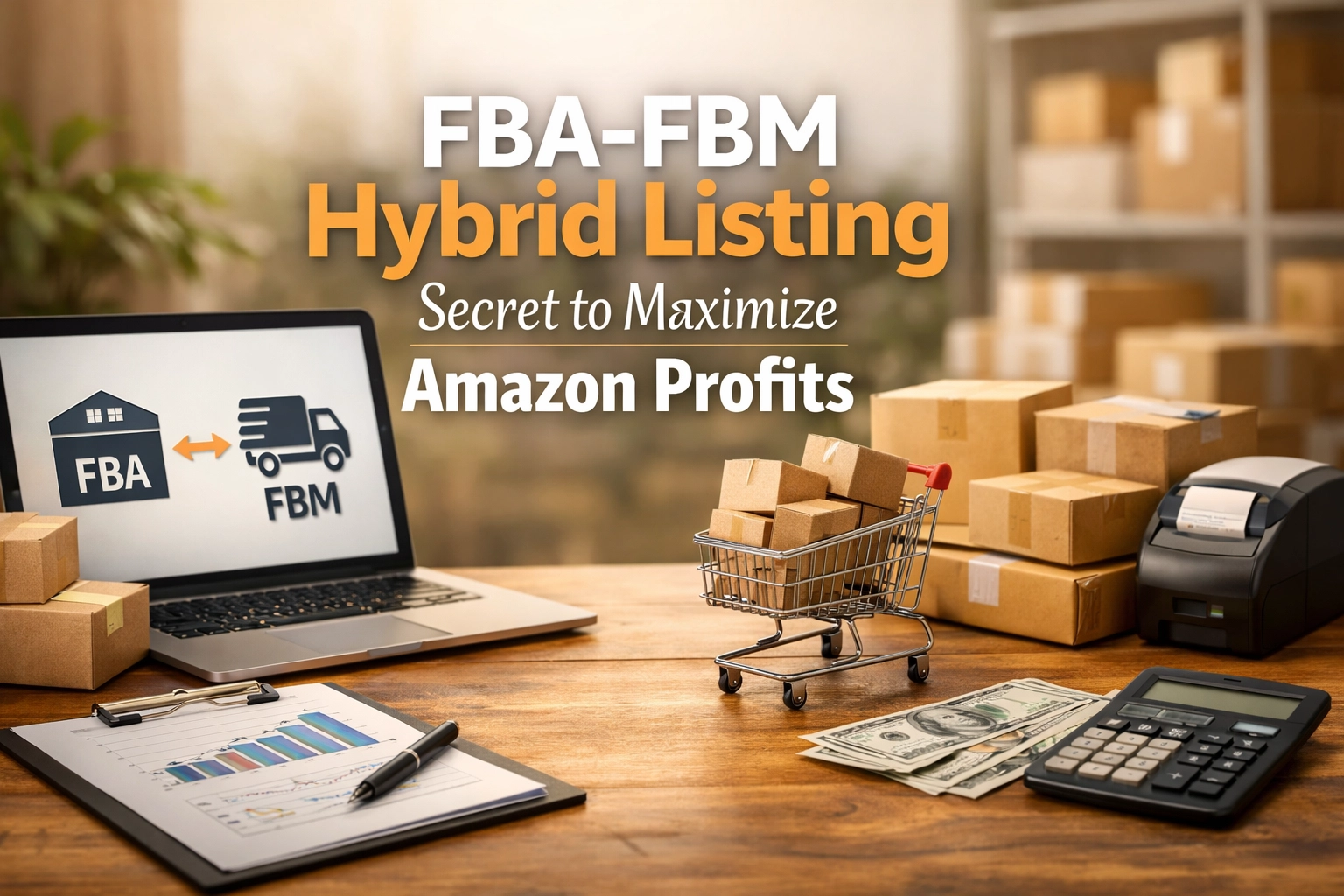
It’s a precarious position to be in. Relying 100% on FBA is a risk that many e-commerce brands can no longer afford to take. Fortunately, there is a better way. The secret isn’t choosing between FBA and FBM, it’s using a Hybrid Listing Strategy to maximize your profits and protect your brand.
The Reality of the FBA-FBM Hybrid Strategy
The key to maximizing profits in 2026 is strategically allocating products based on performance and cost efficiency. By creating mirror listings, you extend your selling capacity far beyond Amazon’s arbitrary inventory limits.

Why You Need a 3PL Partner
The best solution to the Amazon “holding your inventory hostage” problem involves a three-pronged approach:
- Make FBMFulfillment.com your 3PL Partner and primary inventory location.
- Drip-feed replenish your inventory to FBA as needed.
- Create FBM listings to back up your FBA listings.
If you run out of stock at Amazon, you can still sell and protect your rank. Voilà: you are covered AUTOMATICALLY.
The Mirror Listing Secret: How to Build Your Backup
(FBA-FBM HYBRID)
Each product on Amazon can only have one ASIN (Amazon Standard Identification Number). However, that single ASIN can, and should, have multiple listings. Each listing requires a unique SKU (Stock Keeping Unit).
Many sellers make the mistake of thinking one FBA listing is enough. It’s not. If that one SKU runs out of stock at FBA, your listing goes dark. Your “Buy Box” disappears. Your PPC campaigns pause. Your organic rank starts a slow, painful death.
Step-by-Step: Creating Your Hybrid Listing
- First: Create and refine your FBA listing using your primary SKU (e.g., PRODUCT-ABC-123). This is your main driver.
- Next: Copy (Clone) your FBA listing to an FBM listing.
- The Suffix Secret: When you create the FBM version, use the same base SKU but append a suffix like -FBM (e.g., PRODUCT-ABC-123-FBM).
This simple naming convention is crucial for your Warehouse Management System (WMS) and for your own sanity when looking at reports in Seller Central.
The Major Benefits of the Hybrid Model
1. Speed to Market
When you ship a new shipment from the factory, the “Receiving” delay at Amazon can be 2–3 weeks (or longer during peak seasons). Your FBM listing, however, can go live the moment the pallet hits our warehouse floor. This gives you a significant jumpstart on sales and cash flow.
FBMFulfillment can then prepare your FBA shipment that will begin the dripfeed process (see below)
2. Built-In Backup (The Fail-Safe)
If your listing stocks out at FBA, Amazon will automatically switch the “Buy Box” to your Merchant Fulfilled (FBM) listing. You won’t lose your ranking, and you won’t lose the sale. This operational resilience is what separates the professionals from the amateurs.
FBM can manage Master Carton and Each inventory simultaneously due to its advaced technology not available in most 3PLs. This allows us to manage wholesale (like FBA replenishment) and Direct to Consumer (like FBM, Shopify, Tiktok. Woo etc) from the same inventory.
3. Affordable Storage Fees
Let’s be blunt: Amazon is a fulfillment center, not a storage warehouse. They want your inventory in and out in 30 days. FBMFulfillment.com storage fees are much more affordable than Amazon’s and we do not penalize you for slow-moving inventory through the IPI score.

4. Visibility and Synchronization
A problem for many sellers is managing inventory across multiple locations. Since the FBMFulfillment.com system synchronizes your inventory (at the each level) with Amazon in real-time, you can see all of your stock levels directly on your Seller Central dashboard. No more guessing how many units you have left in the “backup” pile.
5. The Drip-Feed Advantage
The key to minimizing your Amazon storage fees and maximizing your IPI score is to minimize your replenishment time. By using our FBA Drip-Feed program, you can maintain a high IPI score. You keep just enough inventory at Amazon to satisfy current demand, while the rest sits in our more affordable facility. As FBA stock gets low, we send more. It’s a lean, mean, profitable machine.
Cost Optimization and Resilience
A hybrid model reduces unnecessary expenses. Given the significant risks of Amazon policy shifts or inventory limit tightening, having an FBM backup ensures orders continue moving. You gain the flexibility to scale for seasonal demand without overcommitting to a single fulfillment method.
Furthermore, using a 3PL allows for better communication. When you work with FBMFulfillment.com, you can communicate with a real human being. Have you ever tried to call “Amazon” to ask about a specific box? Exactly. We provide the human touch that a massive conglomerate simply can’t.
Taking Action
If you are tired of the “catastrophic risk” of being 100% dependent on FBA, it is time to pivot. Transitioning to a hybrid model isn’t just a “good idea”: it’s a survival strategy for 2026 and beyond.
- Audit your current inventory. Identify the slow movers that are draining your profits in FBA fees.
- Set up your mirror listings. Use the SKU suffix method we discussed.
- Partner with a reliable 3PL. We specialize in FBM and FBA prep, making the transition seamless.
The ecommerce boom has fueled massive growth, but it has also increased the complexity of logistics. Don’t let your margins vanish because of poor inventory management.
FBA Dripfeed: The 2026 Strategy for High IPI and Low Fees
FBA Fees Jumped Again in 2026: How Hybrid Fulfillment Protects Your Margins (And Your Sanity)
Ready to protect your Amazon rankings and lower your storage costs?
Contact us at FBMFulfillment.com and we will be glad to help you set up your hybrid strategy today.
Key Takeaways
- Amazon storage fees are rising, and sellers face challenges with inventory management and fulfilling orders efficiently.
- Utilizing an Amazon FBA FBM Hybrid Listing allows sellers to increase profit margins while ensuring sales continuity even during stockouts.
- A successful hybrid strategy involves using a 3PL partner for more affordable storage and real-time inventory synchronization.
- Creating mirror listings with unique SKUs for both FBA and FBM helps protect rankings and sales during inventory disruptions.
- Transitioning to a hybrid model is essential for surviving the e-commerce landscape in 2026 and beyond.
Related Links
Frequently Asked Questions
It’s using FBMFulfillment (or another 3PL) as your primary inventory location, drip-feeding stock into FBA as needed, and creating backup FBM listings on the same product — so a single point of failure at Amazon doesn’t take your listing offline.
Yes — a single ASIN can have multiple listings, each with its own SKU, so you can run an FBA offer and a backup FBM offer on the same product simultaneously.
Instead of sending your full inventory to Amazon at once, you hold the bulk of it at a 3PL and ship smaller, more frequent replenishment batches into FBA — reducing storage fee exposure and inventory limit risk while keeping FBA stocked.
Yes — if your FBA listing goes out of stock, the mirrored FBM listing can keep selling and protect your rank and reviews, instead of your Buy Box, PPC campaigns, and keyword rankings going dark until Amazon receives your next shipment.
In practice, yes — the strategy depends on having reliable outside storage and fast, accurate shipping for the FBM side, plus a fast replenishment cycle into FBA, which is exactly the role a warehouse partner plays.
Yes it can be if you do not pick the right 3PL partner. FBMFulfillment.com has EXCLUSIVE FBA Replenishment Module (FRM) technology that makes FBA Drip Feed incredibly easy.
Article: FBMFulfillment Launches First Automated FBA Replenishment Module
Article: Amazon Inbound Placement Secrets Revealed: How to Eliminate Fees & Slash Replenishment Time with FBMFulfillment