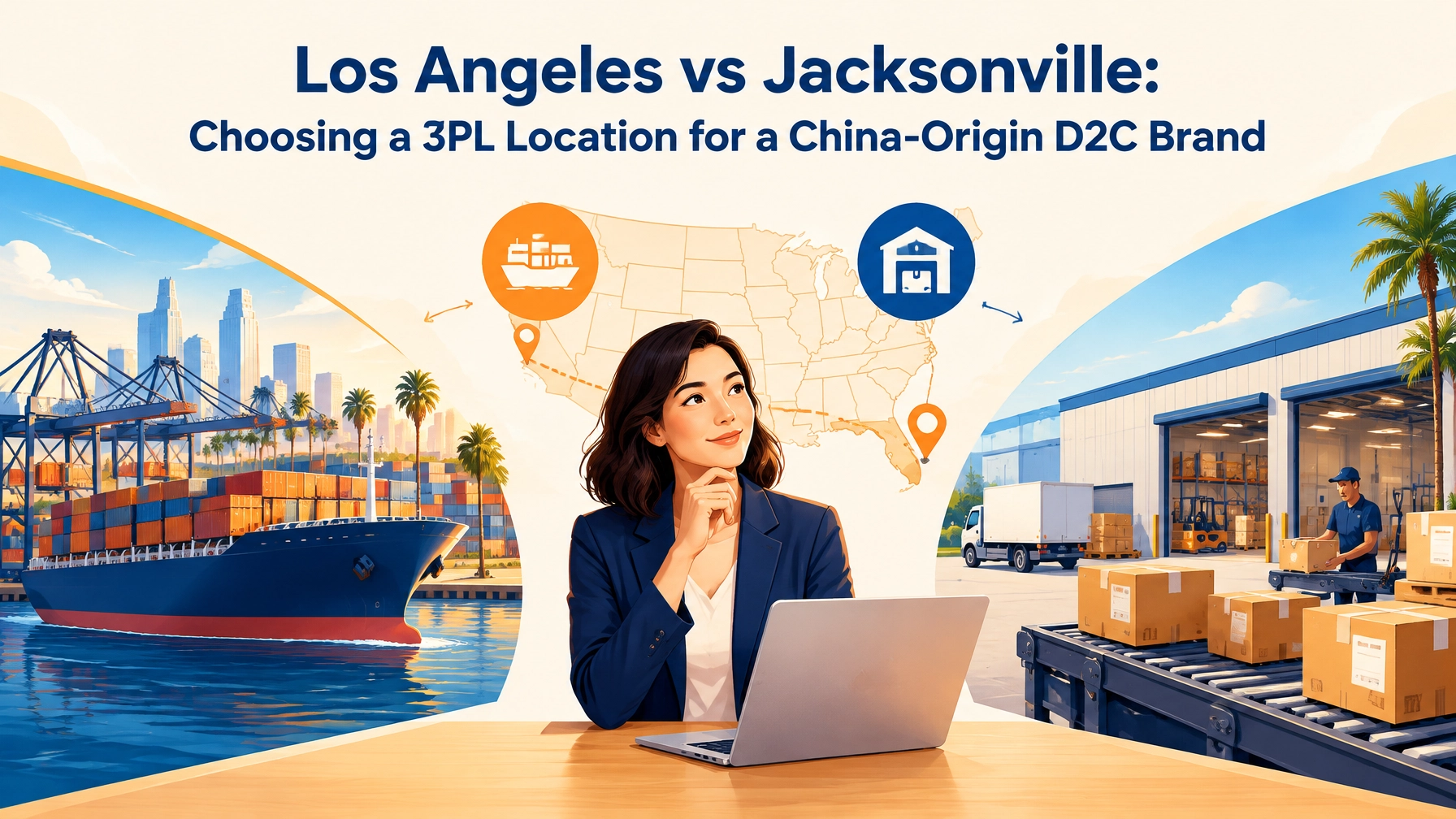
If you are comparing a warehouse location based on its rate card alone, you are missing the costs that shape your margin: getting inventory to the building, storing it, and delivering each order to your customer. Los Angeles has real advantages for China imports and West Coast demand. Jacksonville can offer a stronger cost position for sellers serving the larger East-of-the-Rockies customer base. Your answer depends on your product, order map, and inbound frequency.
1. Why is warehouse location a P&L decision, not a preference?
A warehouse location affects inbound freight, storage, labor, parcel postage, and the delivery promise you can make. These costs compound across every replenishment and every order.
Most sellers compare fulfillment rate cards without modeling geography. That is where money gets missed. A lower pick fee can be outweighed by long-haul inbound freight or higher postage zones. Conversely, a cheaper ocean move can lose its advantage if most customers live far from the warehouse.
The fix is to compare three numbers together: delivered inbound cost, ongoing operating cost, and outbound shipping against your actual order ZIP codes. A rate card alone tells you none of them.
2. Does the population split change the warehouse location decision?
A 2025 adjusted analysis of the likely e-commerce customer population estimates 233 million east of the Rockies versus 71 million west — 77% of the addressable market lives east, about 3.3 to 1. For a national D2C brand, a single West Coast node puts most customers in more expensive shipping zones.
| Likely e-commerce customers, contiguous U.S. | West of the Rockies | East of the Rockies |
|---|---|---|
| Current 2025 adjusted population | 71 million (23%) | 233 million (77%) |
| 5-year change | +1.7% | +3.0% |
| 10-year projection to 2035 | 74 million (+4.2%) | 245 million (+5.2%) |
The figures exclude people who are homeless, in deep poverty, or with limited internet access. Because the East is growing faster, its share edges up to about 77% of 319 million by 2035.
The population figures are not a promise about where your buyers live, and your own order history is the better guide. Still, this is one of the most underweighted numbers in 3PL selection: a national seller should not assume a West Coast warehouse is geographically central.
Distance translates into USPS zones, and zones translate into money. The average USPS zone to a customer is 7.4 from California but 4.7 from Jacksonville. From Jacksonville, about 65% of the U.S. population sits within zone 5; from the Inland Empire that figure is about 23%.
Here is what that looks like split by region, at 12,000 orders a year:
| Region | Orders/yr | Avg USPS zone, CA to JAX | Avg per order, under 1 lb, CA to JAX | Avg per order, 5 lb, CA to JAX | Annual difference, under 1 lb | Annual difference, 5 lb |
|---|---|---|---|---|---|---|
| West of the Rockies | 2,803 | 3.1 to 7.7 | $7.21 to $8.34 | $10.87 to $18.70 | $3,175 more from JAX | $21,965 more from JAX |
| East of the Rockies | 9,197 | 7.4 to 4.7 | $8.27 to $7.62 | $18.13 to $13.02 | $5,959 saved from JAX | $47,013 saved from JAX |
| Net | 12,000 | $2,784 saved | $25,048 saved |
Read the West row carefully, because it is the honest part of the analysis: Jacksonville is genuinely worse for West Coast customers, and the table says so. The East row simply outweighs it by a wide margin, because there are three times as many of those customers.
That is the structural argument in one line: a West Coast warehouse puts most of your customers in a distant zone, and you pay for it on every order.

3. What does the China inbound advantage actually cost and save?
Los Angeles and Long Beach are major China-import gateways. They offer frequent service, extensive import infrastructure, port-adjacent warehousing, and proximity to dense Amazon fulfillment-center networks. China-to-LA/Long Beach port-to-port transit is typically 14–22 days on current services.
All-water service to Jacksonville takes 35–40 days through the Panama Canal. Drewry’s October 15, 2026 benchmark puts Shanghai–Los Angeles at $7,884 and Shanghai–New York at $10,075 per 40-foot container. Drewry does not publish a Jacksonville lane, so the East Coast rate is the working proxy for JAXPORT; quotes into Savannah run similar. That is roughly an $1,800 premium per container to reach Jacksonville by water.
Here is the full per-container comparison for a 40-foot high cube, including the landside costs that decide the real number:
| Per 40′ high cube | CA 3PL (sea to LA) | FBM — sea direct to JAXPORT | FBM — LA/LB plus overland truck | |
|---|---|---|---|---|
| Ocean, Shanghai to port | $7,884 | $10,075 | $7,884 | |
| Port drayage | $650 to Inland Empire | $450 local | $471 to transload dock | |
| Chassis / port fees | $170 | Included | $20 Clean Truck Fund | |
| Transload to 53′ trailer | — | — | $600 | |
| Linehaul LA to Jacksonville | — | — | $4,944 | |
| Final delivery / handling | — | — | $150 | |
| Total per container | $8,704 | $10,525 | $14,069 | |
| Port-to-port transit | 14–22 days | 35–40 days | ~17 days plus 4–5 days truck | |
| Extra carrying cost vs California | — | $329 | $82 |
LA/LB handles roughly 40% of U.S. containerized imports, but that volume brings congestion and added charges. Diesel drayage at LA/Long Beach also pays the Clean Truck Fund at $10 per TEU, and California diesel ran $8.18 per gallon in late September 2026 versus $5.95 in the Lower Atlantic region.
Jacksonville handles about 1.4 million TEUs annually, compared with tens of millions combined at LA/LB. What used to be a clear disadvantage is narrowing: the Ocean Alliance (CMA CGM, COSCO, Evergreen, OCL) began a weekly China-to-Jacksonville service in May 2026, joining ONE’s EC2 service and a ZIM/MSC service added in July. Direct Asia capacity into JAXPORT is growing, which reduces reliance on the gateway most exposed to West Coast labor disruption and congestion.
Note the middle column of that table: landing in LA and trucking to Jacksonville is the most expensive inbound route, adding roughly $5,400 per container over sea-to-LA. It still wins on total cost for most sellers because of postage, but it is not a free lunch.
The right question is not simply “Which port is cheaper?” It is: how often do you import, and how much are faster restocks worth to your working capital? For a seller taking about one container a year, the inbound premium is roughly $1,700 annually once carrying cost is included. Postage decides the outcome long before freight does.
If you import by the pallet rather than the container, the inbound penalty nearly disappears. LCL is priced per CBM on both coasts rather than per container. At 3 pallets per shipment (about 5.5 CBM), ocean runs about $120/CBM to LA and $140/CBM to the East Coast, plus BAF, security, origin and destination CFS/THC charges, about $275 in per-shipment paperwork (house B/L, customs entry, ISF), and roughly $300 for local delivery from the CFS. That works out to about $1,780 per shipment into an Inland Empire 3PL versus $1,890 into Jacksonville — a gap of only about $110.
East Coast LCL takes roughly 7 more days (35–45 versus 28–38). Landing in LA and moving the pallets by LTL to Jacksonville adds about $440 per pallet, which is why that route saves less for small clients.
4. How do product weight and dimensional weight change the answer?
This is where a location comparison gets specific, and where real rate examples beat rules of thumb. Sending a 5-pound box to Florida costs about $19.19 from California (zone 8) versus $10.38 from Jacksonville (zone 3). The same comparison on a sub-1-pound parcel is $8.40 versus $7.18. The gap widens with weight, so heavier and bulkier products gain the most from an eastern position.
That weight sensitivity got sharper in 2026. The July 12, 2026 USPS dimensional-weight change moved the DIM divisor from 166 to 139, which raises billed weight on boxes over one cubic foot and amplifies the zone penalty for any product that is bulky relative to its actual weight.
For typical 1–5-pound parcels, a two-to-four-zone difference commonly adds $2–$8 or more per order before discounts. For heavy or bulky products, the same zone gap commonly adds $6–$20 or more per shipment. On sub-1-pound parcels the dollar gap is smaller, typically $1–$4 per order, and flat-rate or cubic pricing compresses it further. That is the one weight band where LA’s inbound advantage can genuinely carry the decision.
| Product and order profile | Likely advantage |
|---|---|
| Sub-1-pound, high-velocity, West-heavy orders | Los Angeles |
| Typical 1–5-pound parcels, national or East-weighted orders | Jacksonville |
| Heavy or bulky items with national demand | Jacksonville or bi-coastal |
| Frequent imports, West Coast buyers, fast restock priority | Los Angeles |

5. What are the storage and labor cost differences?
California’s cost of doing business does not stay inside the warehouse. It arrives on your invoice, because labor is roughly 60% of a pick/pack fee. A 12.7% wage gap plus the workers’ compensation gap lifts burdened labor about 14.5%, which moves pick/pack from $3.00 to about $3.26 per order. A 22% rent gap moves storage from $20 to about $24.40 per pallet per month.
| Cost driver | California (Inland Empire) | Florida (Jacksonville) | Gap |
|---|---|---|---|
| State minimum wage | $16.90/hr (Jan 1, 2026) | $15.00/hr (Sept 30, 2026) | CA +12.7% |
| Workers’ comp premium | $3.48 per $100 payroll; among the 5 costliest states | $1.82 per $100 payroll | CA ~1.9× |
| Warehouse asking rent | $13.10/sf/yr | $10.71/sf/yr | CA +22% |
| On-highway diesel (late Sept 2026) | $8.18/gal | $5.95/gal (Lower Atlantic) | CA +37% |
| Sales tax on commercial rent | None | None since Oct 1, 2025 (repealed) | Even |
| Warehouse labor rules | AB 701 quota disclosure; daily overtime after 8 hrs | Federal weekly overtime only | Added CA compliance cost |
Applied to a 12,000-order client with 60 pallets, that gap shows up as roughly $3,120 in extra pick/pack, $3,168 in extra storage, and $24 in extra receiving — about $6,300 a year.
FBMFulfillment’s actual rate adds a second gap on top of that. Its $2.50 per-order rate (order fee plus pick/pack) sits $0.50 below the $3.00 market baseline, which is another $6,000 a year at 12,000 orders. Combined, that is about $12,300 a year less in pick/pack, storage, and receiving fees — roughly $61,500 at 60,000 orders and $123,100 at 120,000.
Two notes on those benchmarks. Florida’s minimum wage reached $15.00 on September 30, 2026, and both states now adjust from that level, with Florida starting $1.90 lower. And parcel fuel surcharges are national, so fuel does not show up in your postage rate by warehouse state — it shows up in drayage, the 3PL’s own trucking, and utility costs.
These are starting points, not an all-in quote. Ask each 3PL about receiving, minimums, account fees, labor, peak surcharges, and the terms behind its storage rate.
6. What changes with taxes and nexus?
Sales tax nexus is the familiar part: inventory in either state creates physical nexus regardless of economic thresholds. California’s economic nexus threshold is $500,000 in tangible personal property sales in the current or prior year, with related entities counting; its state rate is 7.25%, average combined around 9%. Florida’s threshold is $100,000 in taxable remote sales in the prior calendar year, with a 6% state rate and average combined around 7%.
The bigger difference, and the one most sellers miss, is income and franchise tax exposure. Inventory in a California 3PL makes an out-of-state seller “doing business” in California for franchise and income tax purposes, with no minimum sales or inventory safe harbor. California’s Office of Tax Appeals has upheld that position in 2025–2026 cases involving as little as $9,403 in California sales.
| Item | Inventory in California | Inventory in Florida |
|---|---|---|
| Income/franchise nexus from stored inventory | Yes, affirmed in recent OTA decisions | Florida has no personal income tax; 5.5% corporate tax applies only to C-corps |
| Minimum annual tax | $800 franchise/LLC tax | None for LLCs and S-corps |
| LLC gross-receipts fee | None below $250K; rises to $900–$2,500 at 60,000–120,000 orders | None |
| Income tax on CA-apportioned profit (10% margin, ~9.3%) | ≈ $500 | None |
| Added return prep and compliance | ≈ $1,500 | Minimal |
| Sales tax registration | Required | Required |
| Estimated annual cost | ≈ $2,800 (≈ $5,800 at 60,000 orders; ≈ $9,900 at 120,000) | ≈ $0 incremental |
That $2,800 is mostly fixed, which is why it hurts small clients most — it lands on relatively few orders. At 1,200 orders a year, avoiding it is worth about $2.35 per order on its own.
Two cautions before anyone plans around this. First, sales into California still create California sales-tax obligations wherever the goods are stored, so moving inventory to Florida removes the income and franchise exposure, not the collection duty. Marketplaces like Amazon and TikTok Shop collect as facilitators on platform sales. Second, California treats every year inventory sat there as a potentially open year, so a seller leaving a California 3PL should ask their CPA about back-filing exposure before the move is finalized.
This is general information, not tax advice. Confirm your situation with a CPA.
7. What does the total cost actually look like?
Rate cards hide the answer, so here is the whole model on one base: a China-origin DTC and marketplace seller doing 12,000 orders a year, about one 40-foot container, $480,000 in revenue, and 60 pallets of average storage.
| Annual cost, 12,000 orders | California 3PL (sea to LA) | FBM — sea to JAXPORT | FBM — LA plus truck |
|---|---|---|---|
| Postage, under 1 lb | $96,246 | $93,462 | $93,462 |
| Postage, 5 lb | $197,223 | $172,175 | $172,175 |
| 3PL fees (pick/pack, storage, receiving) | $56,992 | $44,680 | $44,680 |
| Inbound freight (0.8 container) | $6,963 | $8,420 | $11,255 |
| Inventory carrying cost of extra transit | — | $263 | $66 |
| California franchise/LLC/income tax | $2,814 | — | — |
| Total, under 1 lb | $163,015 | $146,825 | $149,463 |
| Total, 5 lb | $263,993 | $225,538 | $228,176 |
| Saving vs California, under 1 lb | — | $16,190 ($1.35/order) | $13,552 ($1.13/order) |
| Saving vs California, 5 lb | — | $38,454 ($3.20/order) | $35,817 ($2.98/order) |
Read the bottom two rows against the inbound row. The East Coast container premium is real and visible — and it is small next to the postage and operating-cost differences that run the other way.

At 12,000 orders, ocean direct to JAXPORT costs about $16,200 less per year than a California 3PL on sub-1 lb parcels, and about $38,500 less on 5 lb parcels. That is $1.35 to $3.20 per order. The LA-plus-truck route still beats California, saving about $13,600 a year at sub-1 lb.
The savings hold across volume, and they are largest per order for the smallest clients because California’s fixed tax and filing costs land on few orders.
| Annual orders | Containers/yr | Pallets stored | CA tax avoided | Added inbound plus carrying cost | Saving, under 1 lb | Saving, 5 lb |
|---|---|---|---|---|---|---|
| 1,200 | 0.08 (LCL) | 6 | $2,351 | $172 | $3,689 ($3.07/order) | $5,915 ($4.93/order) |
| 12,000 | 0.8 | 60 | $2,814 | $1,720 | $16,190 ($1.35/order) | $38,454 ($3.20/order) |
| 60,000 | 4 | 300 | $5,770 | $8,600 | $72,649 ($1.21/order) | $183,972 ($3.07/order) |
| 120,000 | 8 | 600 | $9,941 | $17,200 | $143,698 ($1.20/order) | $366,343 ($3.05/order) |
Where the answer flips. For sub-1 lb parcels, a 12,000-order seller would need to import more than about 8 containers a year — bulky, low-value goods — before the JAXPORT ocean premium erased the postage and operating savings. Above that import frequency, the calculus genuinely changes. Below it, postage and fees win.
And the western seller’s own market still matters. As the region table showed, shipping to West of the Rockies costs $3,175 more at sub-1 lb and $21,965 more at 5 lb from Jacksonville. The East more than offsets it, but only because three-quarters of the customers are there. If your buyers cluster in California and the West, re-run the model with your own order map — the result can flip.
8. What changes if you import by the pallet instead of the container?
Plenty of sellers never fill a 40-foot container. A brand doing 1,200 orders a year (about 100 a month) importing palletized LCL is a different model, and the numbers change shape.
| Annual cost, 1,200 orders | California 3PL (LCL to LA) | FBM — LCL to East Coast | FBM — LCL to LA plus LTL truck |
|---|---|---|---|
| Postage, under 1 lb | $9,625 | $9,346 | $9,346 |
| Postage, 5 lb | $19,722 | $17,218 | $17,218 |
| 3PL fees (pick/pack, 4 pallets stored, 6 received) | $5,148 | $4,020 | $4,020 |
| Inbound LCL (2 shipments x 3 pallets) | $3,554 | $3,792 | $5,582 |
| California franchise/income tax plus filing | $2,351 | — | — |
| Total, under 1 lb | $20,678 | $17,158 | $18,948 |
| Total, 5 lb | $30,775 | $25,030 | $26,820 |
| Saving vs California, under 1 lb | — | $3,519 ($2.93/order) | $1,729 ($1.44/order) |
| Saving vs California, 5 lb | — | $5,746 ($4.79/order) | $3,956 ($3.30/order) |
What changes versus the container model: the inbound penalty almost disappears, because LCL is priced per CBM on both coasts while California’s $800 minimum tax and filing costs stay fixed regardless of your size. At this scale, avoiding California tax nexus is the single largest saving — about two-thirds of the total for light parcels.
One caution specific to small clients: check monthly minimum billing at any 3PL. At 100 orders a month, a minimum charge can outweigh every figure on this page, in either state.
9. What risks and operating trade-offs should you weigh?
Both coastal markets face elevated property and business-interruption insurance costs compared with inland alternatives. LA carries earthquake, wildfire, traffic, port-congestion, and neighborhood-variable crime exposure. California has seen insurer withdrawals, higher rates, and FAIR Plan pressure following wildfires, including severe events in 2025.
Jacksonville faces hurricane and coastal-flood risk, but lower seismic exposure and less extreme congestion. Florida has long faced high hurricane-related insurance costs and litigation; reforms have been made, but premiums remain a factor.
Los Angeles has denser logistics infrastructure, more 3PL options at scale, and greater Amazon FC density. Jacksonville offers a less congested port, solid highway access, and generally more business-friendly taxes and regulation. Both have highway and rail connections. Neither is risk-free.
10. When is Los Angeles genuinely the right call?
A 3PL Los Angeles option deserves serious consideration if you import from China frequently, sell heavily in California or the West, or need the fastest possible replenishment. It can also fit high-velocity sub-1-pound products where postage-zone savings are relatively small, or sellers who rely on dense local FBA networks.
The Inland Empire can be a middle option: storage may cost less than port-adjacent space, but the extra distance adds drayage time and cost. If most of your orders go to California, the Southwest, and the West, LA’s ocean and outbound advantages can outweigh the East Coast premium. For that seller, Los Angeles is the better choice.
11. When is Jacksonville the stronger single node?
Jacksonville is often a stronger single-node choice for national or East-weighted demand, heavier packages, and sellers focused on reducing storage and per-order costs. It reaches the Southeast, Mid-Atlantic, and much of the East in Zones 3–5, commonly with 2–4 day ground service; the West Coast is typically Zones 7–8.
There is also a density argument that no rate card captures. Florida, Georgia, and the Carolinas are zones 2–4 from Jacksonville, and Florida alone added the second-most residents of any state in 2025. The Southeast is both the closest market and one of the fastest-growing ones.
For sellers searching “warehouse in Jacksonville FL” or “fulfillment center in Florida,” the key is to assess the operation, not just the address. FBMFulfillment operates its own Jacksonville warehouse, without brokers or middlemen. It offers same-day shipping before cutoff, FedEx 2Day service for orders where a dependable two-day delivery promise matters, and a single inventory pool serving Amazon FBM, Shopify, TikTok Shop, Walmart, eBay, and Etsy.
It is also an FDA-registered facility with lot and expiration tracking, FEFO picking, and climate-controlled storage, which matters for cosmetics and nutraceutical importers who cannot treat fulfillment as generic parcel work. FBA prep, removal-order processing, Shopify and DTC orders, and TikTok Shop orders all run from the same ShipHero-managed inventory, so a single stock position serves every channel.
The FBA Replenishment Module supports direct-to-DC shipping and planned 7–10 day replenishment cycles, while inventory stays under your control. The operation uses ShipHero WMS for real-time visibility and provides return processing control. Contract decisions can close in 24 hours, with same-day references available.
Startup policies include waived minimums for 12 months, no onboarding fees, month-to-month terms, enterprise-level pricing and shipping rates, free Ecommerce Academy and in-person coaching, strategic fulfillment locations, world-class technology, and post-pay invoicing.

12. How should you model warehouse location and a multi-node plan?
A bi-coastal setup can cut average shipping zones by 1–3 and reduce postage by 15–30% for national D2C brands. A common pattern is a primary East Coast fulfillment center with a smaller West Coast position for Western customers and China staging. But two nodes also mean more inventory allocation, receiving, and replenishment complexity.
Before deciding, pull your order ZIP mix, package weights and dimensions, container frequency, and inventory carrying cost. Get side-by-side quotes and compare total landed cost plus postage per order, not rate cards alone. If you are comparing “3PL East Coast” options, make the same apples-to-apples comparison across operating fees and carrier rates.
| Your profile | Starting point to model |
|---|---|
| Frequent China imports, mostly West Coast buyers | Los Angeles |
| National or East-weighted orders, moderate inbound frequency | Jacksonville |
| Heavy or bulky products with nationwide demand | Jacksonville versus bi-coastal |
| Balanced national demand at sufficient volume | Bi-coastal, including inventory and transfer costs |
A “Jacksonville 3PL” and a search for “3PL Jacksonville” can lead to very different operating models. Compare references, technology, the actual warehouse operation, and the contract. Move substantive discussions beyond email: request a video call or an in-person meeting. Be cautious of gimmicks, hidden fees, and long-term contracts that lock you in before performance is proven.

13. What are the method and limits of this comparison?
The cost model rests on stated assumptions so you can challenge them: orders spread by state population (Census 2025 estimates), USPS Ground Advantage commercial rates for 2026 including the temporary 8% increase through January 17, 2027, about one 40-foot high cube per 15,000 orders, 60 pallets per 12,000 orders, and $60,000 of inventory per container at a 10% annual carrying cost. Pick/pack, storage, and receiving fees are illustrative market rates, adjusted for the California labor, workers’ comp, and rent gaps in section 6.
USPS zones are estimated from distance bands between each warehouse city and each state’s main population center, with intermediate zones interpolated. Confirm your key lanes against the USPS zone chart before you rely on any single figure.
Ocean and trucking rates are mid-October 2026 spot benchmarks during peak season. Contract and post-peak rates will be lower, so the JAXPORT premium may narrow or widen. Tax figures assume an LLC at 10% margin; C-corps, S-corps, and marketplace-only sellers differ. And the population analysis is not a forecast of your brand’s orders — only your own order file can tell you that.
Use all of this to narrow your choices, then replace every assumption with your own data and live quotes before committing. A good 3PL relationship is a long-term partnership: verify the operation, clarify fees and service levels, and speak directly with the people responsible for your account.
Key Takeaways
- Warehouse geography affects inbound cost, storage, labor, postage, and delivery speed.
- LA is a strong choice for frequent China imports and West-heavy sales.
- China-to-LA transit is typically 14–22 days; all-water East Coast transit is typically 35–40 days.
- Drewry’s October 2026 benchmark: $7,884 per 40′ to LA versus $10,075 to the East Coast proxy.
- Landing in LA and trucking to Jacksonville is the most expensive inbound route at $14,069 per container.
- West Coast container benchmarks are lower, but LA/LB drayage and port charges add to landed cost.
- The cited analysis estimates 233 million likely e-commerce customers east of the Rockies versus 71 million west.
- About 65% of the U.S. population sits within zone 5 of Jacksonville, versus about 23% from the Inland Empire.
- Eight of the nine next-largest states are zones 6–8 from California but zones 3–5 from Jacksonville.
- A 5-pound box to Florida costs about $19.19 from California versus $10.38 from Jacksonville.
- Ocean to JAXPORT runs roughly $1,800 more per container and 13–18 days longer than to LA/Long Beach.
- 77% of likely e-commerce customers live east of the Rockies, at an average zone 7.4 from California versus 4.7 from Jacksonville.
- Jacksonville costs West Coast customers about $3,175 to $21,965 a year more; the East outweighs it.
- On a 12,000-order client, Jacksonville is about $16,200 cheaper a year at sub-1 lb and $38,500 cheaper at 5 lb.
- FBM’s $2.50 per-order rate sits $0.50 below the market baseline, worth about $6,000 a year at 12,000 orders.
- A 1,200-order LCL importer saves about $3,500 to $5,700 a year, with tax nexus avoidance the largest single item.
- California storage in a 3PL triggers franchise and income tax nexus worth about $2,800 a year at that size, mostly fixed.
- Jacksonville generally offers lower storage and labor costs than coastal Los Angeles.
- A two-to-four-zone difference commonly adds $2–$8 or more for 1–5-pound parcels.
- The July 12, 2026 USPS DIM divisor change from 166 to 139 widened the zone penalty for bulky boxes.
- The break-even for sub-1 lb parcels is roughly 8 containers a year before the ocean premium erases the savings.
- LCL into Jacksonville costs only about $110 more per shipment than LCL into an Inland Empire 3PL.
- Dimensional weight makes heavier shipments more sensitive to shipping zones.
- Physical inventory can create nexus in either state; get tax advice for your circumstances.
- Bi-coastal fulfillment can reduce postage for national sellers but adds inventory complexity.
- Compare total landed cost plus postage per order, using your own order and package data.
- Choose a 3PL partner based on transparent terms, real operational capability, and a relationship you can build over time.
Related Links
Frequently Asked Questions
Los Angeles is often better for frequent China imports and West-heavy demand. Jacksonville is often stronger for national or East-weighted orders, heavier parcels, and lower storage and labor costs.
It depends on your order destinations, package dimensions, carrier rates, and delivery service. A two-to-four-zone difference commonly adds $2–$8 or more per 1–5-pound shipment, and $6–$20 or more for many heavy or bulky shipments.
The cited analysis estimates 233 million likely e-commerce customers east of the Rockies and 71 million west. A national seller using only a West Coast node may send many orders through expensive zones.
For common 1–5-pound parcels, the zone difference commonly adds $2–$8 or more per order before discounts. The actual amount depends on the package, destination ZIP, and carrier pricing.
Yes. Drewry’s October 2026 benchmark puts Shanghai–LA at $7,884 and the East Coast proxy at $10,075 per 40-foot container, with all-water transit of 35–40 days versus 14–22 to LA. Get current quotes before booking; rates move.
Storing inventory in California creates franchise and income tax nexus with no minimum safe harbor. For an LLC with 10% margins, that is roughly $800 in minimum franchise tax plus about $500 in income tax and $1,500 in added compliance, around $2,800 a year. Florida adds no equivalent state income tax burden for pass-through entities.
On a modeled 12,000-order China importer, yes: about $16,200 a year cheaper on sub-1 lb parcels and about $38,500 cheaper on 5 lb parcels, after including the higher inbound ocean rate and carrying cost. The savings hold from 1,200 to 120,000 orders a year in the model.
LCL is priced per CBM, so the East Coast penalty shrinks to about $110 per shipment. A 1,200-order client saves about $3,500 a year on sub-1 lb parcels and $5,700 on 5 lb parcels with LCL direct to the East Coast, and avoiding California’s fixed franchise tax and filing costs is about two-thirds of that for light parcels. Check monthly minimum billing before committing.
Yes, and capacity is growing. The Ocean Alliance began a weekly China-to-Jacksonville service in May 2026, joining ONE’s EC2 and a ZIM/MSC service added in July. Frequency is still far below LA/Long Beach, so confirm sailing schedules for your lane.
Dimensional weight can make a package more expensive to ship than its scale weight suggests. For heavy or bulky products, a longer zone commonly increases the postage difference between warehouse options.
The supplied benchmarks show Jacksonville pallet storage at about $12–$20 per month, versus $26–$42 for port-adjacent LA/Long Beach facilities. Actual rates depend on contract terms and services.
Inventory can create physical nexus in either state. Marketplace collection does not necessarily resolve obligations tied to inventory or direct sales. Consult a tax advisor.
The supplied benchmarks list state rates of 6% in Florida and 7.25% in California, with average combined rates around 7% and 9%, respectively. Local rates and business obligations vary.
Consider it when national order volume is high enough for potential 15–30% postage savings to justify additional inventory, receiving, and replenishment complexity. FBMFulfillment can provide a bi-coastal solution initially of over time if the business requires it.
Export order ZIP codes, package weights and dimensions, and inbound container frequency. Compare live quotes for freight, storage, fulfillment, and parcel delivery, then calculate total landed cost plus postage per order. Remember to be looking out the windshield not the rear view mirror. Where is the most potential for your business.