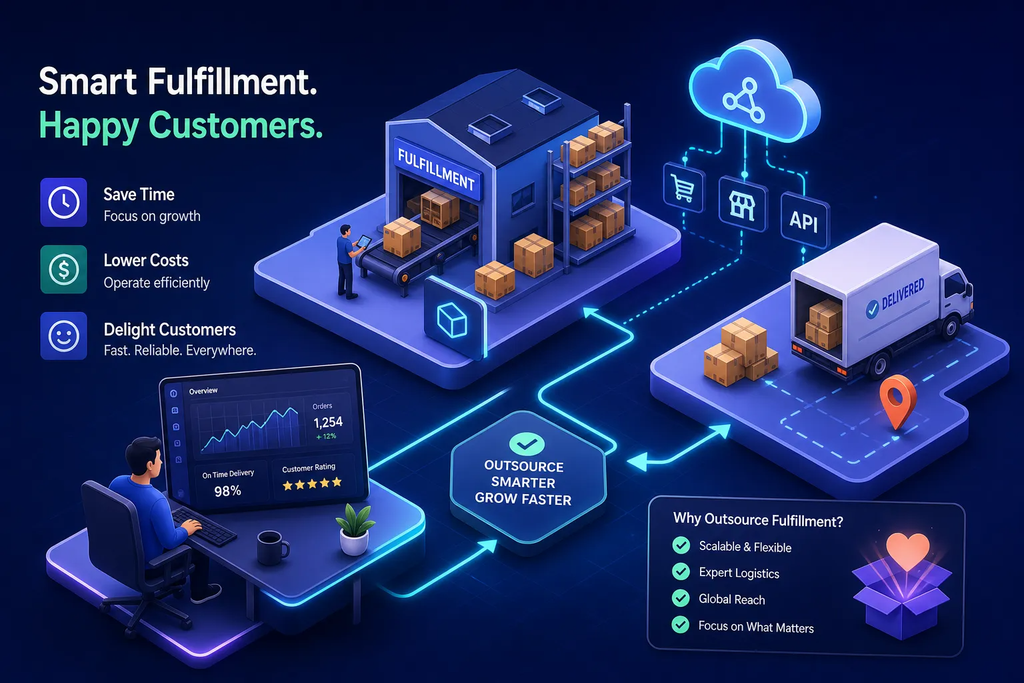
Fulfillment for small business quietly becomes the biggest operational drain on an e-commerce operation before most owners notice it. Processing 50 orders a week from your spare bedroom feels manageable, maybe even enjoyable. Doing 250 orders a week while also running ads, managing suppliers, negotiating with vendors, and handling customer service tickets is where the whole operation starts to crack.
This article covers the core fulfillment models available to small sellers, real cost numbers at different order volumes, and a concrete read on when to stop doing it yourself. It also walks through what to look for in a provider and ends with a practical onboarding checklist so you can make the switch without disrupting your customers.
Fulfillment for Small Business: The Three Models Every Seller Should Understand
Before you can compare costs or evaluate providers, you need a clear picture of what each model actually involves. These aren’t abstract categories, they’re decisions with real tradeoffs in money, time, and control.
In-house fulfillment: the default starting point
Most small sellers start here, and for good reason. When you’re processing fewer than 250 orders a month, in-house fulfillment is usually the lowest-complexity, lowest-cost option available. It works especially well for customized products, fragile items, or anything that requires hands-on quality control before it ships.
What it actually requires: storage space, packaging supplies, a shipping software account, and time. That last one is where most sellers underestimate the real cost. If you’re spending 10 hours a week packing boxes and your time is worth $75 an hour, that’s $750 a week in labor you’re not counting. “Free” in-house fulfillment is only free if your time has no value, and it does.
Amazon FBA vs. FBM: what each model costs your margin
FBA means Amazon stores your inventory in their fulfillment centers and handles picking, packing, shipping, and returns. The tradeoffs: higher fees, limited branding control, and exposure to storage surcharges if your products move slowly. FBM means you control fulfillment directly, either from your own location or through a third-party provider. FBM gives you better unit economics on heavier or slower-moving products and keeps your packaging and customer experience in your own hands.
Specialized FBM providers exist precisely to serve sellers who want the control of FBM without running their own warehouse operation. FBM Fulfillment, for example, works with small brands that need merchant-controlled shipping without the overhead of a warehouse lease or a full logistics team. That structure gives sellers the operational flexibility of FBM with professional pick-and-pack execution behind it.
Third-party logistics and the hybrid approach
A 3PL for small businesses is simply a warehouse that picks, packs, and ships orders on your behalf. You send your inventory to them, and they fulfill orders as they come in from your sales channels. The hybrid model takes this further: keep some SKUs in-house, customized, high-margin, or fragile items that need special handling, and route standard products to a 3PL. This approach lets you test outsourced fulfillment without committing your entire operation at once, which is smart risk management for a small seller who’s never worked with a 3PL before.
What Small Business Order Fulfillment Actually Costs at Different Volumes
Vague cost ranges don’t help you make a real decision. The numbers below are specific enough to model against your own situation, whether you’re evaluating order fulfillment solutions for the first time or benchmarking an existing provider.
Cost per order at 50, 200, and 500 monthly orders
At 50 monthly orders, expect roughly $8 to $18 per order excluding postage, and $13 to $26 all-in with a typical domestic parcel rate. At 200 orders, that drops to $5 to $12 excluding postage, and $8 to $18 fully loaded. The 500-order mark brings costs down further to $4 to $10 excluding postage, or $7 to $16 with carrier rates included. The reason costs drop so sharply with volume is that fixed fees get spread across more orders.
Here’s a concrete example: a 3PL charging $2,000 per month plus $4 per order produces an effective cost of $44 per order at 50 monthly orders. At 200 orders, that same structure drops to $14 per order. At 500 orders, it falls to $8. The math on outsourcing only works once your volume is high enough to absorb fixed costs. This is why low-minimum or no-minimum fulfillment services for small business matter so much in the early growth stage.
The fee categories that inflate your actual total
The advertised pick-and-pack rate is never your real cost. The full fee structure for a typical small-business 3PL in 2026 looks like this:
- Receiving: $25 to $45 per pallet, or $0.25 to $1.25 per unit
- Storage: $15 to $40 per pallet per month
- Pick and pack: $2.50 to $5.00 for the first item, $0.25 to $0.75 for each additional
- Packaging: $0.50 to $2.00 per order
- Outbound postage: $4 to $8 for a standard domestic parcel
- Returns: $3 to $10 per return
- Monthly minimum: often around $500 for small-business-focused providers
Postage typically represents 50 to 70 percent of total fulfillment cost, which is why carrier discounts matter. A 3PL with negotiated rates can pass savings to you that offset some of the pick-and-pack fees. When you’re comparing providers, always request a line-item estimate based on your actual order profile, not their standard rate card.
How to calculate your real in-house cost before comparing
The comparison between in-house and outsourced fulfillment is only valid when you’re honest about what in-house actually costs. Add up labor (at the true hourly value of whoever’s packing), storage (rent allocation or dedicated space cost), packaging materials, shipping software subscriptions, carrier rates without negotiated discounts, and time spent processing returns. Most sellers find they’ve been underestimating in-house cost by 30 to 50 percent. Run this calculation before you evaluate any 3PL quote, or you’ll be comparing an inflated external number against an artificially low internal one.
When In-House Fulfillment for Small Business Stops Making Sense
The signals are specific and observable. Watch for the patterns below, when more than one appears at the same time, fulfillment has become the bottleneck.
The 250-to-500 order crossover point
Below roughly 250 orders a month, in-house fulfillment typically takes a few hours a week and stays manageable. Approaching 400 to 500 orders a month, the math on a 3PL starts to improve: pick-and-pack volume absorbs the fixed fee structure, and carrier discounts reduce postage cost. At 500 orders per month, most small sellers find that outsourcing is faster, cheaper, or both compared to self-fulfillment. If your products are heavy or bulky, the crossover often happens earlier because carrier discount leverage matters more.
Operational red flags that signal it’s time
Order volume is one signal. The others are just as important. Watch for fulfillment consuming more than five hours a week of your time or your team’s time, shipping error rates creeping up, running out of storage space in your location, delays compounding during peak periods, or growth stalling because you’re spending founder hours packing boxes instead of acquiring customers. When any two of these appear together, the business won’t scale past it without a structural change.
What outsourcing actually frees up
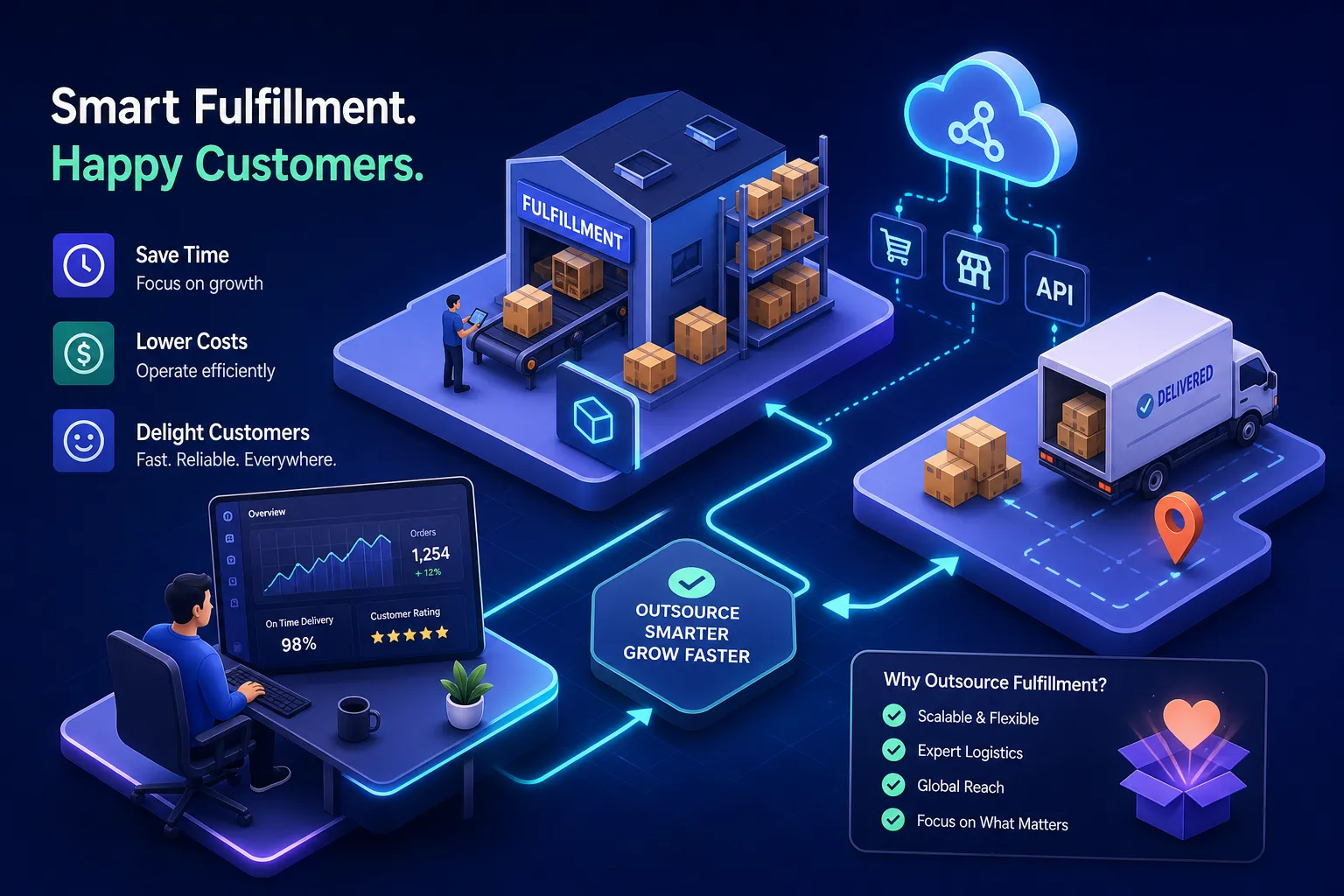
When you hand off fulfillment, you get time back for marketing, product development, and customer acquisition. That’s not a soft benefit, it’s a direct revenue lever. Multi-warehouse 3PLs also improve delivery speed, which reduces cart abandonment and increases repeat purchase rates. A seller who moves from self-fulfillment averaging five-day delivery to a 3PL averaging two-day delivery often sees measurable conversion rate improvements within the first quarter. Frame outsourcing as a growth investment, not just a line item on a cost sheet.
What a Solid Small Business Fulfillment Partner Looks Like
Knowing when to outsource is one thing. Knowing what to look for when you evaluate providers is what separates a good outcome from an expensive mistake.
Platform and carrier integrations you need as a baseline
Shopify, WooCommerce, and Amazon are the non-negotiables for most small sellers. USPS, UPS, and FedEx are the baseline carrier integrations; include DHL if you ship internationally. These integrations need to sync orders, inventory levels, and tracking numbers automatically. If a provider asks you to upload CSV files manually or reconcile inventory by hand, that’s not an integration, it’s extra work you’re paying them to create. For multichannel sellers, also check for Walmart, eBay, Etsy, and TikTok Shop connections.
Warehouse standards: accuracy, speed, and receiving time
Set concrete benchmarks before you start comparing quotes. A strong provider hits 99 percent or better pick accuracy, processes orders same-day for anything received before their afternoon cutoff, and makes inbound inventory available within one to two business days of delivery. These aren’t aspirational targets, they’re baseline operational standards. A 98 percent accuracy rate sounds impressive until you realize that means one out of every 50 orders ships wrong. At 500 monthly orders, that’s 10 incorrect shipments every month generating refunds, replacements, and customer service tickets.
How FBM Fulfillment serves small brands in practice
FBM Fulfillment is built specifically for the seller who wants professional fulfillment execution without signing a large-scale 3PL contract. For Amazon FBM sellers and small direct-to-consumer brands, that means warehousing, pick-and-pack services, carrier selection, and dedicated merchant support, without volume minimums designed for enterprise accounts. A small brand scaling from 200 to 600 orders a month can hand off operations to a provider that understands the FBM model and doesn’t require you to commit to infrastructure sized for 10,000 orders before you’re ready. If you want to explore what that looks like for your business, reach out to our team directly for a quote based on your actual order profile.
Provider Shortlist Checklist: Questions That Separate Good 3PLs from the Rest
Use these questions when you’re talking to providers. The answers will reveal far more than any marketing page.
Pricing and contract questions to ask before signing
Ask for a complete fee schedule that includes receiving, storage, pick-and-pack, packaging, returns, technology or WMS fees, setup fees, and monthly minimums. Then ask for a sample invoice based on your actual order profile, not a hypothetical one. Get clarity on cancellation fees, inventory removal fees, and what happens if you want to leave. Any contract with a lock-in longer than six months and no pilot period is a red flag for a low-volume seller. You need the flexibility to course-correct if the relationship isn’t working.
Service level and accuracy questions that reveal real performance
Don’t accept general claims. Ask for actual performance data from the past 90 days: pick accuracy rate, on-time shipping rate, and what happened during last peak season. Ask what SLAs will be written into your contract and what remedies apply if those SLAs are missed. A provider that can’t share recent performance data or won’t put service commitments in writing is telling you something important about how they operate. Walk away from any provider unwilling to put SLAs in the contract.
Integration and inventory control questions
Ask exactly how orders, inventory levels, and tracking numbers sync between your storefront and their warehouse management system. What happens if the integration fails overnight? Can you see real-time inventory and order status through a dashboard? How often are cycle counts performed, and what’s the inventory accuracy guarantee? These questions reveal whether the provider can actually connect to your sales channels without creating manual reconciliation work for your team every week.
Onboarding Checklist: How to Switch Without Disrupting Customers
The transition itself is where most small sellers make costly mistakes. Follow this sequence to avoid them.
Before the first shipment: setup steps
Before any inventory moves, finalize the integration between your store and the 3PL’s warehouse management system. Set up your full SKU catalog with accurate dimensions and weights, this affects storage pricing and carrier rate selection. Send an initial inbound shipment with proper labeling according to the provider’s specifications, confirm the receiving timeline in writing, and run a small test batch of five to ten orders end-to-end before redirecting all inventory. Do not go fully live until you’ve confirmed that orders import correctly, inventory counts update accurately, and tracking numbers push back to your storefront.
Metrics to track from day one
Set up a weekly tracking routine for these specific KPIs from the moment you launch: order accuracy rate, average ship time from order received to carrier handoff, inventory accuracy percentage, return processing time, and fully loaded cost per order. Tracking these from the start gives you real data to bring into monthly SLA reviews with your account manager, and it catches problems at 50 orders before they compound at 500.
Managing the transition without customer disruption
Run a parallel window of two to four weeks where you keep some backup inventory at your previous location while the 3PL processes new orders. If the integration misfires, you have stock to fall back on while the problem gets resolved. Set a monthly cadence for SLA reviews with your account manager and plan your peak-season volume increases at least 60 days in advance. Switching providers in the middle of Q4 is the single most common mistake small sellers make, and it is entirely avoidable with basic planning.
The Decision Is Simpler Than It Looks
Fulfillment for small business isn’t purely a logistics question, it’s a time and capital allocation decision. Start in-house when volume is low. Watch your order numbers, your error rate, and how many hours a week fulfillment is consuming. When those signals shift, the cost math on outsourcing almost always improves, and the operational benefits compound on top of that.
Use the provider checklist above to compare options on the same criteria: full cost per order, accuracy standards, integrations, and contract flexibility. Then follow the onboarding sequence to make the switch without disrupting the customers you’ve earned.
For Amazon FBM sellers and small brands that want to outsource without the overhead of an enterprise-scale 3PL contract, a specialized provider built for that model is worth a close look. FBM Fulfillment works with small brands at exactly this stage. Get in touch with our team to run the numbers against your actual order profile and see what the transition looks like for your business.
Key Takeaways
- Fulfillment for small business can become an overwhelming task as order volume increases, leading to operational inefficiencies.
- This article discusses three fulfillment models: in-house, Amazon FBA, FBM, and third-party logistics (3PL).
- Understanding real costs at different order volumes helps sellers determine when to outsource fulfillment.
- Outsourcing frees up time for growth activities like marketing and improves delivery speed, enhancing customer experience.
- Use a provider checklist to assess fulfillment partners and follow an onboarding sequence to switch without disrupting customers.
Related Links
Frequently Asked Questions
Fulfillment for small business comes down to three models: in-house fulfillment, Amazon FBA or FBM, and a third-party logistics (3PL) provider. Many sellers use a hybrid approach, keeping customized, fragile, or high-margin SKUs in-house while routing standard products to a 3PL.
Below about 250 orders a month, in-house fulfillment is usually manageable. Between 400 and 500 orders a month, it makes financial sense to outsource fulfillment because fixed fees spread across more orders and carrier discounts improve. Heavy or bulky products reach that crossover point earlier.
Expect roughly $13 to $26 per order all-in at 50 orders a month, $8 to $18 at 200 orders, and $7 to $16 at 500 orders, with postage included. Costs drop with volume because fixed fees are spread across more orders. Postage typically makes up 50 to 70 percent of the total.
Typical fees are $25 to $45 per pallet for receiving, $15 to $40 per pallet per month for storage, $2.50 to $5.00 to pick and pack the first item plus $0.25 to $0.75 for each additional item, $0.50 to $2.00 for packaging, and $3 to $10 per return. Monthly minimums run around $500.
Watch for fulfillment taking more than five hours a week, rising shipping error rates, storage space running out, delays during peak periods, and growth stalling because the founder is packing orders. When several of these show up at once, it is time to change how you fulfill.
With FBA, Amazon handles storage, picking, packing, shipping, and returns, but fees are higher, branding control is limited, and slow-moving products draw storage surcharges. FBM offers better unit economics for heavier or slower-selling products and keeps packaging in your control.
Yes. FBM Fulfillment provides warehousing, pick-and-pack, carrier selection, and dedicated merchant support for Amazon FBM sellers and small direct-to-consumer brands, without the volume minimums designed for enterprise accounts. It is a fit for brands scaling from 200 to 600 orders a month.