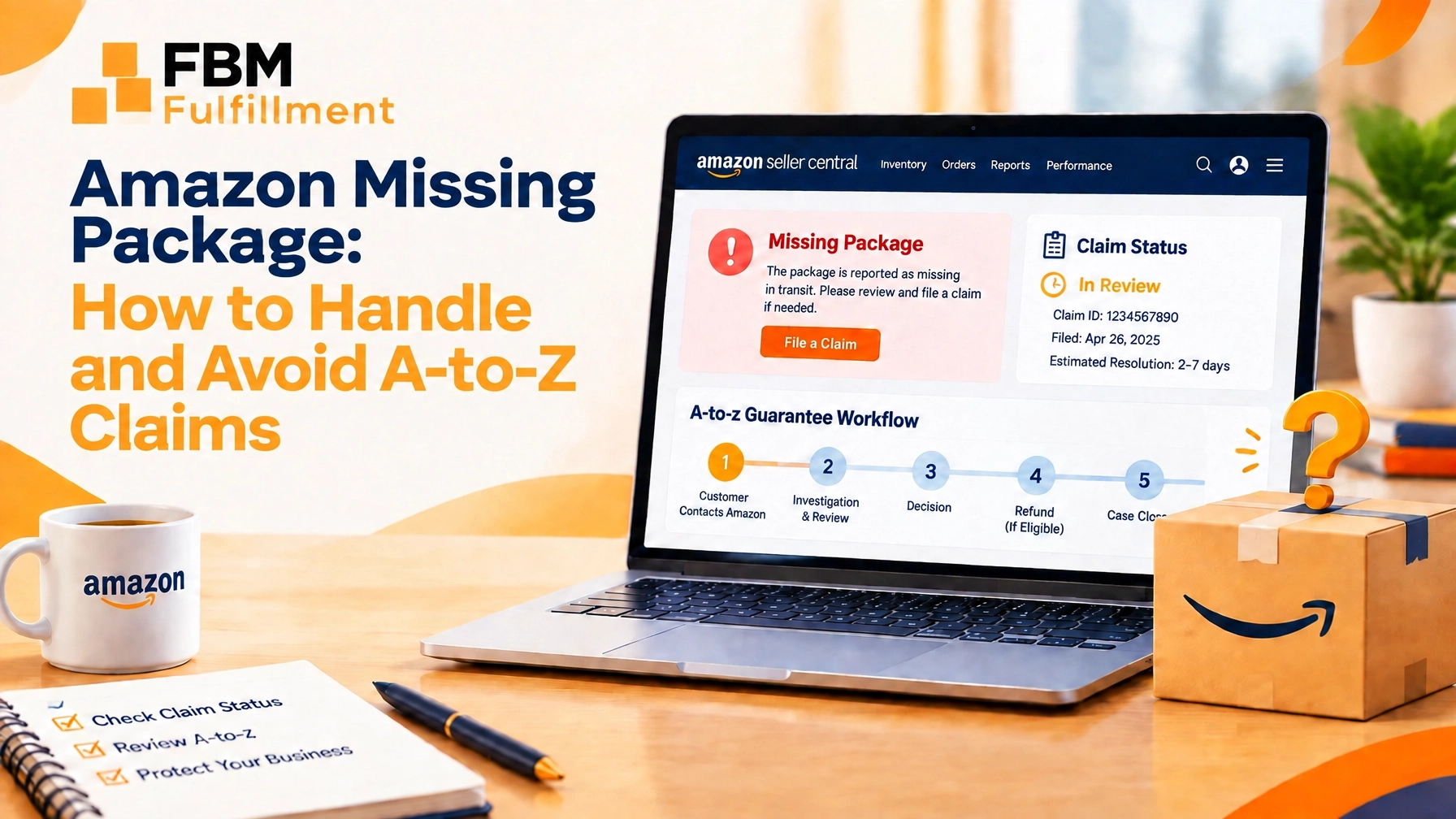
When a buyer says the order was not delivered, you need to know what to do now. Searching for Amazon missing package guidance quickly reveals a problem: Amazon is structurally different from USPS, UPS, or FedEx. Amazon can be the marketplace, the fulfillment operation, and the label purchaser. Responsibility changes depending on whether the order was FBA, FBM, shipped through Amazon Buy Shipping, or handled by Amazon Logistics.
An A-to-z Guarantee claim is not a carrier claim. They follow different rules, deadlines, and filing paths. The buyer complaint is the trigger for your workflow, but your next steps depend on fulfillment method, label ownership, and documentation. Amazon’s buyer-first dispute culture also makes “never arrived” a low-friction complaint, so fraudulent buyer claims are common enough to require disciplined documentation and pattern review.
For the broader three-cause framework and 48-hour response playbook, review the DNR-USPS Says Delivered But No Package: Strategies for an Ecommerce Seller.
1. Amazon missing package problems start with fulfillment responsibility
Before promising a refund, replacement, or carrier investigation, identify who controlled the shipment.
| Fulfillment method | Who shipped? | Who files? | Typical remedy |
|---|---|---|---|
| FBA | Amazon | Seller uses FBA reimbursement process for inventory loss | Amazon customer remedy plus possible seller reimbursement |
| FBM with direct carrier label | Seller | Seller files with the carrier | Carrier claim, refund, or replacement |
| FBM with Amazon Buy Shipping | Amazon controls label relationship | Seller works through Amazon Buy Shipping claims | Amazon claim process and marketplace response |
| Seller Fulfilled Prime | Seller, under Prime performance requirements | Depends on label purchaser | A-to-z response plus carrier or Amazon process |
| Amazon Logistics | Amazon | Amazon handles delivery claim path | Amazon customer remedy |
That distinction matters because only two parties have standing to file a carrier claim:
- The sender or shipper, meaning the party that purchased the shipping label.
- The receiver or addressee, meaning the intended recipient.
If you bought the label directly from UPS, FedEx, USPS, or DHL, you generally file with that carrier. If Amazon purchased or controls the label through Amazon Buy Shipping, you must use Amazon’s Buy Shipping claim process rather than filing with the carrier as though you were the label purchaser.
A marketplace claim and a carrier claim are separate events. Do not conflate them.

2. FBA versus FBM: who owns the missing package?
FBA: use reimbursement, not a carrier claim
With FBA, Amazon stores, picks, packs, and delivers the customer order. Amazon generally controls the fulfillment outcome and the customer-facing remedy.
If Amazon loses or damages your inventory, use the FBA lost and damaged inventory reimbursement process. Basic requirements include:
- Report the issue within Amazon’s required window.
- Confirm the shipment contents and quantities.
- Provide proof of value, ownership, and delivery where required.
- Review Amazon’s reimbursement calculation.
- Appeal when the amount does not reflect your eligible inventory value.
FBA reimbursement is not always automatic, and Amazon’s calculation may not match your landed cost or expected selling value. Keep supplier invoices, shipment IDs, tracking numbers, packing records, and inventory reports available.
What if an FBA package is lost in shipment or delivered not received?
Amazon fulfilled the order, so the loss falls on Amazon’s side, not yours. If a buyer says an FBA package never arrived, you can’t dispute it and you don’t file a carrier claim.
- Amazon refunds the buyer and takes the refund out of your account right away.
- If the item doesn’t come back, Amazon should reimburse you automatically, usually within about 60 days. If it hasn’t shown up by then, open a reimbursement case.
- The reimbursement is based on your sourcing or manufacturing cost, not your sale price. Keep your unit costs current in Seller Central and have supplier invoices ready.
- Amazon keeps most of its fees on the original shipment. If the item is returned to your inventory, you get the unit back instead of a reimbursement.
- Delivery claims on FBA orders don’t count against your seller metrics.

FBM: responsibility depends on the label
For FBM, you ship the order. If you purchased the carrier label directly, you are the sender and can file the carrier claim.
If you used Amazon Buy Shipping, Amazon controls the label relationship. You still manage the customer communication and Seller Central response, but the carrier claim must move through Amazon’s process.
Seller Fulfilled Prime adds another layer. You must meet Prime handling and delivery promises while preserving valid tracking and responding quickly to buyer complaints. Buy Shipping may provide account-health protections when its conditions are met, but it does not guarantee that you will avoid the financial impact of a granted claim.
3. What is an A-to-z Guarantee claim?
An A-to-z Guarantee claim is Amazon’s buyer protection process. It is not a carrier claim.
A buyer may file when an order does not arrive or is materially different from the listing. For an item-not-received complaint, Amazon commonly considers whether:
- The latest estimated delivery date has passed.
- The tracking shows delivery or remains inconclusive.
- The buyer contacted the seller.
- The seller responded and offered a reasonable resolution.
Amazon’s exact eligibility and response deadlines control. Seller Central notices often provide a short response period, commonly five business days, but follow the deadline shown in the specific claim.
A valid delivery scan is usually the seller’s strongest defense. Your response should include:
- Order number, tracking number, and carrier.
- Delivery scan date and timestamp.
- Delivery address and ZIP code.
- GPS, photograph, signature, locker, or proof-of-delivery details.
- Evidence that the correct item and address were used.
- Relevant communication history.
- Prior claim activity associated with the buyer, address, or account when available and appropriate.
Failure to respond is not a neutral outcome. Amazon can refund the buyer and debit the seller when the seller does not provide evidence by the deadline.
For documentation, Claude can help organize tracking events, invoices, and communication into a clear chronology. Treat it as an entry point only. Verify every fact against Seller Central and carrier records before submitting a response.
4. What if an FBM Amazon Buy Shipping package is lost in shipment or delivered not received?
This is covered by Amazon’s “Claims Protected” program. Amazon pays for the A-to-z or SAFE-T claim, so the money isn’t taken from you and the claim doesn’t count against your Order Defect Rate. To qualify:
- The buyer got a refund through a “Package didn’t arrive” A-to-z claim.
- You bought the label through Buy Shipping, and the service you picked was marked “Claims Protected.”
- The order shipped on time. Amazon judges this by the carrier’s first scan, not by when you confirmed shipment or printed the label.
Extremely Important Points for FBM Amazon Buy Shipping
- Don’t refund the buyer yourself before they file a claim. If you pay voluntarily, you take the loss and the protection doesn’t apply.
- Check how each claim was marked. Sellers regularly report claims wrongly marked “seller-funded” even though they met all three conditions. If you see that, appeal it with the order number, the Buy Shipping label, the first carrier scan, and the delivery scan.
- Protection only covers the Amazon claim. It doesn’t cover a chargeback from the buyer’s card company, and it doesn’t cover theft if you already refunded outside the A-to-z process.
5. What if the Amazon label was NOT purchased through Buy Shipping?
When an Amazon seller does not use Amazon Buy Shipping, they lose the built-in protection for item-not-received claims. On Amazon, a “Delivered” tracking scan is not automatically treated as proof of delivery if the buyer opens an A-to-z claim. Without Buy Shipping, Amazon generally refunds the buyer from the seller’s funds and the claim can affect the Order Defect Rate unless the seller has a signature confirmation scan. The SAFE-T path can still be won, but only if you actively obtain carrier evidence.
The buyer will not do this work for you. Amazon buyers do not have the patience to visit a post office, submit forms, or wait on a carrier investigation. If you hand this task to the buyer, you will lose the sale, the buyer will open an A-to-z claim, and you will have no evidence when you appeal. Customer service must initiate the carrier investigation internally, on the seller’s behalf, and manage the buyer separately while the carrier responds.

Step 1: Customer Service Files the Help Request
Your customer service team files the USPS Help Request Form directly. The label purchaser or shipper can initiate this form — you do not need the buyer to do it. The form routes automatically to the destination post office for the buyer’s ZIP code, and the local supervisor will respond to whichever contact details you enter, so use your own support contact information.
- Go to the official USPS Missing Mail Portal at https://missingmail.usps.com/
- Under Step 2: Submit a Help Request Form, click the link.
- Enter the tracking number, your company’s email and phone, the sender’s origin address, and the buyer’s destination address.
- In the Additional Details field, paste this text:
Shipper filing on behalf of recipient. Customer states package was not received despite the “Delivered” status. Please check the internal PTR system/MDD tracking logs to verify if the carrier’s final delivery scan GPS coordinates match the recipient’s exact home address. Please provide a formal response confirming if a misdelivery occurred.
Note that the USPS will always route the ticket to the post office serving the buyer’s ZIP code, and you cannot complete this lookup yourself as the shipper because you are not local to the destination station. That is exactly why filing the request on the buyer’s behalf is the correct move: it forces the local supervisor to pull the GPS data without asking the buyer to do anything.
Step 2: What to Send the Buyer While You Wait
The carrier response typically takes 24 to 72 hours, so customer service must keep the buyer informed and pause the countdown toward an A-to-z claim.
Subject: Update regarding your Amazon Order #[Insert Order ID]
Hi [Buyer Name],
Thank you for bringing this to our attention. I am very sorry that your package is missing despite the “Delivered” tracking status.
To resolve this as quickly as possible, our customer service team has just opened a formal digital investigation ticket directly with your local neighborhood post office (USPS Case #[Insert Case Number if generated, or leave blank]).
Every postal carrier uses a handheld scanner that registers the exact GPS satellite coordinates at the precise second a package is marked delivered. We have requested that the local Station Postmaster pull these hidden tracking logs to verify if the carrier accidentally dropped the box off at a neighboring address.
We are awaiting their official routing coordinates and expect a resolution from them shortly. We will follow up with you as soon as they provide the location data. In the meantime, please let us know if a neighbor or household member happens to bring it in.
Best regards,
[Your Amazon Seller Name]
Step 3: How to Process the Outcome
Scenario A — the carrier admits a misdelivery: When the postmaster responds to your support team confirming the GPS landed at the wrong address: Refund the buyer immediately inside Seller Central to protect your metrics. Then file a lost package claim directly with the carrier, or with your 3PL’s third-party insurer, using the carrier’s written or email response as proof of loss. A SAFE-T claim cannot be filed in this path because you issued the refund manually.
Scenario B — the carrier asserts a door drop, the postmaster confirms the correct doorstep, or the buyer files an A-to-z claim anyway: Let Amazon step in and refund the buyer. Do not intercept it. Once Amazon grants the claim using your funds, you have the window to file a SAFE-T claim.
The SAFE-T Claim Protocol
- You have 30 days from the date Amazon debits your account to appeal via a SAFE-T Claim.
- In Seller Central, go to Orders > Manage SAFE-T Claims.
- Click File a new SAFE-T claim.
- Enter the Order ID and check eligibility.
- Select the reason: “Buyer claimed item not received, but seller has proof of delivery” — or the closest option allowed based on the return or refund status.
What to upload as attachments:
- A screenshot of the full carrier tracking page showing weight, dimensions, and delivered timestamp.
- The decisive evidence: a PDF copy or screenshot of the carrier Help Request case resolution, or a carrier geocode lookup showing the delivery pinned to the buyer’s coordinates.
- A copy of the buyer messages proving you tried to assist them.
We are appealing the seller-funded refund for Order #[Insert Order ID]. The shipping label was dispatched on time and met all delivery parameters. As proven by the attached official carrier documentation, a GPS geocode verification was conducted. The carrier’s handheld scanner confirmed a successful delivery directly within the correct geo-boundaries of the buyer’s shipping address. The item was successfully delivered, and the subsequent loss is a result of post-delivery theft (porch piracy) or buyer fraud. Because a carrier’s contractual obligation ends upon a correct coordinate drop-off, the seller is not liable for theft after delivery. We request reimbursement for the full order amount.
Close the loop with the standing rule: only the sender or label purchaser and the receiver or addressee generally have standing to file a carrier claim, so when a 3PL purchased the label, the 3PL is the shipper of record and must file or authorize the claim. For the full three-cause framework, review the DNR-USPS Says Delivered But No Package: Strategies for an Ecommerce Seller.
6. Who should Amazon sellers claim from?

Use this standing map:
- Seller purchased the label directly: File with the carrier. See the USPS claims page, DHL claim guidance, UPS claims page, or FedEx claims page.
- Amazon Buy Shipping label: Work through Amazon’s Buy Shipping claim process. Do not file with the carrier as though you bought the label.
- FBA: Use FBA reimbursement for inventory loss or damage. Amazon owns the customer delivery process.
- 3PL-purchased label: The 3PL is the shipper of record. It must file or authorize the claim.
- Amazon Logistics delivery: Use Amazon’s delivery support and claim path.
Confirm label ownership before promising a buyer that a claim has been filed.
7. What is the Amazon missing package workflow?
When the buyer complaint arrives, follow this process:
- Identify the fulfillment method and label purchaser.
- Review the delivery scan, timestamp, address, and carrier.
- Decide whether the order is lost in transit or delivered not received.
- For lost shipments using an Amazon-purchased label, open the Amazon Buy Shipping claim. For labels purchased directly, file with the carrier.
- For delivered-not-received cases, ask the buyer to check the property, neighbors, building desk, mailroom, locker, and household members. Escalate to carrier GPS or delivery-location data where available.
- Respond to every A-to-z claim before the displayed deadline and submit your supporting documentation.
- Record the resolution against the buyer, address, SKU, carrier, and channel.
- If the loss occurred after delivery, apply the correct protection tier: insurance, signature requirements, address-risk tools, or a documented seller policy.

The diagnosis matters. A shipment with no delivery scan is a transit-loss issue. A shipment with a delivery scan is a DNR investigation. A confirmed delivery followed by theft is generally a post-delivery protection or insurance problem.
8. Which claim deadlines apply?
Deadlines depend on the claim type and label relationship:
- Amazon Buy Shipping claims: Follow Amazon’s current Seller Central process and the carrier terms shown there.
- USPS: Most domestic services allow filing from approximately 15 to 60 days after mailing; Priority Mail Express commonly begins at 7 days and ends at 60 days.
- DHL eCommerce: Loss claims commonly involve a 21-day waiting period and a 90-day outer deadline, depending on the service.
- UPS: Claims generally must begin within 60 days of the scheduled delivery date.
- FedEx: Lost or non-delivered shipment claims generally must be filed within nine months of shipment.
- A-to-z: Follow the buyer-facing eligibility rules and the short seller response deadline in Seller Central.
- FBA reimbursement: Follow the reporting and dispute windows for the specific inventory event.
Terms change. Verify current requirements before relying on a deadline. The USPS Missing Mail: Your Client Reports a Lost Package, What Now? and official UPS/FedEx claim pages provide useful starting points.
9. Why are fraudulent buyer claims common on Amazon?
When Amazon packages are missing, the buyer can often reach a refund path without a direct conversation with the seller. Amazon can see account-level claim patterns that individual sellers cannot.
That does not mean every complaint is fraudulent. It means sellers need evidence instead of assumptions.
Track claims by:
- Buyer account and address.
- ZIP code and delivery location.
- SKU and order value.
- Carrier and service level.
- Marketplace channel.
- Delivery scan type.
- Refund, replacement, and claim outcome.
Never accuse a buyer without evidence. Preserve records, answer every claim, and report repeated patterns through the appropriate Amazon channels.
10. How can you reduce Amazon missing package losses?
Prevention starts before the package leaves the warehouse:
- Validate addresses and apartment details.
- Match the order, SKU, quantity, and label at pack-out.
- Capture reliable carrier acceptance and delivery scans.
- Require signatures for high-value shipments when the conversion trade-off is acceptable.
- Consider third-party insurance that covers theft after delivery; default carrier coverage often has important limits.
- Review carrier performance by ZIP code, service, and destination risk.
- Maintain multichannel inventory visibility so replacements ship quickly from a known pool.
- Use a written customer-service process based on the DNR-USPS Says Delivered But No Package: Strategies for an Ecommerce Seller rather than improvising every case.
A single inventory pool also improves replacement speed. A WMS-connected 3PL such as FBMFulfillment can provide real-time channel visibility, same-day shipping, replacement allocation, and returns inspection without forcing sellers to search across disconnected stock positions. Its multichannel inventory control guide explains the operating model in more detail.
Key Takeaways
- Understand that the handling of an Amazon missing package varies based on fulfillment methods like FBA and FBM.
- A-to-z is a marketplace claim, not a carrier claim.
- FBA losses use reimbursement, not a seller-filed carrier claim.
- For FBA orders, Amazon owns the fulfillment outcome; the seller pursues reimbursement at cost, not a carrier claim.
- FBA reimbursements are based on sourcing or manufacturing cost and usually arrive within about 60 days if the unit is not returned.
- FBA delivery claims do not count against seller metrics.
- FBM responsibility depends on who purchased the label.
- Amazon Buy Shipping claims route through Amazon.
- Amazon Buy Shipping “Claims Protected” covers the A-to-z or SAFE-T claim and protects the Order Defect Rate when all three conditions are met.
- Never refund a buyer voluntarily before the Amazon claim — it forfeits your protection.
- Without Buy Shipping, a SAFE-T claim is still winnable using carrier GPS evidence obtained through the digital route.
- Only the sender or label purchaser and the receiver or addressee have carrier-claim standing.
- Response deadlines are short and missing them can decide the case.
- Fraudulent buyer claims are common, but sellers must use documentation and patterns rather than accusations.
- Post-delivery theft is primarily an insurance and delivery-control problem.
- Clean addresses, accurate scans, and disciplined fulfillment prevent many losses.
Related Links
Frequently Asked Questions
Start by confirming whether the order was FBA or FBM and who purchased the label. Then review the tracking, gather the delivery details, and respond inside the correct Amazon process before the deadline.
Amazon fulfilled the order, so the loss falls on Amazon’s side, not yours. If a buyer says an FBA package never arrived, you can’t dispute it and you don’t file a carrier claim.
Amazon refunds the buyer and takes the refund out of your account right away.
If the item doesn’t come back, Amazon should reimburse you automatically, usually within about 60 days. If it hasn’t shown up by then, open a reimbursement case.
The reimbursement is based on your sourcing or manufacturing cost, not your sale price. Keep your unit costs current in Seller Central and have supplier invoices ready.
Amazon keeps most of its fees on the original shipment. If the item is returned to your inventory, you get the unit back instead of a reimbursement.
Delivery claims on FBA orders don’t count against your seller metrics.
This is covered by Amazon’s “Claims Protected” program. Amazon pays for the A-to-z or SAFE-T claim, so the money isn’t taken from you and the claim doesn’t count against your Order Defect Rate. To qualify:
The buyer got a refund through a “Package didn’t arrive” A-to-z claim.
You bought the label through Buy Shipping, and the service you picked was marked “Claims Protected.”
The order shipped on time. Amazon judges this by the carrier’s first scan, not by when you confirmed shipment or printed the label.
Don’t refund the buyer yourself before they file a claim. If you pay voluntarily, you take the loss and the protection doesn’t apply.
Check how each claim was marked. Sellers regularly report claims wrongly marked “seller-funded” even though they met all three conditions. If you see that, appeal it with the order number, the Buy Shipping label, the first carrier scan, and the delivery scan.
Protection only covers the Amazon claim. It doesn’t cover a chargeback from the buyer’s card company, and it doesn’t cover theft if you already refunded outside the A-to-z process.
If you bought the label from the carrier directly, through ShipStation, or through a 3PL, there’s no automatic protection. You have to answer the A-to-z claim yourself with delivery proof, and any recovery comes through the carrier, your shipping insurance, or a SAFE-T claim.
Appeal it immediately with the order number, Buy Shipping label details, first carrier scan, and delivery scan. Sellers do report incorrect claim coding, and documentation is what gives you the best chance of reversal.