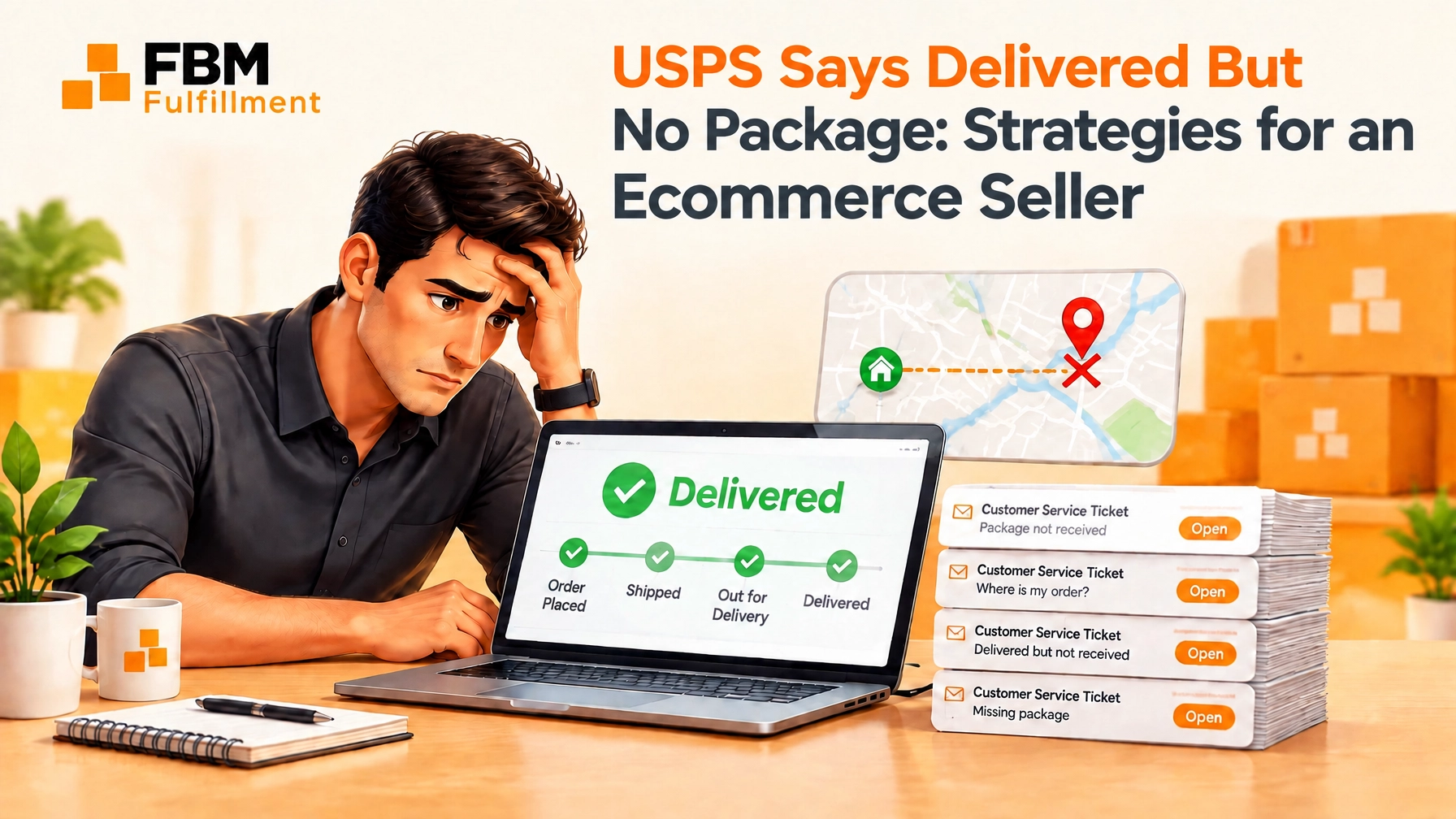
A customer writes: “Tracking says delivered, but I do not have my package.” In other words, usps says delivered but no package shows up. (Could be FedEx or UPS as well) You check the delivery scan. It says Delivered. Now you know what is coming: a refund demand, a replacement request, and another loss coming directly out of your margin.
After 13 years selling on Amazon through FBM and FBA, while also operating across Shopify, Walmart, eBay, Etsy, and TikTok Shop, we have learned an uncomfortable truth. Not every missing package was stolen. Not every claim is genuine. There are four causes:
- Misdelivery: the carrier delivered to the wrong address or scanned at the wrong location.
- Early Scan: the carrier scanned delivery to meet some performance goal with the intent of delivering it later. The biggest issue here is if the carrier does not work the following day to complete the delivery. These packages usually show up a day or two later, so we will not spend much time on this one.
- Fraudulent buyer: the customer received the order but claims otherwise. This is very common on Amazon, where “never arrived” is often the easiest path to a free item.
- Porch piracy: the carrier delivered correctly, often to an insecure location and someone stole the package afterward.
These situations look identical on a tracking page. They do not require the same response.
START WITH THE RIGHT CARRIER GUIDE (after reading the balance of the article)
If usps says delivered but no package, use this hub for the decision framework first. Then go straight to the right operating guide:
- USPS Missing Mail: Your Client Reports a Lost Package, What Now? — For usps missing mail, usps lost package, and missing mail situations involving USPS final mile or DHL eCommerce handoff, including PTR Intranet, MDD GPS escalation, and claim windows.
- UPS and FedEx Lost Package: Your Client Reports a Lost Package, What Now? — For lost parcel ups, ups missing package, ups claim lost package, and fedex missing package scenarios, including delivery-location data, standing, and claim windows.
- Amazon Missing Package: Buyer Claims Not Delivered, What Now? — For amazon missing package and lost amazon package disputes, including A-to-z versus carrier claims, FBA versus FBM, and Buy Shipping.

1. WHAT DOES IT MEAN WHEN USPS SAYS DELIVERED BUT NO PACKAGE ARRIVES?
When usps says delivered but no package arrives, the carrier’s system records a completed delivery while the customer states that the order was not received.
The distinction matters because:
- Misdelivery can be proven with carrier location data.
- A fraudulent buyer claim is handled through documentation, account history, and marketplace processes.
- Porch piracy occurs after a correct delivery and generally requires insurance, a replacement policy, or a seller-funded resolution.
Do not accuse an individual customer without evidence. Instead, track the pattern.
Review claims by:
- Customer account
- Delivery address
- ZIP code
- Sales channel
- SKU
- Order value
- Launch date or promotion period
- Carrier and service level
A cluster of claims around one high-value SKU, or repeated claims from the same address or zipcode, deserves additional review. On Amazon, the platform can see buyer claim patterns even when the individual seller does not have a direct conversation with the buyer.
Operational takeaway: Separate misdelivery, fraudulent buyer claims, and porch piracy before deciding whether to refund, replace, investigate, or file a claim.
2. THE CARRIER’S LIABILITY STOPS AT THE DELIVERY SCAN? (Or does it?)
The carrier’s contract is generally to transport the parcel and complete delivery. The delivery scan is the finish line.
Default carrier coverage of roughly $100 generally applies to:
- Loss while the parcel is in transit
- Physical damage before drop-off
- Certain service failures covered by the carrier’s terms
It does not normally cover:
- Theft after a correct delivery
- A buyer claiming non-receipt after the carrier completed delivery, even if mis delivery or early scan
- Package disappearance from a porch, lobby, or mailroom
- A customer’s failure to secure the parcel
No major carrier (USPS, UPS, FedEx, or DHL eCommerce) protects the shipper from standard Delivered Not Received claims through ordinary default coverage. Declared value is not insurance. It is a contractual liability limit that may increase the carrier’s maximum responsibility for covered loss or damage. It does not automatically create post-delivery theft protection.
What happens with DHL eCommerce Max?
DHL eCommerce Max handles the long-haul movement and then tenders the package to USPS for final mile. Default Shipment Value Protection of up to $100 generally applies to eligible loss or damage before the delivery scan, not after it. When usps says delivered but no package, a shipment marked Delivered is generally auto-rejected unless misdelivery can be proven. For the full DHL, USPS, and U-PIC handoff rules and claim windows, see USPS Missing Mail: Your Client Reports a Lost Package, What Now?.
Once a correct delivery scan exists, the carrier liability argument usually ends. The seller’s responsibility to the customer does not. That difference creates a seller-funded loss unless the seller can prove misdelivery or has another protection layer.
Note: DHL Ecommerce sub economy methods like Parcel Ground and Parcel Express do not carry any protection.
3. HOW CAN YOU PROVE A USPS MISDELIVERY?
USPS carriers scan packages with a Mobile Delivery Device, or MDD. That scan can capture location data within roughly a six-foot radius, but the relevant GPS record is not shown on publically. Instead, it sits in the internal PTR Intranet used by USPS.
That is why the consumer matters. They live near the destination post office, so they are the person best positioned to speak with the local Supervisor or Postmaster and request the internal record. The exact words to use, both in person at the destination Post Office and through the USPS Missing Mail Portal Help Request Form, See our guide: USPS Missing Mail: Your Client Reports a Lost Package, What Now? to learn specific steps to prove a mis delivery.
4. ARE FEDEX AND UPS DELIVERY COORDINATES EASIER TO ACCESS?
Often, yes. FedEx and UPS delivery-location evidence is generally easier for a seller or 3PL to access through account tools than USPS PTR data, which usually requires local station involvement. Access still varies by account type, volume, and service level, so do not promise identical visibility in every case. FedEx and UPS often include a Proof of Delivery photo that can be very helpful. For the full process on delivery-location evidence, standing, and claim windows, see UPS and FedEx Lost Package: Your Client Reports a Lost Package, What Now?.
5. WHAT SHOULD WE SAY TO THE CUSTOMER?
A two-step workflow prevents your support team from refunding every claim immediately and un-necessarily.
First, filter out common delays. Packages are sometimes placed behind a side door, accepted by a neighbor, delivered to a mailroom, or scanned several hours of even days before the final drop-off.
Second, if the order is still missing, move to the appropriate escalation path for the carrier and sales channel involved.
STEP 1: THE “CHECK AROUND THE HOUSE” FILTER
Send this message when the customer first reports a package not received.
Subject: Regarding your missing delivery (Order #[Order Number])
Hi [Customer Name],
I am so sorry to hear that your package hasn’t made it to your hands yet, even though the tracking status shows as “Delivered.”
Because we shipped using [Insert Carrier and Service ie DHL eCommerce Max (which hands off to the USPS for final delivery), USPS Ground Advantage], sometimes postal carriers mark packages as delivered a few hours before they actually drop them off, or they place them in a secure spot to protect them from weather or theft.
Before we initiate a formal investigation, could you please double-check a few quick spots?
- Any side doors, back porches, or behind large plants/structures.
- With any family members or apartment neighbors who might have brought it inside for you.
- Your building’s main office, mailroom, or parcel locker (if applicable).
If it still hasn’t turned up by tomorrow afternoon, please let me know. We will immediately move to Step 2 and work with the Post Office to pull the exact GPS delivery logs to find out exactly where your mail carrier scanned the box.
Best regards,
[Your Client’s Brand Name] Customer Support
STEP 2: MOVE TO THE RIGHT ESCALATION PATH
If the package is still missing after the initial check, do not force every case through one script. USPS and DHL eCommerce final-mile issues follow a different path than UPS, FedEx, or an amazon missing package dispute inside Amazon. Use the companion guides for the full escalation language, claim windows, and platform-specific process.
For USPS final-mile cases, the exact escalation script and the full usps missing mail process are documented here: USPS Missing Mail: Your Client Reports a Lost Package, What Now?. For UPS and FedEx workflows, use this guide: UPS and FedEx Lost Package: Your Client Reports a Lost Package, What Now?. For Amazon-specific disputes, including A-to-z, FBA versus FBM, and Buy Shipping, use this guide: Amazon Missing Package: Buyer Claims Not Delivered, What Now?.
6. WHAT SHOULD YOU DO WHEN GPS SHOWS CORRECT DELIVERY?
Once the scan matches the delivery address, the carrier is generally out of the picture. You likely need to make it right with this customer but you may want to consider a protection strategy going forward.
1. Use third-party shipping insurance
This is usually the best default protection for premium, high-volume B2C operations. Providers such as Route, InsureShield, and ShipSurance may cover some combination of theft, loss, damage, and post-delivery claims. Verify whether the policy specifically covers porch piracy and delivered claims, and review exclusions, claim windows, and documentation requirements.
2. Use signature required service for high-value orders
Use signature required service for higher-value or higher-risk shipments, not every order. A WMS can assign it by order value, SKU, address risk, or channel. For many sellers, this starts making sense around $150 to $200 and above, while lower-value items often cannot absorb the added cost and friction.
3. Create a self-insurance pool
For low-value, high-volume products, third-party coverage and signature fees can cost more than the expected loss. In that case, set aside a small amount per shipment in an internal shrinkage pool and review the results monthly. Track shipped packages, verified claims, replacements, refunds, product cost, shipping cost, and claim rates by channel or ZIP code.
4. Use address-level risk tools
Address-risk tools can flag higher-risk shipments before they move through the cheapest delivery method. Use them to trigger:
- Signature required service
- Secure pickup
- Address verification
- Manual review
- Customer contact before shipment
The goal is simple: make a protection decision before the loss happens.

How should you handle suspected fraudulent buyer claims?
Use evidence, not emotion.
- Measure the claim rate by marketplace and direct channel.
- Compare claims by SKU and order value.
- Check the delivery scan timestamp and address.
- Save carrier responses and scan-location results.
- Review prior claims from the same address or buyer account.
- Use Amazon’s dispute and claim processes instead of silently absorbing every loss.
- Escalate repeat patterns through the marketplace.
Never accuse a buyer without proof. A documented pattern is a reason to investigate and escalate.
7. WHO FILES THE CLAIM?
Parties with Standing
In an ecommerce shipping transaction, there are only 2 parties the have standing to file a claim:
- Purchaser of the Label [Not necessarily the shipper]
- If your 3PL purchased the label on your behalf on their account, they are the shipping party with standing and may file a claim as the shipper.
- If your 3PL printed the label from Amazon Buy Shipping, TikTok Buy Shipping or any other 3rd party, that party must file the claim usually initiated by a service ticket. Your 3PL has no standing to file a claim.
- Seller provided labels either directly or via 3rd party billing, the seller or the owner of the 3rd party account must file the claim.
- Recipient of the package can file the claim.
8. HOW DOES FBMFULFILLMENT HELP REDUCE THE LOSS?
You have a problem. We have a solution.
The problem is simple: the carrier’s delivery scan ends its practical responsibility, while your responsibility to the customer continues. Many 3PLs stop at the tracking number.
Our solution is a fulfillment partner that documents the handoff, supports the claim file, protects inventory accuracy, and ships the replacement fast.
At FBMFulfillment, that means:
- Accurate pick, pack, address validation, and scan discipline
- Documented warehouse handoffs
- Carrier escalation support at shipping volume
- A single inventory pool across Amazon, Shopify, TikTok Shop, Walmart, eBay, and Etsy
- Real-time visibility through ShipHero WMS
- Same-day shipping for orders received before the cutoff
- FedEx 2Day shipping from Jacksonville
- Returned units inspected and quarantined rather than automatically recirculated
- Inventory records updated when a replacement or return is processed
Our startup-friendly policies also include:
- Waived minimums for 12 months
- No onboarding fees
- Month-to-month contracts
- Access to enterprise-level pricing and shipping rates
- Free coaching through Ecommerce Academy and in person
- Strategic fulfillment locations
- World-class technology
- Post-pay invoicing
We remain selective because operations matter. Choosing a 3PL is choosing a long-term business partner, not purchasing a commodity. Move substantive conversations from email to video or in-person meetings, ask direct questions, and avoid gimmicks, hidden fees, and long-term contracts.
THE DNR PLAYBOOK: WHAT TO DO IN THE FIRST 48 HOURS
- Confirm the delivery scan timestamp. Check the carrier, service, destination, and delivery location description.
- Have the consumer inspect the property. Check side doors, back porches, garages, parcel lockers, and protected areas.
- Check with neighbors and household members.
- Check the building office, mailroom, leasing office, or front desk.
- Send the Step 1 email immediately after the initial report.
- Wait through the stated response window unless the customer reports theft or another urgent issue.
- If usps says delivered but no package, route the case to the USPS guide first; otherwise route it to the correct carrier or marketplace guide.
- If misdelivery is proven, collect the documentation and file the carrier claim.
- If delivery appears correct, move to the theft or false-claim track.
- Record the final outcome by customer, address, SKU, channel, and carrier.

Key Takeaways
- Many sellers face challenges when usps says delivered but no package arrives, often leading to refunds or replacements.
- No major carrier protects sellers from DNR through standard default coverage.
- The three causes are misdelivery, early scan, fraudulent buyer, and porch piracy.
- These causes require three different responses.
- The delivery scan generally ends standard carrier liability.
- Default coverage of roughly $100 usually applies before drop-off, not after delivery.
- Declared value is a contractual liability limit, not insurance.
- USPS MDD technology can record delivery location information, while PTR holds the internal USPS scan record.
- FedEx and UPS delivery-location information is often easier to access through appropriate account tools.
- Third-party shipping insurance is the most reliable scalable layer for eligible theft claims.
- Signature required service is best reserved for higher-value orders.
- A self-insurance pool can fit low-value, high-volume operations when supported by actual loss data.
- Accurate fulfillment, address validation, and scan discipline reduce misdeliveries at the source.
- Using guides for USPS, FedEx, and Amazon can streamline responses for missing packages and facilitate claims.
- FBMFulfillment offers solutions to reduce losses by supporting claim processes and ensuring accurate order fulfillment.
Related Links
Frequently Asked Questions
It means the carrier’s tracking system shows a completed delivery, but the customer reports that the package was not received. If usps says delivered but no package, the cause may still be misdelivery, a fraudulent buyer claim, or porch piracy.
You cannot determine that from the public tracking page alone. Start with property and neighbor checks, then request carrier location evidence and review the claim pattern.
Usually not when the package has a valid delivery scan at the correct address. Default carrier liability generally covers loss or damage before delivery. A documented misdelivery may create a stronger claim.
Use the USPS guide for USPS final-mile and DHL eCommerce handoff cases. Use the UPS/FedEx guide for direct carrier claims with those networks. Use the Amazon guide when the dispute sits inside Amazon processes such as A-to-z, FBA, FBM, or Buy Shipping.
It is in our USPS guide: USPS Missing Mail: Your Client Reports a Lost Package, What Now?. That article covers the local post office escalation, PTR Intranet, MDD GPS workflow, and claim timing.
Some third-party shipping insurance programs cover porch piracy, while carrier default coverage usually does not. Review the policy’s exclusions, claim deadlines, documentation rules, and eligible services. You need to weigh the cost vs risk to see if this might make sense. You can also consider a signature required as an alternative for high value items.
Separate the three causes, use the 48-hour workflow, preserve scan and claim documentation, add third-party protection where appropriate, apply signature rules to higher-value orders, and use accurate fulfillment controls to prevent misdelivery. See the carrier specific companion articles for more specific strategies.