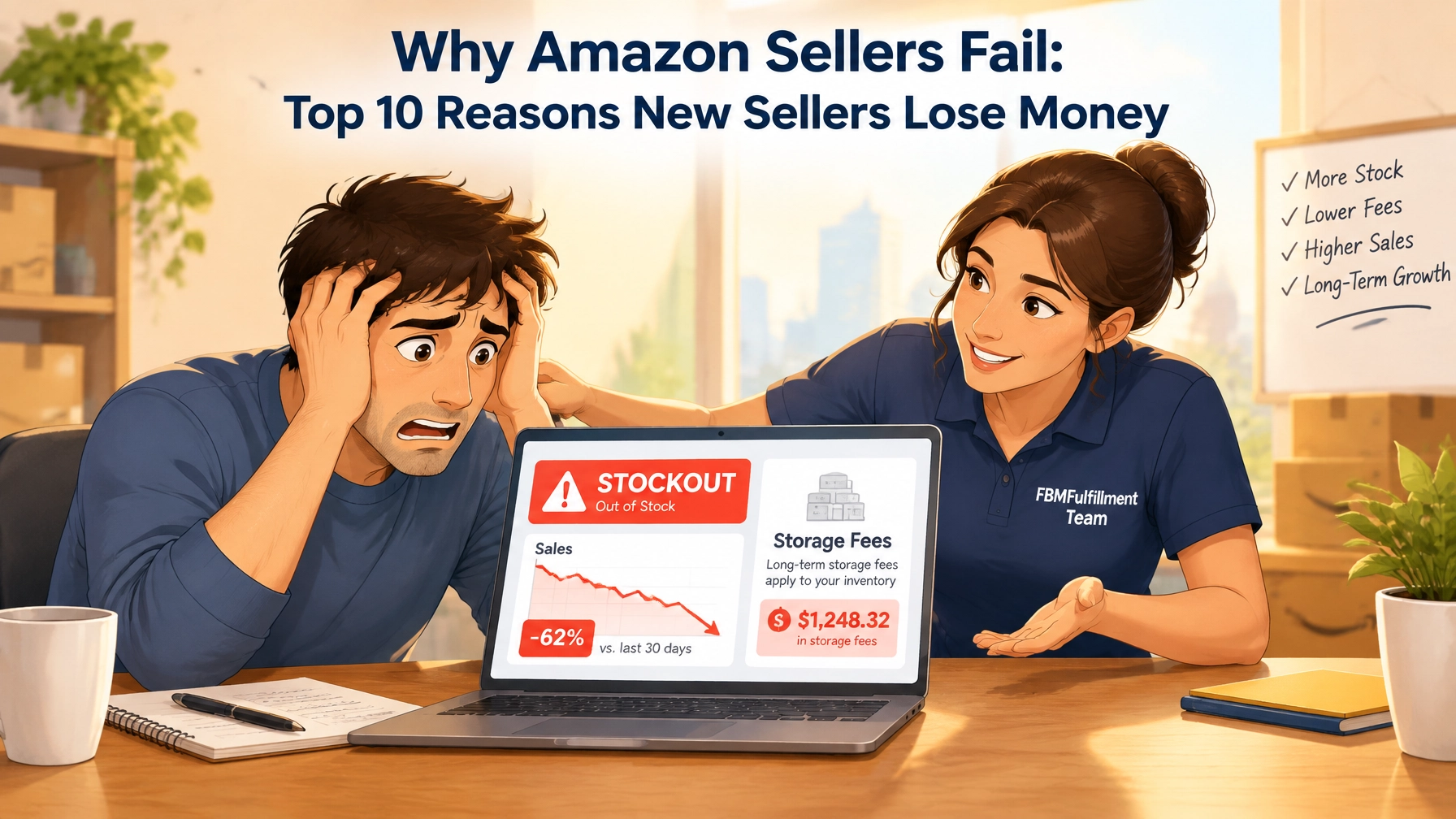

Amazon inventory limits are not just a storage problem. They can turn profitable SKUs into stranded cash, force rushed removal decisions, and leave your best-selling listings exposed to stockouts. Inventory recovery after Amazon limits means getting product out of the wrong place, into a controlled fulfillment position, and back into the right sales channels without creating a second operational problem.
The sellers who recover fastest do not treat Amazon’s limits as a one-time disruption. They build a process that separates sellable inventory from slow stock, protects listing momentum, and gives them somewhere reliable to hold inventory while they decide what to replenish next.
Why Amazon limits create a recovery problem
When Amazon restricts FBA capacity, the immediate instinct is often to send less inventory or create removal orders for everything that will not fit. Both moves can be expensive if they are made without a plan.
Sending too little can cause a stockout before the next inbound shipment is received and checked in. Sending everything back to your own location can create receiving delays, lost carton visibility, and a pile of inventory with no channel strategy. Leaving inventory inside FBA can also mean continued storage charges while your available capacity remains constrained.
The real issue is that Amazon limits remove flexibility at the same time your business needs it most. Your inventory may still be healthy, demand may still be there, and your listings may still convert. But if product is trapped in a slow receiving cycle or spread across fulfillment centers you cannot control, your ability to respond becomes limited.
A recovery plan should answer three questions quickly: What inventory should leave Amazon? Where will it go? How will it keep producing revenue once it arrives?
Start inventory recovery after Amazon limits with the numbers
Do not create removal orders based on frustration alone. Start with a SKU-level view of inventory across Amazon, your warehouse, inbound shipments, returns, and other sales channels. The goal is to understand your actual position, not just the units shown as available in Seller Central.
For each SKU, compare recent daily sales velocity, current FBA available units, reserved units, inbound units, estimated removal timing, storage cost, and gross margin. A high-velocity SKU with a short coverage window deserves a different decision than a product that has been sitting for 120 days.
This is where many brands find a painful gap. Their inventory reports tell them how many units exist, but not which units are truly deployable. Inventory marked as reserved, being transferred, receiving, or under investigation cannot protect a listing from a stockout. Treat it as unavailable until it is physically ready to ship.
Classify inventory by action, not just by SKU
A practical recovery process uses action groups. Fast sellers need protected replenishment coverage. Stable sellers need enough off-Amazon inventory to support the next shipment cycle. Slow sellers need a decision on whether to sell through, redirect to another channel, bundle, liquidate, or hold.
Do not use the same replenishment rule for all three groups. A single blanket decision, such as removing all overstock or stopping every FBA shipment, creates more risk than it removes.
For example, a SKU selling 25 units per day may justify a small, frequent FBA replenishment flow even when capacity is tight. A product selling two units per day with shrinking margins may be better positioned for direct-to-consumer sales, marketplace fulfillment, or a controlled clearance strategy.
Choose a recovery destination before creating removals
A removal order is only the first leg of recovery. The destination matters as much as the decision to remove the inventory.
Product sent to a garage, office, or unprepared local facility often creates a new set of problems: carton damage, missing units, no receiving record, delayed order processing, and poor inventory accuracy. That may be manageable for a few cartons. It is not a serious recovery strategy for a growing catalog.
A 3PL that understands Amazon removals can receive returned FBA inventory, count and inspect it, identify damage or discrepancies, and place sellable units back into available stock. From there, the inventory can support FBM orders, direct-to-consumer orders, wholesale shipments, or future FBA replenishment.
That distinction matters. Recovered inventory should not simply sit in a different warehouse. It should become usable inventory again.
At FBMFulfillment, that usually means receiving removed inventory into a controlled warehouse workflow, reconciling what arrived against what Amazon said was removed, and allocating usable units to the channels that need them most. The objective is operational control, not merely cheaper storage.
Reconcile every removal order
Amazon removal quantities and the units that physically arrive do not always match perfectly. Cartons can arrive in separate deliveries, units can be damaged, and returned merchandise may not be fit to ship without inspection. If you assume every removed unit is immediately sellable, your inventory records will drift quickly.
Build reconciliation into the recovery process. Match each removal order to inbound deliveries, count received units by SKU, document visible damage, and separate sellable, repairable, and unsellable inventory. If there is a shortage, you need clear records before it becomes difficult to trace.
This process is especially important for brands removing a large volume of mixed SKUs. A receiving error on one carton may not seem significant, but repeated discrepancies can distort replenishment decisions and cause avoidable stockouts weeks later.
Use off-Amazon inventory to protect revenue
The strongest response to Amazon limits is not abandoning FBA. It is reducing dependence on a single inventory location.
Keep a working inventory buffer outside Amazon that can serve multiple purposes. It can replenish FBA in smaller batches, fulfill Amazon FBM orders when FBA coverage gets thin, support Shopify or Walmart orders, and provide a fallback if inbound receiving runs late. This buffer should be sized around demand, lead times, and product economics, not a generic percentage of your total stock.
For fast-moving SKUs, drip-feed replenishment is usually more effective than sending one large inbound shipment and hoping capacity remains available. Smaller, planned deliveries help you preserve FBA availability without putting too much stock into Amazon’s network at once.
There is a trade-off. More frequent replenishment can increase handling and freight activity. But for products with strong margins and high sales velocity, those costs may be far lower than the cost of a stockout, lost ranking, or emergency air freight.
Put customer experience ahead of channel loyalty
If FBA inventory becomes constrained, do not let Amazon become the only path to the customer. Seller Fulfilled Prime eligible brands, established FBM operators, and multichannel sellers have an advantage because they can shift fulfillment without waiting for Amazon inventory to become available.
That does not mean every product should move to FBM. Shipping costs, delivery promises, product size, return rates, and operational capacity all matter. A low-margin oversized item may not work economically for merchant fulfillment. A compact, high-margin SKU with reliable warehouse coverage often can.
The right model is often hybrid. Keep enough FBA stock to preserve Prime conversion where it makes sense, while holding the rest in a warehouse that can replenish Amazon and fulfill other orders. This approach prevents one Amazon policy change from putting your entire catalog at risk.
Prevent the next limit from becoming another emergency
Recovery is useful only if it changes the way inventory is managed afterward. Set reorder points based on usable inventory across all locations, not just the FBA available figure. Review sell-through weekly for constrained categories. Watch inbound receiving time, storage exposure, aged inventory, and the number of days of coverage for top SKUs.
Most importantly, give every unit a role before it arrives in the country or leaves your supplier. Some units are allocated for FBA, some for direct fulfillment, and some for wholesale or promotional demand. When inventory has an assigned purpose and a controlled storage location, Amazon limits become a planning variable instead of a revenue-threatening surprise.
The best recovery move is the one that leaves you with more options than you had before. Keep your inventory where you can see it, allocate it, and move it when demand changes. That is how a limit becomes a manageable constraint instead of a crisis.
Key Takeaways
- Amazon inventory limits can hinder sales and create operational challenges, leading to stranded cash and stockouts.
- Effective inventory recovery after Amazon limits requires a solid process that distinguishes between sellable inventory and slow stock.
- Analyze SKU-level data instead of rushing to create removal orders, as careful assessment prevents future stock issues.
- Use off-Amazon inventory strategically to protect revenue and maintain product availability across various sales channels.
- Implement a hybrid fulfillment approach to balance FBA stock with other inventory, enhancing resilience against policy changes.
Related Links
- What an Ecommerce 3PL Warehouse Should Do
- How to Lower Fulfillment Costs Without Slowing Down
- Amazon FBM Fulfillment Service Explained
- Choosing a 3PL for a Growing Ecommerce Brand
- How to Manage Ecommerce Returns Without Losing Margin