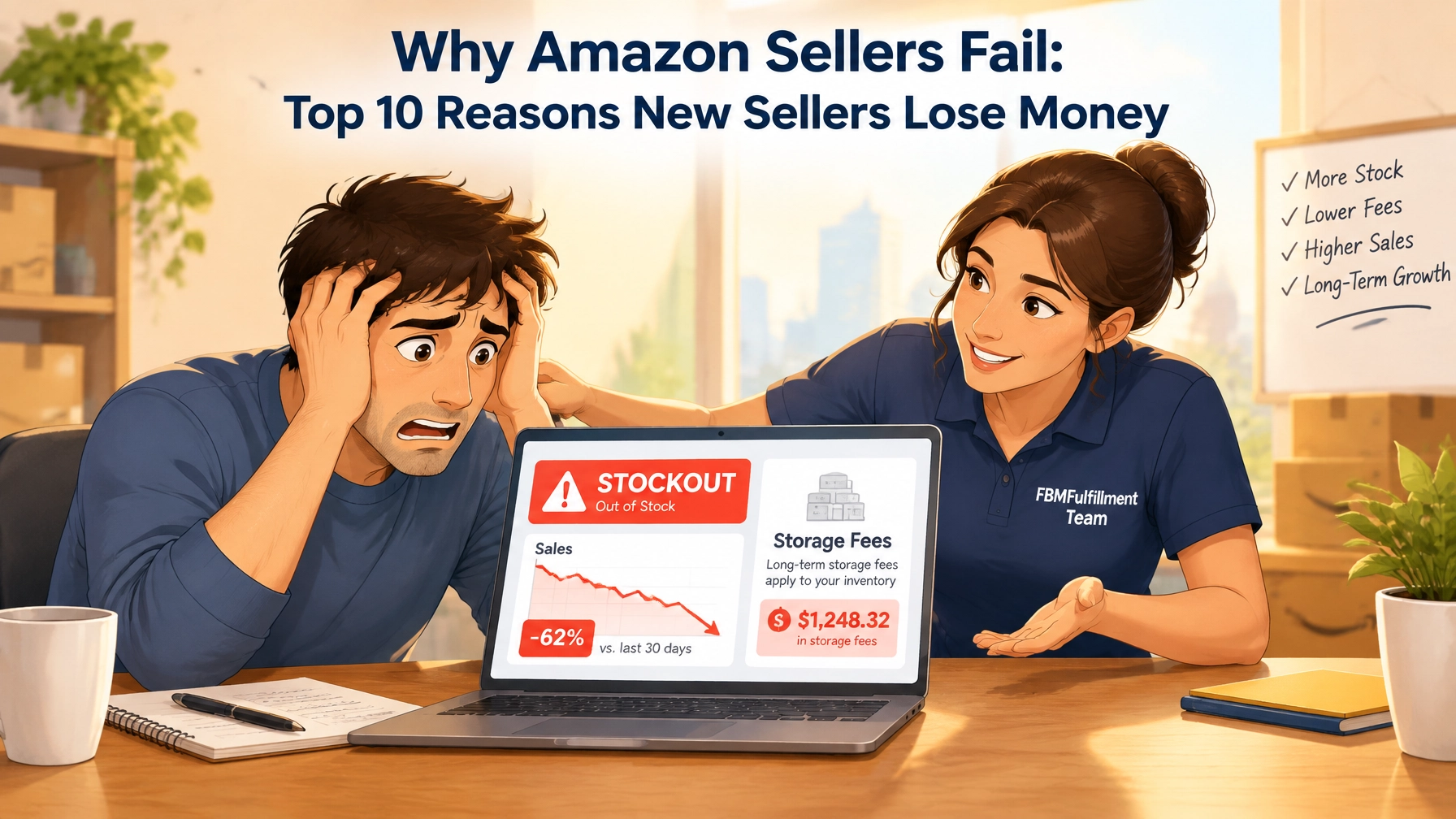
You launched. It did not work. Sales were slow, margins disappeared, and the inventory you expected to turn quickly started consuming cash.
That is why Amazon sellers fail: not because of bad luck, but because preventable operational mistakes compound quickly. After 13 years selling through both FBM and FBA, we have seen the same pattern repeatedly. Sellers choose undifferentiated products, underestimate landed cost, skip quality control, launch without a plan, and then lose control of inventory. Many new Amazon sellers fail for the same operational reasons, again and again.
The solution is disciplined execution before the first purchase order.
How Many of These Are You Guilty Of?
Use this quick self-audit:
- Are you selling a generic product that is identical to dozens of established listings?
- Did you calculate landed cost, Amazon fees, freight, duty, returns, and advertising before placing your purchase order?
- Did you complete a third-party pre-shipment inspection?
- Were your listing, images, PPC campaigns, and review strategy ready before launch?
- Did you plan for Brand Registry before your first inventory arrived?
- Did you send too much inventory directly to FBA?
- Do you have a documented replenishment plan before your first stockout?
- Did your first order consume nearly all available cash?
- Are you monitoring account health and Amazon policy requirements every week?
- Are you relying on passive-income expectations instead of operating a real business?
If you answered yes to even two or three, your risk is already measurable.
Why Amazon Sellers Fail: The Ten Preventable Mistakes
1. No Product Differentiation , Selling a Commodity Into a Price War
Product research tools make it easy to find products with demand. They also make it easy for hundreds of sellers to find the same products.
A new seller sees a popular yoga mat or garlic press, sources an identical unbranded unit from an overseas supplier, and assumes demand will create sales. It will not. Established listings already have thousands of reviews, stronger conversion history, better supplier pricing, and automated repricing systems.
When sales stall, the new seller cuts price. Competitors respond. Margin disappears.
The solution is differentiation before sourcing:
- Create a meaningful bundle.
- Improve materials or construction.
- Offer a unique size, colorway, or configuration.
- Upgrade packaging and instructions.
- Build a real brand story.
- Negotiate exclusivity terms with the factory.
- Solve a customer complaint found repeatedly in competitor reviews.
If you cannot explain why a buyer should choose your product over the top three listings, do not place the order yet. This is one of the earliest points where why Amazon sellers fail becomes painfully obvious.
2. Insufficient Margin , Paying Too Much for the Wrong Economics
Revenue is not profit.
Your real cost includes the product, packaging, freight, customs duty, inbound placement fees, referral fees, FBA fulfillment fees, storage, aged-inventory surcharges, returns, and advertising. New sellers frequently omit freight and duty from their calculations, even though those costs materially change the final unit economics.
MOQ also affects margin. A larger order may reduce unit cost, but it ties up cash and increases storage exposure. A smaller order may carry a higher unit cost but provide better validation.
Before issuing a PO, build a SKU-level P&L using:
- Factory unit cost
- Packaging and labeling
- Freight and duty
- Inspection and prep
- Amazon fees
- Expected PPC spend
- Return and defect assumptions
- 3PL storage and fulfillment costs
- Currency and payment fees
Launching below roughly a 30% margin before ad spend creates a precarious business. Model fee increases and weaker-than-expected conversion, not only today’s best-case numbers. Thin economics are another major reason why Amazon sellers fail even when unit sales look encouraging on the surface.
3. Poor Product Quality , No Final Inspection Before Shipment
A factory QC report can look acceptable while production-run units vary from the approved sample. First-article quality does not guarantee mass-production quality.
Common failures include:
- Material substitutions
- Inconsistent dimensions
- Broken components
- Incorrect colors
- Weak packaging
- Missing accessories
- Damage during international transit
A defect discovered at the factory is inexpensive to correct. The same defect discovered in Jacksonville becomes a return, a refund, a negative review, and potentially unsellable inventory.
Use a written specification sheet with tolerances, retained samples, and a third-party pre-shipment inspection. When units arrive at a fulfillment center, defective returns should be inspected and quarantined, not automatically placed back into sellable inventory.

4. No Sophisticated Launch Strategy , Weak Listing, Images, PPC, and Reviews
Amazon gives a new listing a limited opportunity to generate performance data. The initial honeymoon window is approximately 14–30 days, depending on the product and account circumstances.
Many sellers waste it by launching before the listing is ready.
A launch checklist should include:
- Listing quality: Use relevant keywords naturally in the title, bullets, description, A+ content, and backend search terms.
- Professional images: Include a compliant main image, lifestyle photography, infographics, scale references, and video where appropriate.
- Structured PPC: Separate exact, phrase, and broad campaigns. Add negative keywords. Set a daily budget and monitor spend rather than turning campaigns off or allowing them to burn hundreds of dollars unmonitored.
- Compliant review velocity: Use permitted Amazon programs and follow-up methods. Never manipulate reviews or arrange family-and-friends purchases.
AI tools can help with research, content drafts, and workflow organization, but they do not replace judgment. Sellers exploring AI workflows can review Marblism, then verify every output against customer needs, Amazon policies, and actual margin data.
5. No Brand Registry , Fighting With One Hand Behind Your Back
Brand Registry is not a decorative marketing feature. It provides important operating tools and protection.
Without it, you may lack access to:
- A+ Content
- Sponsored Brands
- Sponsored Display
- Enhanced brand analytics
- Stronger brand protection tools
- Better defenses against listing changes and counterfeit activity
Brand Registry requires a live registered trademark, and that process takes time. The mistake is waiting until the first product launches, or until another seller attacks the listing.
File the trademark during product development. Treat brand protection as part of the launch timeline, not a repair project.
6. Overstock at FBA , Paying Amazon to Hold Slow Inventory
Shipping the entire factory MOQ directly to FBA feels efficient. It often creates a storage-fee trap.
Slow-moving units generate monthly storage charges, aged-inventory surcharges, and removal costs. Excess inventory also traps working capital that could have funded PPC, a better listing, or the next purchase order.
You have a problem: you need inventory available for Amazon, but sending six months of supply into FBA creates unnecessary cost and loss of control.
We have a solution: hold the bulk of your inventory at a 3PL and send smaller replenishment quantities into FBA based on real sales velocity.
This allows you to maintain Amazon availability without paying FBA storage charges on inventory that will not sell for months. For many operators, this is exactly why Amazon sellers fail: they confuse sending more inventory with managing inventory correctly.
7. Stockout , Losing Rank, Buy Box Eligibility, and Momentum
A stockout is more than a temporary sales interruption. It can damage keyword ranking, reduce conversion history, affect Buy Box performance, and force you to spend more on advertising when inventory returns.
The two inventory timelines are different:
- Factory to 3PL: Long and variable. It includes production time, inspection, freight, customs, and receiving.
- 3PL to FBA: Shorter and more predictable. It requires a smaller operational buffer.
Your reorder point must account for lead time, daily sales velocity, safety stock, open purchase orders, and seasonal demand. Do not wait until FBA shows only a few days of supply.
FBMFulfillment’s FBA Replenishment Module supports 7–10 day replenishment cycles, with FedEx 2Day shipping from Jacksonville and direct-to-DC shipping where appropriate. Inventory is held in a single inventory pool that can support Amazon, Shopify, TikTok Shop, Walmart, eBay, and Etsy.
That structure prevents you from maintaining separate, disconnected inventory silos for every channel.
8. Running Out of Cash , The FBA Cash Flow Trap
FBA sellers often pay for inventory, freight, and inbound costs months before the product sells. A first order can consume the entire available budget, leaving nothing for photography, PPC, customer service, or replenishment.
Protect cash flow through:
- Staged purchase orders
- Negotiated payment terms
- MOQ tiers
- Conservative first orders
- A reserve for advertising and reorders
- Post-pay fulfillment invoicing where available
For qualified startup clients, FBMFulfillment offers policies designed to preserve working capital:
- Minimums waived for 12 months
- No onboarding fees
- Month-to-month contracts
- Enterprise-level pricing and shipping rates
- Free coaching through Ecommerce Academy and in-person support
- Strategic warehouse locations
- World-class technology
- Post-pay invoicing
We are selective. A seller needs a well-thought-out plan and reasonable expectations because a client’s failure is costly for both sides.
9. Ignoring Amazon Policy and Account Health Metrics
Amazon protects the customer experience and enforces its policies without negotiating around preventable mistakes.
Common account-health problems include:
- Review manipulation
- Family-and-friends purchases
- Inauthentic inventory claims
- Packaging or prep failures
- Suppressed listings
- Late shipments
- Order Defect Rate drifting toward the suspension threshold
- Missing invoices or compliance documents
Monitor Account Health weekly. Keep supplier invoices, inspection reports, product specifications, and compliance records organized. Never buy reviews, fabricate orders, or use tactics that violate Amazon’s terms.
Policy compliance is an operating cost. Budget time for it just as you budget freight and advertising.
10. The Get-Rich-Quick Mindset , and Surrendering Inventory Control
Amazon is not passive income. It requires continuous learning, administration, customer service, forecasting, and long-term brand development.
Unrealistic expectations cause sellers to quit when:
- A shipment is delayed
- PPC takes longer to optimize
- A competitor lowers price
- Amazon changes a fee
- A listing is suppressed
- The first product requires improvement
There is also a structural control problem with going FBA-only. Your inventory becomes concentrated in one platform, your ability to sell through other channels is limited, and returns may not receive the inspection and quarantine process your brand requires.
A hybrid model gives you more options. An independent inventory pool allows you to fulfill Shopify, TikTok Shop, Walmart, eBay, Etsy, wholesale, and Amazon FBM orders while replenishing FBA when needed.
That operating flexibility is a central reason why Amazon sellers fail when they depend entirely on one fulfillment channel.
How Do Freight, Customs, and Lead Times Affect Profit?
International freight planning belongs in the P&L from the beginning. A low factory price is irrelevant if freight, duty, delays, and minimum order quantities destroy your landed cost.
For freight forwarding, we recommend ExFreight.com. Accounts are available to businesses established in the United States, Canada, the European Union, Australia, Korea, and Japan, as well as businesses in other countries with a U.S. entity.
Non-U.S. sellers should also plan importer-of-record requirements before the shipment leaves the factory. Clearit.com can assist with non-resident importer setup, with no account setup or NRI registration fee through the referenced program.
Do not confuse international transit time with domestic inbound deadlines. Amazon inbound dates refer to domestic arrival deadlines for SPD or LTL shipments departing from a U.S. warehouse or 3PL. They do not apply to international shipments traveling directly from an overseas factory.
You Have a Problem. We Have a Solution.
Most warehouses will not take a new seller. Only a small percentage of 3PL providers, often cited as approximately 3%–5%, actively accept early-stage accounts. The providers that do may bury you in minimums, onboarding charges, hidden fees, and long-term contracts.
FBMFulfillment does the opposite for qualified startups. We offer a lower-friction path while remaining selective because your success and ours are connected.
The right fulfillment provider is not a commodity purchase. It is a long-term business partnership. Think of it less like ordering a shipping label and more like choosing a business partner, you should not rush into a relationship based on a flashy promise.
Move substantive conversations from email to a video call or an in-person meeting. Ask how inventory is received, counted, inspected, replenished, returned, and billed. Avoid gimmicks, hidden fees, vague service commitments, and contracts that make it difficult to leave.
A dependable 3PL should help you protect margin, shorten lead times, control inventory, and build a business that can operate across channels. If you already understand why Amazon sellers fail, the next step is building systems that prevent those failures before they become expensive.
Key Takeaways
- Differentiate the product before placing the purchase order.
- Calculate landed cost and total Amazon fees before setting a price.
- Maintain at least approximately 30% margin before ad spend.
- Use third-party inspection and retain approved samples.
- Prepare the listing, images, PPC, and review strategy before launch.
- File for Brand Registry during product development.
- Keep bulk inventory at a 3PL instead of sending the entire MOQ to FBA.
- Use a replenishment plan based on lead times and sales velocity.
- Protect cash for advertising and the next purchase order.
- Monitor account health and Amazon policy compliance weekly.
- Maintain a single inventory pool across channels where possible.
- Choose a fulfillment partner for long-term operational support, not a temporary discount.
Related Links
Frequently Asked Questions
The most common root problem is poor unit economics. Sellers choose undifferentiated products, underestimate landed cost and advertising, and discover too late that sales volume does not create profit. In practical terms, why Amazon sellers fail usually comes back to bad economics combined with weak operational control.
There is no universal number. Your required capital depends on product cost, MOQ, freight, duty, photography, PPC, packaging, lead times, and cash reserves. Build a complete launch budget before ordering inventory.
Track sales velocity, days of supply, open purchase orders, factory lead times, domestic replenishment time, and safety stock. Keep bulk inventory in a controlled 3PL location and replenish FBA before the remaining supply becomes critical.
It can be, especially for slow-moving inventory, seasonal inventory, and units that remain in storage long enough to generate aged-inventory surcharges. Compare the full FBA storage and removal cost with a 3PL storage and replenishment model.
Yes, if you are building a real brand. Brand Registry supports A+ Content, Sponsored Brands, brand protection, and stronger control over listing assets. Begin the trademark process early because registration takes time.
A new seller should generally avoid launching with less than approximately 40% margin before advertising. Your actual target should reflect returns, PPC, storage, freight changes, and unexpected operational costs.
Many sellers benefit from using both. You can utilize FBM without FBA but you should not use FBA alone unless your replenishment time is less than 4 weeks. Overstocking FBA can be devestatingly expensive and cause failure. FBA can support marketplace delivery expectations, while a 3PL provides inventory control, multichannel fulfillment, returns management, and replenishment flexibility.
There is no guaranteed timeline. Ranking depends on relevance, conversion rate, sales velocity, reviews, price, fulfillment performance, and advertising. The first approximately 14–30 days are especially important for collecting performance data.
The honeymoon period generally refers to the first approximately 14–30 days when a new listing may receive an opportunity to generate sales and performance data. It is not a guaranteed ranking boost, so launch preparation matters.
Do not spend the entire budget on the first inventory order. Reserve money for PPC, photography, freight changes, customer service, and replenishment. Negotiate payment terms, use staged POs, and evaluate post-pay fulfillment options.