
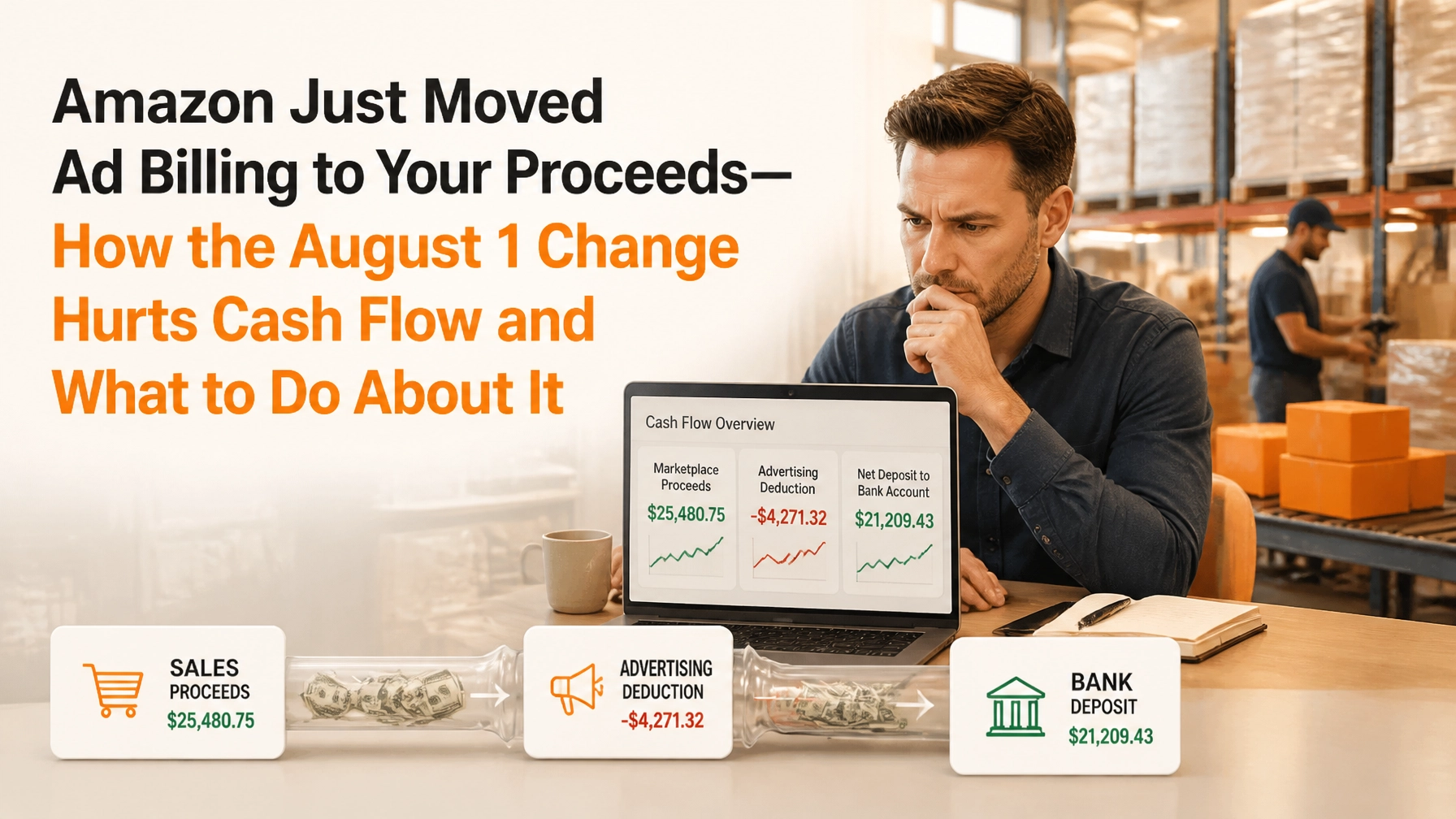
Amazon is changing when it collects advertising costs. As of August 1, 2026, a subset of affected sellers moved from credit card billing to automatic deduction from seller proceeds. This amazon advertising billing change means ad spend is netted against your available account balance before disbursement. Credit cards now serve as a secondary backup when the balance cannot cover the charge.
The advertising expense itself is not the only issue. The timing of the deduction is the issue. When advertising costs reduce your payout before it reaches your bank account, working capital becomes tighter : especially before Q4 inventory purchases.
What does the amazon advertising billing change mean for sellers?
The August 1 update applies to sellers Amazon notified directly. If your account is included, the primary payment structure now works as follows:
- Seller proceeds are deducted first.
- Credit cards remain on file as backup funding.
- Pay by Invoice remains available for eligible advertisers.
- Invoice customers receive 30-day payment terms.
Under the prior structure, many sellers used a credit card as the primary payment method. That created a payment gap between ad spend and the card payment due date. Sellers could use that timing flexibility to purchase inventory, pay staff, cover freight, or fund additional marketing.
That flexibility is now reduced.
Under the new amazon advertising billing model, your advertising costs are deducted from available proceeds before Amazon disburses the remaining amount. If your balance is insufficient, Amazon can charge the backup payment method so campaigns continue running.
The policy followed months of seller backlash. A reported seller ad boycott in April 2026 protested earlier payment policy changes and the loss of credit card float. Amazon later moved the implementation date to August 1.
Read the published cash flow analysis from Slope.
Why does proceeds deduction create an amazon seller cash flow problem?
This is not simply a story about Amazon charging too much.
It is a cash timing problem.
Consider a simple example:
- Scheduled Amazon proceeds: $10,000
- Monthly advertising spend: $4,000
- Remaining proceeds before other deductions: $6,000
The seller still generated $10,000 in proceeds and still spent $4,000 on advertising. But under proceeds deduction, only the remaining balance reaches the bank account during disbursement.
That difference matters when your next obligations are immediate.
- A supplier requires a deposit.
- A freight invoice arrives.
- Q4 inventory must be purchased.
- Payroll is due.
- A product launch requires more advertising.
- A return or chargeback reduces the next payout.
The seller’s profit and loss statement may look acceptable while the bank account becomes precarious. Revenue does not equal available cash.
This is why amazon seller cash flow must be monitored by timing, not only by monthly profitability. Track when money leaves Amazon, when it arrives in your bank account, and when your inventory purchases become due.

What should you check in your Amazon account?
Do not assume that every seller received the same treatment. Amazon’s August 1 update applies to a subset of affected advertisers.
Complete these checks immediately:
-
Review the notice from Amazon Ads.
Confirm whether your account is included in the proceeds deduction rollout. -
Open your advertising billing settings.
Verify whether your account shows proceeds deduction, credit card backup, or Pay by Invoice. -
Confirm your backup card is valid.
A declined backup card can interrupt campaigns when proceeds are insufficient. -
Review your disbursement reports.
Compare advertising charges with the amount ultimately deposited in your bank account. -
Build a weekly cash forecast.
Include advertising spend, inventory purchases, freight, fulfillment, payroll, returns, and expected Amazon disbursements. -
Separate ad performance from cash availability.
A campaign can produce sales and still create a working capital problem if the proceeds are consumed before your next inventory order.
The practical goal is simple: know exactly how much cash is available outside Amazon before increasing ad spend.
Should you choose Pay by Invoice?
Pay by Invoice remains an available alternative for eligible sellers. Under this arrangement, Amazon issues an invoice and provides 30-day payment terms.
That structure can preserve more timing flexibility than immediate proceeds deduction. However, eligibility is account-specific, and sellers must confirm whether the option is available in their advertising billing settings.
Pay by Invoice is not a reason to ignore cash planning. It simply changes the payment date. You still need enough cash to satisfy the invoice when it becomes due.
Before selecting an alternative, compare:
- Monthly advertising spend
- Expected Amazon disbursement schedule
- Supplier payment dates
- Credit line availability
- Q4 inventory requirements
- Available operating reserve
- Backup payment methods
If Pay by Invoice is available and fits your operating cycle, enable it before assuming that credit card billing will continue as the primary method.
How can sellers protect cash before Q4?
The strongest defense is not stopping advertising blindly. It is controlling the parts of the business that create unnecessary cash pressure.
1. Create an independent operating reserve
Do not fund every inventory purchase from the next Amazon payout. Keep a separate reserve for:
- Replenishment orders
- Freight and receiving
- Advertising deductions
- Returns
- Unexpected marketplace holds
- Seasonal demand
The size of the reserve depends on your sales volume and purchasing cycle. The important principle is independence. Your business should not become over-leveraged to Amazon disbursements.
2. Audit advertising by contribution margin
A campaign that generates revenue can still consume too much working capital.
Review:
- Advertising cost of sales
- Contribution margin after fulfillment
- Inventory cost
- Return rate
- Conversion rate
- Reorder timing
- Cash consumed per incremental sale
Reduce or pause campaigns that produce revenue without enough contribution margin to fund the next inventory cycle.
3. Reduce inventory trapped in one channel
Excessive dependence on FBA can create additional pressure when your proceeds are already being reduced by advertising deductions. A more controlled model uses a single inventory pool to support Amazon FBM, Shopify, Walmart, TikTok, eBay, Etsy, and wholesale orders.
That model gives you more control over where inventory is allocated and how quickly it can generate cash across channels.
4. Use predictable replenishment instead of emergency transfers
An emergency FBA shipment can create rush labor, rushed freight decisions, and poor cash allocation. A planned FBA Replenishment Module gives sellers a more structured way to move inventory from a fulfillment warehouse into FBA.
FBMFulfillment’s FBA Replenishment Module supports predictable 7 to 10 day replenishment, shipment visibility, and tighter control over the inventory held outside Amazon. That matters when your advertising deductions are already reducing the proceeds available for new purchases.

How can 3rd party fulfillment services improve operating control?
A fulfillment strategy can directly affect cash timing.
With the right 3rd party fulfillment services, you can keep inventory outside Amazon until demand requires replenishment. You can also fulfill orders from one controlled inventory pool rather than committing every unit to FBA in advance.
That approach supports:
- Lower dependence on Amazon disbursement timing
- Better inventory possession control
- Multi-channel fulfillment from one stock pool
- Same day order processing
- Predictable FBA replenishment
- More direct return management
- Better visibility into available inventory
FBMFulfillment provides same day fulfillment and reliable FedEx 2Day delivery from its Jacksonville, FL operation. The company offers no onboarding fees and no minimums, making it easier to test a controlled fulfillment model without adding another large upfront cash requirement.

What is the FBMFulfillment solution?
You have a problem: Amazon advertising deductions reduce the cash reaching your bank account before Q4 inventory purchases are due.
We have a solution: keep more inventory control outside Amazon and replenish FBA according to a predictable plan.
FBMFulfillment was built from the ecommerce seller’s viewpoint. The goal is not to eliminate Amazon. The goal is to prevent your business from becoming dependent on one marketplace for inventory possession, fulfillment, returns, and operating cash.
The FBA Replenishment Module supports a deliberate hybrid model:
- Store inventory in a controlled fulfillment warehouse.
- Use the same inventory pool for multichannel orders.
- Replenish FBA based on planned demand.
- Maintain visibility into available stock.
- Keep cash tied to inventory only when the channel requires it.
This gives sellers another operating option as Amazon changes billing, payment, and fulfillment policies.
What should you do now?
Start with a cash flow audit before changing your advertising strategy.
- Confirm whether the August 1 billing update applies to your account.
- Check whether Pay by Invoice is available.
- Verify your backup card.
- Recalculate weekly Amazon disbursements.
- Separate advertising performance from cash availability.
- Protect an independent operating reserve.
- Review how much inventory is committed to FBA.
- Evaluate a controlled replenishment process.
- Compare 3rd party fulfillment services before Q4 demand accelerates.
The central lesson is straightforward: Amazon is changing the collection timing for advertising, not merely changing an expense line. Sellers who depend entirely on marketplace proceeds will feel the impact first.
Sellers with independent cash reserves, disciplined ad spending, a controlled inventory pool, and a reliable FBA Replenishment Module have more room to operate.
For help reviewing your fulfillment and replenishment strategy, contact FBMFulfillment. We will be glad to help.
Key Takeaways
- As of August 1, 2026, Amazon changes the timing of advertising costs, moving to automatic deductions from seller proceeds.
- This new amazon advertising billing structure can tighten working capital, especially before Q4 inventory purchases.
- Sellers should audit their cash flow, verify backup payment methods, and monitor advertising expenses against available cash.
- Options like Pay by Invoice can offer flexibility, but sellers must plan cash availability carefully.
- FBMFulfillment provides solutions to improve inventory control and cash flow management amidst these changes.