You’re scaling. Your Shopify orders are spiking, TikTok Shop is finally humming, and your Amazon FBM listings are moving. You need a fulfillment partner, so you go searching. Suddenly, a “consultant” or a “referral agency” appears, promising to find you the “perfect warehouse” at no cost to you. Sounds like a win, right? Wrong.
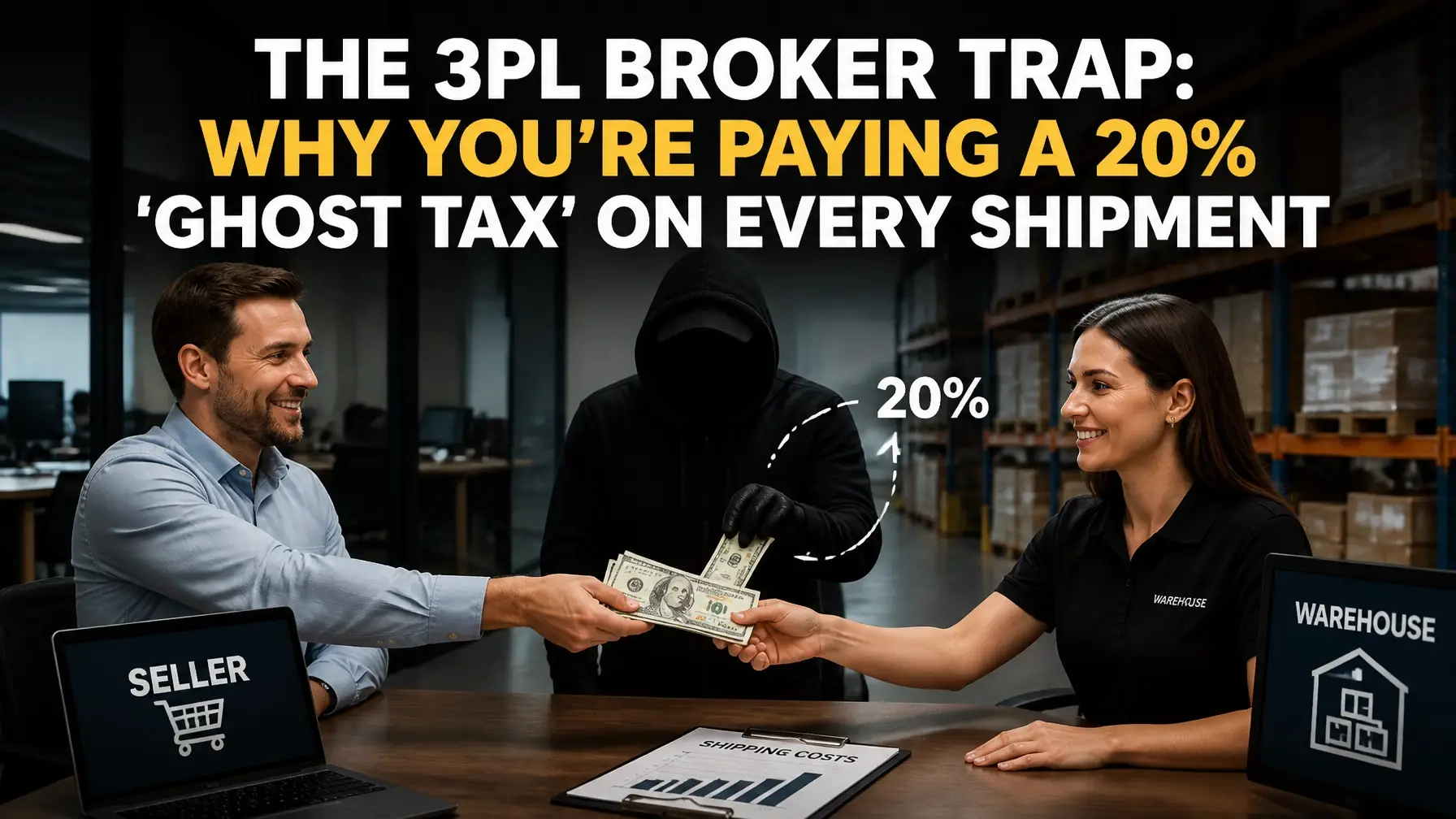
In the world of logistics, there is no such thing as a free lunch. If you aren’t paying the middleman a flat fee upfront, you are likely walking straight into a trap where you’ll pay a “Ghost Tax” on every single order you ship. Understanding the 3PL middleman risks is the difference between a profitable Q4 and a year spent wondering where your margins vanished.
What is a 3PL Middleman (and Why Should You Care)?
A 3PL broker or referral agency is essentially a matchmaker that doesn’t own a single square foot of warehouse space. They don’t have forklifts, they don’t have a crew, and they’ve never personally taped a box. They are sales organizations that sit between you and the actual asset-based warehouse.
The problem isn’t that they exist: it’s how they are paid. Most of these agencies operate on a “revenue share” or “commission” model. They refer you to a warehouse, and in exchange, the warehouse pays them a percentage of your monthly spend. Forever. To cover that commission, the warehouse often inflates your rates. You think you’re paying market price, but you’re actually subsidizing a kickback. Knowing what to look for in a 3PL means knowing who actually owns the building.
The 20% ‘Ghost Tax’ Explained

When you work through a broker, your invoice is rarely transparent. You might see a “Pick and Pack” fee of $2.50. What you don’t see is that the warehouse is actually charging $2.00, and the middleman is skimming $0.50 off the top. This is the Ghost Tax.
And yes, the ads are getting slicker.
Lately, middleman platforms have been running versions of the same pitch over and over:
- “Pre vetted 3PLs”
- “Real pricing in minutes”
- “Free matching”
- “At no cost to your brand”
- “Need a backup plan?”
Sounds clean. Sounds safe. Sounds efficient. That is exactly why it works.
What These 3PL Middleman Ads Really Look Like
Companies in this category, including platforms using hooks like those seen from Fulfill4us, WareLink, fulfilment.com, and 3PL Bridge, usually sell the same story with different design templates:
- We already vetted the warehouses for you
- We can show you pricing fast
- We are free to use
- You need options and a backup plan
- Your current 3PL is probably overbilling you anyway
Founder to founder, here’s the problem: none of that means they are aligned with your margin.
“Pre Vetted 3PL” Usually Means “They Agreed to Pay Us”
This is one of the biggest 3PL middleman risks in the market right now.
When a broker says a warehouse is “pre vetted,” that sounds like a hard operational standard. You picture site audits. SLA reviews. Inventory accuracy verification. Client reference checks. Real due diligence.
Sometimes some of that happens. But very often, “pre vetted” also conveniently means the warehouse joined the broker’s network and accepted the referral economics. In plain English: they agreed to pay to play.
That matters. A lot.
Because the moment the platform gets paid only when it places you, the incentive shifts:
- They are not rewarded for sending you to the cheapest competent operator
- They are not rewarded for telling you to stay where you are if your current setup is fine
- They are rewarded when a deal closes
- They are rewarded more when spend is higher and the warehouse can support the commission structure
That is not neutral advice. That is lead generation wearing a logistics costume.
“Real Pricing in Minutes” Is Usually Not Real Pricing
Another favorite hook in these ads is “real pricing in minutes” or “instant quotes.” It sounds amazing until you think about how fulfillment pricing actually works.
Real fulfillment pricing depends on:
- SKU dimensions
- Weight breaks
- Order profile
- Multi unit frequency
- Zone distribution
- Return rate
- Receiving cadence
- Storage turns
- Special projects
- Retail compliance work
- Packaging requirements
You do not get true pricing in minutes unless somebody is simplifying the math, skipping ugly line items, or showing you a polished estimate that gets revised later.
Even platforms that advertise fast quote visibility often note that final pricing comes after a call, data review, or custom consultation. That is the tell. The ad sells speed. The contract delivers complexity.
“At No Cost” Is the Oldest Trick in the Book
If a platform promises to find you a warehouse at no cost, you are still paying for it. Just not in a way that is easy to spot.
Where the Markups Hide:
- Shipping Rates: This is the big one. Brokers often have “platform rates” where they add a 10-15% margin on top of FedEx or UPS costs. If you aren’t seeing the original carrier invoice, you’re being taxed.
- Storage Fees: They might quote you a “low” monthly rate, but bake in massive overage penalties that go straight to the agency’s bottom line.
- Account Management Fees: You’re often charged a monthly “support fee” for a middleman who just passes your emails along to the actual warehouse manager.
- Referral Economics Buried in Your Rate Card: The warehouse bakes the broker payout into your pricing model from day one.
- Hidden 20% Markups on Shipping and Storage: This is the part sellers miss. “Free” matching platforms are often monetized by the warehouse side, and that money does not come from thin air. It gets recovered through padded shipping, padded storage, or both.
Given the significant 3PL middleman risks, these “small” markups can easily snowball into a 20% increase in your total fulfillment spend. For a business doing 5,000 orders a month, that’s thousands of dollars a month in pure “Ghost Tax.”
And if you came in through a broker that bragged it was “free,” that 20% markup is often the bill you never realized you signed.
The Communication Game of Telephone

Perhaps the most frustrating of all 3PL middleman risks is the communication breakdown. When you have a crisis: say, an influencer post goes viral and you need to prioritize 1,000 orders: you don’t talk to the guy on the floor. You talk to the broker.
The broker then emails the warehouse. The warehouse manager, who is juggling 50 other clients, gets back to the broker three hours later. The broker then “translates” that message back to you. By the time you get an answer, the shipping cutoff has passed.
Communication is a game of telephone. In a fast-paced ecommerce environment, you need a direct line to the people holding your inventory. At FBM Fulfillment, we built our system from a seller’s perspective precisely to avoid this bureaucratic lag. When you need an answer, you get it from the source.
The White Hat Alternative: Ecommerce Fulfillment Alliance
Here is what the broker model does not want you to notice: there is a better version of national fulfillment that does not require a toll collector in the middle.
The Ecommerce Fulfillment Alliance (EFA) at efa3pl.com is the White Hat alternative.
Instead of a sales office brokering access to warehouses it does not own, EFA is a co op of independent, asset-based operators who work together directly. Think actual warehouse owners. Actual operators. Actual people with forklifts, labor, lease obligations, carrier relationships, and skin in the game.
That is the difference.
Broker Telephone Game vs EFA Direct Access
With a broker network, the communication flow usually looks like this:
- You email the platform
- The platform relays it to the warehouse
- The warehouse replies to the platform
- The platform repackages the answer for you
That is slow. That is diluted. That is dangerous when orders are stacking up.
With the EFA model, you are dealing with the operators themselves:
- You work with the actual warehouse handling your freight
- You have direct access to the real owner or operating team at each node
- If inventory needs to move across the network, the warehouse owners coordinate directly with each other
- Problems get solved by the people with authority, not by a middle layer forwarding emails
That is the opposite of the broker trap.
Big Box Reach Without the Broker Tax
A lot of sellers want national coverage. Fair. You want East Coast reach. West Coast reach. Faster ground zones. Redundancy. Expansion room.
The usual pitch is that you have to go through a giant platform or marketplace to get that footprint. You do not.
The EFA model gives you the national reach people associate with a “Big Box” 3PL, but without losing access to the humans actually running the operation at every node. You are not dropped into a faceless network. You are connected to independent operators who know their facilities, know their labor, and know their numbers.
That means:
- National scale
- Direct owner access
- Asset-based execution
- No middleman markup layered in by a sales office
That last part matters. A lot.
Because when you are dealing with the assets instead of a referral platform, there is no extra broker toll to bury inside shipping and storage. No ghost layer. No mystery commission. No polished intro call followed by padded invoices.
FBM Fulfillment Is a Founding Member of EFA
FBM Fulfillment is a founding member of the Ecommerce Fulfillment Alliance. That matters because it shows exactly how we think about growth.
We do not believe sellers should have to choose between:
- direct access and national scale
- accountability and network reach
- transparent pricing and operational flexibility
Through EFA, we can help provide broader geographic coverage and real operator collaboration without pushing you into the broker model. In other words, you can get scale without the broker tax.
The “Backup Plan” Hook? Another Red Flag.
Some newer 3PL search platforms lean hard on the backup plan scare tactic. The pitch goes something like this: your current warehouse could fail you, peak season could break things, carrier problems could hit, so you need to get inside their platform now and keep a backup ready.
On the surface, that sounds prudent. In reality, it is often a fear based funnel.
Of course you should think about operational redundancy. Smart operators always do. But there is a huge difference between:
- having a real secondary fulfillment strategy, and
- being nudged into a broker ecosystem designed to keep you sourcing, comparing, and switching inside their platform forever
That is where the lock in starts.
Once your relationships, quote history, introductions, and “recommended network” all live inside the middleman layer, you are no longer building direct leverage with the warehouse operators themselves. You are building dependency on the platform. They become the gatekeeper. They control the flow of options. They frame the choices. They sit in the middle of every future move.
That is not a backup plan. That is outsourced control.
A real backup plan looks different:
- You know exactly where your inventory sits
- You know who runs the floor
- You have direct escalation paths
- You understand onboarding timelines before a crisis hits
- You are not relying on a broker to “find” capacity when the market gets tight
Given the serious 3PL middleman risks, fear based ad copy should make you slow down, not speed up.
The Accountability Void: Who Do You Sue?
When 500 units of your best-selling SKU go missing, who is responsible?
- The broker says: “I just made the introduction; it’s the warehouse’s fault.”
- The warehouse says: “We followed the instructions provided by your broker.”
Accountability vanishes when issues arise. Brokers often use “Master Service Agreements” that shield them from any actual liability regarding inventory loss or shipping errors. You are left in a precarious position, fighting a battle on two fronts while your customer reviews tank. This lack of clear ownership is one of the most devastating 3PL middleman risks for a growing brand.
The “40% Invoice Hike” Pain Point Does Not Prove Brokers Are the Fix
You will also see ads built around billing horror stories. One common angle is the sudden invoice spike. A warehouse bills one amount for months, then your invoice jumps 40%, and now a broker wants to swoop in as the adult in the room.
Here is the part they do not say out loud: brokers do not eliminate these billing quirks. They monetize them.
Why? Because the same overpriced, confusing, fee-heavy warehouses are often the very ones that can afford aggressive referral payouts and marketplace participation. If a warehouse has bloated rate cards, padded storage logic, messy accessorials, and constant “exceptions,” it has more room to fund middlemen.
So when a broker uses the pain of a 40% invoice hike in its marketing, ask the obvious question:
Who benefits from keeping sellers trapped in a market full of bad pricing behavior?
Not you.
If anything, a broker layer can make invoice scrutiny worse:
- You may lose direct visibility into base carrier charges
- You may not see the original warehouse pricing assumptions
- You may get a polished comparison that hides ugly accessorial logic
- You may end up in another high rate warehouse that simply pays better referral economics
That is why these billing pain point ads are so slippery. They position the broker as your protector while quietly profiting from the exact warehouse behavior that created the pain in the first place.
That is one more reason 3PL middleman risks are not theoretical. They show up in your invoice. Every month.
How to Spot a Broker Masquerading as a Warehouse
Many referral agencies are getting smarter. They build flashy websites with stock photos of “their” warehouses, but they don’t actually own them. Here are key steps to vet your partner:
- Ask for the Address: If they won’t give you the specific physical address of the warehouse before you sign, it’s a broker.
- Request a Video Tour: Ask to see a live walk-through of the facility. If they can’t produce a manager on the floor within 24 hours, they don’t control the asset.
- Verify the Contract: Is the contract with the warehouse entity or a “Logistics Management” company? If it’s the latter, you’re in the broker trap.
- Check for “National Networks”: Be cautious of companies claiming 20+ locations. Often, these are just loosely affiliated warehouses managed by a central middleman. This is often part of the national warehouse myth that leads to higher complexity and hidden costs.
The Asset-Based Solution: FBM Fulfillment

The alternative is simple: Work with the people who actually do the work.
FBM Fulfillment is an asset-based 3PL. We own the warehouse, we hire the staff, and we manage the technology. There is no “Ghost Tax” here because there is no middleman to pay. When you work with us, your margins stay in your pocket.
And through our role as a founding member of the Ecommerce Fulfillment Alliance, you are not limited to a single isolated building either. You get access to a White Hat network of independent operators working together directly, not a broker platform skimming value off the top.
Why Direct is Better:
- Total Inventory Control: Your stock isn’t stuck in a “network.” It’s in our building, under our eyes.
- Actual 2-Day Delivery: We don’t rely on “platform averages.” We use FedEx 2Day service to ensure your customers get their packages when promised.
- Seller-to-Seller Support: We were ecommerce sellers first. We know the pain of Amazon storage fees and the chaos of TikTok Shop surges. We built our 3PL to solve the problems we actually faced.
- National Scale Without the Sales Office: Through EFA, you can get broader network reach while still dealing with actual asset-based warehouse operators.
- No Middleman Markup: You are dealing with the assets, not a referral layer adding hidden costs to shipping and storage.
Avoid the 3PL middleman risks that sink otherwise healthy businesses. Stop paying for a broker’s vacation and start investing in a fulfillment partner that actually moves the needle for your brand.
Whether you’re deciding between FBA vs FBM or looking to escape the “Ghost Tax” of your current provider, the answer is always transparency.
Contact us at FBM Fulfillment today, and let’s get your margins back where they belong.
Key Takeaways
- Working with 3PL middlemen can lead to a hidden ‘Ghost Tax’ that inflates fulfillment costs.
- 3PL brokers operate on commission, causing warehouses to raise prices to cover these fees.
- Direct access to asset-based fulfillment eliminates additional markups and improves communication.
- The Ecommerce Fulfillment Alliance offers a network of independent operators without a middleman markup.
- Understanding 3PL middleman risks is essential to protecting your profit margins.