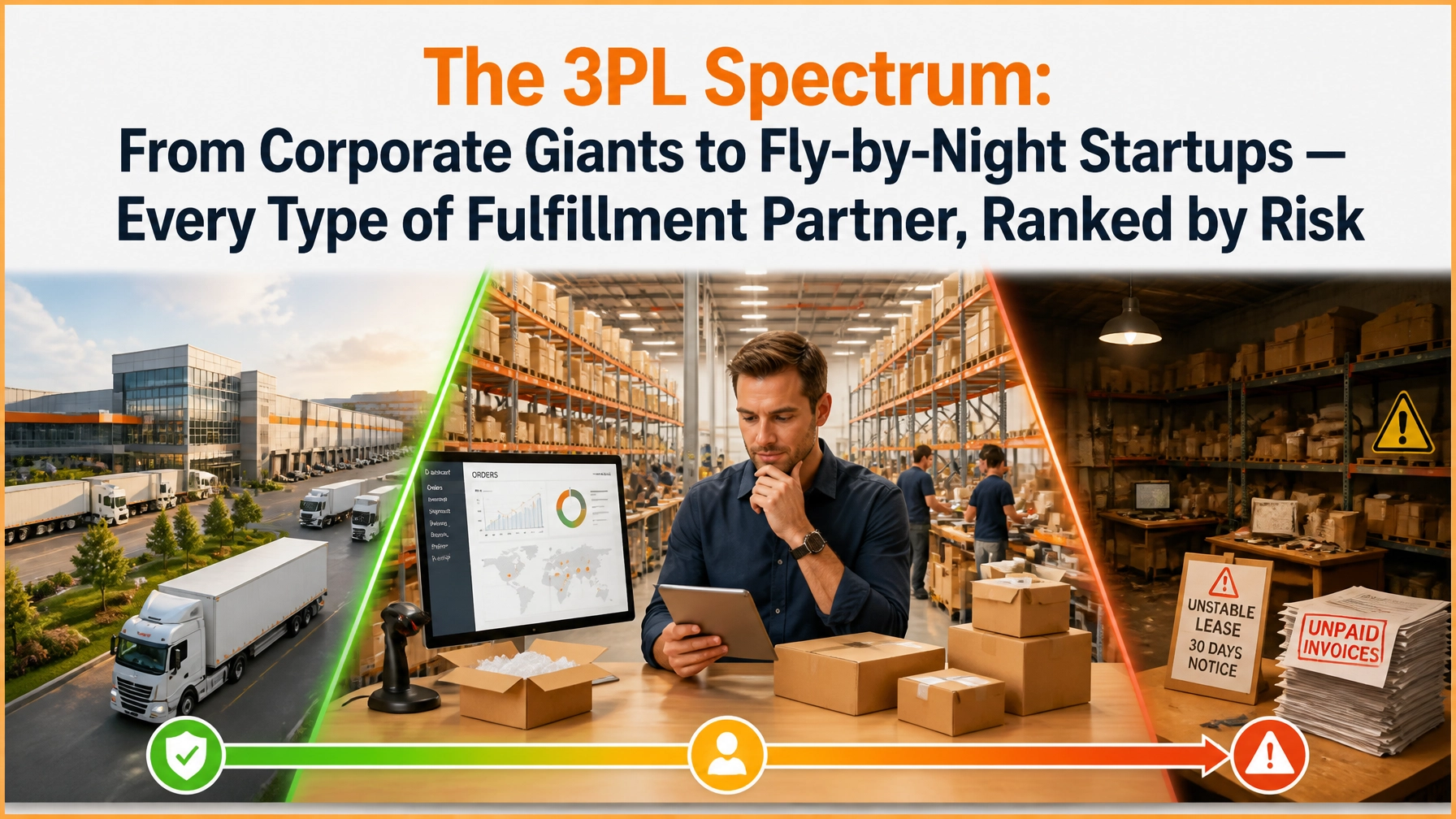
Your inventory is your largest asset: and it sits in someone else’s building. That creates a risk many ecommerce sellers underestimate. The single most important factor when comparing 3rd party fulfillment services is not price or flashy software. It is survival risk.
Will your fulfillment partner still exist six months from now? Will your inventory still be accessible? Can you leave without paying a painful exit fee?
The 3PL (3rd party fulfillment services) market spans six distinct tiers, from global logistics corporations to undercapitalized startups. Each has a place. Each carries different operational, financial, and relationship risks.
1. THE CORPORATE BEHEMOTHS: Is maximum scale worth minimum attention?
Examples include FedEx, UPS, DHL, XPO, Ryder, NFI, Kuehne+Nagel, DSV, C.H. Robinson, and J.B. Hunt. Not every company in this group offers the same plug-and-play ecommerce service, but these are the types of asset-heavy logistics operators that serve large enterprise accounts.
They own or control extensive warehouse, transportation, labor, and technology networks. Their customers include major retailers, manufacturers, and Fortune 500 companies.
Pros
- Deep balance sheets and long operating histories
- Large domestic and international networks
- Enormous capacity for wholesale and retail programs
- Enterprise-grade SLAs, EDI, WMS, and transportation systems
- Lower survival risk than almost any smaller provider
Cons
- You may be too small to matter
- Onboarding is contract-heavy and slow
- Integration may be designed for EDI rather than Shopify or TikTok Shop
- Minimums can involve 1,000-plus monthly orders, dedicated labor, or large storage commitments
- Account management can be highly impersonal
A $3,000 monthly account is noise to a corporate behemoth. Pricing is usually custom and may include annual or multi-year commitments, per-pallet storage, implementation charges, technology fees, fuel surcharges, and minimum storage payments.
Risk ranking: Low survival risk. High relationship risk.
These 3rd party fulfillment services fit sellers shipping 10,000-plus orders per month, managing wholesale programs, or supplying major retail accounts. They are usually a poor fit for a growing brand that needs flexibility.
2. THE VENTURE-FUNDED SCALERS: Does modern software hide financial pressure?
This tier includes ecommerce-native 3rd party fulfillment services companies such as ShipBob, ShipMonk, Cart.com, Flexport, Radial, Stord, and Whiplash. These businesses grew by raising substantial capital, acquiring companies, building networks, or leasing capacity across multiple facilities.
Pros
- Attractive dashboards and modern integrations
- Multi-node fulfillment options
- Shopify, Amazon, Walmart, TikTok, and marketplace connectivity
- Straightforward sales presentations
- Self-service inventory and order visibility
- Strong marketing and polished onboarding
Cons
- Impersonal Service
- Locked into a long term contract probably not in your best interest.
- Onboard fees.
- Service quality can vary by warehouse node
- Rapid growth may create receiving, support, or inventory problems
- Network consolidation can force inventory moves
- Pricing often becomes more complicated after onboarding (Hidden Fees)
- You may be managed as an account metric rather than a business relationship
- Slow communication responses usually via a ticket system with 24 hour response,
- Expensive exit fees.
- High Minimums may exclude many sellers. Definitely not startup friendly.
- Often will not accept accounts with a large sku count.
Public pricing provides useful examples, although you should treat third-party estimates as estimates. ShipMonk’s published pricing page explains that its monthly minimum is calculated from projected order volume and the first-item pick fee, reduced by 20%. Industry comparisons commonly cite a minimum near $250 per month.
Third-party comparisons have also reported ShipBob pricing near a $275 monthly minimum, a setup fee beginning around $975, pallet storage near $40 per month, and pick-and-pack charges commonly ranging from $2.50 to $3.50 per order. Confirm every number in your contract.
Watch for:
- Receiving charges per carton or SKU
- Put-away fees
- Per-SKU setup fees
- Kitting and special project charges
- Returns processing
- Storage dormancy surcharges
- Shipping markups
- Fuel or logistics surcharges
- Inventory removal and exit fees
- Monthly platform or technology fees
These providers generally serve hundreds to thousands of SKUs and brands shipping roughly 500 to 10,000 orders per month. Some accept smaller sellers, but minimum spend still applies even if your order count is low.
Publicly reported events also demonstrate why network structure matters. Shopify acquired Deliverr for approximately $2.1 billion in 2022, then sold the majority of its logistics business, including Deliverr, to Flexport in 2023. Shopify’s official acquisition announcement documents the transaction.
As of August 2026, public reporting has described unconfirmed ShipBob “network optimization” and potential node consolidation. ShipBob has not publicly confirmed a broad warehouse closure program. That distinction matters. You should not treat rumors as facts: but you should treat sudden network changes as a reason to review your contingency plan.
Risk ranking: Moderate to high.
The risk is not necessarily that the company disappears. The risk is that your preferred warehouse, service model, pricing, or inventory placement changes after you have committed.
3. THE MARKETPLACE BEASTS: Is convenience costing you control?
This category includes Amazon FBA, Amazon Multi-Channel Fulfillment (MCF), Walmart Fulfillment Services, and Shopify’s former fulfillment operation.
These services are attached to the marketplace where you already sell. That makes onboarding easy and capacity enormous.
Pros
- Prime or marketplace delivery advantages
- Fast setup for marketplace orders
- No separate 3PL relationship for certain channels
- Extensive fulfillment infrastructure
- Often no traditional monthly order minimum
Cons
- Inventory is controlled inside the marketplace ecosystem
- Fees can compound quickly
- Surcharges for overage. Volume limitations.
- Stock is harder to redirect across channels.
- Can be difficult to resolve issues.
- Returns and grading policies may not match your standards
- You have less control over replenishment timing and inventory placement
- Slow stale communication responses usually via a ticket system with 24 hour response,
Amazon fees can include fulfillment, storage, aged inventory charges, low-inventory fees, inbound placement charges, and seasonal surcharges. Amazon MCF pricing is based on unit size, weight, service level, and destination. Always review the current Amazon fulfillment pricing information before comparing it with a warehouse quote.
Risk ranking: Low bankruptcy risk. High control and strategy risk.
Marketplace fulfillment can be a useful channel-specific tool. It should not automatically become the only place your inventory exists.
4. THE SPECIALIST MID-MARKET 3PL: Can you get scale without becoming invisible?
This is where established, operationally focused providers fit. Examples include FBMFulfillment, Red Stag Fulfillment, Shipfusion, and other quality-focused regional operators.
These companies generally operate their own warehouse or maintain direct operational control instead of simply reselling someone else’s capacity. They often serve brands shipping from approximately 100 to 5,000 orders per month, with catalogs ranging from a few dozen SKUs to several thousand.
Pros
- Direct accountability
- More flexible SKU and volume requirements
- Faster communication with decision-makers
- Better support for multichannel sellers
- More transparent exceptions and inventory investigations
- Greater control over returns and defective products
- They can often offer superior technology
- Shopify, Amazon, Walmart, TikTok, and marketplace connectivity
- Self-service inventory and order visibility
- Potential for no onboarding fees, minimums, or long-term contracts
Cons
- Fewer warehouse nodes than the largest networks
- You may need to pay for premium two-day shipping
- Geographic coverage depends on the provider’s warehouse strategy
Make sure their offering is a fit to your product and strategy as to: Technology, Sku support, proximity to ports, proximity to your median customer location, FDA Registration. How well do they handle FBA Drip feed and how difficult is placing an order?
FBMFulfillment is a seller-built ecommerce fulfillment center Florida sellers can use for multichannel B2C, wholesale, returns, and FBA replenishment. The Jacksonville operation supports same-day shipping Monday through Friday, FedEx 2Day service, multi-unit orders, large SKU catalogs, and a single inventory pool across Amazon, Shopify, Walmart, eBay, Etsy, and TikTok Shop.
The warehouse management system resources explain how inventory visibility and order control support the operation. You can also review 3PL pricing guidance before requesting a quote.
Risk ranking: Low to moderate.
You still need to perform due diligence. Tour the facility. Check the BBB profile and rating. Ask how long the company has occupied its building, who physically handles your inventory, and how quickly inventory can be returned if the relationship ends.
5. ASSET-LIGHT BROKERS AND BUDGET AGGREGATORS: Who actually touches your product?
This tier includes sourcing and logistics aggregators such as CJ Dropshipping, China-based networks, white-label warehouse resellers, and brokers that coordinate fulfillment through facilities they do not own.
Pros
- Low advertised rates
- Large product catalogs
- International reach
- Flexible sourcing options
- Sometimes no published minimum
Cons
- You may not know which warehouse physically holds your stock
- Quality varies by facility and supplier
- Support can be slow or fragmented
- Per-item and per-package fees can destroy the headline rate
- Inventory accuracy may be difficult to verify
- Claims can move between the broker and the actual warehouse
Public reviews and seller discussions have described inventory discrepancies, oversells, inconsistent product batches, and billing or support complaints involving CJ Dropshipping. That does not mean every order fails. It means you should evaluate this model as a managed sourcing relationship: not assume it provides the same control as a direct warehouse operator.
Risk ranking: Moderate to high.
Ask for the legal name and physical address of the warehouse holding your inventory. If the answer is vague, your risk is not vague.
6. UNDERCAPITALIZED STARTUPS: Is the cheap quote a warning?
This is the collapse-risk tier. These providers often offer very low rates, aggressive guarantees, and friendly sales support. The business model, however, may depend on another funding round, one large customer, or continuously expanding warehouse volume.
Pros
- Low introductory pricing
- Flexible sales promises
- Willingness to accept small accounts
- High-touch support during the sales process
Cons
- Sudden shutdown or lease loss
- Payroll and labor instability
- Delayed receiving and shipping
- Limited insurance or working capital
- Inventory trapped during a dispute
- Little recovery if the company enters bankruptcy
The Packable and Pharmapacks bankruptcy is a documented warning from the broader ecommerce ecosystem. Court records show that Hilco Merchant Resources was retained to help sell inventory and equipment. Public reporting described approximately $79 million in remaining inventory during the liquidation process.
Packable was not a conventional 3PL, but the event demonstrates the central lesson: when another company controls your stock, financial failure can become your emergency.
Do not use Melonn as a collapse example without evidence. Available public reporting describes Melonn’s funding and fulfillment operations but does not establish the shutdown and inventory loss claims sometimes repeated online.
Risk ranking: Extreme.
A cheap rate is not proof of efficiency. It can be proof that the provider is underpricing the work.

HOW DO YOU RANK ANY 3PL BEFORE SIGNING?
Use this survival test:
- What are their SLAs and what evidence is there they meet them?
- Who physically holds your inventory? Get the warehouse address and legal entity.
- How stable is the operation? Ask about facility tenure, ownership, lease term, and insurance.
- What is the real fee structure? Calculate storage, receiving, pick-and-pack, shipping, returns, kitting, and exit costs.
- What minimums apply? Confirm monthly spend, order volume, storage, SKU, and seasonal commitments.
- How many SKUs do they actually support? Ask for examples similar to your catalog.
- What client size do they want? A provider serving 100,000 orders monthly may not prioritize your 300.
- What happens if you leave? Demand written inventory removal, data export, and transition terms.
- How are returns handled? Defective products should not automatically re-enter sellable inventory.
- Can they meet your delivery promise? Verify cutoff times and actual carrier performance, not just advertised zones.
You have a problem. We have a solution.
Key Takeaways
- 3rd party fulfillment services vary in risk, scale, and operation, making it crucial to assess survival risk over price.
- Corporate behemoths offer low survival risk but may neglect smaller accounts due to their size.
- Venture-funded scalers provide modern technology but pose a moderate to high survival risk with complicated contracts.
- Marketplaces offer ease of use but can decrease control over inventory and incur hidden fees.
- Specialist mid-market 3PLs balance accountability and flexibility, while undercapitalized startups pose extreme risks despite low rates.