Peak season is approaching. Your inventory is moving faster, order volume is rising, and every fulfillment decision affects margin. Then an invoice arrives with storage minimums, receiving charges, handling surcharges, and fees you never saw in the sales proposal.
That is the danger of signing a 3PL contract without reviewing the complete fee schedule. The headline pick-and-pack rate looks attractive. The operational details tell a different story.
Many sellers sign quickly because they are focused on getting inventory out of their garage, meeting marketplace shipping requirements, or preparing for Q4. They compare one or two advertised rates, accept a standard agreement, and assume the warehouse will charge only for storage, picking, packing, and postage.
Unfortunately, the most expensive hidden fees often appear when your volume increases, your inventory arrives in multiple shipments, or you try to leave.
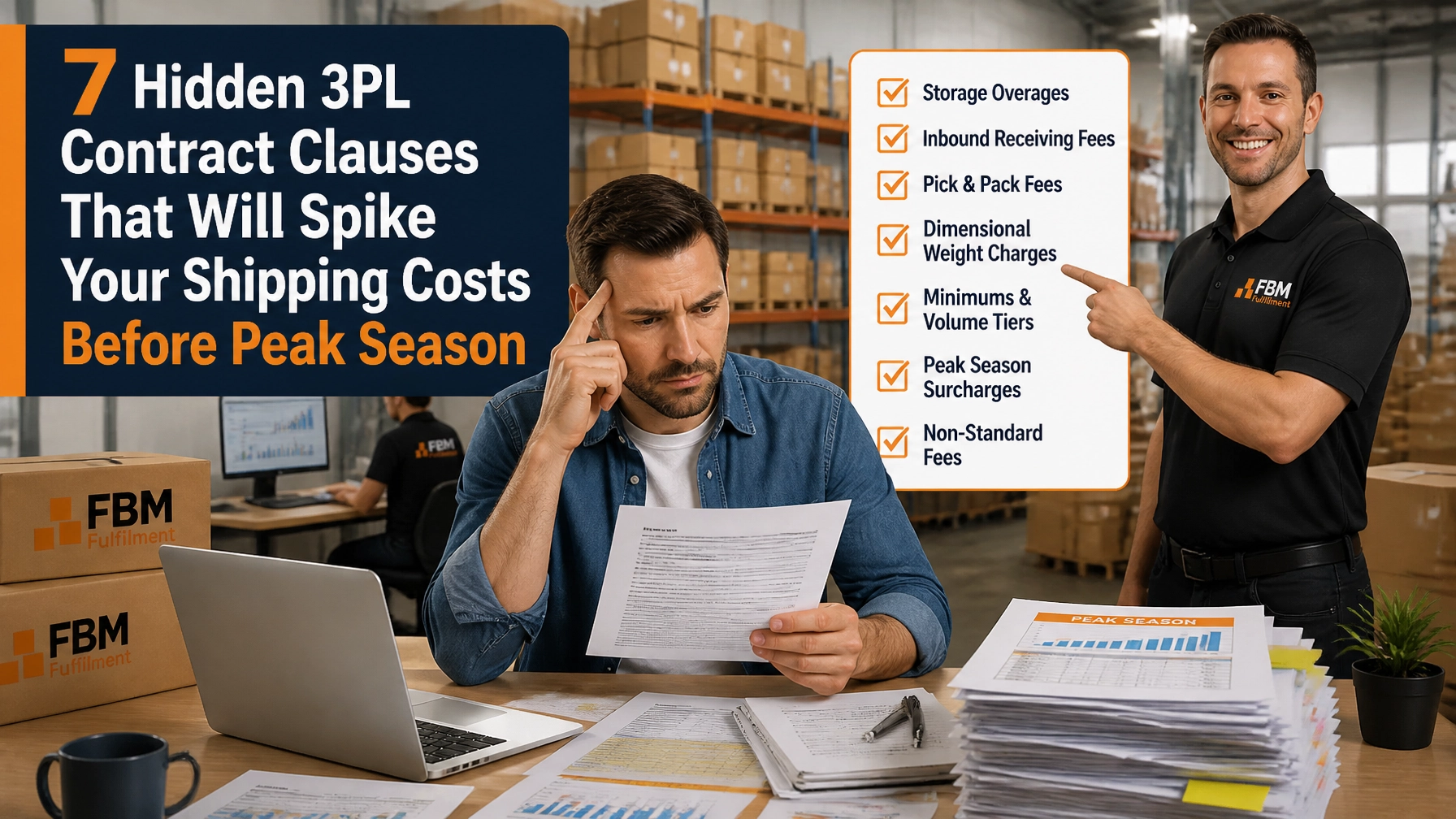
This guide explains seven clauses to review before peak season turns a convenient fulfillment arrangement into an expensive one.
Why do hidden fees appear right before peak season?
A 3PL proposal is usually designed to show a simple cost per order. The agreement and fee schedule often contain the real economics.
The problem is not always intentional. Fulfillment pricing is operationally complex. Storage, receiving, returns, packaging, freight, labor, and special projects all carry different costs. However, vague contract language transfers that uncertainty to you.
Before accepting any agreement, ask for:
- The complete fee schedule
- A per-order and per-unit cost breakdown
- Peak season pricing
- Receiving and exception charges
- Shipping markup terms
- Minimum commitments
- Exit and inventory removal costs
A seller should understand the total cost of a typical order, not just the advertised pick fee.

1. Can minimum monthly storage fees hurt you when inventory is low?
A minimum monthly storage or account commitment can create a charge even when your inventory and order volume are modest.
Look for language such as:
- “Minimum monthly billing”
- “Minimum storage commitment”
- “Minimum monthly revenue”
- “Minimum number of pallets or units”
- “The greater of actual charges or monthly minimum”
This clause is especially damaging for seasonal sellers, new product launches, and brands with uneven sales. You may pay the same minimum during a slow month that you pay during a strong month.
The risk increases when the minimum is calculated across multiple services. Storage, fulfillment, receiving, and account management minimums can stack together.
What to request instead: Ask for a clear explanation of whether minimums apply. If they do, determine whether the minimum can be waived during onboarding, product testing, or seasonal slow periods. Get the answer in writing.
2. Does the 3PL contract auto-renew with higher prices?
Long-term auto-renewal language is easy to miss. It may appear near the end of the agreement, surrounded by legal provisions that sellers do not read closely.
A typical clause states that the agreement renews automatically for another 12 months unless you provide written notice 60, 90, or even 120 days before the end of the term.
The next sentence may allow the provider to increase rates upon renewal.
That creates two separate risks:
- You miss the cancellation deadline and become locked in again.
- Your rates increase while your ability to negotiate disappears.
Peak season makes this particularly precarious. A seller may discover service issues in October, but the contract may prevent an orderly transition until the following year.
What to negotiate:
- Month-to-month terms after the initial setup
- A short cancellation notice period
- No automatic price increase without advance written notice
- A defined cap on annual increases
- The right to terminate for repeated SLA failures
The goal is flexibility. Your fulfillment partner should earn your business through performance, not retain it through paperwork.
3. Are receiving fees charged per carton, SKU, or unit?
Receiving fees can multiply quickly when a container, truckload, or large supplier shipment arrives before Q4.
Some warehouses charge by pallet. Others charge by carton, SKU, unit, purchase order, or receiving hour. A shipment containing many SKUs can trigger several fees at once.
Review whether the agreement charges separately for:
- Each carton received
- Each SKU counted
- Each purchase order
- Mixed cartons
- Labeling or relabeling
- Pallet breakdown
- Reconciliation of an inaccurate packing list
- Rework caused by supplier errors
A per-carton fee may sound minor until 1,000 cartons arrive during peak preparation. A per-SKU fee can be even more significant for a catalog with many variations.
What to request instead: Ask for sample receiving invoices based on your actual inbound profile. Provide the expected carton count, SKU count, pallet configuration, and shipment frequency. A realistic example is more useful than a general rate card.
4. What does “handling” or “peak surcharge” actually include?
“Handling” is one of the most dangerous words in a fulfillment fee schedule because it can mean almost anything.
It may refer to labor for packing. It may refer to a seasonal surcharge. It may refer to carton selection, additional packaging, quality control, or an administrative task. If the definition is vague, the cost is difficult to predict and nearly impossible to audit.
Search the agreement for:
- Peak season surcharge
- Seasonal handling fee
- Holiday labor fee
- Operational surcharge
- Additional handling
- Temporary rate adjustment
- Carrier cost recovery
Ask when the surcharge applies, what triggers it, and whether it affects all orders or only certain service levels.
A warehouse that adds a fixed, published peak fee is easier to evaluate than one that reserves the right to add “reasonable” charges whenever volume increases.
Protect your margin: Require written peak dates, exact amounts, affected services, and advance notice for any rate change. Also ask whether your same-day shipping SLA remains unchanged during the busiest weeks of the year.
5. Are cross-dock and special handling add-ons clearly defined?
Cross-docking, transfer preparation, kitting, inspection, repacking, and urgent processing are legitimate services. The problem begins when the contract mentions them without a defined price.
For example, a supplier may send inventory that needs to move directly from receiving to outbound fulfillment. A warehouse may treat that shipment as a cross-dock project and charge for receiving, staging, order preparation, and expedited handling.
Other add-ons may include:
- Special carton requirements
- Product inspection
- Bundling or kitting
- Batch processing
- Pallet restacking
- Shipment segregation
- Same-day project work
- Manual order intervention
These charges can surface when your business changes quickly, such as during a flash sale or marketplace promotion.
What to request instead: Ask for a special-project rate card and a written approval requirement. No nonstandard work should be billed without your authorization, a scope of work, and an estimated cost.
6. Could exit fees make leaving financially impossible?
A seller may assume that ending a fulfillment relationship simply means shipping remaining inventory to another warehouse. The contract may tell you otherwise.
Exit-related charges can include:
- Inventory removal fees
- Per-pallet loading fees
- Per-carton handling fees
- Account closure fees
- Data export charges
- Transfer documentation fees
- Special project management fees
- Final inventory count charges
You may also pay freight to move every remaining unit to the next provider. If the inventory is not palletized or labeled according to the new warehouse’s requirements, additional rework costs can appear.
Review warehouse lien language carefully as well. The provider may have rights related to unpaid invoices, but the process should be clearly defined. A dispute over a small invoice should not create an indefinite operational crisis.
What to negotiate:
- A written inventory release timeline
- Clear removal rates
- Standard CSV or API data access
- A defined dispute process
- Narrow, understandable lien provisions
- No penalty for ending a month-to-month arrangement
A fair provider should make it easy to transition your inventory and data in an orderly way.
7. Is a broker or middleman adding a markup?
Some sellers do not contract directly with the warehouse operating their inventory. Instead, they work through a broker, consultant, software platform, or referral partner that resells warehouse capacity.
That arrangement is not automatically bad. It does create another layer that must be examined.
Ask:
- Who is the legal contracting party?
- Who physically possesses the inventory?
- Who controls the WMS?
- Who handles claims and shortages?
- Is shipping billed at carrier cost?
- Is a percentage markup added to warehouse or carrier charges?
- Are referral fees included in your rates?
- Can the broker change warehouse locations without your approval?
A low advertised rate can become expensive when a middleman adds margin to storage, fulfillment, shipping, or special projects.
You should know exactly who is accountable when an order is late, inventory is missing, or a return is processed incorrectly.

What red flags should sellers vet before signing?
Be cautious when a provider offers rates that are dramatically below the market but refuses to provide a detailed fee schedule.
Other warning signs include:
- No transparent per-unit or per-order breakdown
- Pricing that changes based on unexplained “handling”
- A long-term agreement presented as nonnegotiable
- Mandatory minimums with no volume flexibility
- No written peak season SLA
- A broker that will not identify the operating warehouse
- Separate charges for routine receiving tasks
- No clear inventory release process
- Refusal to provide sample invoices
Do not evaluate 3rd party fulfillment services using only the first quote. Build a complete cost model using your average order, units per order, monthly inventory, inbound carton count, return rate, and expected Q4 volume.
Then check operational credibility. Review customer feedback, complaint history, business registration, references, insurance information, and the provider’s Better Business Bureau profile.
What should you look for in a fulfillment partner?
The best agreement is not necessarily the one with the lowest line-item rate. It is the one you can understand and forecast.
Look for:
- Transparent per-order and per-unit pricing
- No onboarding or administrative fees
- No minimum order or storage commitments
- No long-term contract requirement
- Defined receiving and return procedures
- Clear carrier billing and surcharge policies
- Same-day shipping expectations in writing
- Accurate inventory reporting
- Direct access to decision-makers
- Documented operational performance
If you are comparing an ecommerce fulfillment center florida sellers can use, location is only one part of the decision. The provider’s accountability, WMS discipline, shipping process, and invoice transparency matter just as much.
A search for 3pl jacksonville may produce many results, but the right question is not simply, “Where is the warehouse?” Ask, “How will this provider protect my landed fulfillment cost during peak?”
FBMFulfillment was built from an ecommerce seller’s viewpoint. Its founders experienced poor service, rising costs, and operational stress firsthand before building their own warehouse operation. The company emphasizes zero onboarding and administrative fees, no minimums, and no long-term contracts.
That flexibility is valuable when you are testing a channel, launching a product, or adjusting inventory strategy. Founder-led decision-making also means sellers are not forced to navigate an endless corporate escalation process when an operational issue requires attention.
The company’s operating history is equally important. After opening its own warehouse, FBMFulfillment reports that Seller Fulfilled Prime performance improved from poor to perfect. That focus on operational excellence extends to multichannel B2C fulfillment, wholesale orders, FBA replenishment, and returns.
For sellers comparing a fulfillment center in florida, FBMFulfillment offers a direct way to review its services and contact the team.
What is the practical next step before peak season?
Pull out your current agreement and highlight every phrase containing:
- Minimum
- Surcharge
- Handling
- Additional
- Renewal
- Termination
- Removal
- Pass-through
- Markup
- Special
Then request written answers to these five questions:
- What will I pay if my order volume drops?
- What fees activate during peak season?
- What does receiving cost for my actual shipment profile?
- How much will it cost to remove my inventory?
- Who controls my inventory and invoice if a third party is involved?
If the answers are vague, do not rely on verbal assurances. Ask for an amended fee schedule or contract language.
A fulfillment relationship should support growth, not hide costs until your busiest selling period. Review the numbers now. Confirm the operational commitments. Choose a partner that gives you control and accountability before Q4 exposes every weakness in the agreement.
Key Takeaways
- Review the complete fee schedule before signing a 3PL contract to avoid unexpected costs.
- Hidden fees often appear when order volume increases, making it crucial to understand all charges upfront.
- Ask for detailed breakdowns of costs, including minimums, auto-renewal terms, and hidden fees related to handling and receiving.
- Check for exit fees and contract terms that could complicate transitioning to another provider later on.
- Choose a fulfillment partner based on transparency, flexibility, and operational reliability, not just the lowest rates.