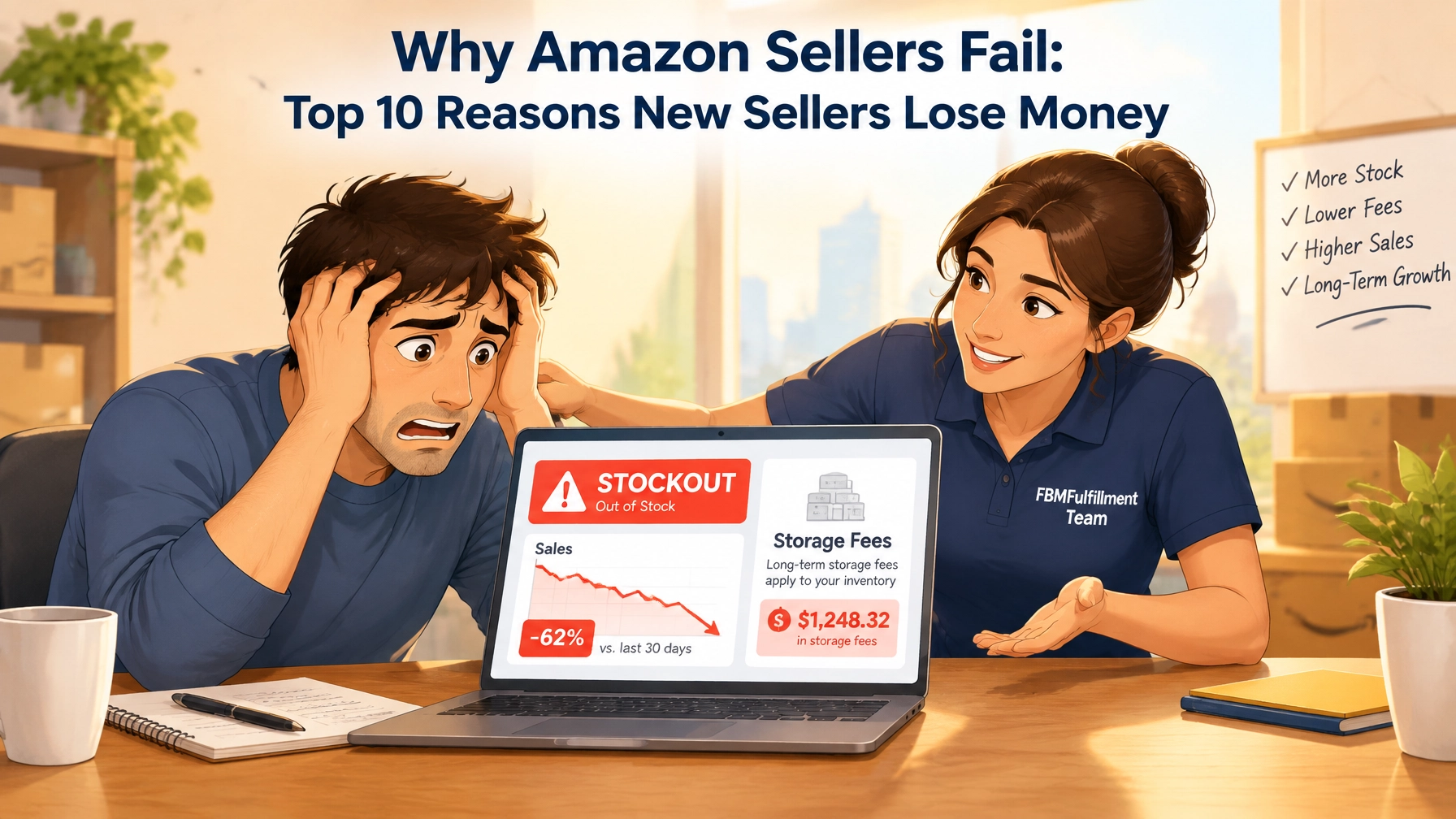

A stockout on a profitable Amazon SKU is rarely just a missed day of sales. It can mean lost keyword momentum, a weakened conversion history, more aggressive competitor pricing, and an expensive scramble to get inventory received. Restock planning for Amazon is how sellers prevent that chain reaction while avoiding the opposite problem: too much inventory sitting in FBA and generating storage costs, aged-inventory exposure, and cash-flow pressure.
The objective is not to keep every unit inside Amazon at all times. It is to keep enough sellable inventory positioned in the right place to protect demand. For many growing brands, that means treating FBA as a fulfillment node, not the only place inventory can live.
Why Amazon replenishment is harder than a simple reorder point
A basic reorder point assumes demand and lead times are stable. Amazon sellers know they are not. A SKU can sell 20 units a day for weeks, then jump to 60 after a coupon, ranking improvement, influencer mention, or competitor stockout. At the same time, an FBA shipment may take far longer than expected to check in, transfer between fulfillment centers, and become available for sale.
That gap matters. If you calculate replenishment only from average daily sales and supplier lead time, you are planning for a clean supply chain that does not exist. Amazon inventory planning needs to account for the full interval between deciding to replenish and having sellable units available to customers.
For an FBA product, that interval can include production time, freight transit, port or customs delays when applicable, delivery appointment timing, Amazon receiving, and internal transfers. For an FBM SKU, the relevant lead time may be shorter once inventory is already at your warehouse, but capacity, carrier cutoffs, and seasonal order spikes still matter.
Build your restock plan around sellable days of cover
Start with a number every operator should know: days of cover. This is your available sellable inventory divided by expected daily unit sales. The calculation is straightforward, but the forecast behind it requires judgment.
Use recent sales history as the starting point, then adjust for what is actually changing. A product with stable, non-promotional sales may justify a longer lookback period. A SKU coming out of a deal, price change, or ad push should not be forecast from its recent peak alone. Likewise, a product that was already constrained by low stock has artificially suppressed sales data. Its trailing average may understate true demand.
The practical question is not, “How many units did we sell last month?” It is, “How many units are we likely to sell before the next batch can be received and made available?”
A useful working formula is:
Reorder point = forecast daily sales × total replenishment lead time + safety stock
If a SKU sells 25 units per day and requires 30 days from replenishment decision to sellable FBA inventory, expected demand during the lead time is 750 units. If you want 10 additional days of protection, safety stock is 250 units. Your reorder point is 1,000 units across available FBA inventory, inventory in transit, and inventory that can be released quickly from reserve stock.
The formula is simple. The discipline is in using realistic inputs and reviewing them often.
Separate available inventory from inventory that only looks available
Do not give every unit the same value in your planning sheet. Units checked in and sellable at Amazon are not the same as units marked inbound. Inbound units may still be moving, waiting for an appointment, sitting in receiving, or being transferred. They reduce risk, but they cannot protect your listing until Amazon makes them available.
The same applies to warehouse inventory. Product at a 3PL can be highly useful reserve stock, especially when it can be drip-fed into FBA or used to support FBM orders. But it should be labeled separately from inventory already positioned for customer delivery.
A clean inventory view usually distinguishes sellable FBA units, reserved FBA units, inbound units by shipment status, 3PL reserve inventory, supplier-ready inventory, and inventory committed to other channels. Without those distinctions, sellers often believe they have coverage when they only have inventory in motion.
Use different safety-stock rules for different SKUs
One blanket buffer across the catalog creates waste. A high-velocity, high-margin SKU with volatile demand deserves more protection than a slow-moving item with predictable sales. A seasonal product might need a large buffer before its peak, then a sharply reduced one when the season closes.
Classify your catalog by velocity, margin, demand variability, and replenishment difficulty. The SKUs that drive most revenue and ranking risk should receive the most frequent review. Long-tail products can be managed with broader rules, especially when their low sales volume makes daily forecasting noisy.
Supply risk also changes the answer. A domestic item that can be replenished in seven days does not need the same reserve as a container-based import with a 60-day lead time. Neither does a product that can be fulfilled through FBM from domestic reserve inventory need to carry the exact same FBA buffer as an FBA-only listing.
Safety stock is not a sign that the plan is weak. It is an explicit cost for protecting revenue against demand variation and operational delay. The goal is to set that cost deliberately rather than paying for it through emergency air freight, lost sales, or excess FBA storage.
Plan FBA and FBM as one inventory system
The strongest restock planning for Amazon does not force every unit through FBA. It assigns inventory based on speed, cost, and risk.
FBA remains valuable when Prime conversion, Amazon fulfillment coverage, and customer expectations justify the fees. But sending too much inventory into FBA can create storage friction, stranded inventory risk, and less flexibility when demand shifts to Shopify, Walmart, or another channel. Keeping strategic reserve inventory in a capable US fulfillment center gives brands options.
That reserve can support drip-feed FBA replenishment as sales accelerate. It can also support Amazon FBM orders when an FBA listing runs low, when FBA receiving is delayed, or when you want more direct control over fulfillment. This is especially useful for hybrid sellers that cannot afford a single Amazon receiving issue to stop their entire sales operation.
The trade-off is coordination. Splitting inventory across FBA, FBM, and direct-to-consumer channels requires accurate counts and clear allocation rules. If channels pull from the same physical inventory without controls, overselling becomes the next problem. A 3PL should provide the operational visibility and process discipline to make reserve inventory an advantage, not another spreadsheet liability.
Create a weekly replenishment operating rhythm
Amazon restocking should not be a monthly task completed after inventory feels low. For important SKUs, review demand, days of cover, inbound status, and exceptions every week. During Prime events, Q4, major promotions, or a product launch, review more frequently.
Your review should answer a few direct questions: Which SKUs will hit their reorder point before the next shipment is sellable? Which inbound shipments are late or partially received? Which products are selling above forecast? Which slow movers are tying up capital inside FBA? And which items have enough reserve inventory to support another FBA shipment or FBM coverage?
Keep the decision-making visible. Every replenishment order should have an owner, a target arrival date, a quantity rationale, and a contingency plan. If a shipment misses its expected receiving date, decide early whether to adjust ads, revise promotions, activate FBM, or release reserve inventory. Waiting until stock is nearly gone limits every option.
Watch for the signals that break forecasts
Forecasts fail most often when sellers mistake past sales for future demand. Watch for changes that invalidate the baseline: price moves, coupon launches, ad-budget increases, improved organic rank, competitor outages, review changes, variations being added or removed, and calendar events. Returns can also distort the picture, particularly in categories with high post-purchase return rates.
Do not let a successful promotion create a permanent purchase order. Separate promotional lift from baseline demand, then decide whether the lift is likely to persist. On the other hand, do not under-order a product simply because it was out of stock during the period you used to calculate average sales.
The best plans are revised plans. You do not need a perfect forecast to run profitable inventory. You need a process that spots variance early and gives your team enough time to act.
Make replenishment a margin decision
Restocking is often treated as an availability problem: keep products in stock, full stop. That is incomplete. The right question is whether each additional unit is positioned where it produces the best return with acceptable risk.
A large FBA shipment may reduce per-unit inbound handling, but it can increase storage exposure and tie up cash. A smaller, more frequent drip-feed model may cost more operationally, yet preserve flexibility and reduce the impact of Amazon inventory limits or receiving delays. The better choice depends on SKU velocity, margin, demand confidence, and how quickly reserve stock can move.
FBMFulfillment works with sellers who need that reserve position to be operational, not theoretical: inventory stored accurately, replenishment released on schedule, and orders fulfilled across channels when demand changes. That level of control turns inventory into a tool for protecting sales rather than a growing liability.
The next time a SKU is approaching its reorder point, do not ask only how fast you can send more units to Amazon. Ask where the next units should sit, what risk they are protecting against, and how much flexibility they preserve if the forecast changes tomorrow.