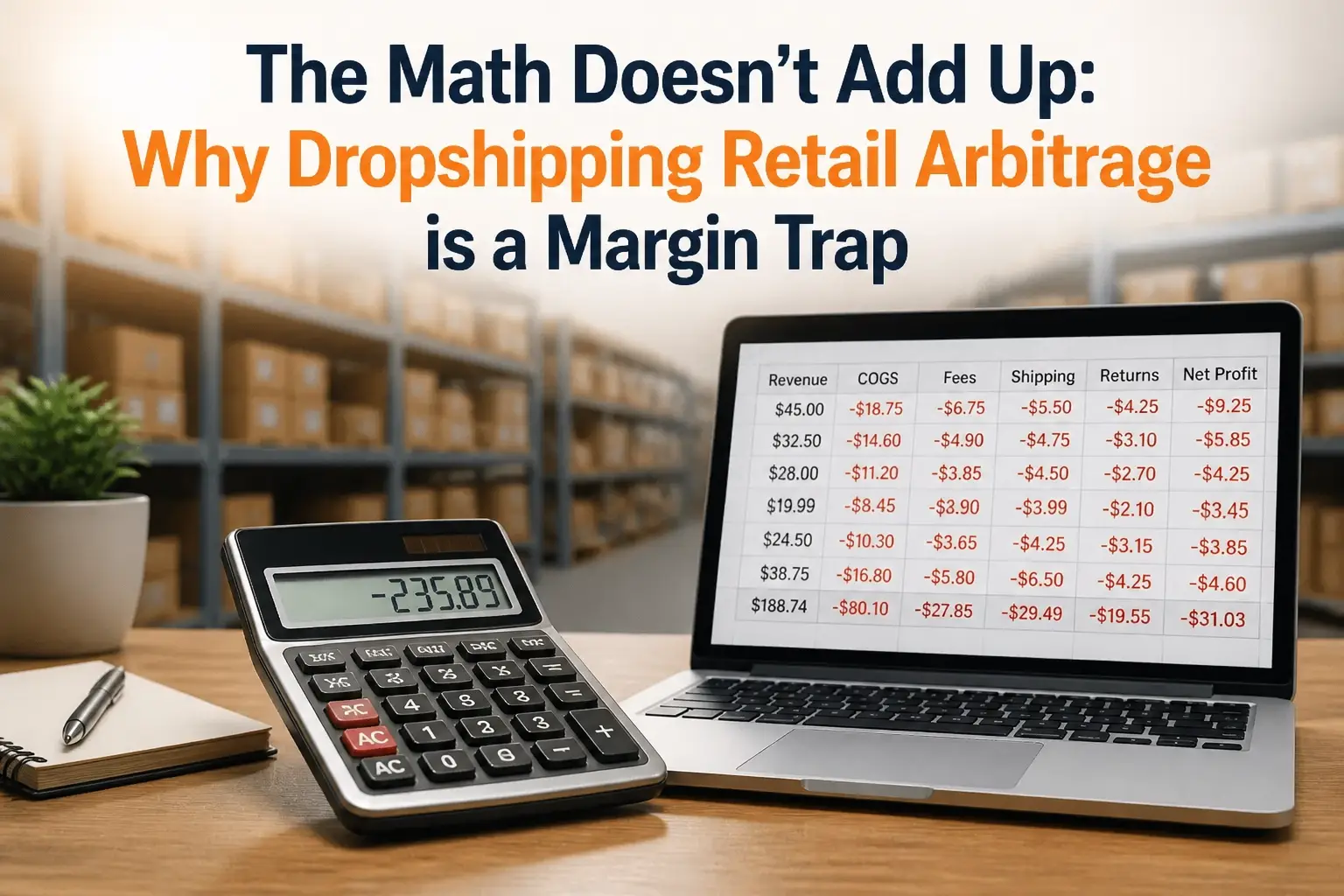
Let’s get real for a second. If you’ve spent any time in the ecommerce world lately, you’ve probably seen the “get rich quick” gurus pitching Dropshipping Retail Arbitrage as the ultimate low-risk side hustle. They make it sound like magic: find a deal at Walmart, list it on Amazon for double the price, and watch the profits roll in while a 3PL handles the dirty work. It sounds like the dream, right?
Unfortunately, the dream is actually a mathematical nightmare. For most sellers, this model isn’t a ladder to wealth: it’s a high-speed treadmill that leads directly to burnout and a drained bank account. When you peel back the curtain and look at the actual 3PL fees, shipping costs, and platform takes, the math simply doesn’t add up. At FBMFulfillment.com, we see thousands of orders move through our doors, and we’ve watched this specific model crush promising founders time and time again.
The Brutal Reality of the Fee Stack
To understand why Dropshipping Retail Arbitrage is a losing game, you have to look at the “fee stack.” Most beginners only look at the buy price versus the sell price. Experienced sellers look at what’s left after everyone else takes their cut.
Let’s break down a more realistic arbitrage deal. You find a product for $24.00 and see it selling for $39.99 on Amazon. On paper, that spread looks tempting. In reality, in a somewhat efficient market, a lot of hustlers are fighting over pennies on the front end and getting crushed by dollars on the back end.
The real formula is simple: Selling Price – Purchase Price – Fees = Profit. And in Dropshipping Retail Arbitrage, the fees usually overwhelm the spread.
1. Start With the Actual Gross Margin
Before you even talk about fulfillment, ads, or shipping, you need to subtract what you paid for the product.
- Sale Price: $39.99
- Purchase Price: -$24.00
- Gross Margin Before Fees: $15.99
2. The Amazon Referral Fee
Amazon isn’t a charity. They take their cut right off the top. For most categories, the Amazon Referral Fee is roughly 15%.
- Amazon Referral Fee (15%): -$6.00
- Remaining: $9.99
3. The PPC Tax
In 2026, the “organic” sale is a myth for new listings. If you want that Buy Box, you’re likely running aggressive Sponsored Products just to get visibility. That ad bill gets ugly fast.
- PPC Spend (Estimated 18% of revenue): -$7.20
- Remaining: $2.79
4. Inbound Freight (The “Hidden” Killer)
You have to get that single unit to the warehouse. Even using discounted carrier rates, shipping one item from your house or from a retail source to a 3PL is expensive because there is no consolidation and no scale.
- Inbound Freight: -$3.25
- Remaining: -$0.46
The 3PL “Unit of One” Problem
This is where the Dropshipping Retail Arbitrage model truly breaks. Most professional 3PLs: ourselves included: are built for scale. We are optimized to receive pallets and move hundreds of units of the same SKU. The issue is not that 3PL pricing is somehow unreasonable. The issue is that processing a single random unit: a literal quantity of 1: is the least efficient, most expensive way to operate in any warehouse.
There is no economy of scale here. None.
Every step is happening at its most costly level:
- Receiving one random unit
- Prepping one random unit
- Storing one random unit
- Picking and packing one random unit
- Shipping one random unit
That is not a 3PL problem. That is a model problem.
- 3PL Receiving Fees: Most warehouses charge a flat receiving fee or a per-item fee structure because labor is labor. When you process a quantity of 1, that labor gets spread over exactly one unit. (Estimated: -$3.00)
- 3PL Prep Fee: Does it need a barcode? A poly bag? A fragile sticker? On a one-off unit, each touch carries maximum cost. (Estimated: -$2.25)
- 3PL Order Fee: The labor to pick and pack that single unit. Again, no scale. (Estimated: -$3.50)
Remaining after 3PL labor: -$9.21
The Final Blow: Postage and Delivery
Now you have to actually ship the item to the customer. Even with our high-volume FedEx and UPS discounts, postage for a single standard-sized package is going to bite hard because, once again, you are shipping one unit with zero scale advantages.
- Postage Fee to Consumer: -$8.75
Your Net Profit: -$17.96
You didn’t make money. You started with a thin gross margin, then let one-off fees destroy it. That is the harsh reality of a somewhat efficient market. Too many sellers are chasing the same retail spreads, so the leftover margin is tiny before operations even begin. Then every operational step: receiving, prepping, picking, packing, and shipping: happens at the most expensive possible level because it is all built around one-off units. Hustlers end up fighting over cents and losing dollars.
What About Returns?
We haven’t even factored in the “R” word. In the world of FBM fulfillment, returns are a reality of doing business. In a retail arbitrage model, your return rate is often higher because you’re sourcing items that might have damaged packaging or been handled by a hundred retail customers before you bought them.
When a customer returns that item, you lose the outbound shipping cost, you pay return processing, and there is a real chance the unit cannot be resold as new. In a model this thin, even one return is catastrophic.
A realistic return event looks like this:
- Lost outbound postage: -$8.75
- Return processing fee: -$3.00
- Potential unrecoverable inventory loss: -$24.00
That is another -$35.75 hit on top of an already bad order economics profile. So yes, even if you had scraped together a few dollars of “profit” across a week of orders, one return would wipe it out instantly. That is the entire game with Dropshipping Retail Arbitrage. Tiny upside. Brutal downside. You can read more about how bad inventory math can kill your margins here.

High Failure Rate: The Effort Trap
The most devastating part of Dropshipping Retail Arbitrage isn’t just the negative margin; it’s the massive amount of effort required to lose that money.
To make this model “work” (at least on paper), you have to:
- Physically drive to stores or spend hours scouring websites.
- Scan hundreds of items to find one with a spread.
- Manage 100 different SKUs with a quantity of 1 each.
- Handle the logistical nightmare of “drip-feeding” tiny shipments to your warehouse.
This is not a scalable business. It’s a job: and a low-paying one at that. There is no economy of scale in the model. Every operational step is executed as a one-off, which means receiving, prepping, and shipping all happen at their least efficient and most expensive level. Many sellers find themselves trapped in a cycle where they are constantly “investing” more capital just to cover the 3PL fees and shipping costs of the previous month’s failures.
The Buy Box Race to the Bottom
There is another brutal problem with Dropshipping Retail Arbitrage that new sellers completely underestimate: Buy Box competition.
Because this is retail arbitrage, you have zero Brand Registry protection. You do not own the listing. You do not control the offer. You do not have a moat. If you find a so called “unicorn” product, assume thousands of other sellers using the exact same training, the exact same scouting software, and the exact same deal alerts will find it too.
And when they do, they become your competitors overnight.
That is how the race to the bottom starts:
- More sellers pile onto the same ASIN
- The Buy Box gets split or rotates unpredictably
- Sellers start undercutting each other
- Price drops fast
- The already thin margin disappears completely
This is what happens in any business model with no real barriers to entry. If it is “quick and easy,” it is also easy for everyone else. And if everyone can do it, nobody can make money at it for long.
That is the deeper problem. Dropshipping Retail Arbitrage is not just operationally broken. It is strategically broken. You are competing in a market where your “edge” can be copied in hours, your price can be undercut overnight, and your margin can vanish before your inbound shipment even lands.
Who Is Actually Getting Rich Off Dropshipping Retail Arbitrage?
Let’s call it what it is. In most cases, the only people getting rich from this model are the ones selling scammy training courses and the YouTubers farming clicks with screenshots, hype, and fantasy math.
They sell the dream. You eat the fees.
That’s the part new sellers rarely hear. The real money often isn’t in running Dropshipping Retail Arbitrage. It’s in convincing inexperienced sellers that this broken model is some kind of hidden goldmine. Unfortunately, once you layer in Amazon fees, shipping, returns, and 3PL fees, the operator is left holding the bag while the guru already got paid.
A Better Way: Scaling with Intent
At FBMFulfillment.com, we aren’t here to rain on your parade. We want you to succeed because when you scale, we scale. But we want you to scale something sustainable.
Here is our stance, clearly:
- We do not offer RA Dropshipping. We refuse to participate in a scam where we already know the client is being set up to fail.
- We do offer a limited, legitimate RA program. But the rules are strict because the inventory has to be real and ready to move.
- You must buy in bulk
- We must physically receive the inventory first
- You can never list the product for sale until it is in our possession and ready to ship
- No selling air. Period.
Instead of chasing a single-unit margin trap, look at these models:
- Proprietary Product: Build or invent something defensible, like UFM, then protect it with Brand Registry and patents. This is one of the strongest business models in ecommerce because you are not just reselling the same commodity as everyone else. You own the brand story. You control the listing. You create actual barriers to entry.
- Private Label Under Your Own Brand: Use contract manufacturing and sell under your own brand with Brand Registry in place. A common path is importing products that are not directly sold in the US, but you need to be smart here. Be wary of Chinese factories undercutting you once they see demand. That is why you should push for unique features, better designs, improved packaging, or custom colors that make your offer harder to clone.
- Wholesale: Buy wholesale and sell retail, ideally with MAP pricing protection in place. This is a much healthier model than retail arbitrage because you are buying with intent, buying at scale, and working within a real supply chain instead of chasing random one-off retail spreads.
- Craft, Customization, or POD: Sell products with proprietary designs, custom elements, or personalized touches. If your designs are yours, your offer is yours. That gives you more control and creates a real reason for customers to buy from you instead of a dozen interchangeable sellers.
Conclusion: Stop Working for Your Prep Center – Logistics Provider
If your business model depends on a 3PL processing single-unit retail items, you aren’t an ecommerce mogul: you’re a donor. You are donating your time and capital to the “Ecosystem of Fees.”
The goal of professional ecommerce fulfillment is to provide operational excellence that increases your margin through efficiency. Retail arbitrage does the opposite; it forces the 3PL to be inefficient, and you pay the price for it.
Ready to move past the “hustle” and start building a real brand? Let’s talk about how we can support your growth with actual 2-day delivery and inventory control that keeps the profit in your pocket, not Jeff’s.
Key Takeaways
- Dropshipping Retail Arbitrage often leads to financial loss due to high fees and competition.
- Most beginners overlook the true cost structure, focusing only on buy and sell prices.
- The 3PL model fails with single units, making operations inefficient and costly.
- Many sellers chase small margins but face significant losses, especially from returns.
- A better approach includes building proprietary brands or bulk purchasing for better margins.
Related Links
Frequently Asked Questions
For most sellers, no — once you subtract the Amazon referral fee (~15%), PPC spend needed for visibility (often 15–20% of revenue), and inbound freight, the spread between retail buy price and Amazon sell price is usually gone before you account for storage and fulfillment.
Amazon, Training Agencies/ Groups, Consultants (PPC, Tools and Listing SEO), Tools
The main stack is the Amazon referral fee, PPC/advertising spend to win the Buy Box on a non-differentiated product, inbound freight, and fulfillment costs — each one taking a bite out of what looks like a healthy spread on paper.
Selling products you source or manufacture directly, where you control the cost basis and margin, rather than reselling retail stock at a markup that shrinks every time a competitor undercuts the same listing.
Referral fees run roughly 15% for most categories, and PPC spend to stay visible on a new or undifferentiated listing can easily run another 15–20% of revenue — together that’s often a third or more of the sale price before any other cost.
No — a 3PL can make fulfillment cheaper and faster, but it can’t fix a business model where the product cost, referral fee, and ad spend already consume the entire margin before fulfillment is even factored in.
This is why FBMFulfillment only accepts Retail Arbitage clients in limited situations. Since we do not charge onboarding fees, minimums or longterm contracts, the high failure rate of Arbitrage does not make sense for us nor is it ethical.