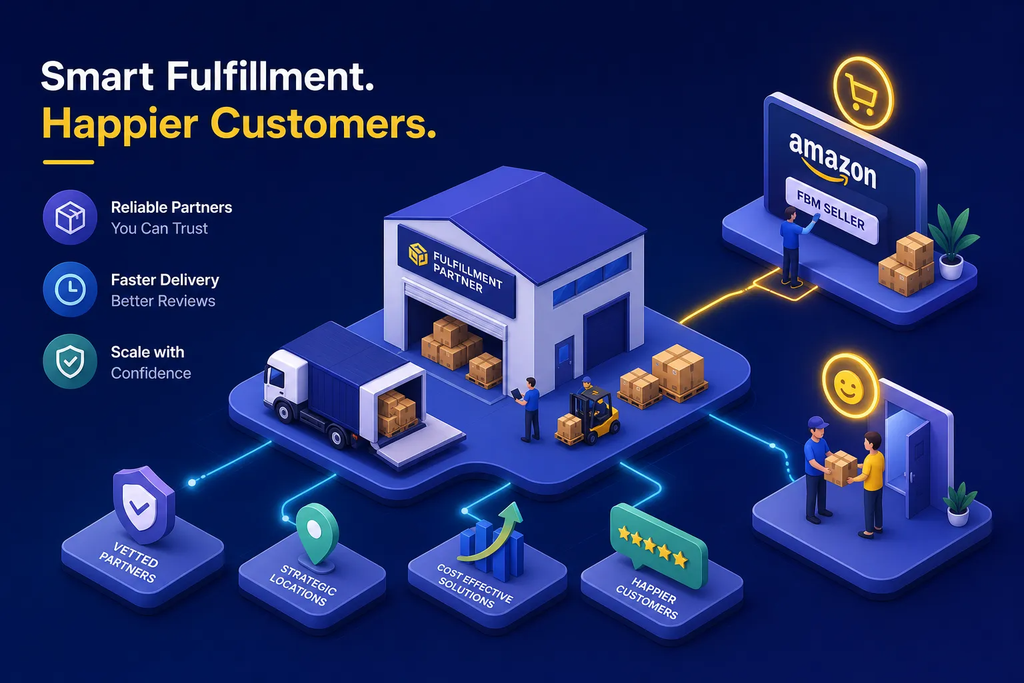
Small business fulfillment for Amazon FBM sellers becomes a genuine bottleneck faster than most founders expect. Amazon doesn’t care where you pack your boxes, it cares whether orders ship on time, arrive complete, and generate zero complaints. That’s the tension every Amazon FBM seller eventually hits: you’re personally accountable for shipping speed and accuracy, but your per-order costs keep climbing as your garage fills with poly mailers and your evenings disappear into label printing. At some point, the math stops working in your favor, and the sellers who recognize that inflection point early are the ones who actually scale.
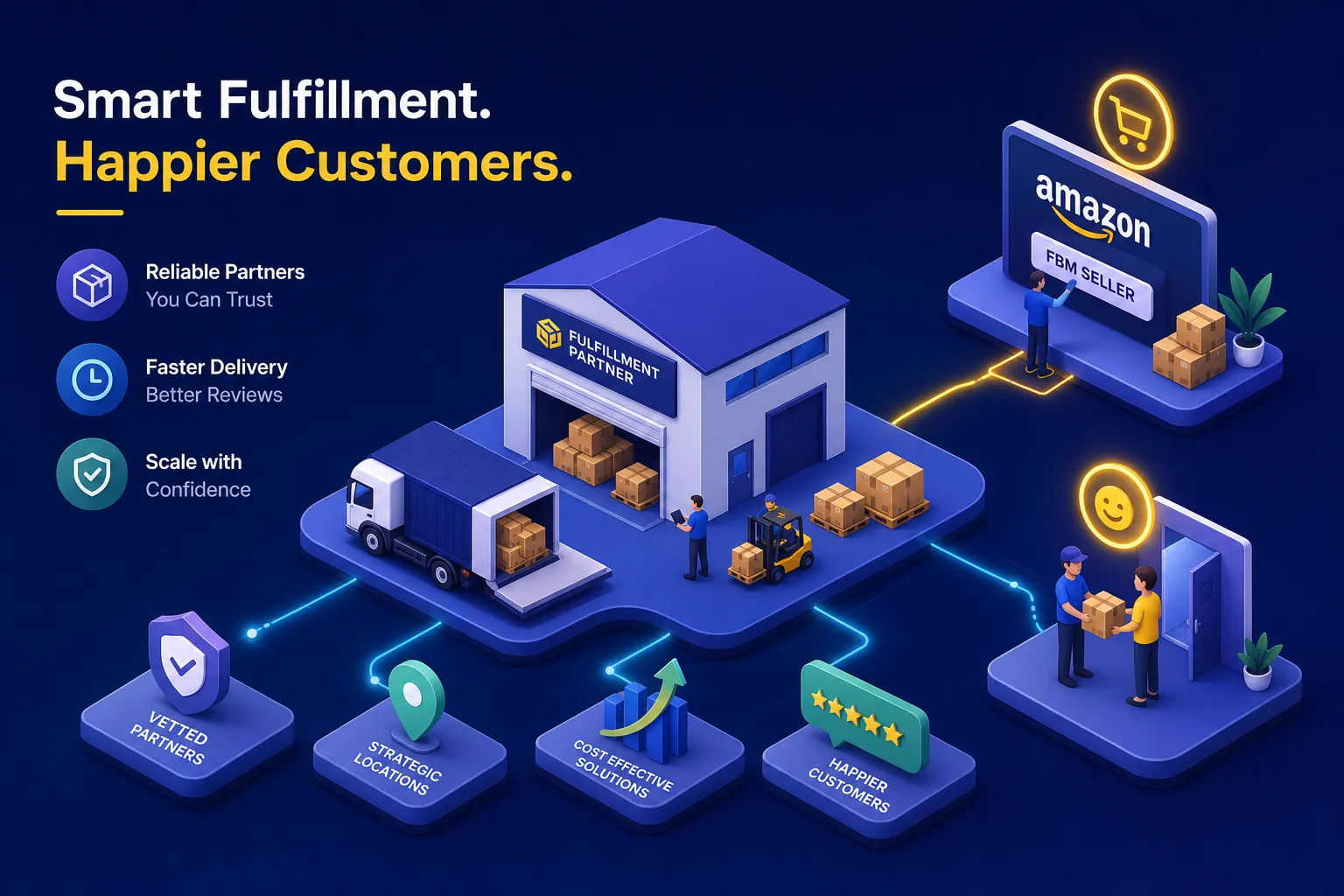
This is where your fulfillment strategy becomes a growth lever rather than a back-office chore. Outsourcing to the right partner, at the right time, can cut your per-order cost, protect your Amazon seller metrics, and give you your time back. FBM Fulfillment is built specifically for Amazon FBM merchants and small D2C brands that need a real logistics partner, one that treats small business fulfillment as a core competency, not an afterthought. This article walks you through the cost comparison between in-house and 3PL fulfillment, explains which fulfillment models actually fit small businesses, and gives you a concrete checklist to evaluate any provider before you sign.
When in-house shipping starts costing more than it saves
In-house fulfillment isn’t wrong. For early-stage sellers, it’s often the right call. The problem is that most sellers keep doing it well past the point where it’s still economical, because the true cost is spread across so many line items that the math is hard to see clearly.
The 500-order threshold most FBM sellers underestimate
The progression looks like this: below 300 orders per month, in-house fulfillment is usually the cheaper option, assuming you’re not dealing with bulky products or complex shipping geographies. From 300 to 500 orders per month, the decision depends heavily on your SKU count, how much of your own time you’re consuming, and whether you’re leasing space specifically for storage. Once you cross 500 to 1,000 orders per month, a regional 3PL begins matching or beating your fully loaded in-house cost, even before you account for the founder time that gets freed up. At 1,000 orders per month and above, outsourcing is almost always the financially sound move.
The key phrase there is “fully loaded.” Most sellers compare their postage rate to a 3PL’s advertised pick fee and conclude they’re cheaper staying in-house. That’s not a real comparison.
The fully loaded cost founders forget to calculate
A real in-house cost calculation includes several categories that rarely appear on a single invoice: labor and payroll overhead, warehouse rent and utilities allocated to your fulfillment operation, packaging materials, shipping software, equipment depreciation (scales, label printers, shelving), the cost of re-shipping errors, returns handling, and the management time that could be spent on sourcing, marketing, or product development. Once you add those up, small business fulfillment handled in-house typically runs $8 to $15 per order, not just the postage you see on the label.
That number tends to surprise sellers, and it’s the figure that makes the 3PL comparison actually useful.
Small business fulfillment costs: in-house vs. 3PL for Amazon FBM sellers
Here’s how the numbers stack up for a typical single- or two-item domestic shipment from a small business operation.
| Fulfillment approach | Typical all-in cost per order | What’s included |
| In-house | $8, $15 | Labor, packaging, allocated warehouse rent, software, and retail postage rates |
| Regional or independent Tech-enabled 3PL | $6, $12 | Pick/pack, packaging, storage allocation, receiving allocation, and discounted postage |
| Tech-enabled or national 3PL | $8, $15 | Similar services with multi-node inventory and more software overhead |
Breaking down the numbers for a typical FBM shipment
On the in-house side, labor and packing typically runs $2 to $6 per order, packaging materials add another $0.50 to $3, and shipping often costs 15 to 40% more than what a 3PL pays because individual sellers lack volume-based carrier contracts. Add allocated overhead and the total lands squarely in that $8 to $15 range.
On the 3PL side, pick and pack runs $2.50 to $5.50 per order, with single-item B2C averages closer to $3.20 before postage. Storage typically costs $18 to $45 per pallet per month, receiving runs $5 to $18 per pallet, and carrier-discounted postage for standard domestic ground generally falls in the $4 to $7 range. The 3PL’s structural advantage comes from negotiated carrier contracts that individual small businesses simply can’t access, and from shared warehouse infrastructure spread across many clients.
Where 3PLs win on carrier rates and shared overhead
The cost advantage a 3PL carries is structural, not marketing. When a warehouse ships thousands of packages per day across its entire client base, the carrier discount it negotiates reflects that volume. A seller shipping 600 orders a month on their own gets retail or near-retail rates. The same seller routing orders through a 3PL gets access to those negotiated rates indirectly, and that postage gap alone often closes the cost difference.
Never compare just the advertised pick fee. The real comparison is pick/pack plus postage plus storage plus receiving plus monthly minimums plus returns handling. Some 3PLs charge monthly minimums ranging from $500 to $3,000, which can eliminate their cost advantage entirely at lower volumes. Always compare the full basket before making a decision.
Small business fulfillment models to consider
Not all fulfillment providers are the same, and the model that works for a same-day grocery brand in Brooklyn is not the model that works for an FBM seller shipping automotive accessories nationwide. Understanding the operational differences lets you filter options quickly instead of drowning in vendor demos.
Regional 3PLs vs. micro-fulfillment centers
Regional 3PLs offer broad inventory capacity, better economies of scale, and centralized management. They’re the right default choice for most small businesses with customers spread across the country. Micro-fulfillment centers (MFCs) are compact, often automated facilities positioned in dense metro markets to enable same-day or next-day delivery. They sound appealing, but the trade-offs are real: higher facility costs, limited SKU capacity (MFCs stock fast-movers only), and frequent replenishment complexity that can create stockout risk.
For most small businesses, the smartest setup is a hybrid: a regional 3PL for the full catalog, with MFC placement only for proven fast-moving SKUs in your highest-density customer markets. Before committing to an MFC, look for concrete triggers, for example, a significant share of orders concentrated in a single metro or daily velocity high enough to justify dedicated local inventory. Building an MFC network to solve a problem you don’t yet have is a fast way to add cost without adding speed.
How to choose a small business fulfillment partner for Amazon FBM
FBM sellers face a constraint that other ecommerce merchants don’t deal with as directly: Amazon measures your Late Shipment Rate and Order Defect Rate against your account, not against your fulfillment partner. If your 3PL confirms a shipment after Amazon’s required ship-by date, that’s your late shipment, not theirs. LSR should stay below 4%, and ODR should stay below 1%; crossing those thresholds triggers selling restrictions and can lead to offer deactivation under Amazon’s current policies.
That means accuracy and same-day cutoff compliance aren’t optional features on a 3PL checklist. A regional 3PL with 98 to 99% same-day cutoff compliance and a documented order accuracy rate above 99.5% provides meaningful protection for your seller metrics, treat 99% as a minimum floor, not a target. A budget provider with variable performance can destroy an account you’ve spent years building. Multi-channel sellers also need a model that routes orders from Shopify, WooCommerce, TikTok Shop, and Amazon without manual intervention, because manual routing at volume is where mistakes happen.
How FBM Fulfillment helped a multi-channel seller cut costs and simplify distribution
The following scenario is an illustrative example based on outcomes typical of sellers who transition from in-house to outsourced fulfillment at similar order volumes. Individual results will vary depending on product profile, carrier mix, and channel configuration.
A small D2C brand was selling on Amazon (FBM), Shopify, and a wholesale channel, shipping around 700 orders per month. They were operating out of a leased storage unit with two part-time packers, running multi-channel order routing manually, and spending significant owner time on daily fulfillment operations.
The setup: warehousing, shipping, and merchant support under one roof
Their fully loaded per-order cost was running $13 to $14, and the manual routing between Amazon and Shopify meant inventory errors and occasional overselling. They moved inventory to FBM Fulfillment’s warehouse, connected their Amazon and Shopify stores through direct integrations, and handed off daily fulfillment operations. The transition covered three core needs: secure warehousing and storage, reliable pick-and-pack with daily carrier handoffs before cutoff, and dedicated merchant support for escalations when something went wrong.
The outcome: lower per-order cost and cleaner multi-channel operations
After the transition, all-in per-order costs dropped to the $8 to $9 range, primarily because of carrier rate discounts and the elimination of allocated warehouse overhead. Order accuracy held above 99.5%. The Amazon Late Shipment Rate improved because orders were being tendered to carriers same-day, before cutoff, consistently. The founder recovered significant time previously spent on daily logistics tasks. Multi-channel inventory sync through the integration reduced overselling errors across platforms.
None of that required a complex setup or a restrictive long-term contract. It required choosing a fulfillment partner that understood FBM seller constraints and built its operations around them.
What to lock down before signing with a fulfillment partner
A 3PL that sounds good in a sales call and performs poorly in operation is worse than staying in-house. These are the specific terms and integration requirements you need to confirm before you commit.
The integration checklist for Shopify, Amazon, and beyond
For Shopify, confirm native app support with SKU mapping, order routing rules, inventory sync, fulfillment-service permissions, and automatic tracking updates back to the store. For Amazon, verify Selling Partner API (SP-API) authorization, ASIN and SKU mapping, fulfillment channel rules, and shipping-confirmation compliance. These aren’t optional; Amazon requires tracking confirmation to count an order as shipped on time.
For WooCommerce, clarify whether the connection is a direct REST API integration or a third-party plugin the merchant has to maintain and update. For TikTok Shop, require a native or API-based integration, not CSV uploads. Across all channels, verify that bundles, split orders, partial fulfillment, and returns are supported in the integration, not just basic order import. Ask the 3PL to walk you through what happens when an API call fails. A provider that doesn’t have a clear answer to that question isn’t operating at the level FBM sellers need.
SLA minimums that protect your seller metrics
Write these into the contract as specific, measurable terms, not aspirational language:
- Order accuracy at 99.5% or above, defined as correct SKU, quantity, address, and inserts, with wrong-item and short-ship errors counted as failures
- On-time fulfillment at 98% or above, measured at carrier handoff, not delivery
- Same-day cutoff compliance at 98% or abovefor qualifying orders received before the agreed cutoff
- Dock-to-stock receiving within 24 to 48 hoursfor standard, compliant shipments, with 48 to 72 hours as the acceptable backstop for higher-volume inbound weeks
- Return disposition within five business daysof warehouse receipt
Require monthly scorecards with actual results versus targets, not just a summary. Require escalation contacts by name for critical incidents.
Require written fee credits or a defined cure period for repeated misses. Be cautious of contracts that roll all of these into a single “perfect order rate” metric without component-level reporting; an aggregate score can hide whether the real problem is in picking, receiving, shipping, or returns handling.
Choosing the right setup for your current stage
The right small business fulfillment model depends on where your business is today, not where you hope it will be in two years. Here’s a practical framework based on order volume.
Matching provider type to your order volume and SKU profile
Below 300 orders per month, stay in-house and start tracking your fully loaded per-order cost monthly so you know exactly when the math shifts. From 300 to 1,000 orders per month, evaluate a regional 3PL with multi-channel integration, reasonable monthly minimums in the $750 to $1,500 range, and documented SLA performance. Above 1,000 orders per month, a tech-enabled national 3PL or a hybrid regional-plus-MFC model may unlock better carrier rates and faster delivery in your top markets.
SKU count, product dimensions, and customer geography are real modifiers that can shift these thresholds in either direction. A seller with 200 SKUs and bulky products may find the economics flip at 300 orders per month. A seller with five compact SKUs and predictable demand may stay competitive in-house past 600 orders. Run your own numbers before assuming any general threshold applies to your operation.
Getting a fulfillment audit before you commit
Before signing any 3PL contract, request a fulfillment audit. A proper audit surfaces your current fully loaded per-order cost using your actual labor, postage, storage, and overhead data. It identifies the specific integration requirements for your channel mix. It gives a 3PL enough information to quote accurately rather than presenting ballpark estimates that shift once onboarding starts.
FBM Fulfillment offers a zero-obligation quote and small business fulfillment audit for sellers who want real numbers before making a decision. If you’re shipping 300 or more orders per month and spending more time on logistics than on growing your business, request a fulfillment audit from our team. It costs nothing to find out what outsourced order fulfillment actually costs for your specific volume and product profile, and it’s the only way to make a genuinely informed comparison.
Key Takeaways
- Small business fulfillment for Amazon FBM sellers needs careful strategy to balance cost and efficiency.
- In-house methods often become costly beyond 300 orders per month, making third-party logistics (3PL) a viable option.
- Accurate cost calculations must include hidden expenses like labor, overhead, and shipping software, with in-house fulfillment averaging $8 to $15 per order.
- 3PL services typically reduce costs to $6 to $12 per order through better carrier rates and shared efficiencies.
- Choosing the right fulfillment partner and model depends on order volume, SKU profile, and should align with specific business needs.
Related Links
Frequently Asked Questions
Small business fulfillment is the process of storing inventory, picking and packing orders, and shipping them to customers. Small businesses either handle it in-house or outsource it to a third-party logistics (3PL) provider that manages warehousing, shipping, and returns for them.
In-house fulfillment typically runs $8 to $15 per order once labor, rent, packaging, software, and retail postage are counted. A regional 3PL for small business usually costs $6 to $12 per order, covering pick and pack, packaging, storage, receiving, and discounted carrier postage.
Below 300 orders a month, in-house fulfillment is usually cheaper. Between 300 and 500 orders, it depends on SKU count and space costs. At 500 to 1,000 orders, regional 3PLs begin matching in-house costs, and above 1,000 orders outsourcing is almost always the better financial move.
The best 3PL for small business sellers is one that protects your Amazon metrics: 99.5% or higher order accuracy, 98% or higher same-day cutoff compliance, and direct integrations with Amazon, Shopify, WooCommerce, and TikTok Shop. For sellers shipping 300 to 1,000 orders a month, a regional 3PL is usually the best fit.
Some do. Monthly minimums at 3PLs range from $500 to $3,000. Sellers shipping 300 to 1,000 orders a month should look for minimums between $750 and $1,500, and compare the full cost of pick and pack, postage, storage, receiving, and returns rather than the advertised pick fee alone.
Look for order accuracy of 99.5% or higher, on-time fulfillment of 98% or higher measured at carrier handoff, dock-to-stock receiving within 24 to 48 hours, and return disposition within five business days. These terms help keep your Amazon Late Shipment Rate under 4% and Order Defect Rate under 1%.
Yes. FBM Fulfillment offers a zero-obligation quote and fulfillment audit for sellers shipping 300 or more orders a month. The audit calculates your fully loaded per-order cost using your actual labor, postage, storage, and overhead, and identifies the integrations you need before you commit.