Are your Q4 shipping margins already under pressure? The holiday peak surcharge environment will make that pressure worse. Carrier demand charges, Amazon FBA peak fees, higher storage costs, tighter delivery windows, and unpredictable marketplace demand can quickly turn a profitable holiday order into a loss.
The solution is not simply negotiating a lower rate with one carrier or sending more inventory into FBA. You have a problem: too much fulfillment dependence. We have a solution: a multichannel 3PL backup plan built around inventory control, same day fulfillment, and dependable delivery lanes.
1. What Does the 2026 Holiday Peak Surcharge Environment Look Like?
The 2026 holiday season has already produced published fee increases and defined surcharge windows. Your Q4 plan should account for three separate cost categories:
- Carrier demand and residential charges
- Amazon FBA and MCF peak fulfillment fees
- Higher storage and handling costs during the busiest weeks
FedEx demand surcharges
FedEx has published its 2026 demand surcharge schedule. The most important dates are:
- September 28 through November 22: Early peak charges begin for certain handling and package categories.
- October 26 through November 22: Demand surcharges begin for services including FedEx 2Day, Ground Residential, Home Delivery, and Ground Economy.
- November 23 through December 27: The highest holiday demand window.
- December 28 through January 17: Reduced post holiday charges continue before ending in January.
During the highest window, FedEx lists a $2.35 per package demand surcharge for FedEx 2Day and related services, $0.80 for Ground Residential and Home Delivery, and $4.05 for Ground Economy. Additional handling charges can reach $11.85 per package during the same period.
For larger shippers, FedEx also calculates certain residential demand charges based on peak volume compared with a June baseline. That means your effective surcharge can depend on how sharply your weekly volume increases.
Review the official FedEx 2026 demand surcharge schedule and your negotiated carrier agreement before finalizing Q4 pricing.
UPS peak costs
UPS also operates a defined holiday peak period, with additional charges that can vary by service level, package characteristics, residential delivery, and weekly volume. The core 2026 planning window runs approximately from early November through late December.
Exact UPS charges depend on your contract and the final rate guide. Do not copy another seller’s surcharge assumptions into your forecast. Review your own UPS agreement, especially if you use air services or experience major Cyber Week volume increases.
USPS holiday pricing
USPS has traditionally handled holiday pressure through temporary pricing adjustments on selected parcel services rather than a surcharge structure identical to FedEx or UPS. The important issue is visibility. If your shipping strategy assumes USPS will always be the lowest cost option, verify the applicable 2026 rates before peak orders begin.
A carrier can remain inexpensive on one lane and become less attractive on another. Rate shopping must be based on the actual destination, package profile, promised delivery date, and current peak charge.
Amazon FBA and MCF peak fees
Amazon’s 2026 holiday peak fulfillment fee period runs from October 15, 2026, through January 14, 2027. The period applies to FBA, Multi Channel Fulfillment, Remote Fulfillment, and Buy with Prime in applicable programs.
Amazon has indicated an average increase of approximately $0.32 per unit over non peak fulfillment rates, although the actual increase depends on size tier, weight, price band, and service. Amazon’s 3.5% fuel and logistics related surcharge also continues to apply.
Storage creates another margin problem. Standard size FBA storage rates increase substantially during October through December. The 2026 published comparison is approximately $0.78 per cubic foot from January through September versus $2.40 per cubic foot in Q4.
You can review the applicable tables through Amazon’s 2026 FBA fulfillment fee guidance.

2. What Is the Peak Surcharge Trap?
The holiday peak surcharge trap occurs when a seller has only one practical fulfillment path.
You send all inventory to FBA. Amazon controls the storage, fulfillment cost, replenishment timing, and marketplace availability.
Or you ship every order through one carrier. That carrier controls the available service options, surcharge structure, pickup capacity, and delivery network.
Then peak arrives.
Your fees increase. Your inventory becomes difficult to reposition. Your delivery promises tighten. Your marketplace demand shifts. You absorb every cost because you have no operational alternative.
That is the trap.
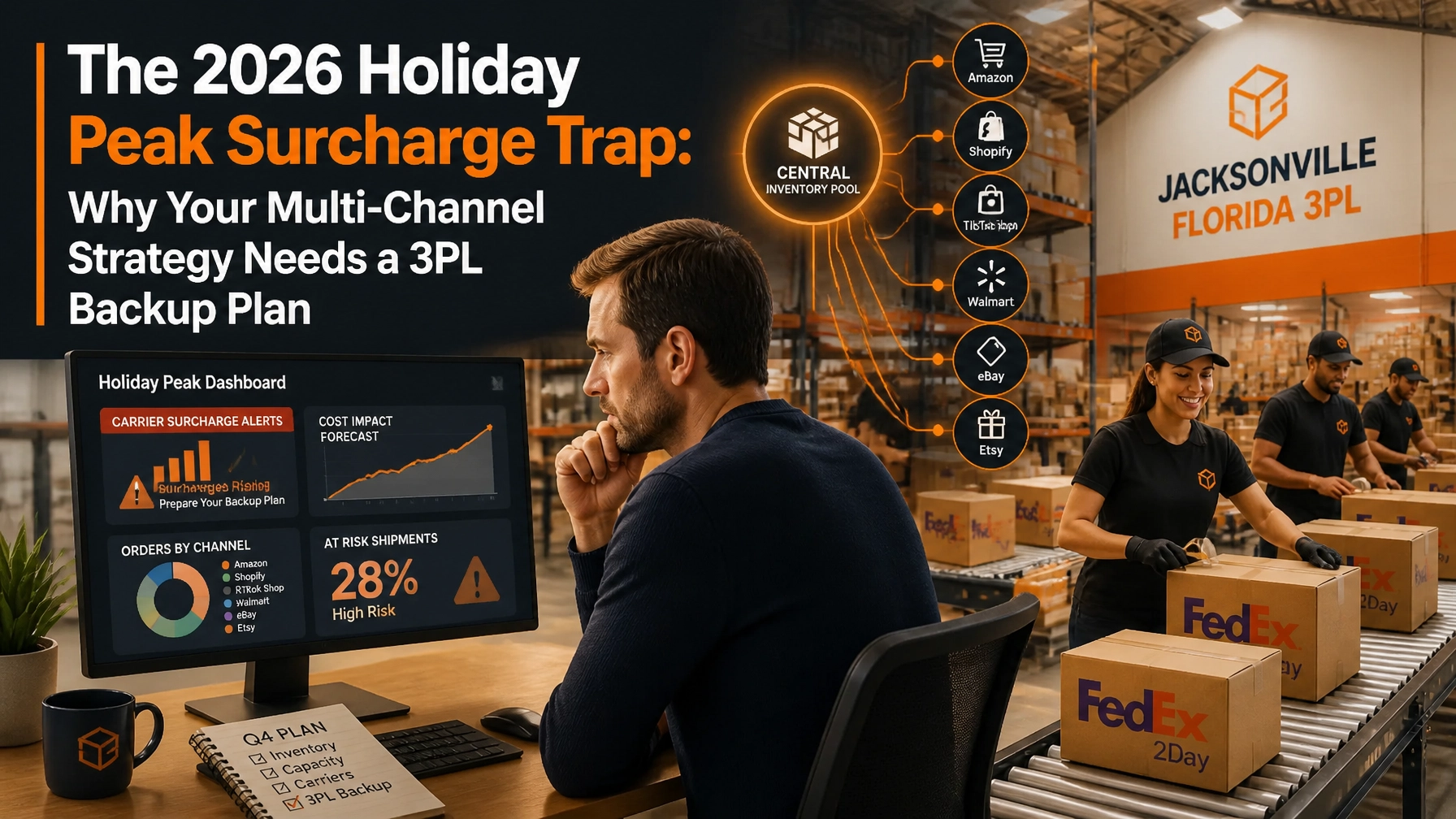
A seller with a multi channel strategy and a 3PL backup has more control. Inventory can be positioned outside Amazon and allocated across Amazon FBM, Shopify, TikTok Shop, Walmart, eBay, and Etsy. Orders can be routed through the service level that offers the best balance of cost and reliability.
The purpose is not to eliminate every surcharge. That is unrealistic. The purpose is to avoid being forced into the most expensive lane for every order.
What changes when you have a backup?
A capable 3PL can help you:
- Preserve inventory outside Amazon’s fulfillment network
- Maintain FBM availability when FBA stock becomes constrained
- Ship direct to Shopify and social commerce customers
- Rebalance stock across channels from one inventory pool
- Compare shipping costs by destination and service
- Protect customer delivery promises during carrier congestion
- Reduce the risk of marketplace stockouts
This is why 3rd party fulfillment services are not simply a storage alternative. During peak, they become a contingency system.
3. Why Does Multi Channel Fulfillment Matter During Peak?
Marketplace demand rarely moves evenly.
A TikTok Shop video can create an immediate spike. A Shopify promotion can outperform its forecast. Walmart demand can rise while Amazon sales soften. Etsy can produce strong seasonal demand for a specific product variation.
If all your inventory is isolated inside one channel, you cannot respond quickly.
Amazon MCF and FBA fees can spike during the same period that storage rates increase. Fulfillment windows tighten, and inbound replenishment can take longer when receiving networks are busy. A stockout during the highest demand weeks is not a minor inconvenience. It can lead to lost ranking, canceled orders, lower conversion, and missed promotional revenue.
A multichannel fulfillment operation gives you one operational view of available inventory. The warehouse management system should track:
- Sellable units by SKU
- Reserved units
- Channel allocations
- Reorder points
- Inbound purchase orders
- FBA replenishment shipments
- Daily order volume
- Same day shipping performance
- Carrier service and cost by lane
Your inventory strategy should match your SKU structure across channels. FBMFulfillment explains this issue in Amazon, TikTok, and Shopify walk into a warehouse, including why consistent SKU mapping is essential for accurate inventory synchronization.
The holiday peak surcharge becomes much easier to manage when your inventory is not trapped in one marketplace and your orders can move through multiple fulfillment paths.
4. What Should Your Q4 Backup Plan Include?
A backup plan must be operational, not theoretical. Here are the key steps.
Step 1: Pre position inventory before peak
Move your core Q4 inventory into your 3PL before carrier and warehouse networks become congested. Do not wait until Black Friday demand is already visible.
Use historical sales, current purchase orders, promotional calendars, and channel growth rates to set a practical reserve. Your goal is to hold enough inventory to support direct fulfillment without starving FBA or another marketplace.
Step 2: Set a same day shipping cutoff
A reliable cutoff creates a measurable service promise. Orders received before the cutoff should enter the pick, pack, and ship workflow that same day.
This is the operational value of same day fulfillment. It gives you a way to protect handling time even when carrier transit networks are under pressure.
Step 3: Use FedEx 2Day for a defined delivery commitment
For products where delivery speed affects conversion, plan around FedEx 2Day rather than an inconsistent promise based on average transit time.
Actual delivery depends on destination, pickup timing, holidays, weather, and carrier terms. Still, a dedicated FedEx 2Day strategy gives you a more consistent two business day framework than relying on the least expensive available service for every order.
Step 4: Create channel specific reorder points
Your Amazon reserve should not consume the units needed for Shopify, TikTok Shop, Walmart, eBay, or Etsy. Set separate thresholds and review them daily during peak.
When a channel approaches its reorder point, adjust the allocation before the listing shows unavailable.
Step 5: Test the fallback before November
Send test orders through every connected channel. Verify SKU mapping, address transmission, inventory deductions, shipping service selection, tracking updates, and customer notifications.
A backup plan that has never been tested is not a backup plan.

5. Why Consider a Jacksonville 3PL for Holiday Fulfillment?
Location affects lead times, carrier access, labor availability, and replenishment flexibility. A 3pl jacksonville operation can provide a strategic Southeast base for brands shipping throughout the United States.
FBMFulfillment operates from Jacksonville, Florida, with a model designed around ecommerce sellers rather than traditional pallet storage alone. The company provides:
- Same day fulfillment for orders received before the daily cutoff
- FedEx 2Day delivery planning
- Multichannel B2C fulfillment
- FBA replenishment and dripfeed storage
- Wholesale fulfillment
- Return processing with seller control
- One inventory pool for multiple sales channels
- No onboarding fees
- No minimums
- No long term contract requirements
For a brand searching for an ecommerce fulfillment center florida, Jacksonville offers a practical location for inventory staging and nationwide parcel distribution. The model is especially relevant for sellers who need a shopify fulfillment company that can also support Amazon FBM, TikTok Shop, Walmart, eBay, and Etsy without separating inventory into disconnected systems.
FBMFulfillment was built from an ecommerce seller’s viewpoint. That matters during Q4 because the focus stays on the problems sellers actually experience: missed cutoffs, stockouts, delayed replenishment, inaccurate inventory, expensive returns, and unclear carrier performance.
Learn more about the 3PL built by sellers for sellers or review the company’s multichannel fulfillment resources.

6. How Do You Avoid the 2026 Peak Surcharge Trap?
Start with a simple weekly review from September through January.
Track:
- Fulfillment cost per order
- Carrier surcharge cost
- FBA and MCF fees
- Storage cost by channel
- Same day ship percentage
- Delivery performance
- Stockout risk
- Return volume
- Available units outside Amazon
Do not evaluate Q4 only by gross revenue. Evaluate contribution margin after fulfillment, storage, carrier charges, marketplace fees, and returns.
The best lane is not always the lowest quoted rate. A slightly higher shipping cost can be financially superior if it protects conversion, reduces late delivery claims, and keeps a high velocity SKU available.
The holiday peak surcharge is manageable when you have options. It becomes dangerous when every order must follow one channel, one warehouse, or one carrier path.
Final Recommendation: Build the Backup Before Peak Begins
You have a problem if your Q4 plan depends on Amazon FBA capacity, one carrier agreement, or a single isolated inventory pool.
We have a solution: position inventory with a multichannel 3PL, connect every sales channel, establish same day fulfillment cutoffs, and use FedEx 2Day for orders where delivery reliability protects the sale.
FBMFulfillment provides same day fulfillment, Jacksonville based inventory control, no onboarding fees, no minimums, and multichannel support from one pool. If you are reviewing your Q4 readiness, contact FBMFulfillment. We will be glad to help you evaluate your inventory position, service requirements, and peak fulfillment options before the most expensive weeks arrive.
Sources
- FedEx 2026 Demand Surcharges
- FedEx 2026 Surcharge and Fee Changes
- Amazon 2026 FBA Fulfillment Fee Guidance
Key Takeaways
- Q4 shipping margins face pressure from the holiday peak surcharge, with rising carrier fees, FBA costs, and storage charges.
- A multichannel 3PL backup plan can reduce dependence on a single carrier or FBA, protecting against unexpected costs.
- Understanding carrier schedules for FedEx, UPS, and USPS is critical for managing surcharges during peak season.
- Establishing same day fulfillment and maintaining inventory flexibility can mitigate risks and improve customer service during high demand.
- Using a Jacksonville-based 3PL offers strategic advantages for ecommerce fulfillment, including same day shipping and multichannel support.