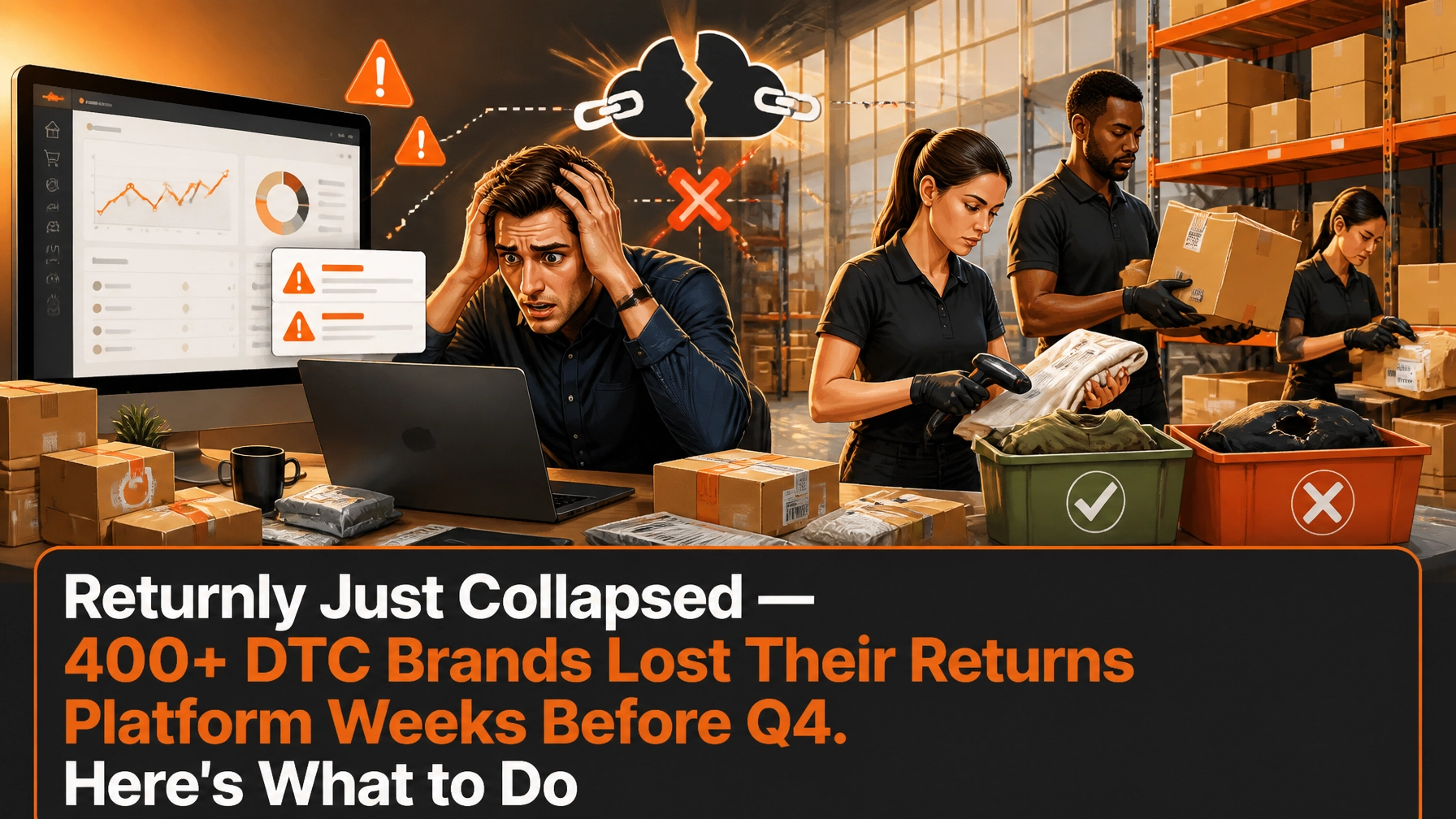
Returnly, the returns and credits fintech acquired by Affirm in 2021, ceased operations in June 2026 after a multiyear decline. Roughly 400 to 600 midmarket Shopify merchants were left without their returns platform just months before the Q4 2026 peak season. The crisis is severe because ecommerce returns management is already under pressure, with return volumes running 18% to 24% above the same period in 2025.
Brands are now scrambling to migrate to Loop Returns, AfterShip, and Happy Returns, the UPS owned returns network. But replacing software is only one part of the problem. Your inventory still has to come back, get inspected, be restocked, or be routed to the correct disposition.
You have a problem. We have a solution.
A reliable 3PL can keep your returns operation running even when a fintech layer disappears.
Important: This article reflects the August 2026 breaking news brief supplied for this report. Returnly’s original acquisition by Affirm is documented by Retail Dive, while the current migration landscape is also reflected in Loop’s Returnly transition resource.

1. What happened to Returnly, and why is the timing so dangerous?
Returnly was not simply a returns portal. It combined returns processing with instant credits, exchanges, and financial workflows. That made it deeply embedded in the post purchase experience for many Shopify merchants.
When the platform ceased operations, affected brands lost access to a critical operational layer.
The immediate risks include:
- Returns portals going offline
- Customer return requests becoming difficult to process
- Store credit and exchange workflows requiring reconstruction
- RMA data and return histories needing review
- Warehouse teams receiving returns without matching system instructions
- Restocking decisions becoming slower and less consistent
- Customer service teams handling more manual requests
The timing makes everything worse. Q4 is approaching quickly. Holiday orders generate more volume, more exchanges, more delivery issues, and more customer support tickets. A returns platform migration during this window creates a precarious chain reaction.
A brand can select replacement software in a week. That does not mean the warehouse workflows, inventory rules, customer communications, and financial processes are ready in a week.
What should affected merchants do immediately?
Do not wait for your return volume to expose the gaps.
- Export every available Returnly record. Save return histories, RMA details, customer information, store credit balances, and disposition records.
- List every integration. Identify connections to Shopify, your WMS, ERP, email platform, customer service tools, and accounting system.
- Choose a replacement returns platform. Evaluate Loop Returns, AfterShip, Happy Returns, or another provider based on migration support, reporting, integrations, and customer experience.
- Test the full workflow. Create a test return, receive the item, inspect it, approve or reject the disposition, update inventory, and confirm the customer notification.
- Coordinate with your 3PL before peak. Your warehouse must know how the new RMA structure, labels, inspection rules, and inventory updates work.
The most dangerous mistake is treating the migration as a software project only. It is an inventory and fulfillment project.
2. Is ecommerce returns management becoming a capacity crisis?
Yes. The Returnly shutdown arrived as return volume was already increasing across ecommerce.
Industry estimates for 2026 place ecommerce returns in the 18% to 24% range, depending on category and product mix. That means a brand shipping 10,000 orders during a major sales period could receive approximately 1,800 to 2,400 returns.
Those units require physical handling.
They must be received. Opened. Identified. Inspected. Graded. Restocked or isolated. Then the inventory record must be updated correctly.
Meanwhile, reverse logistics capacity is stretched thin. Warehouses are preparing for holiday inbound shipments and outbound order volume. Carrier networks are handling seasonal pressure. Warehouse labor is harder to reserve at the last minute.
This is where a fragile returns chain breaks.
A fintech vendor disappears. Return volume rises. The replacement platform is not configured. The 3PL has no dedicated inspection workflow. Returned products sit in an accumulating pile. Sellable inventory remains unavailable. Defective items risk being placed back into active stock.
That is not a customer experience issue alone. It is an inventory control failure.
3. Why does a returns platform migration fail without warehouse control?
A returns platform can tell you that a return has been initiated. It cannot replace disciplined physical processing.
The warehouse still needs clear answers:
- Did the correct SKU come back?
- Is the unit unopened, used, damaged, or defective?
- Is the packaging complete?
- Can it be sold to a new customer?
- Should it be restocked, refurbished, liquidated, or discarded?
- Does the inventory system show the correct available quantity?
- Should the customer receive a refund, exchange, or store credit?
Without defined processes, the answers become inconsistent.
One employee may approve a unit for resale while another isolates the same defect. A returned product may be placed into inventory without testing. A Shopify order may be refunded while the unit remains missing from the warehouse system. An Amazon, Walmart, TikTok, or eBay unit may be returned to the wrong channel inventory.
You have a problem: a returns app has vanished or changed direction.
We have a solution: move the physical return process to a fulfillment partner with direct possession and control of your inventory.
At FBMFulfillment, return processing includes total control over the physical return workflow. Returned products can be inspected before they are placed back into available inventory. Defective items are separated so they do not reach new customers. Restocking decisions remain connected to the inventory pool rather than trapped inside a marketplace or disconnected application.
4. What does a controlled 3PL returns operation look like?
A dependable ecommerce 3PL should give you visibility from the moment a return is authorized through final disposition.
A controlled process includes:
-
Return authorization and routing
The customer receives instructions and the return is routed to the correct warehouse. -
Receiving and identification
The warehouse scans the package, matches the RMA, and identifies the SKU and order. -
Condition inspection
The unit is inspected for defects, damage, missing components, signs of use, and packaging condition. -
Disposition decision
The product is approved for restocking, held for review, routed for refurbishment, or assigned to another disposition path. -
Inventory update
The available quantity reflects the actual condition of the returned unit. -
Customer and channel coordination
Refund, exchange, or credit actions are aligned with the customer record and the relevant sales channel.
This is the operational foundation of strong returns management services. The technology matters. The physical execution matters more.

5. Can one inventory pool protect brands across multiple channels?
It can, provided the fulfillment partner maintains accurate inventory possession and channel controls.
Many DTC merchants sell through Shopify while also operating on Amazon, Walmart, TikTok, eBay, Etsy, and Facebook. A return from one channel can affect inventory available to every other channel.
If the product is held in a marketplace system, the seller may not have full control over inspection, restocking, or disposition. That creates a dangerous gap. A defective unit can remain tied to inventory availability. A sellable unit can remain unavailable for days. A customer return can become a stockout somewhere else.
FBMFulfillment supports multi channel inventory possession from its Jacksonville, Florida fulfillment center. Your inventory remains under a unified operational process rather than being scattered across disconnected locations and systems.
That gives your team greater control over:
- Returns from Shopify and other direct channels
- Amazon FBM order inventory
- Wholesale inventory
- FBA replenishment and overflow inventory
- Restocking decisions
- Defective item isolation
- Same day fulfillment after inventory is approved
The advantage is simple: your inventory does not disappear just because one software vendor does.
6. What should you ask a 3PL before Q4 begins?
Do not accept a vague statement that returns are “supported.” Ask for process details.
Confirm the following:
- Does the warehouse inspect every returned unit?
- Who decides whether an item is resellable?
- How are defective units isolated?
- How quickly are approved units restocked?
- Can the warehouse support multiple sales channels?
- Does the WMS maintain an audit trail?
- Can the team process same day outbound orders during peak?
- Where is inventory physically located?
- Are there onboarding fees?
- Are there monthly minimums?
- Can the 3PL handle your current SKU count and expected Q4 volume?
A technology vendor may help you replace Returnly. A capable fulfillment partner helps you protect the inventory and customer experience behind the software.
FBMFulfillment offers same day fulfillment, reliable FedEx 2Day delivery, no onboarding fees, and no minimums. The Jacksonville, Florida location gives growing brands a practical fulfillment center southeast option while maintaining support for nationwide ecommerce operations.

7. What is the best solution for Returnly affected brands?
Do not rebuild the same fragile structure with a different logo.
A new returns platform can restore the customer facing workflow. But the long term protection comes from combining returns software with a fulfillment operation that controls receiving, inspection, restocking, and disposition.
That is the core lesson from the Returnly collapse.
Ecommerce returns management cannot depend entirely on a single fintech middleman. Your brand needs operational redundancy, direct inventory control, and a warehouse team that can execute when return volume spikes.
At FBMFulfillment, we built our operation from the viewpoint of ecommerce sellers who have experienced inventory delays, marketplace restrictions, and poor return visibility firsthand. Our return management for ecommerce keeps the physical process accountable while supporting your broader multichannel fulfillment operation.
Q4 is approaching fast. Do not wait for your returns portal, warehouse, or customer service team to fail under pressure.
Contact FBMFulfillment to discuss your return volume, inspection requirements, and fulfillment needs. We will be glad to help you build a more controlled returns operation before peak season.
Sources and further reading
- Retail Dive: Affirm to acquire returns startup Returnly for $300M
- Loop Returns: Welcome Returnly Merchants
- FBMFulfillment Contact Us
Key Takeaways
- Returnly ceased operations in June 2026, affecting 400 to 600 midmarket Shopify merchants during a peak returns season.
- Ecommerce returns management faces a crisis as return volumes exceed 18% to 24% above previous years, creating pressure on inventory control.
- Affected brands must act quickly to export records, choose a replacement platform, and coordinate with fulfillment partners.
- A controlled returns process with a reliable 3PL ensures proper inspection, restocking, and disposition of returned products.
- Long-term success depends on integrating returns software with a fulfillment operation that maintains direct inventory control.