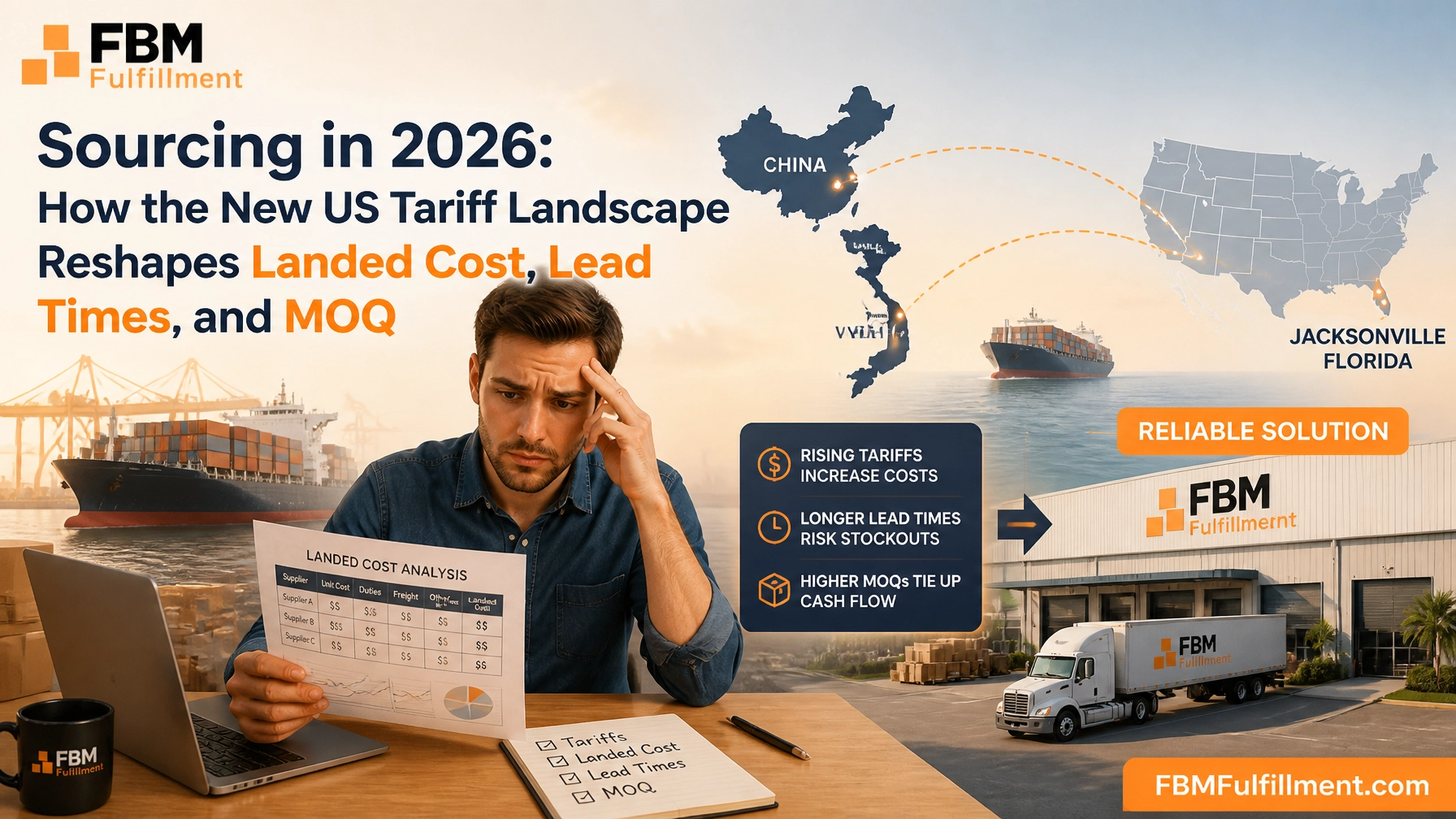
If you are sourcing products for the US market in 2026, landed cost is no longer determined by factory pricing alone. Baseline tariffs, Section 301 duties, customs fees, ocean freight, lead times, and minimum order quantities now directly affect your margin and cash flow.
A supplier offering the lowest unit price can still produce the worst financial outcome.
The problem is straightforward: a low factory quote does not protect your margin if tariffs add 25%, the MOQ consumes your working capital, or a 90 day replenishment cycle causes a stockout.
You have a problem. We have a solution: evaluate every sourcing country using the complete operating equation, then place cleared inventory in a US fulfillment network that can move orders quickly across every sales channel.
What changed in the 2026 tariff environment?
The 2026 import environment has several layers. They are applied according to the product’s HTS classification, country of origin, and applicable trade measures.
1. Baseline tariff rates still apply
Every imported product has a product specific duty rate under the Harmonized Tariff Schedule of the United States. Apparel, footwear, furniture, electronics, cosmetics, and other categories can have very different rates.
Do not use a country average as your final estimate.
Your first calculation must identify:
- The correct 10 digit HTS code
- The actual country of manufacture
- The customs value
- Any applicable trade agreement
- Any product specific tariff or quota
2. Section 301 duties continue to affect China
Many China origin products remain subject to Section 301 duties in addition to standard HTS rates. Depending on the product category, the Section 301 layer may be 7.5% or 25%, with substantially higher rates for certain strategic products.
The U.S. Trade Representative’s Section 301 China tariff information should be reviewed alongside the HTS schedule.
A China product with a 6% base duty and a 25% Section 301 duty does not have a 25% total tariff. It has a stacked tariff exposure before freight, brokerage, and domestic logistics are included.
3. De minimis is no longer a margin strategy
For 2026 planning, assume the complete end of duty free de minimis treatment for commercial ecommerce shipments, including packages valued at $800 or less. Shipments now require appropriate entry procedures and are subject to applicable duties, taxes, and fees.
The CBP de minimis factsheet and 2026 Federal Register rules provide additional detail.
Direct shipping every customer order from overseas can now create:
- Additional customs processing
- Duty collection problems
- Delivery delays
- Customer service issues
- Unexpected returns
- Margin erosion on low value orders
The practical answer is to import inventory in controlled commercial shipments, clear it properly, and fulfill domestic orders from a US warehouse.
How should you calculate landed cost?
Landed cost is the amount required to get sellable inventory from the supplier into your fulfillment operation.
A practical formula is:
Product cost + international freight + insurance + duties + Section 301 or other tariffs + customs brokerage + port charges + inland transportation + receiving costs + storage
FOB versus CIF: what is the difference?
Under an FOB quote, the supplier generally prices the goods through the agreed origin point, such as the factory or export port. You then arrange and pay for freight, insurance, customs handling, and inland delivery.
Under a CIF quote, the supplier includes the product cost, insurance, and freight to the named destination port. CIF can simplify quoting, but you still need to confirm:
- Which destination port is included
- Whether destination charges are excluded
- Who controls the carrier and customs broker
- Whether inland transportation is included
- How the customs value is calculated
- Whether the supplier has added a freight markup
Do not add freight twice. Do not assume CIF includes delivery to your warehouse.
US customs valuation depends on the transaction and applicable rules; duty is not automatically calculated from every expense shown on a commercial invoice. Your customs broker or trade professional should confirm the correct treatment for your product.
Example: why a cheaper supplier can cost more
Assume:
- FOB product cost: $10.00
- Freight and insurance allocation: $1.25
- Customs value used for the example: $10.00
- Base duty: 6%
- Additional tariff layer: 12.5%
- Brokerage, port, and domestic transportation allocation: $1.50
The product is not a $10.00 item in your inventory system.
It is closer to:
- Product cost: $10.00
- Base duty: $0.60
- Additional tariff: $1.25
- Freight and insurance: $1.25
- Domestic logistics and import handling: $1.50
- Estimated landed cost: $14.60
That $4.60 difference affects your advertising budget, marketplace fees, wholesale pricing, and contribution margin.

Which sourcing countries deserve consideration in 2026?
The table below is a planning framework, not a substitute for an HTS classification review. Tariff treatment can change by product, origin qualification, trade remedy, and current customs action.
| Sourcing country | 2026 tariff planning view | Typical production lead time | Typical MOQ reality | Seller perspective |
|---|---|---|---|---|
| China | Base HTS duty plus Section 301 duties and other applicable layers | 20–45 days | 100–1,000 units for many categories | Strong supplier depth, speed, tooling, and component access. Tariff stacking can be severe. |
| Vietnam | Base HTS duty plus applicable 2026 country and product layers | 30–60 days | 500–2,000 units | Strong alternative for apparel, bags, furniture, footwear, and consumer goods. Capacity and component sourcing require verification. |
| India | Base HTS duty plus applicable additional tariff layers | 30–75 days | 500–3,000 units | Useful for textiles, home goods, leather, jewelry, and selected consumer products. Supplier consistency varies by region and factory. |
| Pakistan | Base HTS duty plus applicable additional tariff layers | 45–75 days | 500–2,000 units | Relevant for textiles, towels, sports goods, leather, and apparel. Quality control and production scheduling are critical. |
| South Korea | Product specific duty, possible preferential treatment, and applicable additional measures | 20–45 days | 300–1,500 units | Strong for electronics, beauty, components, and higher specification products. Unit cost is often higher. |
| Japan | Product specific duty, possible preferential treatment, and applicable additional measures | 30–60 days | 300–1,500 units | Strong quality and engineering capabilities. Often better for premium products than low price products. |
| Thailand | Base HTS duty plus applicable additional tariff layers | 30–60 days | 500–2,000 units | Good fit for selected home goods, food related products, automotive components, and consumer goods. |
| Bangladesh | Base HTS duty plus applicable additional tariff layers | 45–90 days | 1,000–5,000 units | Competitive for apparel and textiles, but longer planning cycles and larger MOQs can tie up capital. |
| Colombia | 0% base duty for qualifying goods under the U.S.-Colombia Trade Promotion Agreement (TPA), but non qualifying goods face the standard country baseline layer plus HTS duty and any applicable additional measures | 20–45 days | 100–1,000 units | Attractive for shorter regional replenishment, apparel, leather, accessories, and selected agricultural or home categories. Verify TPA qualification carefully, including strict rules of origin such as Yarn Forward for applicable textile and apparel products. |
Tariff comparison by country: what actually stacks onto your HTS duty?
This is the part many sellers miss.
The baseline or special 2026 tariff layer does not replace your HTS duty. It stacks on top of the item’s specific 10 digit HTS code rate. That is the crux of landed cost in 2026.
A simple example: if a jacket from Pakistan carries a 5% HTS duty and the 2026 baseline layer is 12.5%, your estimated total tariff load is about 17.5% before brokerage, port charges, inland transportation, and storage.
Given the significant risks, use the table below as an estimate based planning tool only. Verify the exact 10 digit HTS classification, country of origin, trade program qualification, and any current exclusions or trade remedies with your broker before placing a PO.
| Country | 2026 Baseline/Special Tariff Layer | HTS Stack on Top | Total Effective Range (by category) |
|---|---|---|---|
| China | ~34% average effective under the 2026 Section 301 regime, including the Section 301 forced labor tariff layer effective July 24, 2026, plus legacy China tariff layers where applicable. Certain categories can spike much higher. | Product specific 10 digit HTS duty stacks on top. Many categories still face item specific base duties in addition to the China layer. | Common estimates: apparel ~34–54%, electronics ~34–39%, home goods ~37–42%, cosmetics ~34–37%. |
| Vietnam | ~10% baseline layer for planning purposes. | Product specific 10 digit HTS duty stacks on top, often keeping total exposure materially below China depending on classification. | Common estimates: apparel ~10–30%, electronics ~10–15% depending on HTS. Roughly half of China’s load in many categories. Be cautious of CBP transshipment risk if goods are actually China made. You need real substantial transformation in Vietnam. |
| India | 10% baseline layer for planning, reduced from a proposed 12.5% level. | Product specific 10 digit HTS duty stacks on top. Textile and apparel sellers should also watch for category specific anti dumping exposure where applicable. | Common estimates: electronics ~10–15%, apparel ~20–30%. |
| Bangladesh | 10% baseline layer for planning. | Product specific 10 digit HTS duty stacks on top, especially relevant for textile and apparel classifications. | Estimated ranges vary by HTS. Apparel can move materially above the baseline once HTS duty is added. Unfortunately, the ongoing US excess capacity investigation covering textiles and leather could trigger higher category specific tariffs soon. |
| Pakistan | 12.5% standard forced labor tier for consumer goods and manufacturing categories. | Product specific 10 digit HTS duty stacks on top. | Example planning math: a 5% HTS duty item lands near ~17.5% total tariff load. Apparel and textile categories can run higher depending on HTS. |
| Thailand | 12.5% baseline/special layer commonly applied to electronics, jewelry, and automotive parts. | Product specific 10 digit HTS duty stacks on top. | Estimated ranges vary by HTS. Electronics often stay in the mid teens once base duty is added, while jewelry and parts can climb higher by classification. |
| South Korea | 12.5% compound cap for planning purposes. Certain electronics have independent exclusions. | Product specific 10 digit HTS duty stacks on top unless a valid exclusion applies. | Estimated ranges vary by HTS. Many electronics remain in the low to mid teens, but category treatment must be verified line by line. |
| Japan | 12.5% compound cap for planning purposes, with trans Pacific exceptions in certain lanes or categories. | Product specific 10 digit HTS duty stacks on top unless a valid exception applies. | Estimated ranges vary by HTS. Electronics and engineered goods often remain moderate, but exact treatment depends on classification and exception status. |
| Colombia | 0% for qualifying goods under the active U.S.-Colombia Trade Promotion Agreement (TPA). Non qualifying goods or goods that fail TPA origin rules face the standard 12.5% baseline layer for planning, subject to current trade treatment. | For qualifying TPA goods, the base duty can be 0%. For non qualifying goods, the item specific 10 digit HTS duty stacks on top of the standard country baseline layer. Textile and apparel sellers must verify strict rules of origin, including Yarn Forward where applicable. | Two very different outcomes: qualifying TPA goods can be 0% duty, while non qualifying goods can land in the mid teens or higher once HTS duty is added on top of the baseline layer. Origin qualification is everything. |
| Mexico & Canada | 0% only for strictly USMCA compliant goods. | For qualifying goods, no additional tariff stack applies. For non qualifying goods, normal HTS duty and any applicable trade measures can still apply. | Best case: 0% for properly qualifying USMCA goods. Worst case: standard HTS and other measures if qualification fails. Do not assume North American shipping automatically means duty free treatment. |
Perhaps the most important takeaway: country level tariff headlines are never your final landed cost. Your real number is the baseline or special tariff layer plus the item specific HTS rate plus any other applicable trade remedy, fees, freight, and domestic handling costs.
Why is Vietnam attracting so much sourcing attention?
Vietnam is a serious alternative for sellers who need to reduce concentration in China without moving entirely to higher cost manufacturing regions.
Where Vietnam works well
Vietnam has established capabilities in:
- Apparel and footwear
- Bags and accessories
- Furniture and home goods
- Wood products
- Consumer goods
- Selected electronics assembly
- Outdoor and sporting products
The strongest opportunity is not simply “Vietnam has lower tariffs.” The better question is whether the total landed cost remains attractive after production, freight, MOQ, inspection, and inventory carrying costs are included.
What should you verify?
Some Vietnam factories rely on imported fabric, components, hardware, or subassemblies. If significant transformation does not occur in Vietnam, country of origin analysis becomes important.
Ask suppliers for:
- A complete bill of materials
- The manufacturing location for each major component
- Production records showing substantial transformation
- Factory ownership and subcontractor details
- Lead time by order quantity
- Sample, pilot, and production inspection procedures
- Carton dimensions and freight assumptions
Vietnam can reduce tariff exposure while increasing production lead time. Ocean freight routing to the US East Coast can also make the replenishment cycle longer than a China shipment moving through a different port network.
A 12% savings on duties is not a savings if you need to hold four additional months of inventory to prevent a stockout.
How do lead time and MOQ change the sourcing decision?
Tariffs are visible. Working capital pressure is often hidden.
Lead time affects inventory investment
Your total replenishment lead time includes:
- Product development
- Sample approval
- Production scheduling
- Manufacturing
- Quality inspection
- Export documentation
- Ocean transit
- Customs clearance
- Drayage and inland delivery
- Warehouse receiving
If your factory takes 45 days to produce and ocean freight takes another 35 days, you are already near an 80 day cycle before domestic receiving.
You need safety stock for that entire period.
MOQ affects cash flow
A supplier with a low tariff may require a 5,000 unit MOQ. If your landed cost is $14 per unit, that order requires $70,000 before the inventory begins generating revenue.
A second supplier may charge a higher unit price but accept a 500 unit MOQ. For a growing seller, the second option may produce a better return because it reduces:
- Cash tied up in inventory
- Storage exposure
- Product obsolescence
- Discounting risk
- Forecasting errors
The best sourcing country is not the one with the lowest tariff. It is the one that produces the strongest margin after tariff, lead time, MOQ, and demand risk are combined.
Where should cleared inventory live in the United States?
Once your inventory clears customs, it needs a reliable operational home.
A US based 3PL allows you to import consolidated freight, hold inventory domestically, and fulfill orders without repeating international customs procedures for every customer shipment.

FBMFulfillment.com is located in Jacksonville, Florida, a major port city positioned for direct ocean freight handling. Our team supports sellers with:
- Ocean freight container handling
- Importer of record support
- Domestic inventory receiving
- Same day fulfillment
- FedEx 2Day delivery
- Zero onboarding fees
- No minimum order requirements
- Single pool inventory control across Amazon, Shopify, TikTok Shop, Walmart, eBay, and Etsy
That single inventory pool matters. You can sell through multiple channels without dividing stock into isolated marketplace systems or sending every unit into Amazon storage.
Our shipping quote calculator can help you begin evaluating domestic fulfillment economics, and you can contact FBMFulfillment to discuss your sourcing and inventory plan.
What is the practical 2026 sourcing strategy?
Use this process before approving a supplier:
- Classify the product correctly. Confirm the HTS code and country of origin.
- Map every tariff layer. Include base duties, Section 301, sector measures, and applicable country surcharges.
- Build both FOB and CIF models. Confirm what freight, insurance, and destination charges are included.
- Calculate true cash exposure. Multiply landed cost by MOQ, then add safety stock.
- Model the complete lead time. Include production, ocean transit, customs, drayage, and receiving.
- Run a supplier audit. Verify factory capacity, component origin, quality systems, and subcontractors.
- Import into a US 3PL. Centralize inventory and fulfill marketplace orders domestically.
- Review quarterly. Tariff schedules, exclusions, freight rates, and supplier conditions change.
You have a problem: tariffs, lead times, and MOQs can quietly destroy a profitable product.
We have a solution: compare the full sourcing equation, then protect your margin with controlled imports, US inventory possession, and dependable third party logistics 3pl services.
A reliable fulfillment center in Florida can help turn a complicated global sourcing decision into a controlled domestic operating model. For sellers searching for a 3pl Jacksonville partner, FBMFulfillment provides the warehouse infrastructure and same day fulfillment support needed to scale across channels.
This article is for operational planning and is not customs, legal, or tax advice. Tariff treatment depends on the product, HTS code, country of origin, valuation, and current US trade rules. Confirm final classifications and duties with a qualified customs broker or trade counsel.
Sources and planning references
- USITC Harmonized Tariff Schedule
- USTR Section 301 China tariff actions
- CBP suspension of duty free de minimis treatment
- Federal Register 2026 de minimis interim rules
- Dimerco 2026 US tariff update
Key Takeaways
- In 2026, landed cost involves more than factory pricing; tariffs, duties, and fees now impact margins.
- Understanding the comprehensive operating equation helps evaluate sourcing decisions effectively.
- Calculating landed cost requires including various components like production cost, tariffs, and transportation fees.
- Verify supplier details and compliance to avoid hidden costs and potential supply chain issues.
- Utilizing a US 3PL for inventory management streamlines fulfillment and reduces logistical challenges.