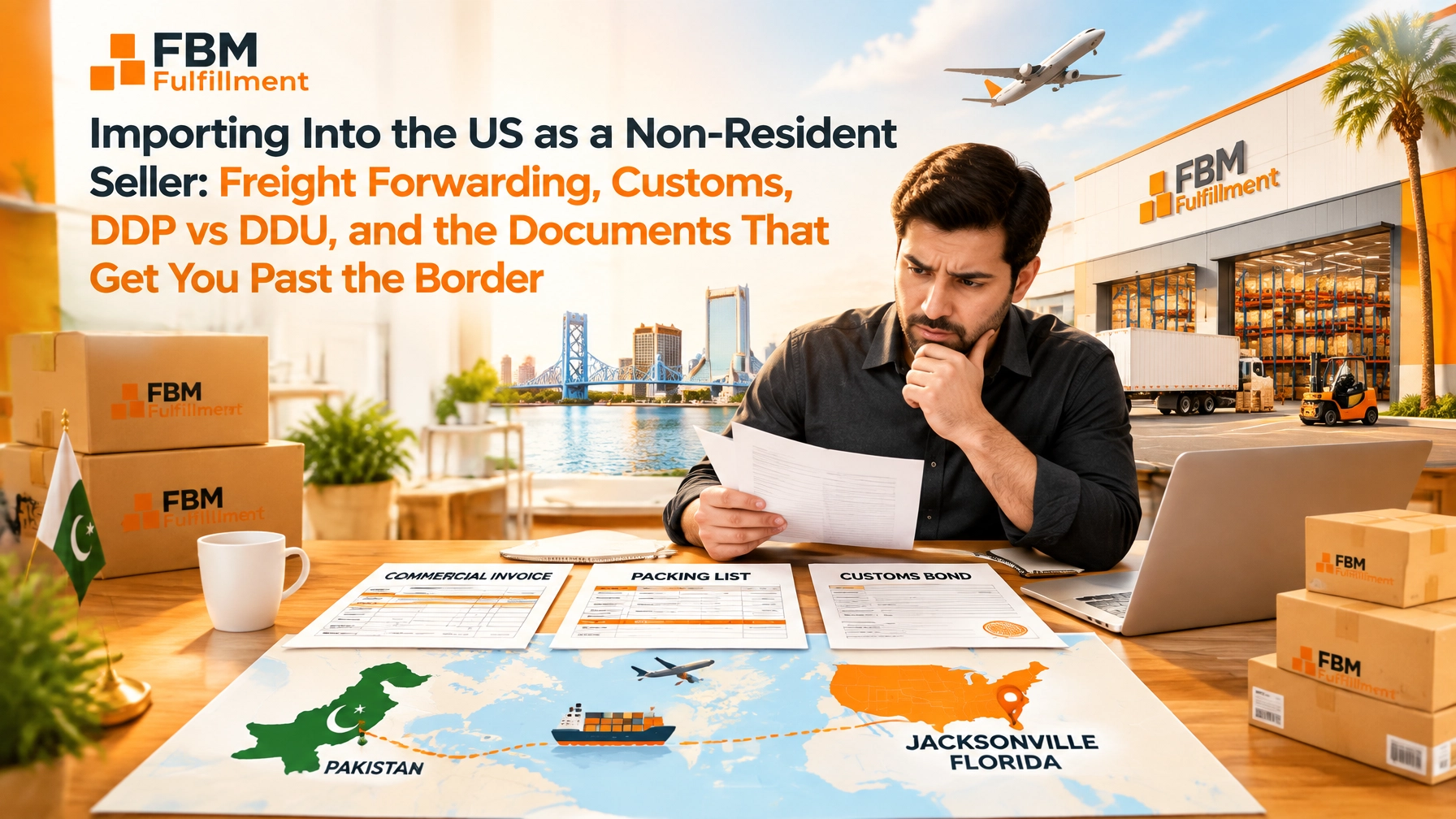
You have products, customers, and a plan to sell in the United States. Now you need to get inventory into a US warehouse without creating a customs problem. The first question is simple: who is the importer of record? From freight forwarding and customs bonds to DDP vs DDU, this guide explains the import process step by step using a Pakistani seller shipping inventory to FBMFulfillment’s Jacksonville warehouse as our running example, but the same process applies to sellers in Vietnam, China, India, the EU, the UK, and anywhere else outside the United States.
Important 2026 update: The Section 321 de minimis exemption has been indefinitely suspended. The old assumption that commercial shipments valued below $800 can enter duty-free without a normal customs process is no longer valid. Even one low-value carton now requires a customs entry, duty payment, and a customs bond. There is no safe “test box under the radar.”
This article is educational and does not replace advice from a licensed customs broker, tax professional, or attorney.
1. Who Does What Before Your Inventory Reaches the US?
International shipping involves several parties. Confusing their responsibilities creates delays, unexpected charges, and serious liability.
What does a freight forwarder do?
Your freight forwarder moves the cargo. The forwarder typically:
- Books ocean or air transportation
- Arranges pickup from your factory
- Consolidates LCL or air freight
- Coordinates export-side paperwork
- Issues or manages the bill of lading or air waybill
- Tracks the shipment from origin to the United States
A freight forwarder is not automatically your customs broker. Moving cargo and clearing cargo are different jobs.
What does a customs broker do?
Your customs broker clears the cargo. A licensed US customs broker:
- Files the entry with US Customs and Border Protection
- Reviews or assigns HTS classifications
- Calculates duties and government fees
- Arranges your customs bond
- Coordinates with CBP
- Handles Partner Government Agency requirements when necessary, including FDA, USDA, EPA, DOT, or FWS filings
For a non-US resident seller, choosing the right customs broker is one of the most important decisions in the entire process.
Who is the importer of record?
The importer of record is the party legally responsible for the goods entering the United States. That party is responsible for:
- Accurate classification
- Correct valuation
- Country of origin
- Regulatory compliance
- Duty and fee payment
- Responding to CBP after entry
For the non-US resident seller model described here, your overseas company should be identified as the Foreign Importer of Record, or FIOR. You retain ownership of the inventory while FBMFulfillment stores and ships it for you.
A 3PL, like FBMFulfillment, is the ultimate consignee and delivery destination. It is listed as the deliver-to party, not the owner or importer. The 3PL should not act as the importer of record because it does not own your products. Taking that role would expose the 3PL to potential customs fraud claims, safety violations, and back duties connected to merchandise it did not purchase or control.
2. Should You Ship DDP or DDU to Your US 3PL?
What is DDP?
DDP means Delivered Duty Paid. Under DDP, you or your freight provider arrange and prepay:
- International freight
- Customs clearance
- Duties
- Broker fees
- Delivery to the named US warehouse
For a non-resident seller shipping inventory to a US 3PL, DDP is the correct operating model. Your shipment instructions should clearly state:
DDP : FBMFulfillment Jacksonville warehouse address
What is DDU?
DDU means Delivered Duty Unpaid. It is also commonly described as collect shipping. Under DDU:
- The shipper does not prepay import duties and clearance charges
- The receiving party is expected to pay before delivery
- The 3PL may be presented with unexpected charges
A fulfillment warehouse should reject DDU or collect shipments. The warehouse is providing logistics services for your inventory. It should not be forced to advance duties, terminal charges, or customs fees on your behalf.
When comparing DDP vs DDU, the practical answer is clear: use DDP to the 3PL’s warehouse address and confirm in writing who will appear as the importer of record on the customs entry.
3. What Must You Set Up Before Your First Shipment?
You need four prerequisites before shipping commercial inventory.
1. Obtain a non resident EIN (See Clearit.com below)
A non resident EIN is an IRS Employer Identification Number issued to a foreign entity. Because you generally do not have a US SSN or ITIN, you cannot use the standard online EIN application.
You apply using IRS Form SS-4 by fax, mail, or the international IRS phone process. The IRS states that international applicants can submit Form SS-4 by fax or mail. Allow approximately 2 to 4 weeks for the process, although timing can vary. Clearit’s team confirms that a US entity is not required to proceed as a non-resident importer. Foreign Articles of Incorporation are acceptable for verification, and a sole proprietor can also qualify. For an individual, the POA title would be listed as self.
- Direct IRS filing: $0
- Paid filing assistance: commonly $150 to $300
Start here first. The EIN is often the bottleneck before you can finalize importer registration and a bond.
2. Complete CBP Form 5106 (See Clearit.com below)
CBP Form 5106 establishes or updates your importer identity in CBP systems and helps obtain a CBP Assigned Number when appropriate. Your broker can facilitate the filing and verify your importer information. A digital broker like Clearit can facilitate this for you — including Non-Resident Importer setup at no additional charge.
3. Purchase a customs bond (See Clearit.com below)
A customs bond guarantees that applicable duties, fees, and compliance obligations will be paid. In the 2026 operating environment described above, every commercial shipment requires a bond, including a low-value air carton.
Your two main options are:
- Single Entry Bond: Covers one shipment.
- Continuous Bond: Covers qualifying shipments for 12 months.
If you plan to replenish inventory regularly, a continuous bond is usually the more practical choice. Clearit’s team also notes there is a good chance future US rules for non-resident importers will require an Annual Continuous Bond, so sellers should budget for the $500 annual bond even if they begin with single entry bonds.
4. Sign a broker Power of Attorney (See Clearit.com below)
You must authorize your licensed customs broker to act on your behalf. The POA allows the broker to file entries, communicate with CBP, and coordinate clearance under your importer account.
Clearit’s team confirms that for a foreign business, the Power of Attorney should be signed by a person with one of these titles: General Manager, Managing Director, Officer, Director, Deputy Director, or Assistant Manager. For an individual sole proprietor, the title should be self. A non-resident certification or comparable proof of legal existence may also be required. Clearit strongly recommends including a copy of a valid government-issued ID for the person signing the POA now, and notes this is expected to become mandatory very soon.
4. Why Consider Clearit for Your Importer Setup?
For many non-resident sellers, a digital customs broker simplifies the process. Clearit can support HTS classification, entry filing, bond purchase, importer setup and verification, Non-Resident Importer support, CBP Form 5106 facilitation, and PGA filings when required. There is no charge from Clearit for Non-Resident Importer of Record setup. If you are a non-US seller without a US entity, this is the recommended option — you can establish your importer identity without paying an extra setup fee. Clearit’s team confirms there are no fees for account setups of any sort. NRI registration is part of their onboarding process: they verify and register the account with US CBP, help open the bond, and help register the CBP Assigned Number, also called the CAN or CAIN, as part of the importer identity process. They also confirm that foreign Articles of Incorporation are acceptable for verification, so forming a US LLC or corporation is not required.
Clearit’s team advises that the normal onboarding timeline is about 3 days to get the non-resident importer registered, verified, and bonded. Faster is possible, but 3 days is the comfortable timeline. This becomes critical for ocean freight because all of this must be completed before the ISF can be filed. Start account setup no less than 1 week before vessel departure. If you begin 2 days before the container sails, you are too late.
You can begin through the FBMFulfillment referral link:
Start your Clearit importer setup through the FBMFulfillment link
Clearit’s published US pricing includes the following:
| Service | Published fee |
|---|---|
| Ocean brokerage, including 3 HTS codes and 1 invoice | $149.95 |
| Air brokerage, including 3 HTS codes and 1 invoice | $129.95 |
| Truck brokerage, including 3 HTS codes and 1 invoice | $89.95 |
| Non-Resident Importer of Record (NRI) setup | No charge |
| On-time ISF filing | $50.00 |
| Merchandise Processing Fee | 0.3464%, minimum $33.58, maximum $651.50 |
| Harbor Maintenance Fee | 0.125% |
| PGA filing, if required | $35.00 |
| Prior Notice, if required | $35.00 |
| Disbursement | 5% of duty, MPF, and payables |
| CFS, CES, or terminal payment | $25.00 plus disbursement |
| Additional HTS classification | $15.00 each |
| Additional invoice | $15.00 each |
| ISF bond, if required | $90.00 |
| Handling fee | $25.00 |
| Late ISF filing | $100.00 |
| Single Entry Bond | Minimum $40.00, plus $35.00 preparation and $5.00 per $1,000 of shipment value |
| Continuous Annual Bond | $500.00 |
Fees can change, and your product category may require additional services. Confirm the final quote before shipping.
Clearit onboarding timeline
- Typical timeline: about 3 days for verification, CBP registration, CAN or CAIN registration, and bond setup
- For ocean freight: start at least 1 week before vessel departure because importer setup must be completed before the ISF can be filed
- Practical warning: if you start 2 days before the container sails, you are too late
5. Why Consider ExFreight for Freight Forwarding?
For the freight forwarding side, FBMFulfillment recommends ExFreight as a digital freight forwarding marketplace for the ocean or air leg of your shipment.
Who is eligible to use ExFreight?
ExFreight offers a free account. Businesses established in the United States, Canada, EU, Australia, Korea, and Japan are eligible to open an account. If your business is established in another country not on that list but you have a US entity such as an LLC or corporation, you are also eligible to open an account in the name of your US entity.
Why use ExFreight?
- Free account
- Very quick and easy to use with instant quotes
- Competitive rates
- A competitive marketplace model that searches options across carriers, shows hundreds of options, and ranks them according to your preference such as cost or on time performance
- All quotes are port to door, helping you avoid hidden fees
- Supports Parcel, Air, LCL, and FCL shipping
- Full visibility and control of routing options including ports, carriers, and transit times
- Excellent tracking
- Excellent customer service
- Based in the USA, in Florida, which matters for East Coast and Southeast inbound routing to Jacksonville
How does ExFreight fit with Clearit?
Use ExFreight for the freight forwarder and cargo movement side. Use Clearit for the customs broker and customs entry side. They are complementary pieces of the same import flow.
6. What Belongs on Your Commercial Invoice?
Your commercial invoice must be in English and should give both CBP and your broker a complete picture of the shipment.
Include:
- Your legal entity name, origin-country address, and contact information as shipper/exporter
- Your company name marked Foreign Importer of Record
- Your non-resident EIN or CBP Assigned Number
- FBMFulfillment’s legal company name, Jacksonville warehouse address, and receiving contact
- Invoice number and date
- Purchase order number, if applicable
- Plain-English descriptions for every line item
- Material and intended use
- Six to ten digit HTS code
- Country of origin
- Quantity and unit of measure
- Unit price and total value in USD
- Currency stated as USD
- Incoterms stated as DDP to the FBMFulfillment warehouse address
Do not use only a SKU number as the product description. “ABC-100” does not explain what the product is, what it is made from, or how it is used.
Do not declare a value of $0. Even if you are transferring your own inventory to the United States, you must declare a realistic customs value. “Value for customs purposes only” without a dollar value can trigger questions or a hold.
7. What Belongs on Your Packing List?
Your packing list tells the broker, carrier, CBP, and warehouse team how the shipment is physically organized.
Include:
- Shipper, importer, and ultimate consignee information matching the invoice exactly
- Commercial invoice reference number
- Total pallet and carton count
- Length, width, and height for each master carton
- Gross and net weight per carton
- Item quantities by carton
- SKU or model numbers matching your 3PL inventory system
- UPC, EAN, or another scannable barcode on every sellable unit
Number cartons clearly: Box 1 of 50, Box 2 of 50, and so forth. Your manifest must match those carton numbers.
The invoice and packing list must reconcile exactly. Differences in quantities, values, or carton counts can trigger a customs exam and delay warehouse receiving.
8. How Do Entry Rules Apply to Different Shipment Sizes?
With de minimis suspended, shipment size changes the entry type, not whether the shipment needs customs processing.
| Example | Entry treatment | Bond and cost considerations |
|---|---|---|
| One air carton under $2,500 | Informal Entry Type 11 | Entry, duties, and bond still apply. Courier processing may add approximately $25 to $50 plus duties. |
| Multi-pallet shipment valued at $8,000 | Formal Entry Type 01 | Single Entry Bond may cost approximately $75 to $150. Ocean shipments may also require an ISF bond. |
| $40,000 full container | Formal Entry Type 01 | A continuous bond is the logical choice for repeated imports. Clearit lists its annual bond at $500. |
A low-value carton is not an excuse to ship without a broker, bond, realistic invoice, or declared value.
9. What Happens When Your Cargo Lands?
The normal flow is:
- Your ExFreight-arranged shipment delivers to the US port or airport.
- Your customs broker files the entry with CBP using the bond.
- Duties, broker fees, and other charges are paid under the DDP arrangement.
- CBP releases the cargo.
- The shipment moves to FBMFulfillment’s Jacksonville facility.
- The receiving team checks carton counts against the packing list.
- Barcodes are scanned and SKUs are reconciled.
- Inventory is placed into your account and available for fulfillment.
Your inventory remains yours. FBMFulfillment provides storage, receiving, preparation, shipping, and return control. Once orders arrive from Amazon, Shopify, TikTok Shop, Walmart, eBay, or Etsy, inventory can be shipped through a single pool with same day fulfillment and FedEx 2Day service.
10. US Sales Tax: What a Non-Resident Seller Actually Needs to Do
Here is the good news. Sales tax is usually the part that scares overseas sellers the most, but for marketplace sales, the system is far simpler than many expect.
Every US state that charges sales tax has enacted marketplace facilitator laws. When you sell on a marketplace such as eBay, Amazon, Walmart, Etsy, or TikTok Shop, the platform automatically calculates, collects, and remits US sales tax to the state. The tax money never touches your account. You do not need to register for sales tax permits across 45 plus states for marketplace sales, and you do not file sales tax returns in those states for those sales. This removes the single most intimidating piece of US compliance for a non resident seller.
What is the physical nexus catch?
There is one important catch. Storing inventory in a US state creates a physical presence, also called nexus. Because your goods sit in a 3PL warehouse, for example FBMFulfillment’s Jacksonville, Florida facility, you have a business presence in that state in the eyes of tax authorities.
What changes if you sell outside marketplaces?
If you ever add a direct website such as Shopify, WooCommerce, or Magento fulfilled from the 3PL, marketplace facilitator rules no longer apply to those direct orders. You would need to register for a sales tax permit in the state where your inventory is stored, and potentially other states as you grow, collect tax on direct orders shipped to buyers in that state, and remit it. That is why sellers who add direct channels should consult a US ecommerce CPA before launch.
Practical guidance
- For marketplace only sellers: no sales tax registration is needed for marketplace sales. The platform handles it.
- For direct channel sellers: register for a sales tax permit in the state where your 3PL warehouse is located, collect and remit for in state direct sales, and get professional help as you expand.
- Keep flawless records of US sales regardless: your home-country tax authority, for example Pakistan’s FBR or your local equivalent, may ask for proof of international ecommerce revenue, and good records protect you both at home and abroad.
- This article is educational, not tax advice: confirm the current rules with a licensed tax professional or US ecommerce CPA.
11. Why Is Jacksonville a Practical Location for Your Import Program?
A 3PL Jacksonville location gives you a port-city advantage. Your inbound freight can reach a nearby fulfillment operation, reducing unnecessary domestic transportation after customs release.
FBMFulfillment supports non-US resident sellers with:
- No onboarding fees
- No minimums
- No long-term contracts
- Post-pay invoicing
- Competitive fulfillment and shipping rates
- Receiving and inventory reconciliation
- FBA and FBT-style preparation
- Same day fulfillment
- Controlled returns processing
- Multichannel inventory management
If you are searching for a fulfillment center in Florida, ecommerce fulfillment near me, 3rd party fulfillment services, or b2b order fulfillment services, the import process should be part of your evaluation: not an afterthought.
You Have an Import Problem. We Have a Solution.
You have a problem. The US border is a wall of forms, bonds, classifications, fees, and deadlines. One mistake can hold your inventory for weeks or cost more than the goods are worth.
FBMFulfillment has a solution: a seller-focused fulfillment operation with clear receiving standards, a strategic Jacksonville location, startup-friendly terms, and experience supporting overseas sellers who retain ownership of their inventory.
Use ExFreight for the freight forwarder side and Clearit for the customs broker side. Begin your customs setup with a licensed customs broker through Clearit via the FBMFulfillment affiliate link. And remember: Clearit charges no fee for Non-Resident Importer of Record setup, making it the recommended choice for overseas sellers establishing their importer identity. Clearit’s team also confirms that you do not need a US entity, foreign Articles of Incorporation are acceptable, and sole proprietors can qualify. Their normal onboarding timeline is about 3 days, but for ocean freight you should start no less than 1 week before vessel departure because the importer account and bond must be in place before the ISF can be filed. If you want to use ExFreight, remember the account eligibility rules: businesses established in the United States, Canada, EU, Australia, Korea, and Japan can open accounts directly, and sellers in other countries can still qualify if they have a US entity such as an LLC or corporation. Then contact FBMFulfillment at sales@fbmfulfillment.com or +1 (904) 530-9694 to coordinate your receiving requirements before you book freight.
Key Takeaways
- The article explains the crucial role of the importer of record in shipping inventory to the US, highlighting responsibilities like classification and duty payment.
- It discusses the differences between DDP and DDU shipping methods, recommending DDP for non-resident sellers to avoid unexpected fees.
- The article outlines key prerequisites for shipping, such as obtaining a non-resident EIN and completing CBP Form 5106.
- Clearit facilitates the process of becoming an importer of record, offering support for non-resident sellers without additional setup fees.
- FBMFulfillment and ExFreight are recommended partners for customs brokerage and freight forwarding respectively, optimizing the import process.
Related Links
- FBMFulfillment Inbound Freight & Customs: Your Global Pipeline to Jacksonville
- The Non-Resident’s Playbook: How to Sell on Amazon, Etsy, eBay & Shopify in the US Market in 2026
- What the White House ‘Transshipment Scam’ Report Means for E-Commerce Importers and Sellers
- International Brands Seeking US Fulfillment
- Etsy Now Requires Non-US Sellers to Prepay US Duties (DDP) : What Changes and How to Stay Compliant
Frequently Asked Questions
Four prerequisites: a Non-Resident EIN (IRS Form SS-4, roughly 2-4 weeks, $0 filing directly or $150-$300 with paid help – no US entity required); CBP Form 5106 to establish or update importer identity (a broker can typically file this at no extra charge); a customs bond (a Single Entry Bond for one shipment, or a Continuous Bond covering 12 months of shipments, roughly $500/year); and a Broker Power of Attorney authorizing a licensed customs broker to file entries and communicate with CBP on the importer’s behalf.
The Section 321 de minimis exemption has been indefinitely suspended, so the old assumption that commercial shipments under $800 could enter duty-free without a normal customs process no longer holds – every shipment, including low-value cartons, now needs proper customs processing.
A freight forwarder books ocean or air transportation, arranges pickup from the factory, consolidates LCL or air freight, handles export-side paperwork, and tracks the shipment to the US. A customs broker is a separate role: filing the entry with CBP, reviewing or assigning HTS classifications, calculating duties and fees, arranging the customs bond, and handling any Partner Government Agency requirements (FDA, USDA, EPA, DOT, FWS).
The importer of record carries legal responsibility for goods entering the US – accurate classification, correct valuation, country-of-origin compliance, duty/fee payment, and responding to CBP. For non-US resident sellers, the overseas company itself serves as a Foreign Importer of Record (FIOR), retaining ownership of the inventory. The 3PL only acts as the ultimate consignee and delivery destination – not the owner or importer – which protects it from customs fraud liability.
Under DDP (Delivered Duty Paid), the seller or freight provider prepays international freight, customs clearance, duties, broker fees, and delivery to the named US warehouse. Under DDU (Delivered Duty Unpaid, also called collect shipping), the seller doesn’t prepay those charges and the receiving party is expected to pay before delivery. The recommendation is DDP shipped directly to the 3PL’s warehouse address, with written confirmation of who’s designated as importer of record – fulfillment warehouses should reject DDU arrangements.
Clearit is the customs brokerage the article recommends – it handles HTS classification, entry filing, bond purchase, importer setup and verification, Non-Resident Importer (NRI) support, CBP Form 5106 filing, and PGA filings, all with no charge for Non-Resident Importer of Record setup itself. Onboarding typically takes about 3 days to get registered, verified, and bonded. For ocean freight specifically, sellers should start the setup at least 1 week before the vessel departs, since everything needs to be complete before ISF filing – starting just 2 days before departure is too late.
The commercial invoice must be in English and include the shipper’s legal name and address, the company marked as “Foreign Importer of Record,” the Non-Resident EIN or CBP Assigned Number, FBMFulfillment’s legal name and warehouse address, invoice number and date, plain-English line-item descriptions (not just SKU numbers), material and intended use, a 6-10 digit HTS code, country of origin, quantities, unit and total value in USD, and Incoterms stated as “DDP to the FBMFulfillment warehouse address.” The packing list needs matching shipper/importer/consignee info, the invoice reference number, total pallet/carton counts, dimensions and weights per carton, item quantities, SKU numbers matching the 3PL’s system, and a scannable barcode on every sellable unit. The invoice and packing list must reconcile exactly, or the shipment risks delay or customs examination.
Yes. A single air carton under $2,500 typically clears as an Informal Entry (Type 11), with the courier adding roughly $25-$50 plus duties. A multi-pallet shipment around $8,000 needs a Formal Entry (Type 01) with a Single Entry Bond (roughly $75-$150). A full container around $40,000 also needs a Formal Entry, and a continuous $500/year bond makes more sense for sellers importing repeatedly. Even low-value cartons still require a broker, a bond, a realistic invoice, and a declared value.
For marketplace sales (Amazon, eBay, Walmart, Etsy, TikTok Shop), no – every US state that charges sales tax has marketplace facilitator laws requiring the platform itself to calculate, collect, and remit the tax, so the money never touches the seller’s account and there’s no need to register in 45+ states. That changes if a seller also fulfills direct sales through their own website (Shopify, WooCommerce, Magento) from the 3PL warehouse – marketplace facilitator rules don’t apply there, so the seller needs to register for a sales tax permit in the state where inventory is stored and collect/remit tax on direct in-state orders themselves. This is educational information, not tax advice, and sellers are advised to confirm current rules with a licensed tax professional.
Use ExFreight for freight forwarding and Clearit for customs brokerage – the two are complementary, with ExFreight moving the cargo and Clearit handling the entry. Start the Clearit account setup through FBMFulfillment’s link, since Non-Resident Importer of Record setup is free through that channel. Then contact FBMFulfillment directly (sales@fbmfulfillment.com or +1 (904) 530-9694) to coordinate receiving requirements before booking freight. Once cleared, cargo moves to FBMFulfillment’s Jacksonville facility, where the receiving team checks carton counts against the packing list, scans barcodes, reconciles SKUs, and places inventory into the account – the seller retains ownership throughout, with FBMFulfillment handling storage, receiving, prep, shipping, and returns.