A new White House report puts importer of record responsibility and country-of-origin accuracy under sharper scrutiny. For e-commerce sellers, the issue is not political. It is operational.
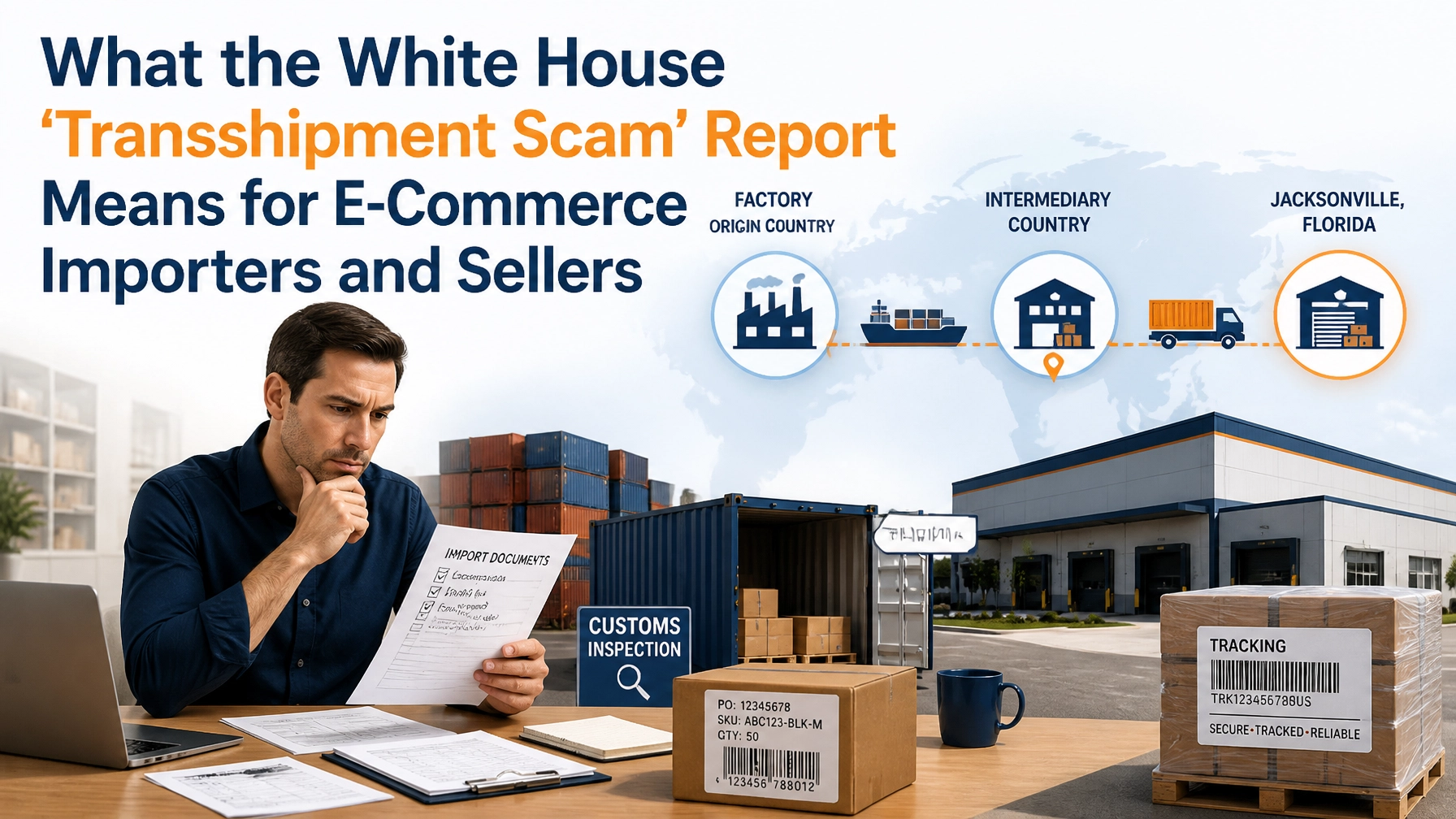
The 25-page report, titled The Great Transshipment Scam, describes concerns that goods may be routed through intermediary countries, relabeled, repackaged, or minimally assembled before entering the United States under a different origin declaration.
The report estimates that tariff-avoiding transshipment could affect between $19 billion and $26 billion in annual US tariff revenue, while citing broader estimates of transshipped goods ranging from approximately $34.2 billion to $303 billion annually. Those figures are estimates presented in the report, not a finding that every shipment routed through a third country is unlawful.
For sellers, however, the message is clear: supply chain transparency is becoming a commercial requirement, not merely a customs preference.
What is the transshipment concern?
Transshipment itself is not automatically illegal. Goods can legitimately move through multiple countries before reaching the United States.
The compliance problem arises when an intermediary country is used to make goods appear to originate there even though the manufacturing process did not create a valid change in origin. The report cites activities such as:
- Limited assembly
- Finishing work
- Repackaging
- Relabeling
- Documentation changes
- Routing through bonded warehouses or free trade zones
The central question is whether the processing in the intermediary country created a legally recognized substantial transformation. A shipping route alone does not determine origin.
Goods manufactured in one country do not automatically become products of another country simply because they were shipped through a different port, stored in another warehouse, or placed in new packaging there.
The Fox News report summarizes the White House position and identifies more than 40 countries described as presenting elevated transshipment risk. The report mentions countries across several regions, including Panama, Mexico, Colombia, Brazil, Argentina, Chile, Peru, Costa Rica, and the Dominican Republic.
That does not mean every supplier, shipment, or importer connected to one of these countries is noncompliant. It means routing patterns involving intermediary countries are likely to receive more attention.

1. What does importer of record responsibility mean?
The importer of record is generally responsible for ensuring that an entry is accurately classified, valued, documented, and supported. Depending on the transaction structure, this may be the seller, a US subsidiary, a customs intermediary, or another designated party.
The important point is simple: you cannot outsource your underlying compliance responsibility by forwarding a supplier’s statement to a customs broker.
If a supplier or foreign intermediary provides an inaccurate country-of-origin declaration, the importer can face consequences even when the seller did not personally create the paperwork.
Potential consequences include:
- Retroactive tariff assessments
- Customs penalties
- Cargo detention
- Shipment seizure
- Requests for manufacturing records
- Compliance audits
- Additional bonding requirements
- Disruption to inventory availability
- Marketplace stockouts and delayed customer orders
The report states that CBP is using prototype artificial intelligence tools to identify possible transshipment patterns. These tools may analyze shipment data, routing histories, product information, and inconsistencies across documents.
That creates a new operational reality. CBP does not need to examine every carton individually to identify a pattern. Repeated routing through the same intermediary country, inconsistent supplier addresses, unusual documentation, or a mismatch between declared origin and production records can create a risk signal.
Can a foreign importer of record protect your business?
A foreign importer of record structure does not automatically eliminate the seller’s exposure. The legal and commercial consequences depend on the transaction, customs entry, contracts, ownership structure, and applicable regulations.
Sellers should understand exactly:
- Who is listed on each customs entry.
- Who provides the country-of-origin information.
- Who owns the goods during transit.
- Who pays duties and taxes.
- Who maintains the supporting records.
- Who is responsible if CBP challenges the entry.
A thinly documented importer arrangement can create a precarious situation. Your supplier may control the paperwork, but your business may absorb the financial impact through retroactive billing, inventory delays, or contractual disputes.
2. Why could retroactive tariffs create a serious cash-flow problem?
The report states that importers found to have falsified product origin can face tariffs applied retroactively for roughly one year.
For a growing e-commerce seller, one year of imports can represent a substantial exposure. Consider a product that appears profitable because it enters under a lower duty rate. If CBP later determines that the goods should have been declared under a higher rate, the business may receive a large unexpected bill.
That bill can affect:
- Product profitability
- Reorder timing
- Advertising budgets
- Payroll
- Vendor payments
- Marketplace cash reserves
- Q4 inventory planning
The risk becomes more severe when a seller uses frequent replenishment shipments or imports many SKUs. A small documentation weakness repeated across hundreds of entries can become a major liability.
Do not build your margin model around an origin assumption that your supplier cannot prove.
Before placing your next purchase order, ask for the records supporting the declared origin. If the answer is only “the goods ship from Country X,” that is not enough to establish where the goods originated.
3. What documents should e-commerce importers maintain?
Your customs file should tell a consistent story from production through delivery. That story needs to be supported by objective records.
Maintain documentation such as:
- Bills of materials
- Manufacturing location records
- Production flow descriptions
- Factory addresses and ownership details
- Purchase orders
- Commercial invoices
- Packing lists
- Bills of lading
- Certificates or declarations of origin
- Supplier certifications
- Processing records from intermediary countries
- Product classification decisions
- Communications concerning manufacturing and routing
- Written customs advice or legal analysis when appropriate
Documents should also match one another. A supplier invoice listing one factory, a bill of lading listing another shipper, and a packing list naming a third entity can generate questions even when the underlying transaction is legitimate.
Review your records before CBP requests them. Waiting until an audit begins is a poor compliance strategy.
You have a problem: your supply chain is difficult to verify
Many e-commerce sellers rely on overseas suppliers, sourcing agents, consolidators, and freight forwarders. Each additional handoff can create a documentation gap.
You may not know:
- Whether components came from another country
- Whether final assembly was substantial
- Where labels were applied
- Whether cartons were consolidated or repacked
- Which entity arranged the export
- Whether the declared origin matches production reality
We have a solution: build traceability into the purchasing process
Add origin verification to your supplier onboarding checklist. Require suppliers to disclose the manufacturing location, processing steps, routing plan, and records available to support the origin declaration.
Then have a qualified customs broker or trade attorney review difficult classifications and origin determinations. A 3PL can support receiving, inspection, and inventory controls, but it should not replace professional customs advice.
4. How can a US 3PL reduce operational exposure?
A compliant US fulfillment operation does not change the origin of imported goods. It does provide a controlled destination for inventory after customs clearance and helps separate import compliance from domestic order fulfillment.
Working with an experienced provider of third party logistics 3pl services can give sellers stronger control over:
- Receiving records
- Carton and unit counts
- SKU identification
- Condition inspections
- Lot or batch tracking
- Inventory ownership
- Order routing
- Channel allocation
- Return processing
FBMFulfillment.com operates a fulfillment center in florida in Jacksonville, a port city positioned to support direct ocean freight handling and domestic distribution. For importers, that location can simplify the movement from cleared freight into a controlled US inventory environment.
The operating model is straightforward:
- Your customs broker manages the entry and documentation process.
- Your freight arrives through the appropriate US port channel.
- The warehouse receives and inspects the shipment.
- Inventory is recorded into the warehouse management system.
- Units remain in one controlled inventory pool.
- Orders are fulfilled across your sales channels.

5. Why does single-pool inventory control matter?
Importers often lose visibility when inventory is divided among marketplaces, overseas intermediaries, and separate fulfillment networks.
A US 3PL can help you maintain possession and visibility after the goods clear customs. FBMFulfillment.com supports true single-pool, multichannel inventory control across:
- Amazon
- Shopify
- TikTok Shop
- Walmart
- eBay
- Etsy
This model helps sellers allocate the same controlled inventory pool across channels instead of allowing stock to become trapped in one marketplace system.
The company also offers importer-of-record support, receiving and inspection controls, zero onboarding fees, and no minimums. These details matter for growing brands that need operational structure without committing to a large fixed warehouse program.
For sellers that use Amazon FBA, a US 3PL can also support replenishment planning and overflow inventory while preserving control over stock before it moves into Amazon’s network.
Learn more about FBMFulfillment’s FBA replenishment approach.

What should sellers do now?
Given the significant risks, complete a practical review of your import process before your next major replenishment cycle.
Origin and supplier checklist
- Identify the actual manufacturer for each high-volume SKU.
- Map every country involved in production, processing, storage, and routing.
- Confirm that the declared origin is based on the appropriate legal standard.
- Request bills of materials and manufacturing records.
- Compare invoices, packing lists, and bills of lading.
- Review any third-country assembly or relabeling activity.
- Ask your customs broker to identify high-risk classifications.
- Model the financial impact of a retroactive duty assessment.
- Confirm who is listed as the importer of record.
- Keep records organized for the period required by applicable regulations.
Do not treat this as a one-time exercise. Recheck the process when you change suppliers, products, factories, shipping lanes, or corporate entities.
The bottom line for e-commerce importers
The White House report does not make every third-country shipment suspicious. It does signal that origin accuracy, supply chain transparency, and importer accountability are receiving increased attention.
The commercial lesson is direct: you have a problem if your product origin depends on incomplete supplier assurances or unexplained routing. We have a solution when you combine professional customs guidance with controlled US inventory operations.
A reliable 3pl jacksonville partner can help you receive, inspect, track, and distribute cleared inventory from a strategic port city. FBMFulfillment.com can also help multichannel sellers maintain one visible inventory pool across Amazon, Shopify, TikTok Shop, Walmart, eBay, and Etsy.
Your importer of record remains responsible for accurate customs entries, so consult a qualified customs broker or trade attorney for legal determinations. Once your goods are properly cleared, contact FBMFulfillment.com and we will be glad to help you build a more transparent, controlled, and scalable fulfillment operation.
Sources and further reading
- The Great Transshipment Scam report : White House Office of Trade and Manufacturing Policy
- White House report coverage : Fox News
- CBP Enforce and Protect Act information
- FBMFulfillment.com contact page
- FBMFulfillment.com multichannel fulfillment resources
Key Takeaways
- The White House report highlights increased scrutiny on importer of record responsibility and origin accuracy for e-commerce sellers.
- Transshipment can be legal, but using intermediary countries to misrepresent origin raises compliance concerns.
- Importers must maintain detailed documentation to avoid retroactive tariffs and compliance issues.
- Working with a reliable US 3PL can enhance visibility and control over inventory after customs clearance.
- E-commerce sellers should review their import processes and ensure supply chain transparency to mitigate risks.