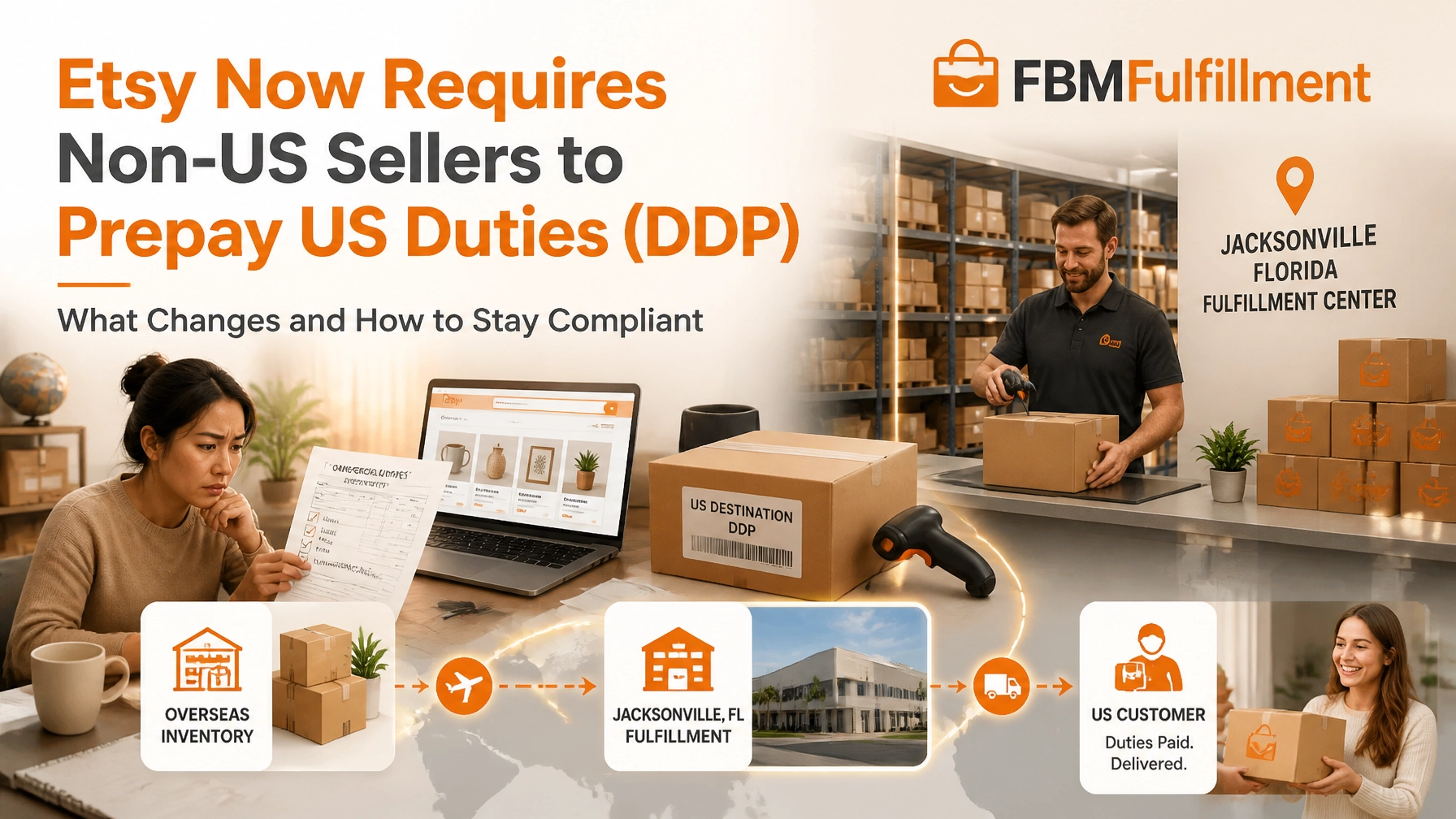
If you are a non-US seller shipping Etsy orders to American buyers, the customs rules changed on July 9, 2026. The new etsy duty paid requirement moves the cost and operational responsibility for US import duties onto you.
Under Etsy’s updated policy, you must use Delivered Duty Paid (DDP) for orders shipped from outside the United States to US customers. You must also account for estimated duties and import fees in the price shown at checkout.
Ignore the rule, and the consequences are serious. The order can lose Etsy Purchase Protection, and your buyer may receive a refund for duties or carrier collection fees charged after checkout.
This is not a general guide to international selling or forming a US business. It is a tactical breakdown of Etsy’s DDP requirement and the fulfillment structure that helps you stay compliant.
What does “etsy duty paid” mean under Etsy’s new rule?
Delivered Duty Paid means the seller takes responsibility for the shipment until it reaches the agreed delivery point. For an Etsy order shipped to a US buyer, that responsibility includes:
- Export clearance in the origin country
- Transportation to the United States
- US import clearance
- Applicable customs duties and import fees
- Delivery to the customer without surprise customs charges
In practical terms, the customer should see the full expected cost at checkout. They should not receive a message from the carrier demanding additional payment before delivery.
Etsy’s Seller Handbook guidance on changing global tariff policies states that non-US sellers shipping to US buyers must use DDP beginning July 9, 2026. Etsy also explains that duties and import fees should be accounted for upfront through the seller’s pricing.
The new policy applies based on the shipment route:
- Non-US seller shipping from outside the US to a US buyer: Covered
- US seller shipping from within the US to a US buyer: Not covered by this specific rule
- Non-US seller holding inventory in a US warehouse: The customer order is fulfilled domestically after the inventory has already been imported
That final structure is important. The sale can still occur on Etsy, but the product no longer crosses the border after the customer places the order.
Why does Etsy Purchase Protection matter?
Etsy is enforcing this change through its buyer protection framework.
US-bound orders from non-US sellers must be DDP compliant to qualify for Etsy Purchase Protection. Orders shipped with unpaid duties, often described as Delivered Duty Unpaid or DDU, no longer receive the same protection.
If you ship without prepaid duties, you face several risks:
- The order may not qualify for Etsy Purchase Protection.
- You may become responsible for a refund if the order is late or does not arrive.
- If the buyer is charged tariffs or carrier collection fees, Etsy may refund those charges to the buyer.
- Those refunded charges can then be deducted from your seller account.
- A customer may reject or abandon a package because the final delivery cost was higher than expected.
This creates a direct financial penalty for treating customs as an afterthought.
A product can be profitable on paper and unprofitable after duties, brokerage, handling, and delivery costs are included. If those costs are not built into your listing price, every US order can expose your margin.
How does DDP change your Etsy pricing?
The seller must move from a product price to a landed cost model.
Your US customer should effectively pay one price that accounts for:
- Product cost
- International transportation
- Customs duty estimate
- Import processing and brokerage charges
- US domestic fulfillment
- Final mile delivery
- Etsy fees and payment processing
- Your target margin
This does not mean you can estimate casually. Product classification directly affects the duty calculation. A difference in material, construction, intended use, or product category can change the applicable tariff treatment.
Build a SKU level landed cost file
Create a cost record for every product you sell to US buyers. At minimum, record:
- Etsy listing and SKU
- Product description
- Country of origin
- Materials and composition
- Declared customs value
- Likely tariff classification
- Estimated duty rate
- Brokerage and import processing charges
- Freight cost per unit
- US storage and pick and pack cost
- Final delivery cost
- Minimum acceptable margin
Review the file whenever your supplier, packaging, product materials, freight method, or duty environment changes.
Do not apply one broad percentage to every listing if your catalog contains materially different products. A simple estimate that works for one SKU can create a devastating margin error on another.
Etsy may provide estimated tariff tools within the listing workflow, but a calculator is only a planning aid. It is not a customs entry, a classification ruling, or a payment mechanism. Confirm your approach with a qualified customs professional when the classification or duty exposure is material.
What happens if DDP is unavailable?
Etsy’s guidance recognizes a limited exception when DDP services are not available in the seller’s country.
If that applies, Etsy requires the seller to:
- Clearly state in the listing that delivery duties are not included.
- Tell the buyer that duties and carrier fees may be due at delivery.
- Message the buyer with the estimated total duty and carrier fee amount.
- Receive the buyer’s explicit agreement before shipping.
This exception does not eliminate the commercial risk. A non-DDP order can still lose Etsy Purchase Protection. Treat it as a constrained fallback, not as a normal operating model.
Before using the exception, document that DDP was genuinely unavailable for the shipment origin and service route. Keep the buyer communication and approval with the order records.
What is the problem with acting as your own importer of record?
DDP is a shipping term. Importer of record is a customs responsibility.
The importer of record is the party identified on the customs entry as responsible for the accuracy of the import information and payment of legally applicable duties. Under US customs rules, the party listed on the entry carries the formal obligation even when a broker files the paperwork.
That distinction matters.
A shipping label that says DDP does not automatically solve the importer of record issue. Your logistics provider, customs broker, and commercial documents must all align.
Before shipping inventory to the US, confirm:
- Who will be listed as the importer of record
- Whether that party is eligible to act in that capacity
- Who will provide the customs bond, if required
- Who will provide product and classification information
- Who will pay duties and import fees
- How customs documents will be stored
- What happens if customs challenges the declared information
A non resident llc in usa can be part of a broader US operating strategy, but forming an entity by itself does not guarantee compliant import handling. Entity formation, tax registration, customs responsibilities, and fulfillment operations are separate decisions.
Work with a licensed customs broker or qualified import professional for your specific structure. The US customs entry regulation at 19 CFR 141.1 provides useful legal context on importer responsibilities.
You have a problem. We have a solution.
Shipping every Etsy order from your home country creates repeated customs events. Every order requires a new shipment, a new import process, and a new opportunity for incorrect pricing or unpaid charges.
The better structure for many growing sellers is to consolidate inventory into the United States.
FBMFulfillment.com is an independent ecommerce 3pl in Jacksonville, Florida. We support US inbound logistics, inventory receiving, product preparation, and multichannel distribution for sellers that need a reliable domestic fulfillment base.
The operating model is straightforward:
- Consolidate products into a planned US inbound shipment.
- Coordinate the import process with the appropriate customs broker or importer of record.
- Receive and verify landed inventory at the US warehouse.
- Store inventory in a controlled US fulfillment environment.
- Connect Etsy and other sales channels to one inventory pool.
- Ship customer orders domestically after the sale.
This structure helps you price DDP accurately because the import event happens before the customer order. Your Etsy listing can reflect a more predictable landed cost instead of absorbing an unknown customs bill on every shipment.
It also supports more than Etsy. The same inventory can serve Shopify, Walmart, eBay, TikTok Shop, Facebook, and other channels through a single US fulfillment operation.

How can a US 3PL improve compliance and delivery?
A US warehouse does not replace your customs broker or eliminate your responsibility to provide accurate product information. It does, however, give you a practical operating base after the goods are legally imported.
With US inventory already landed, you can:
- Avoid charging a US buyer unexpected customs fees at delivery.
- Reduce the number of individual international shipments.
- Improve delivery speed and tracking consistency.
- Maintain clearer inventory records by SKU.
- Reconcile inbound costs against actual unit economics.
- Fulfill Etsy and other channels from the same stock.
- Process returns inside the United States.
- Reprice listings when duty or freight assumptions change.
FBMFulfillment’s multichannel fulfillment services are designed for sellers managing more than one ecommerce channel. The company also provides ecommerce fulfillment cost guidance to help sellers evaluate the full operational cost rather than looking only at pick and pack charges.
There are no onboarding fees and no minimums, making a US fulfillment structure more accessible for sellers testing demand before committing to larger inventory volumes.

What should you do before your next US Etsy shipment?
Use this implementation checklist:
-
Identify every Etsy order shipped from outside the US to a US buyer.
These are the orders affected by the July 9, 2026 rule. -
Review your shipping service.
Confirm whether it is genuinely DDP. Do not rely only on a service name or a seller dashboard setting. -
Calculate landed cost by SKU.
Include product, freight, duties, brokerage, fulfillment, delivery, platform fees, and margin. -
Review product classification.
Confirm that your descriptions, materials, country of origin, and customs information are accurate. -
Confirm importer of record responsibilities.
Make sure your broker, freight provider, and fulfillment partner agree on the process. -
Update Etsy pricing.
Build estimated US duties and import costs into the customer’s checkout price. -
Audit your customer messaging.
Make sure US buyers are not told to expect a separate customs bill unless you are using Etsy’s limited exception process. -
Consider consolidated US inbound inventory.
If US demand is consistent, importing stock in planned shipments can reduce repeated customs exposure and simplify domestic fulfillment.
The strategic advantage of US landed inventory
The new etsy duty paid policy makes customs part of your storefront economics. It is no longer enough to know your product cost and international postage.
You need accurate classification, documented import responsibility, realistic landed costs, and a fulfillment workflow that prevents surprise charges from reaching the buyer.
For some sellers, the right answer is to stop treating every Etsy order as a separate international shipment. Import inventory into the US through a controlled process, store it with an independent ecommerce 3pl, and fulfill the final order domestically.
Treat etsy duty paid as an operating requirement, not a checkbox. If you need help evaluating US inbound, preparation, storage, or multichannel distribution, contact FBMFulfillment and we will be glad to help.
Sources
- Etsy Seller Handbook: Navigating Evolving Global Tariff Policies
- Etsy Help Center: Taxes, Customs, and Tariffs
- 19 CFR 141.1: Liability for duties
Key Takeaways
- Starting July 9, 2026, non-US sellers must comply with the new etsy duty paid rule, using Delivered Duty Paid (DDP) for shipments to US buyers.
- DDP requires sellers to cover export clearance, transportation, US import clearance, and all customs duties upfront to avoid surprise charges for customers.
- Etsy Purchase Protection applies only to DDP-compliant orders; those shipped with unpaid duties may lose this protection and incur financial penalties for sellers.
- Sellers should calculate landed costs accurately, including product price, shipping, and duties, and adjust Etsy pricing accordingly.
- Consolidating inventory in the US can simplify compliance, reduce shipping complexities, and enhance fulfillment efficiency.