AI should help you choose a 3PL faster, with better information and fewer surprises.
Sometimes it does.
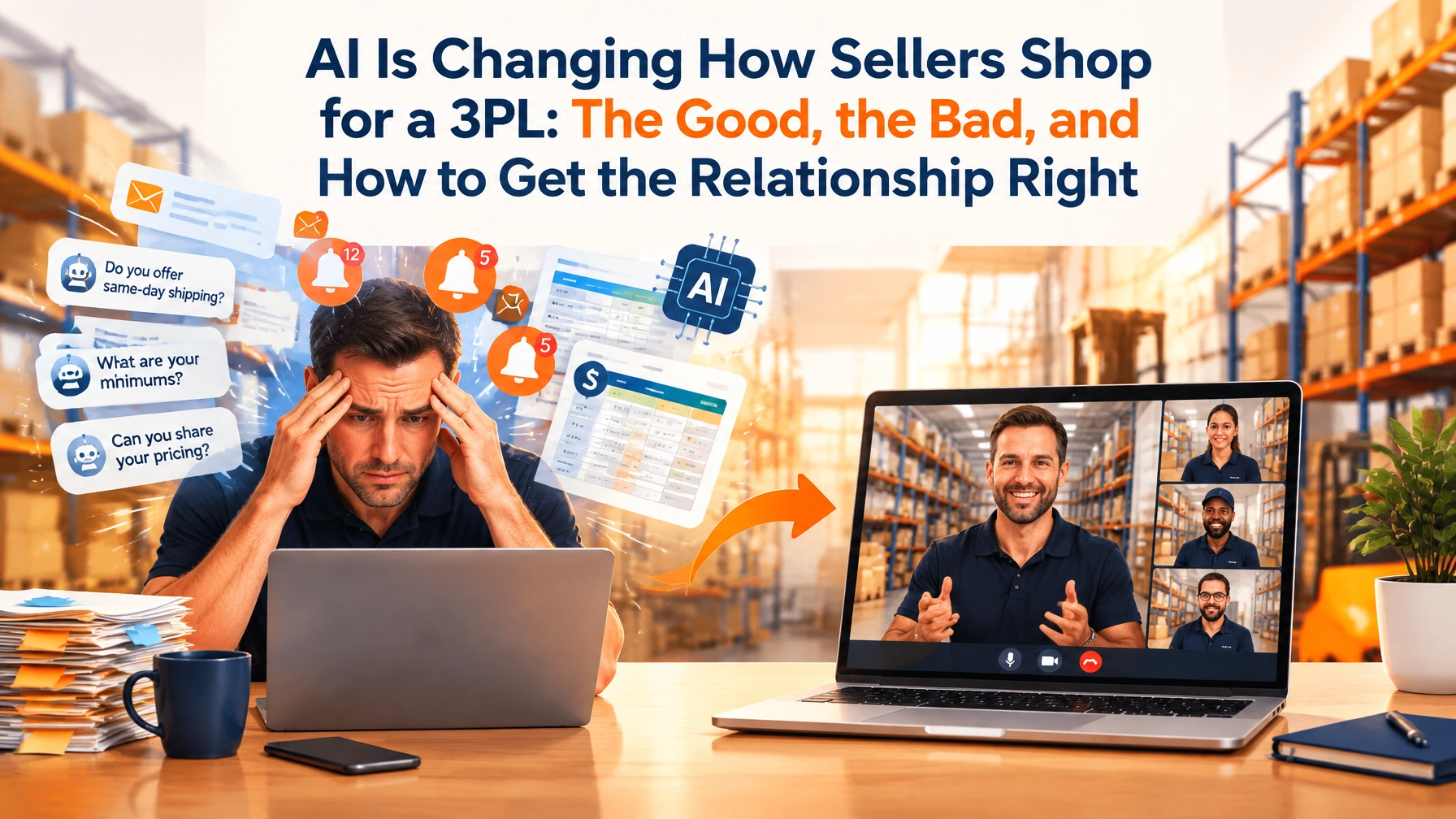
But from our side of the desk, we are seeing a new pattern: prospective clients doing an order of magnitude more work while getting worse results. Endless questions. Repeated questions. Long messages that do not acknowledge the answers. Requests for standardized rate cards before we understand the business. Contract edits that appear to be copied from AI but do not apply to the actual relationship. All symptoms of understanding gaps and information overload.
The tool is not the problem.
The way it is being used is the problem.
You Are Not Shopping for a 3PL — You Are Looking for a Business Partner
Think of choosing a fulfillment partner the way you would approach finding a life partner. You are not buying a commodity. You are choosing someone to build a business and a future with — someone who will hold your inventory, represent your brand to your customers via quality execution, and be there through growth, peak season, and the occasional crisis.
Your first interactions matter the same way first dates matter. A thoughtful first conversation can set the foundation for a strong fruitful long-term match. An endless barrage of questions, ignored answers, or a know-it-all tone can turn off the best candidates before they ever get to know you.
The best partnerships — like the best marriages — start with mutual respect, humility, honest communication, and both sides listening.
The Turnoffs: What Turns a Great 3PL Off
Before you attempt to choose a 3PL, remember this:
- The best providers are evaluating you too.
A few questions are fine. Due diligence is responsible. But there is a difference between diligence and interrogation.
Here are the biggest turnoffs:
- Endless questions without narrowing the decision. A few are fine. An interrogation is not. Nobody wants a partner who interviews them forever. Right or Wrong, This oftens sends a signal that this will be a problematic long term client. Lose/Lose
- Not reading answers the other side put substantial effort into. Asking what was already answered is like asking the same question on a second date.
- Asking the same questions over and over. That is a big red flag.
- Asking questions you clearly do not understand. This is the AI-generated question that sounds confident but makes no sense.
- Quoting a dozen 3PLs at once. Shopping around is fine. Playing the field loudly signals you are not ready to commit. Yes screen candidates offline, but avoid the information shotgun just because technology makes it easy.
- Demanding a rate card before explaining your business. That is asking for a commitment before you have shown anything about yourself.
- Arrogant, know-it-all attitudes. Everyone is a genius now. The ones who build lasting relationships are the ones who listen.
- Arguing over contract language you cannot explain, especially AI-generated edits that do not apply. That shows up to the relationship already fighting.
- Not appreciating the value of talking to the owner instead of a remote salesperson.
- Never asking how long the 3PL has been in business. That is the one question that matters most because experience is the foundation of trust.
The same issue appears when AI generates an email that sounds highly confident but does not reflect your actual business. Every sentence may look polished, yet the questions reveal that the sender has not considered their landed cost, lead times, minimum order quantities, product dimensions, order profile, or returns process. How would you perceive an AI response to your generated AI inquiry. Totally unproductive.
- That creates a credibility problem.
- AI some times makes sloppy mistakes
- Never forgetg AI is known to hallucinate an answer if it does not find a credible one.
AI can make everyone sound certain. It cannot give you operational experience.
The Turnons: What Attracts a Great 3PL to You
The strongest fulfillment relationships usually begin with the same signals that make any serious partnership work.
Here is what attracts a great 3PL to you:
- A well-thought-out plan. You know your product, channels, volume range, landed cost, and margins.
- Reading responses and coming back with thoughtful follow-ups.
- Honest, direct communication. A good 3PL is as interested in a good fit, as much as you are. They will advise if the fit does not make sense for you and or them and often refer you to a vetted 3PL that is a better fit for your needs.
- Reasonable expectations about what a 3PL is and is not.
- Open-mindedness and a willingness to listen and learn.
- Asking smart questions — including “How long have you been in business?”
- Treating the relationship as a future partnership, not a one-time transaction.
- Willingness to get on a video call and have a real conversation.
- Humility. Knowing what you do not know and being willing to be taught.
- A long-term mindset. You are looking for someone to grow with, not just to ship boxes.
AI can help you prepare for a productive conversation with a fulfillment partner. It can also create noise, waste time, and damage the relationship before it begins. Here is how to use it effectively, where it backfires, and how to start a 3PL partnership on the right foot.
How can AI help you choose a 3PL?
AI is genuinely useful when it helps you become a more informed seller.
Use AI for quick screening
An email and a few AI-assisted questions are perfectly appropriate for an initial screen.
Ask your top three to 10 questions that are clearly the most important to you: (not 10 questions each question requiring 10 responses, that is 100 questions)
- Where is the warehouse located?
- Which ecommerce platforms and marketplaces are supported?
- What order volume and SKU profiles can the operation handle?
- What are the receiving, storage, fulfillment, and return capabilities?
- Does the provider support your required shipping timeline?
Then evaluate the response. Is it clear? Is it professional? Does it answer your actual questions?
That first screen helps you determine whether a conversation is worthwhile.
Use AI for research
AI can help YOU understand terms such as:
- Pick and pack
- D2C fulfillment
- Multichannel fulfillment
- FBA preparation
- Returns processing
- Inventory possession
- Warehouse management systems
You can also use it to compare different types of 3rd party fulfillment services before contacting providers. That preparation is valuable because you arrive with context instead of asking a fulfillment company to teach you every basic term by email.
Use AI to prepare, not replace judgment
AI can summarize proposals, organize notes, compare service features, and help you create a list of questions.
That is AI used correctly.
The best seller is not the one who sends the most questions. It is the one who uses AI to learn, then arrives with better questions.

Why can AI-assisted outreach backfire?
It backfires in three ways.
First, it wastes time. A 3PL must understand your operation before giving a responsible answer. If the conversation becomes an endless loop of questions and corrections, the provider is spending time without gaining clarity.
Second, it lowers confidence. When you ignore answers or repeat the same questions, the 3PL begins to wonder whether you will follow receiving instructions, shipping cutoffs, billing requirements, and standard operating procedures after onboarding. Think about the first date analogy.
Third, it alienates the best options. The road not taken because you drove past it so fast while playing on your phone.
Established 3PLs usually have enough business to be selective. They do not need to accept a relationship that begins with chaos, unrealistic demands, and constant argument. Desperate providers may tolerate anything to win an account. That does not automatically make them the right partner.
There are many newer 3PLs in the market. A newer company is not automatically a bad company but they are usually not the best fit. However, you should ask how long the business has operated, who owns it, how inventory is controlled, and what happens when something goes wrong.
Do you really want off-the-rack pricing?
The rate card request deserves special attention.
Most good 3PLs do not have one universal rate card that applies fairly to every ecommerce seller. Fulfillment pricing depends on details such as:
- SKU count and product characteristics
- Unit and carton dimensions
- Order volume and order-line count
- Packaging requirements
- Channel mix
- Storage needs
- Return frequency
- Shipping destinations
- Special handling requirements
When a prospect begins with “send me your rate card,” it is often AI-generated boilerplate. The honest question is this:
Do you really want off-the-rack pricing for a made-to-measure relationship?
A partner who asks questions before quoting is not necessarily stalling. That partner may be protecting you from an inaccurate estimate that looks attractive initially and fails once your inventory arrives.
The right conversation examines total operating cost: not only the lowest line item.
Should you talk to the owner or a remote sales representative?
When you contact FBMFulfillment, you may be speaking directly with the owner of the business.
Many sellers do not realize the difference.
A remote sales representative may collect information and send it to another department. They will likely provide you the “canned” response from the approved script. An owner or operator can often work to understand your needs, discuss the warehouse, the systems, the risks, and the decision in the same conversation. They may be able to create a solution for your specific need that is not necessarily on the menu.
That is a significant advantage.
The question you should ask every provider is:
How long have you been in business?
The answer reveals experience. It reveals whether the company has handled inventory discrepancies, carrier failures, receiving problems, peak season pressure, returns, charge disputes, and difficult customer situations.
Operational scar tissue matters.
When you choose a 3PL, you are not only buying warehouse labor. You are trusting another company with your inventory, customer experience, and reputation.
What red flags should you watch for?
You should evaluate the 3PL carefully. The relationship must work both ways.
Watch for:
- Fees that appear late in the process
- Gimmicks, fees and promotional noise instead of clear operating details
- Onboarding or exit fees that discourage you from leaving, even if you are not happy
- Long-term contracts that limit your ability to leave
- Vague answers about inventory control
- Claims that cannot be supported with a real process
- Pressure to sign before you understand the terms
If you see these issues, move on.
At the same time, recognize that good 3PLs also have standards. A reliable fulfillment partner will not accept unlimited confusion, disrespect, or bad-faith negotiation.
Arguing aggressively over contract language is especially problematic when the proposed edits appear AI-generated and you cannot explain why they apply or are important. Established 3PLs generally will not negotiate a bespoke contract for a small opportunity or an early-stage seller when the requested changes are unrelated to the actual risks.
Do not overreach, especially as a startup.
You may unintentionally alienate the strongest options before the partnership begins.
Why is a video call better than email ping-pong?
Email is fine for a quick screen.
There is far more value in a video conference, or an in-person meeting when practical.
A 30-minute conversation can reveal more than 30 emails because both sides can ask follow-up questions, clarify assumptions, and determine whether the relationship feels workable.
Come prepared to discuss:
- Your products and sales channels
- Your realistic expected order volume. Outrageous exaggeration is a red flag, especially compared to your initial inventory.
- Your SKU count
- Your inventory source
- Your landed cost and target margin (generally)
- Your supplier lead times
- Your minimum order quantities
- Your packaging and returns requirements
- Your growth expectations
You do not need a perfect forecast. You do need a thoughtful plan.
Ask questions. That is how you avoid surprises.
Then listen and learn.

How do you start the relationship correctly?
A strong partnership starts with reasonable expectations.
You should understand that a 3PL is your fulfillment partner. It is not automatically your marketing department, product developer, sourcing agent, lender, or business strategist.
You should also understand what the provider expects from you:
- Read communications thoroughly.
- Avoid asking questions that have already been answered unless you need clarification.
- Provide accurate product and inventory information.
- Follow agreed receiving and shipping procedures.
- Communicate changes before they become emergencies.
- Pay invoices promptly.
- Treat the relationship as a long-term partnership rather than a one-time transaction.
If you are trying to choose a 3PL, keep perspective. You are not merely comparing warehouse rates. You are selecting the company that may be responsible for your inventory five years from now.
What matters most to us?
At FBMFulfillment, the most important priority is long-term mutual success.
We succeed when you succeed. Failure is expensive for both sides.
We value:
- Direct and honest communication
- A well-thought-out plan
- Reasonable expectations
- Operational excellence over slogans
- Sellers who are willing to listen
- A partnership built around future growth
We are startup-friendly, but we are still selective. Our policies include:
- Minimums waived for 12 months
- No onboarding fees
- Month-to-month contracts
- Access to enterprise-level pricing and shipping rates
- Free coaching through Ecommerce Academy and in-person sessions
- A strategic Jacksonville location
- World-class fulfillment technology
- Post-pay invoicing
Our Jacksonville operation supports sellers searching for an ecommerce fulfillment center florida, a 3pl jacksonville provider, a fulfillment center in florida, or ecommerce fulfillment near me. We support multichannel inventory, reliable same day fulfillment, and practical operational guidance.
If you are large enough or have unique product requirements to justify a regional warehouse strategy, our Ecommerce Fulfillment Alliance my be the right solution.
We spelled out the full policy in “The Startup-Friendly 3PL: The Policies That Turn a Fulfillment Partner Into a Launch Pad”.
The goal is not to accept every account. The goal is to build sustainable relationships with sellers who are prepared to grow.
You have a problem. We have a solution.
You have a problem: AI makes it easier to generate noise and harder to build trust. If you rely on it too heavily, you may send more emails, ask weaker questions, and push away the fulfillment partners best equipped to help you.
We have a solution: stop the email barrage and schedule a video call.
Use AI to research. Use it to organize. Use it to prepare.
Then have a real conversation with an open mind.
You can choose a 3PL based on clarity, experience, communication, and operational fit: not just a generated comparison table.
If you are ready to choose a 3PL, contact FBMFulfillment at sales@fbmfulfillment.com or +1 (904) 530-9694 to schedule a conversation.
You may discover that we are not the right fit. That is okay.
A constructive conversation will still leave you with more clarity than another round of automated emails.
Key Takeaways
- Choosing a 3PL is about finding a business partner, not just a service provider.
- Effective communication builds strong partnerships; avoid endless questions and repeated inquiries.
- AI is valuable for research, screening, summarizing, and preparing questions.
- AI can aid in research and preparation, but it shouldn’t replace personal judgment in discussions.
- AI becomes harmful when it produces endless, repetitive, or poorly understood questions.
- Do not demand a rate card before the 3PL understands your operation. 🚩
- Read the answers you receive before asking additional questions.
- Listen and learn with an open mind.
- Be aware of red flags like unexplained fees and unrealistic demands during negotiations.
- A video call fosters better understanding than email exchanges; prioritize clarity and long-term partnership.
- A fulfillment relationship is a future partnership, not a one-time transaction.
- Ask how long the provider has been in business.
- Startup-friendly policies work best when both sides communicate honestly and operate responsibly.
Related Links
Frequently Asked Questions
The problem isn’t AI itself, it’s how sellers use it. AI-assisted outreach often turns into endless questioning, repeated inquiries, premature rate-card demands, and AI-generated arguments over contract language. That extra volume of activity doesn’t lead to better outcomes, it often produces worse ones because it damages the relationship before it starts. “Garbage at the Speed of Light?”
Treat it like choosing a business partner, not buying a commodity. A good fulfillment relationship depends on mutual respect, humility, honest communication, and both sides actually listening to each other, not just the lowest quote or the fastest turnaround.
Interrogation-style questioning that never narrows toward a decision, ignoring answers already given, questions that sound confident but show no real understanding, requesting quotes from dozens of providers at once, demanding a rate card before explaining your business, and an arrogant or combative tone.
A well-researched operational plan, thoughtful follow-up questions, direct and honest communication, reasonable expectations, openness to learning, a willingness to get on a video call, humility about what you don’t know yet, and a long-term growth mindset rather than a purely transactional one.
Use it for what it’s good at: narrowing down to a handful of essential questions, researching fulfillment terminology and concepts, summarizing proposals, organizing notes, and comparing features. AI should prepare you to have a better conversation, not replace the conversation itself.
Three reasons. It wastes the provider’s time with endless loops of questions and corrections that don’t actually clarify your operation. It erodes confidence, because a provider who watches you ignore answers assumes you won’t follow procedures after onboarding either. And it can push top providers away entirely, since established 3PLs are selective and chaotic first contact is a fast way to get deprioritized.
Not really. Fulfillment pricing depends on SKU count, product dimensions, order volume, packaging needs, channel mix, storage requirements, return rates, and shipping destinations. A good provider will ask questions before quoting rather than handing over a one-size-fits-all rate card, because off-the-rack pricing rarely fits a relationship that’s supposed to be built around your specific operation.
Talking to an owner or operator often gets you further, since they can speak directly to warehousing, systems, and operational risk in one conversation and may be able to shape a more customized solution on the spot.
“How long have you been in business?” The answer tells you how much real operational experience they have handling inventory issues, carrier failures, peak seasons, and other situations that only come up with time.
Fees that only surface late in the conversation, vague answers dressed up with gimmicks instead of real operational detail, onboarding or exit fees designed to discourage you from leaving, long-term contracts that limit flexibility, unclear explanations of inventory control, unsupported claims, and pressure to sign before you understand the terms.
A 30-minute video call surfaces more useful information than 30 emails back and forth, because both sides can clarify assumptions in real time and get a feel for whether the partnership will actually work. Come prepared to talk through your products, sales channels, order volume, SKU count, where your inventory comes from, landed costs, lead times, MOQs, packaging needs, returns requirements, and growth expectations.
A 3PL is a fulfillment partner. It isn’t your marketing department, product developer, sourcing agent, lender, or business strategist. Understanding that boundary up front helps set realistic expectations for the relationship.
Read communications thoroughly before asking follow-up questions, avoid repeating questions that have already been answered, provide accurate product and inventory information, follow the agreed-upon procedures, communicate changes proactively, pay invoices on time, and treat the relationship as a long-term partnership rather than a one-time transaction.
Waived minimums for the first twelve months, no onboarding fees, month-to-month contracts, enterprise-level pricing, free coaching, the advantages of a Jacksonville location, advanced technology, and post-pay invoicing. These policies work best when both sides hold up their end with honest communication and responsible operating practices.