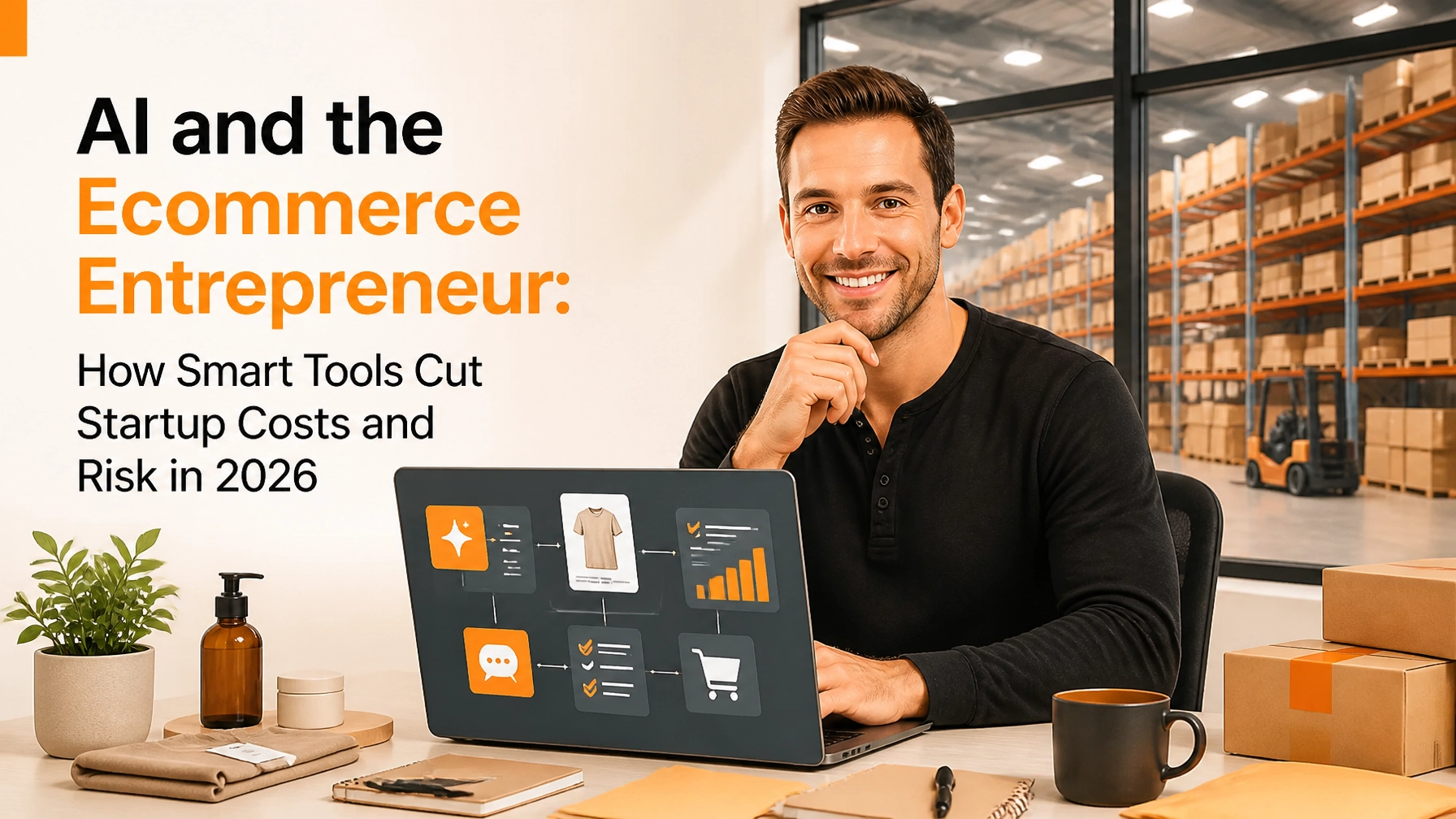
Can you launch an ecommerce brand without raising $50,000 first? In 2026, AI for ecommerce entrepreneurs is making that possible. You can research a product, evaluate demand, build a brand, create a storefront, produce marketing content, and contact suppliers with tools that cost a fraction of a traditional team.
That does not mean ecommerce is risk-free. Inventory, freight, lead times, minimum order quantities, customer service, and fulfillment remain real business responsibilities. AI removes much of the knowledge and design barrier. It does not remove the physical one.
1. Why Did Starting an Ecommerce Brand Once Cost $50K+?
The traditional ecommerce launch required a large cost stack before you could test whether customers wanted your product.
You often needed:
- A product developer or consultant
- A branding agency and graphic designer
- Professional product photography
- A copywriter for listings and website pages
- A web developer
- A marketing agency
- Warehouse space and packing equipment
- Initial inventory and packaging
- Paid advertising before you had reliable conversion data
Each line item created a larger financial commitment. You could spend tens of thousands of dollars before receiving enough customer feedback to know whether your product, offer, or positioning was correct.
Capital was the moat.
That barrier favored established companies and well-funded startups. A solo entrepreneur with a strong product idea could still lose simply because the launch required too many specialists too early.
2. How Does AI for Ecommerce Entrepreneurs Change the Starting Line?
AI changes the economics of knowledge work.
A general-purpose AI subscription can cost approximately what you once paid for a single hour of professional consulting. Ecommerce platforms also increasingly include AI features for product descriptions, customer support, merchandising, and store management. Shopify, for example, outlines multiple ways entrepreneurs can use AI to develop and operate online businesses in its AI business ideas guide.
You can now:
- Generate and compare product concepts
- Analyze competitors and customer reviews
- Draft supplier questions and negotiation messages
- Produce packaging and listing concepts
- Build a storefront from a structured prompt
- Create dozens of ad variations
- Draft email sequences and blog outlines
- Turn one video idea into content for several channels
Your job changes. You no longer need to personally perform every knowledge task. Your job becomes judgment.
You still need to decide whether the product solves a real problem, whether the margin works, whether the supplier is reliable, and whether customers will buy. AI gives you more options and faster feedback before you commit substantial capital.

3. Can AI Reduce Product Research Risk?
Yes, if you use it before placing your first purchase order.
AI can help you organize and analyze:
- Marketplace reviews and recurring complaints
- Search terms and keyword intent
- Competitor pricing and product positioning
- Product feature gaps
- Seasonal demand patterns
- Customer language and buying objections
- Trend signals across social platforms
You can ask AI to create a competitor teardown, group thousands of reviews by complaint type, or compare the features customers praise against the features they criticize.
That does not replace validation. It makes validation faster.
Order samples. Speak with potential customers. Test a landing page. Run a small advertising experiment. Confirm that the opportunity is large enough to justify the inventory, freight, and lead-time commitment.
This is where AI for ecommerce entrepreneurs creates its first major advantage: you can eliminate weak ideas before you spend heavily on inventory.
4. How Can AI Improve Sourcing Decisions?
Sourcing is not simply finding the lowest factory quote. Your real calculation is landed cost.
Landed cost can include:
- Product cost
- Tooling or mold charges
- Packaging
- Freight
- Duties and tariffs
- Inspection costs
- Domestic transportation
- Storage and fulfillment handling
AI can help you build a supplier comparison matrix that includes more than unit price. You can compare minimum order quantities, production lead times, payment terms, certifications, packaging requirements, and estimated landed cost.
You can also use AI to draft:
- Requests for quotation
- Factory interview questions
- Product specification sheets
- Quality-control checklists
- Sample evaluation forms
- Negotiation emails
- Purchase order review questions
This is also where an AI team starts to matter. [Stan] can help with lead sourcing and outreach to suppliers or partners, while [Eva] can keep the follow-up, scheduling, and internal coordination organized so sourcing work does not stall.
Use caution. AI can organize information, but it cannot physically inspect a factory or guarantee a supplier’s claims. Verify certifications. Order samples. Confirm production capacity. Use independent quality control when the product category demands it.
AI helps you ask better questions. You still have to verify the answers.
5. Can AI Handle Graphic Design and Branding?
Professional design used to require a significant upfront budget. Today, you can start with an AI-generated direction and refine it into a usable brand system.
You can create first drafts for:
- Logos and color palettes
- Packaging concepts
- Product image backgrounds
- Lifestyle scene concepts
- Marketplace listing graphics
- A+ content layouts
- Comparison charts
- Social media templates
- Email banners
A design that once began with a $5,000 agency engagement can now begin with a prompt, a reference image, and a clear creative brief.
The important word is begin. You still need to check trademark conflicts, image rights, product accuracy, packaging compliance, and consistency across every sales channel. AI-generated creative should support your brand strategy, not replace it.
6. How Quickly Can You Build and Maintain a Website?
You can launch a polished ecommerce storefront in a weekend if your product information, images, pricing, and policies are ready.
AI can help you:
- Structure your navigation and collection pages.
- Draft product descriptions based on verified specifications.
- Create FAQs from customer objections.
- Write shipping, return, and warranty explanations.
- Suggest SEO titles and meta descriptions.
- Generate customer-service chatbot responses.
- Identify outdated or unclear website copy.
- Create maintenance checklists for promotions and product launches.
You should never allow AI to invent product claims, shipping promises, certifications, or return conditions. Review every important page yourself.
Your storefront earns the first sale. Your operations determine whether you earn the second.
7. Can AI Help You Compete in Marketing and Outreach?
You do not need a ten-person marketing department to begin testing demand.
AI can produce multiple versions of:
- Paid ad hooks
- Product benefits
- Email subject lines
- Abandoned-cart sequences
- Influencer outreach messages
- Affiliate recruitment emails
- Customer survey questions
- Social media captions
- SEO content briefs
- Video ad scripts
You can then test the variations instead of arguing about which one sounds best. Data should decide.
AI also helps you personalize outreach at a practical scale. You can provide an influencer’s niche, audience, recent content, and product category, then create a relevant first draft instead of sending the same generic message to everyone.
Do not automate trust away. Personalize the message, disclose commercial relationships, and review claims before publication.
8. How Can AI Keep Your Digital Media Consistent?
Consistency is one of the biggest advantages available to a lean founder.
A single product insight can become:
- A blog article
- A short-form video script
- A carousel post
- An email newsletter
- A product FAQ
- A customer-service response
- A podcast outline
- A sales-team talking point
AI can help you create a content calendar, repurpose long-form material, draft captions, identify content gaps, and organize approval workflows.
This is where specialized AI help becomes practical. [Penny] can produce and update blog content, while [Sonny] can repurpose that content into platform-specific social posts without forcing you to start from zero every time.
This lets you maintain a reliable presence across Shopify, Amazon, TikTok Shop, Walmart, eBay, Etsy, and other channels without hiring a separate content department for each platform.
The winning approach is not publishing the most content. It is building a repeatable system that communicates the same clear value proposition wherever your customer discovers you.
9. How Can AI Help With Customer Service Without Owning the Whole Inbox?
Customer service becomes a time trap fast. Especially when the founder is answering the same order-status question all day.
AI can help you set up:
- 24/7 chatbot support for routine questions
- Automated order-status responses
- Return-request triage
- FAQ escalation workflows
- Multilingual support
- Routine ticket deflection so you are not chained to the inbox
This is a practical win for lean ecommerce teams. Customers get faster responses. You get more time back for sourcing, merchandising, and cash-flow decisions. And if you use an agentic toolset, [Rachel] can act as a 24/7 AI receptionist who answers inbound calls around the clock, takes messages, and helps a solo founder look staffed from day one.
Keep the caveat honest. AI should handle the routine. Humans must own edge cases, chargebacks, and anything involving money or promises.
10. How Can AI Help With Social Media Execution?
Social media usually breaks down because the founder runs out of time, not ideas.
AI can help you produce:
- Captions
- Hashtag research
- Content calendars
- Short-form video scripts
- Repurposed versions of one asset across TikTok, Instagram, Facebook, LinkedIn, and Pinterest
- Community-management draft replies
That creates a lean-founder advantage. You can stay consistent across channels without hiring a full content team on day one. [Sonny] is a good example of how an AI social media manager can draft posts and help manage the content calendar across platforms.
The point is not to automate your voice into generic noise. The point is to create a repeatable publishing system, keep the message aligned, and respond faster when content starts working.
11. How Can AI Support Legal and Compliance Basics?
Legal work is another area where founders lose time early.
AI can help draft and organize first-pass versions of:
- Privacy policies
- Terms of service
- Refund policies
- Seller agreements
An AI legal associate such as [Linda] can be useful here for producing those first-pass drafts and keeping policy updates organized.
It can also help flag compliance basics such as:
- FTC disclosure rules
- Marketplace policy requirements
- FDA or FCC category rules when relevant
- Advertising claim review
- Tax-setup basics
- Importer-of-record considerations
- Resale-certificate requirements
That speed matters. But the caveat is non-negotiable.
AI drafts. A qualified attorney reviews. Never treat AI output as legal advice.
Use AI to get organized and identify gaps. Do not use it as a substitute for legal review when your policies, claims, or product category create real exposure.
12. What Is Agentic AI — and Why It Changes the Game for Solo Founders?
Most entrepreneurs still think about AI as a chatbot.
You open ChatGPT, Claude, or Gemini. You ask a question. It gives you an answer. Then you do the work. You copy the draft, send the email, update the page, schedule the follow-up, and manage the next step yourself.
That model is useful. It is cheap. It is accessible. Every founder should use it.
But it is not the same as agentic AI.
Agentic AI takes action on your behalf. It does not just respond to a prompt. It can draft, schedule, answer calls, research leads, create content, process requests, and complete multi-step workflows without you sitting at the keyboard for every step. It behaves more like a remote employee than a search box.
Here is the difference in plain language:
- A chatbot answer says: “Here is a return policy draft.”
- An agentic workflow says: “I drafted the return policy, filed it in the right workspace, updated your help page, and notified you that it is ready for review.”
That shift matters. A lot.
For a solo ecommerce founder, the real bottleneck is rarely ideas. The real bottleneck is recurring operational work. Inbox management. Content updates. Lead follow-up. Supplier communication. Customer calls. Policy drafting. Calendar coordination. Small tasks that seem minor individually but consume the week when stacked together.
This is where agentic AI becomes a strategic advantage.
Why Does Agentic AI Matter More Than Another Chat Window?
Chat-first AI helps you think faster.
Agentic AI helps you operate faster.
That is the distinction.
If you are running a lean ecommerce business, you do not only need better brainstorming. You need execution support that keeps moving while you are reviewing samples, dealing with a freight issue, packing emergency orders, or sleeping.
An agent can keep workflows progressing in the background. It can prepare drafts, organize information, move tasks from one step to the next, and reduce the number of times you need to reopen the same project. Instead of starting from zero every morning, you are reviewing progress.
For a founder, that is leverage.
Why Is Marblism Different?
Marblism is an agentic AI platform built for entrepreneurs who want an actual AI team, not just another chatbot tab.
The platform includes six named AI employees, each with a specific job:
- [Eva] — Executive Assistant: calendar management, scheduling, inbox triage, and internal coordination
- [Stan] — Sales Associate: lead sourcing and outreach, including unlimited leads
- [Sonny] — Social Media Manager: drafting and managing social posts across platforms
- [Penny] — Blog Writer: writing and updating blog content
- [Rachel] — Receptionist: answering your phone 24/7 with no call cap, handling inbound calls, taking messages, and booking calls
- [Linda] — Legal Associate: drafting legal documents such as policies and agreements
That is the key difference. You are not buying isolated prompts. You are getting role-based AI employees designed to do recurring business work.
You also get the whole team under one subscription. No per-seat fees. Unlimited team members. Unlimited workspaces if you operate multiple businesses. Revisions are included, which matters more than most founders realize. Iterating on a draft does not burn extra hours. Chatting with your agents, configuring them, and reviewing their work is free. Only completed agent actions draw from the monthly hour balance.
That pricing logic fits how founders actually work. You should not be penalized for refining a task before it is done right.
Is Rachel the Killer Feature for Ecommerce Founders?
For many sellers, yes.
[Rachel] answers your business phone around the clock with no call cap. That means you do not miss a customer call, supplier callback, or wholesale inquiry because you were asleep, in transit, receiving inventory, or buried in fulfillment work.
That matters more than it sounds.
A missed inbound call can mean a lost order, a delayed vendor conversation, or a support problem that gets worse because nobody answered quickly. A human receptionist can cost thousands per month. Rachel is included in the subscription.
For a solo founder, that is one of the clearest examples of AI removing a real business bottleneck rather than just producing more text.
Is Marblism Actually Affordable?
Compared with hiring, yes. Dramatically.
The base plan includes 50 agent-hours per month and starts at roughly:
- $44/month billed monthly
- About $33/month billed quarterly
- About $24/month on annual billing
Higher tiers scale to 70, 100, 150, 300, 500, and 1000+ hours, but even the upper tiers are a fraction of the cost of a single employee.
Compare that to the cost stack from the beginning of this article. If you hired:
- An assistant
- A receptionist
- A content writer
- A social media manager
you would likely spend tens of thousands of dollars per year. Marblism delivers that kind of functional coverage for less than a few hundred dollars a month in many cases.
That does not mean AI fully replaces skilled people in every situation. It means you can delay hiring, lower fixed overhead, and stay lean longer while still keeping the business moving.
How Does Marblism Compare With ChatGPT, Claude, and Gemini?
Be honest about the landscape.
ChatGPT, Claude, Gemini, and similar tools are excellent general-purpose assistants for ideation, drafting, research, summarization, and second opinions. They are cheap, useful, and every entrepreneur should be using at least one of them.
But they are still mostly chat-first tools.
You prompt. They respond. You execute.
They do not answer your phone. They do not manage your content calendar as an assigned role. They do not source your leads as a standing sales function. They do not complete multi-step workflows on their own in the same role-based way an agentic platform is designed to.
That is why the practical setup for a lean founder is not either-or.
Use ChatGPT or Claude for thinking, framing, and draft generation.
Use Marblism for the doing. The recurring operational work that would otherwise eat your week.
Why Should You Get a Second AI Opinion?
Because AI is powerful, fast, and still imperfect.
One of the cheapest forms of risk reduction available today is to run important work through more than one model. Ask the same question in ChatGPT and Claude. Compare the outputs. Use one AI to critique another AI’s response. That process catches errors, exposes blind spots, and forces clearer reasoning.
For high-stakes work, this matters even more.
If the topic involves legal language, financial decisions, policy promises, compliance claims, or product statements, get:
- A first AI draft
- A second AI opinion
- A qualified human review
Here is a simple example:
- Draft a supplier negotiation email with Claude
- Have ChatGPT pressure-test the tone, logic, and leverage points
- Then let [Stan] or [Eva] finalize the outreach and send it through the proper workflow
That is a practical operating model. You are using general AI for analysis and comparison, then using an agentic system for execution.
Want to See the Platform We Actually Use?
Marblism is the platform the FBMFulfillment team runs on for content, sales, support, and operations. It is also how the FBMFulfillment blog workflow itself operates. That is why this recommendation is based on firsthand use, not generic affiliate noise.
If you want one of the fastest ways to stand up a real AI team around your business, use this link:
Get a 10% off Lifetime Discount for Marblism.
13. What Can AI Not Do? Pack a Box.
AI cannot receive your shipment, count your cartons, place inventory into a bin, pick the correct SKU, pack the order, hand it to a carrier, or inspect a return.
That physical fulfillment leg remains real.
You need a reliable operation for:
- Receiving and verifying inventory
- Barcode and SKU control
- Storage and inventory visibility
- Same day fulfillment
- Accurate picking and packing
- Carrier handoff
- Multichannel order routing
- Return inspection and disposition
- Defective-product quarantine
This is where many undercapitalized founders get hurt. You start in a garage to save money. Then orders increase, inventory spreads across your home, shipping cutoffs become stressful, and mistakes consume the time you intended to spend on marketing.
The opposite mistake is just as dangerous. You sign with a provider that imposes expensive onboarding fees, order minimums, or a long-term commitment before your product has proven itself.
You have reduced digital overhead, but you still need a physical partner that matches your launch stage.
14. Why Is FBMFulfillment Startup-Friendly?
FBMFulfillment is one of the few startup-friendly 3PL providers designed around the realities of a lean ecommerce entrepreneur.
You can start without:
- Onboarding or administrative fees
- Minimum order requirements
- Long-term contracts
- The cost of leasing and operating your own warehouse
Instead, you can test your product, protect your available capital, and scale the operation as demand becomes clearer.
FBMFulfillment provides:
- The Most Advanced Technology
- Same day shipping Guarantee
- Affordable Negotiated Carrier Rates without markup.
- Startup Friendly Pricing (only 2-5% of 3PLs even accept startups)
We grow with you grow.
- No onboarding fee
- Minimums waived for 12 months (only $100 min invoice after that)
- No admin fees, platform fees, webstore fees or other BS fees
- Month to month – No long term agreement
- No up front deposit
- Simple storage fees with no gimmicks
- A single inventory pool across Amazon, Shopify, TikTok Shop, Walmart, eBay, Etsy, and other channels
Strategic Flexibility. - Professional error free pick and pack fulfillment services
- Controlled returns processing
- Inventory visibility and possession control
- Wholesale and direct-to-consumer fulfillment
- Support for FBA replenishment [Drip Feed] and overflow inventory
Located in Jacksonville, FBMFulfillment can be a practical choice when you are comparing an ecommerce fulfillment center florida sellers can use for multichannel growth. If you search for 3PL Jacksonville, fulfillment center in Florida, or ecommerce fulfillment near me, evaluate more than the warehouse’s location. Review its order accuracy, shipping cutoffs, integration capability, return process, and willingness to support smaller brands.
FBMFulfillment was built from an ecommerce seller’s viewpoint. The team experienced the pain of unreliable fulfillment, marketplace performance pressure, inventory restrictions, and poor return control firsthand. That operational scar tissue matters when your business is still proving itself.
As your volume grows, you can move from a small launch program into broader regional operations when the economics support it.

15. How Should You Combine AI With Fulfillment in 2026?
Use AI to reduce the cost of thinking. Use a capable 3PL to reduce the risk of executing.
A practical launch sequence looks like this:
- Research the opportunity using customer language, competitor data, and demand signals. [Claude, ChatGPT, Gemini]
- Understand your Market
- Understand your competition
- Develop your Ideal Customer Profile ICP
- Develop a differentiation strategy
- Create IP if possible (Trademark, Copyright, Design or Utility Patent]
- Amazon Brand Registry
- Order samples and validate quality before committing to a large MOQ.
- Calculate landed cost using realistic freight, duties, packaging, and fulfillment assumptions. [Claude, ChatGPT, Gemini]
- Build the brand and storefront with AI-assisted creative and verified product information. [Claude]
- Stand up your AI team so operations keep moving while you focus on decisions. That can include [Eva], [Stan], [Sonny], [Penny], [Rachel], and [Linda].
- Set up customer service systems [Eva], [Rachel]
- Create legal and policy drafts with AI, then have a qualified attorney review them before launch. [Linda]
- NDA
- Purchase Agreements
- Get Discovered on Google and AI, [Penny]
- Keyword Research (insure your keywords fit your ICP to maximize conversion)
- Add blogs to your website targeted at your ICP
- B2B and Wholesale Outreach [Stan], [Allison] Great for service businesses as well.
- Research prospects on LinkedIn and book appointment
- Automated Outbound cold calling (Amazing quality)
- Test marketing and social media with small campaigns, repurposed content, and multiple creative variations. [Sonny]
- Facebook, Instagram, X, LinkedIn, Threads, Pinterest
- Create Promotional Videos Youtube
- Start with controlled inventory rather than buying more units than your lead time and sales data justify.
- Use a startup-friendly 3PL so you do not add warehouse overhead before you need it. [FBMFulfillment]
- Review the numbers weekly, including conversion rate, contribution margin, return rate, inventory velocity, shipping cost, and support-ticket trends.
Use this link for a 10% Lifetime Discount to Marblism
This approach lowers risk without pretending risk has disappeared.
You Have a Problem. We Have a Solution.
Your problem is that capital, specialized knowledge, and operational complexity used to block the door to ecommerce.
AI lowers the knowledge barrier. It helps you research, source, design, build, market, and communicate with far less upfront spending.
But the physical barrier remains. Products still need to be received, stored, picked, packed, shipped, and returned correctly.
Our solution is to pair your AI-enabled business model with startup-friendly fulfillment. FBMFulfillment gives you 3rd party fulfillment services without requiring you to build a warehouse operation before your product is proven.
AI for ecommerce entrepreneurs helps you launch lean. FBMFulfillment helps you operate reliably. Together, they give you a practical path from product idea to scalable ecommerce business.
Contact FBMFulfillment to discuss your product, channels, inventory, and fulfillment requirements. We will be glad to help you build the physical operation behind your next digital-first brand.
Key Takeaways
- In 2026, AI for ecommerce entrepreneurs enables a lean startup process without needing $50,000 upfront.
- AI streamlines product research, sourcing, graphic design, customer service, and marketing, reducing dependency on specialists.
- Agentic AI acts on your behalf, automating tasks like drafting policies and managing workflows, freeing up time for founders.
- Using a startup-friendly 3PL like FBMFulfillment allows entrepreneurs to scale operations without upfront warehouse costs.