You’ve finally landed that massive retail account. Your Shopify store is humming along, and now a major distributor wants 10 pallets of your best-seller. It’s the dream, right? Then the operational nightmare begins. You realize your current setup can’t handle a pallet pull without stopping every Shopify order in the building. Or worse, you’re forced to split your inventory into “silos”, 5,000 units for DTC and 5,000 units for wholesale. Suddenly, you have double the capital tied up in stock, yet you’re still stocking out on Shopify while the wholesale pallets sit gathering dust.
Finding the right B2B order fulfillment services is the only way to break this cycle. Most sellers treat wholesale and DTC as two different businesses, but in 2026, that’s a recipe for a cash flow heart attack. If your inventory isn’t working as a single, fluid pool, you aren’t scaling; you’re just getting more complicated.
THE INVENTORY SILO NIGHTMARE?
Many 3PLs will tell you to keep your wholesale stock separate from your “pick-and-pack” stock. They do this because their internal systems are too antiquated to handle both from the same bin. This creates “Inventory Silos.”
Given the significant risks of silos, here is what usually happens:
- Dead Capital: You have $50k of stock sitting in the “Wholesale” zone that your Shopify store can’t “see” or sell.
- Stockout Traps: Your TikTok shop goes viral, you sell out of your DTC pool, and you lose thousands in sales while 10 pallets of that exact product are sitting ten feet away, “reserved” for a wholesale order that isn’t shipping for three weeks.
- Inbound Inefficiency: You’re paying double the freight and double the receiving fees because you’re sending separate shipments to different zones or even different warehouses.
Unfortunately, most “modern” fulfillment centers are just glorified parcel pickers. They panic when a BOL (Bill of Lading) shows up for a 20-pallet LTL shipment.
WHAT IS A SINGLE INVENTORY POOL?
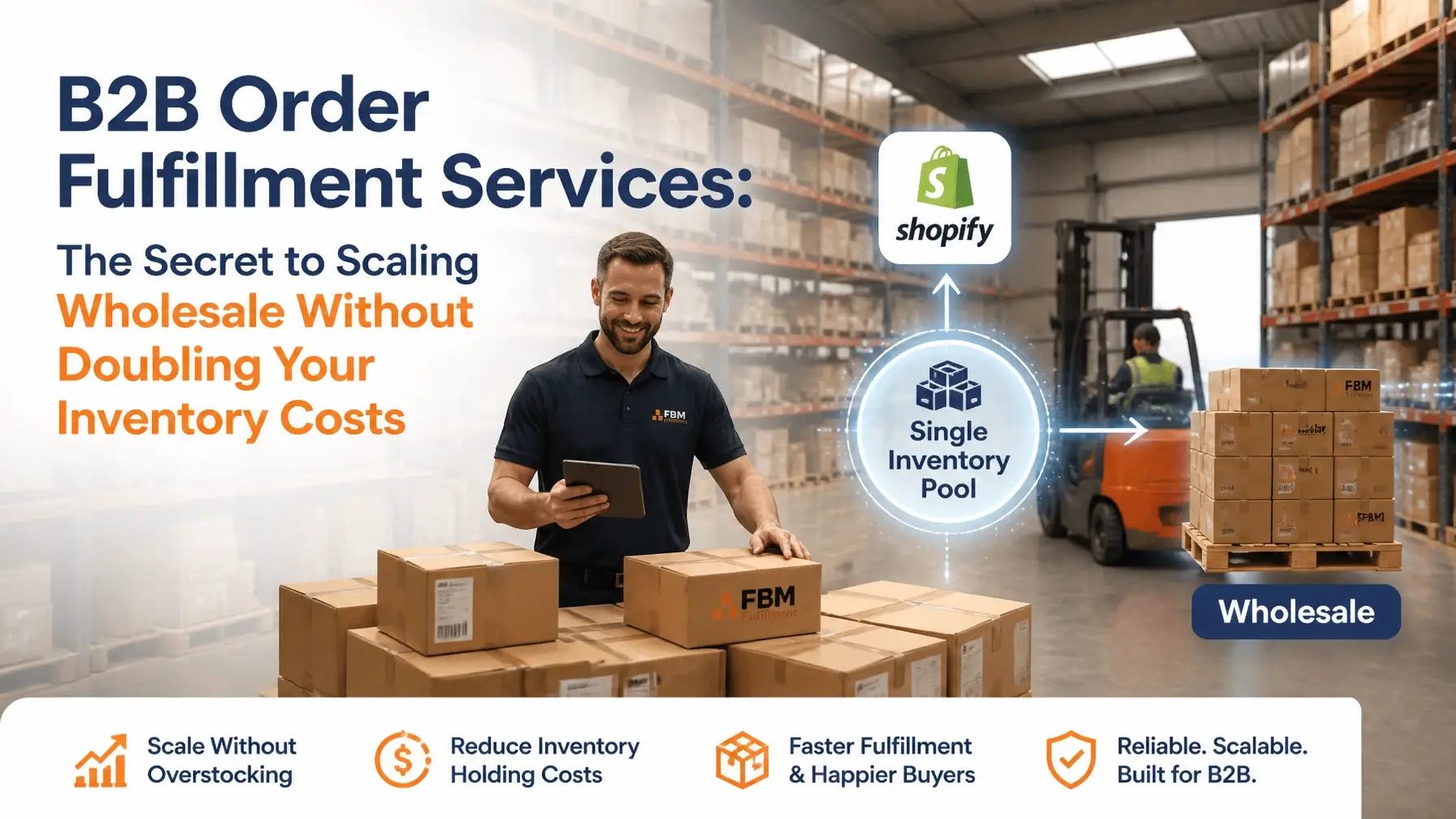
The “Single Inventory Pool” model is the holy grail of B2B order fulfillment services. Instead of physically or virtually “locking” stock into specific channels, all your inventory, whether it’s arriving via container or being prepped for FBA, sits in one master pool.
Whether an order comes from Shopify, TikTok Shop, or a manual wholesale PO (Purchase Order), it pulls from the exact same pile of units. B2B order fulfillment services that utilize this model allow you to maximize your “Available-to-Promise” (ATP) inventory across every single channel simultaneously.
B2B FULFILLMENT VS. B2C LOGISTICS: THE BALANCING ACT
Doing wholesale right is about much more than just moving pallets. It’s about compliance. While B2C is all about speed and pretty packaging, B2B is a world of routing guides, UCC-128 labels, and strict delivery windows. One mistake on a pallet label for a major retailer can lead to “chargebacks” that wipe out your entire margin on the deal.
At FBMFulfillment.com, we built our warehouse from an ecommerce seller’s perspective. We know the pain of FBA inventory mistakes and the necessity of precision. We treat a 1-unit Shopify order and a 1,000-unit wholesale order with the same operational excellence.
Key Steps to a Successful B2B/B2C Hybrid:
- Unified WMS: Your warehouse management system must sync in real-time with your Shopify, Walmart, and wholesale portals.
- Pallet-to-Parcel Flexibility: Your 3PL should be able to “break” a wholesale pallet to fulfill a surge in DTC orders without a week-long “work order” delay.
- Retailer Compliance: Ensure your provider can handle EDI (Electronic Data Interchange) and specific retailer labeling requirements.
B2B ORDER FULFILLMENT SERVICES AND CASH FLOW
The biggest drain on an ecommerce business isn’t marketing, it’s inventory. If you can fulfill your wholesale orders from the same stock as your Shopify orders, you can operate with 30-40% less total inventory. That is cash you can put back into R&D or ad spend.
When looking for B2B order fulfillment services, don’t just look at the pallet storage rate. Look at the flexibility. Can they handle an FBA drip-feed replenishment and a wholesale distributor order from the same lot? If the answer is no, you’re going to be buried in storage fees and split-shipment costs.

WHY FBMFULFILLMENT.COM IS DIFFERENT
We didn’t start as a logistics company; we started as sellers. We experienced the “precarious” nature of 3PLs that couldn’t handle the complexity of multi-channel growth. Most 3PLs are built for one thing: high-volume, low-complexity parcel shipping. When a wholesale order hits, their “standard” workflow breaks.
Our B2B order fulfillment services include:
- Total Inventory Control: Your stock is never “stuck.” If you need to pull 500 units from a wholesale pallet to cover a Shopify spike, we do it.
- Wholesale Precision: We handle the heavy lifting of LTL (Less Than Truckload) and FTL (Full Truckload) shipping with full compliance for major retailers.
- 2-Day Delivery Guarantee: While we handle your massive B2B moves, your Shopify customers still get FedEx 2Day service that actually arrives in two days.
Perhaps the most devastating mistake a growing brand makes is choosing a 3PL based on “cheap” pallet rates, only to realize that the 3PL has zero experience with wholesale routing guides. The hidden costs of chargebacks and missed delivery windows will bankrupt you faster than high storage fees ever could.
3. HOW TO TRANSITION TO POOLED INVENTORY
If you are currently stuck in a siloed model, the transition might seem daunting. However, the operational excellence gained is worth the effort.
- Audit Your SKUs: Standardize your SKU naming conventions across all platforms.
- Consolidate at a Pro-Level 3PL: Stop using one 3PL for Shopify and another (or FBA) for wholesale. Move everything to a single 3PL fulfillment center that has the muscle for B2B.
- Set Buffer Rules: Use your WMS to set “safety stock” levels so a surprise wholesale order doesn’t leave your Shopify store with zero “buyable” inventory.
Voilà: you are covered AUTOMATICALLY. You now have a lean, mean fulfillment machine that scales as fast as your marketing can drive sales.
FINAL TAKEAWAY: SCALE SMART, NOT HEAVY
Scaling to wholesale shouldn’t mean doubling your inventory headaches. By leveraging a single inventory pool and expert B2B order fulfillment services, you keep your capital liquid and your operations tight.
Before you sign another lease or another siloed 3PL contract, check what to look for in a 3PL. If they can’t handle a pallet and a parcel with the same level of care, they aren’t a partner: they’re a bottleneck.
Contact us at FBMFulfillment.com and we will be glad to help you transition to a smarter, more profitable fulfillment model.