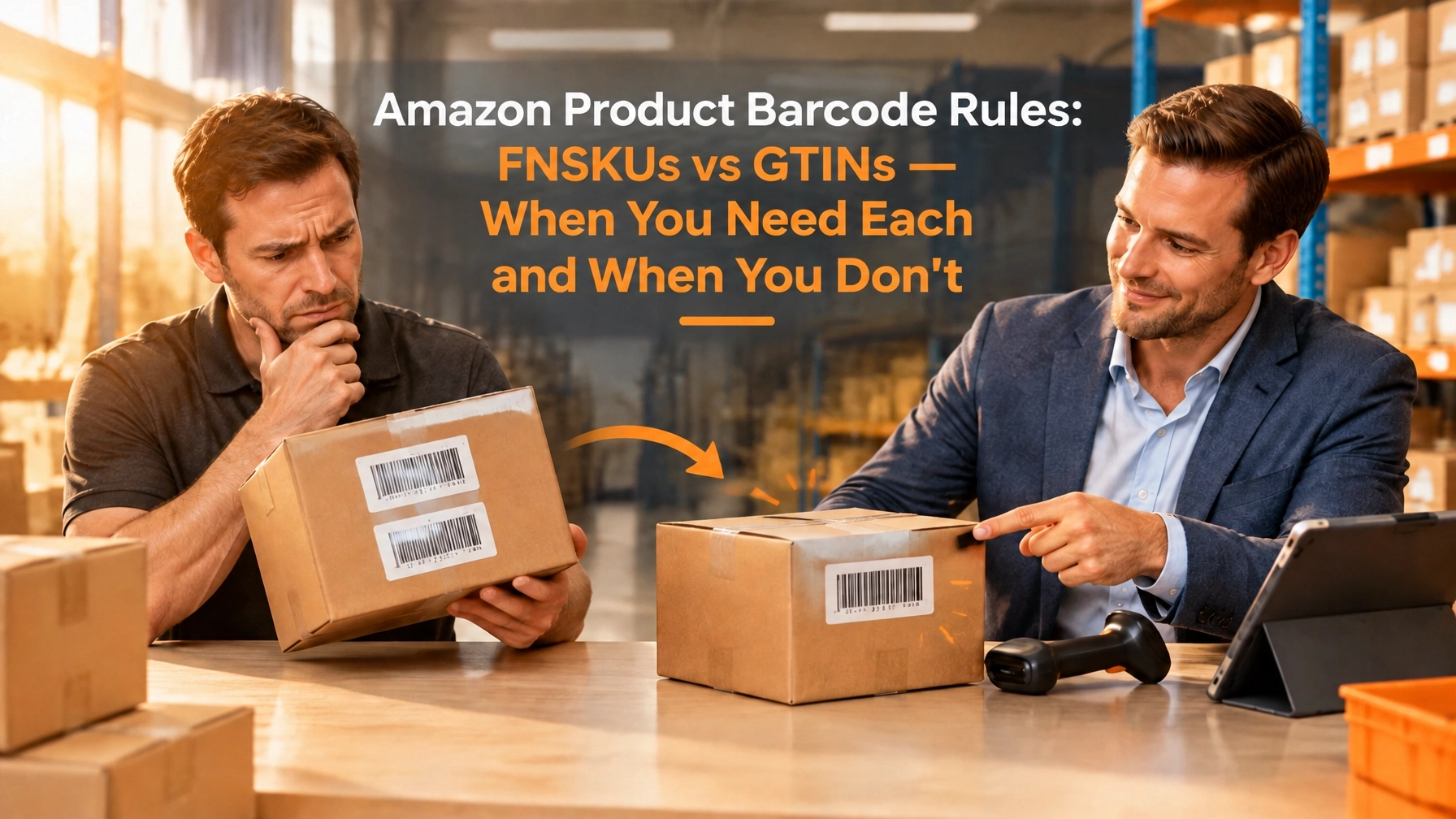
Amazon product barcode rules changed in a big way. For US FBA inventory shipped on or after March 31, 2026, Amazon ended commingling and narrowed who can use manufacturer barcodes stickerless. Resellers must label each unit with an FNSKU. Eligible brand owners may use a manufacturer barcode, but only when the product and offer meet Amazon’s requirements.
That difference affects inbound compliance, per-unit costs, and inventory control. Here’s how to choose correctly and avoid paying for labels you don’t need.
1. What is an FNSKU?
An FNSKU, or Fulfillment Network SKU, is the amazon fnsku barcode: an Amazon-generated code, typically an X00… number, tied to your seller account and your offer on an ASIN. It is printed and applied to each unit sent to FBA. The code identifies your inventory as yours, rather than relying only on the product’s shared manufacturer barcode.
FNSKUs have been part of FBA’s operating structure since its early years in the mid-2000s. They gave Amazon a way to identify individual sellers’ inventory inside a shared fulfillment network. When commingling allowed eligible units with the same manufacturer barcode to be handled together, using an FNSKU was a way to keep your units identifiable and separate. From March 31, 2026, commingling ended for new US and European FBA inventory.
Keep these identifiers straight:
- Seller SKU: Your internal ID for an offer or inventory record.
- ASIN: Amazon’s catalog ID for a product.
- GTIN/UPC: A global trade item identifier, often printed on retail packaging.
- FNSKU: Amazon’s seller-specific FBA barcode for identifying your units.

They are related, but they are not interchangeable. A GTIN identifies a trade item; an ASIN identifies an Amazon catalog record; your seller SKU identifies your offer; and an FNSKU identifies your FBA inventory.
2. What is a GTIN?
A GTIN, or Global Trade Item Number, is a product identifier issued through GS1. UPC, EAN, ISBN, and JAN are all types of GTIN. A UPC is one member of the GTIN family, not a separate alternative to the family as a whole. A common GTIN UPC question is whether the code printed on the package can also serve as the FBA barcode. In 2026, the answer depends on your seller role and product eligibility.
Amazon uses product identifiers to match listings to catalog records. When the product is already in Amazon’s catalog, your GTIN may identify the matching ASIN. It does not replace your seller SKU or automatically qualify your offer for stickerless FBA.
Some private-label or handmade products may qualify for a GTIN exemption when they do not have an eligible product identifier. An exemption allows listing without a GTIN; it does not waive FBA labeling requirements. GTIN-exempt products still need an FNSKU for FBA, including products sold by brand owners.
3. When is a manufacturer barcode acceptable under Amazon barcode requirements?
For US FBA inventory shipped on or after March 31, 2026, only brand owners with the appropriate Brand Registry role can use an eligible manufacturer barcode stickerless. The amazon barcode requirements are strict, so check all of these conditions:
- You hold the Brand Representative selling role for the relevant brand.
- The product is linked to that brand in Brand Registry.
- The product has one valid, scannable GTIN that matches the ASIN.
- The offer is for a new-condition product and the barcode and product otherwise meet Amazon’s eligibility requirements.
Brand enrollment alone is not enough. In Seller Central, verify your selling role under Brand Relationships. Amazon notes that enrolling a brand does not automatically associate every product with it.
Packaging matters, too. The manufacturer barcode must be scannable and should be the only visible scannable product barcode. Multiple barcodes, an unreadable code, a mismatched GTIN, or an ineligible product can make stickerless use a costly mistake. Check the product’s current barcode eligibility in Seller Central before building the shipment; eligibility can depend on product or category restrictions.
Amazon’s stated rationale is that brand owners who obtain GTINs for their own products are responsible for those products, so an eligible manufacturer barcode can identify their inventory. For everyone else, the FNSKU distinguishes one seller’s units from another’s.
Transition note: Stickerless inventory already in an Amazon fulfillment center, or already in transit, before March 31 can sell through under its original SKU under Amazon’s transition guidance. Switching an offer to Amazon barcodes requires creating a new SKU. Reviews and ratings are attached to the ASIN, so a new SKU does not reset them. Amazon also waived low-inventory-level fees for affected ASINs during the transition.

4. When do you have to have an FNSKU?
The amazon fba barcode you choose determines what must arrive at the fulfillment center. Under the post-March 31 rules, plan on applying an FNSKU if you are:
- An arbitrage, online arbitrage, wholesale, or other reseller.
- An authorized reseller. A letter of authorization does not exempt you from the labeling requirement.
- Selling a GTIN-exempt product.
- Sending a bundle or multipack whose individual product barcode does not properly identify the sellable unit.
- Sending used or collectible inventory.
- Sending an item whose manufacturer barcode is missing, unscannable, mismatched, or not the only visible scannable code.
Some packaging formats, including apparel packaging that hides the UPC, may also need FNSKU labeling. Verify the requirements for the specific product and offer rather than assuming one rule covers every SKU.
Units received without a required label can be treated as defective, may not be eligible for reimbursement, and can be flagged in the Inbound Performance Dashboard. Do not send a shipment based on an assumption that a prep center or Amazon will correct it.
5. What are the pros and cons of FNSKU vs UPC?
| Choice | Pros | Cons |
|---|---|---|
| Eligible manufacturer barcode, stickerless | No per-unit label application; less prep labor; fewer label-placement errors; potentially faster inbound prep. | Only available to eligible Brand Representatives and eligible products; barcode and packaging must pass checks; less seller-specific identification on the unit. |
| FNSKU / Amazon barcode | Seller-specific inventory identification and traceability; works for resellers and GTIN-exempt products; supports more precise identification for removal and return workflows. | Adds a per-unit labor and materials cost; requires correct application; creates another step in receiving and shipment prep. |
One pre-2026 concern about commingling, another seller’s units being treated as yours, changed when Amazon ended commingling for new shipments. But FNSKUs remain useful for seller-specific tracking and control. For resellers, they are now mandatory for new inbound inventory, not a preference.
Amazon’s US FBA Label Service — the last amazon labeling option for inbound units — ended for shipments created from January 1, 2026. The former service charged $0.55 per unit; that is a historical reference, not a current option. Sellers now label in-house or pay a prep center. Build the actual per-unit cost into your margins.
6. Are you using FNSKUs when you don’t need them?
Yes. Some sellers still default to applying an FNSKU label to every unit, even when the amazon product barcode already printed on the packaging qualifies for stickerless use. Others pay a prep center to label eligible products because no one checked the Brand Representative role or verified barcode eligibility.
That may be sensible if you want consistent seller-specific tracking. But it should be a deliberate choice, not a charge that appears because your process was never reviewed.
Use this quick audit:
- Verify eligibility: Confirm the Brand Representative role for the brand and check the product’s FBA barcode eligibility.
- Audit packaging: Confirm the GTIN is scannable, matches the product, and is the only visible scannable barcode.
- Choose a method: Use the manufacturer barcode only if the offer and product qualify. Otherwise, apply FNSKUs.
- Check every prep invoice: Confirm you are not paying for optional labeling on eligible inventory by default.
The old $0.55-per-unit service rate illustrates the scale: 10,000 units would have meant $5,500 in labeling at that rate. Your actual in-house cost will differ, but label stock, labor, equipment, and quality checks still add up. Since the 2026 change, FNSKU labeling is mandatory for resellers and optional for eligible brand owners. The right cost-control move is to check first.
7. How do you create a GTIN manufacturer-barcode FBA listing?
Use this process only if your amazon product barcode — the GTIN the manufacturer printed — qualifies for stickerless use:
- Obtain a valid GTIN. If you own the brand, obtain product identifiers through GS1. Avoid reusing a GTIN assigned to a different product.
- Verify your Brand Representative role. In Seller Central, check Brand Relationships and confirm the role applies to the brand and product.
- Create or match the listing. Choose Add a Product, enter the UPC or other GTIN, and confirm the result is the correct product. If you create a new listing, make sure the brand information is accurate.
- Set the FBA barcode preference. In the FBA inbound workflow, select Manufacturer Barcode if Amazon presents it as an available option for the offer.
- Confirm SKU eligibility. Check the FBA barcode setting for that specific SKU before you create the shipment.
- Inspect retail packaging. Verify that the manufacturer barcode is legible, matches the product, and is the only visible scannable product code.
Warning: If an eligibility condition fails, the shipment can be flagged or received as unlabeled inventory. Check Seller Central’s current requirements before shipping; do not rely on a previous SKU setup or another product’s eligibility.
8. How do you create an FNSKU FBA listing?
Use an Amazon barcode when you are a reseller, the product is GTIN-exempt, or the product does not qualify for stickerless use.
- Create the offer. Add the product to the catalog or create a new SKU for an existing ASIN. If switching a current offer from a manufacturer barcode to an Amazon barcode, plan for the new-SKU requirement.
- Choose Amazon Barcode. Set the preference to Amazon Barcode (FNSKU) in the offer or FBA barcode settings. Amazon labeling menus and paths change often, so confirm the selection for the specific SKU.
- Print the unit labels. Print the amazon fnsku barcode labels from Seller Central or download the label PDF for your prep center. Standard label stock commonly used for FNSKUs is 3⅛ × 1⅒ inches; check your printer and label template before a production run.
- Apply labels correctly. Place each FNSKU flat and readable. Cover other scannable product barcodes so the wrong code cannot be scanned, but do not cover required product information or safety details.
- Build and verify the shipment. Confirm the shipment shows the amazon fba barcode setting — Amazon Barcode (FNSKU) — then check that every unit is labeled before it leaves your facility.
- Keep evidence. Retain prep records and shipment details. Unlabeled units can be treated as defective and may not qualify for reimbursement.

9. What can a 3PL do about FNSKU prep?
You have a problem. We have a solution. For resellers, FNSKU application is now a required per-unit cost. Incorrect labels can turn inventory into ineligible, non-reimbursable defects. Managing label stock, labor, and verification in-house adds overhead.
FBMFulfillment provides FBA prep and relabeling, including FNSKU application, placement checks, barcode verification, and master-carton or case labeling. Prepared inventory can feed the FBA Replenishment Module (FRM), with 7–10 day replenishment cycles and direct-to-DC shipping from a single inventory pool. From Jacksonville, FBMFulfillment also ships DTC orders with FedEx 2Day service and a same-day shipping cutoff.
FBMFulfillment supports Code 128, UPC, EAN, and QR barcodes for warehouse operations. Non-conforming stock can be relabeled for a charge. Review our Amazon barcode requirements FAQ before sending inventory.
Startup-friendly policies include waived minimums for 12 months, no onboarding fees, month-to-month terms, enterprise-level pricing and shipping rates, free coaching through Ecommerce Academy and in person, strategic locations, world-class technology, and post-pay invoicing. We aim to build long-term partnerships, not lock sellers into long contracts. For a substantive 3PL conversation, move beyond email: arrange a video or in-person meeting, ask to see the operation, and watch for red flags such as gimmicks, hidden fees, and restrictive contracts.
Key Takeaways
- Amazon product barcode rules changed on March 31, 2026: commingling ended and stickerless eligibility narrowed.
- An FNSKU identifies your seller-specific FBA inventory; a GTIN identifies a trade item.
- A UPC is one kind of GTIN, not a replacement for an FNSKU in every situation.
- Since March 31, 2026, eligible Brand Representatives may use manufacturer barcodes stickerless.
- Resellers, including authorized resellers, must use FNSKUs for new inbound inventory.
- GTIN-exempt products still need FNSKUs for FBA.
- Check your Brand Representative role under Brand Relationships; brand enrollment alone is not enough.
- Make sure the manufacturer barcode is scannable and the only visible scannable product code.
- Amazon’s US FBA Label Service ended for shipments created from January 1, 2026.
- Unlabeled units can be treated as defective, may not qualify for reimbursement, and can appear in the Inbound Performance Dashboard.
- A switch to Amazon barcodes requires a new SKU, but reviews and ratings remain with the ASIN.
- Audit prep charges regularly; apply labels when required, not automatically.
- Ask a 3PL to explain its labeling process, charges, and partnership terms before sending inventory.
Resellers must label each unit with an FNSKU, the amazon fnsku barcode that uniquely identifies their inventory.
Related Links
Frequently Asked Questions
The amazon fnsku barcode is Amazon’s seller-specific FBA barcode, generally beginning with X00, used to identify your units for a specific offer on an ASIN.
A Global Trade Item Number is a product identifier. UPC, EAN, ISBN, and JAN are types of GTIN.
No. A UPC is one type of GTIN. GTIN is the broader identifier family.
Only if you meet Amazon’s current amazon barcode requirements. For new inventory shipped on or after March 31, eligible Brand Representatives may use it; resellers must use FNSKUs.
No. You need the Brand Representative selling role for the relevant brand, and the product and offer must also meet Amazon’s eligibility rules.
No. Authorization from the brand does not make you a Brand Representative and does not exempt you from FNSKU labeling.
Amazon can treat them as defective, flag them in the Inbound Performance Dashboard, and deny reimbursement eligibility
Amazon’s US FBA Label Service ended for shipments created from January 1, 2026. Label in-house or use a third-party prep provider
It depends on your labor, materials, and prep provider. Amazon labeling used to be available as a paid US service at $0.55 per unit, but that service ended for shipments created from January 1, 2026.
Create a new SKU for the offer and select Amazon Barcode in its FBA barcode settings. The ASIN’s reviews and ratings remain associated with the ASIN.
Yes. GTIN exemption does not remove FBA barcode labeling requirements.
Commingling was the practice of handling eligible units with the same manufacturer barcode together in fulfillment. Amazon ended commingling for FBA inventory shipped on or after March 31, 2026.