Are your products still at the factory, on an ocean vessel, or waiting for a freight booking? The Amazon holiday inbound deadlines are approaching quickly. Amazon has published exact arrival dates for Prime Big Deal Days, Black Friday Week, and Cyber Monday. These are not ship-by dates. Your inventory must arrive at Amazon facilities in time to be received and processed.
Miss the window and the consequences are serious: reduced Prime badge eligibility, weaker Buy Box performance, lower visibility, and lost holiday sales.
You have a deadline problem. We have a speed solution. The most reliable strategy is to work backward from Amazon’s arrival dates, stage inventory domestically, and replenish FBA in controlled shipments rather than depending on one late inbound load.
1. What are the Amazon holiday inbound deadlines?
Amazon’s official Holiday 2026 announcement provides separate deadlines based on the inventory channel and shipment split option selected.
| Event | AWD shipment deadline | FBA with “minimal shipment splits” | FBA with “Amazon-optimized shipment splits” |
|---|---|---|---|
| Prime Big Deal Days | September 2, 2026 | September 9, 2026 | September 16, 2026 |
| Black Friday Week and Cyber Monday | October 14, 2026 | October 21, 2026 | October 28, 2026 |
The Amazon-optimized shipment splits option is the one most sellers select. That does not make October 28 a comfortable shipping date. It is the final arrival deadline identified by Amazon for that option.
Important clarification: these arrival deadlines apply to domestic inbound shipments within the United States. In practical terms, that means SPD (small parcel delivery) and LTL (less than truckload) shipments moving from your U.S. warehouse or 3PL to Amazon fulfillment centers. They do not apply to international shipments still moving from overseas factories or suppliers.
The Prime badge arrival windows assume a domestic origin. The international factory to U.S. leg by ocean freight or air freight is a separate, longer timeline that happens before this domestic deadline clock even starts.
This is exactly why U.S. staging matters. A 3PL warehouse gives you flexibility on the factory to U.S. leg, where transit is longer and less predictable, while the final U.S. to Amazon SPD or LTL leg is the one that must hit Amazon’s arrival windows.
The Amazon holiday inbound deadlines are designed to give Amazon’s fulfillment network time to receive and position inventory before demand accelerates. Amazon also explains that fulfillment center teams focus on receiving holiday inventory in September and October before shifting toward customer order processing in November and December.
That means late inventory creates two risks at once:
- Your shipment may not be received by the deadline.
- Amazon capacity may become more difficult to secure as peak approaches.
2. When do holiday peak fulfillment fees apply?
Holiday peak fulfillment fees apply from October 15, 2026, through January 14, 2027.
According to Amazon, the fee window applies to:
- Fulfillment by Amazon (FBA)
- Remote Fulfillment with FBA
- Multi-Channel Fulfillment (MCF)
- Buy with Prime
Amazon states that the peak increase will average $0.32 per unit, with a 3.5% fuel and logistics-related surcharge applying on top of holiday peak fulfillment fees. Sellers should verify product-specific rates in Amazon’s Revenue Calculator, Profit Analytics dashboard, and Fee and Economics Preview Report.
Getting inventory into Amazon before October 15 does not remove peak fulfillment fees from units fulfilled during the peak period. However, early planning can reduce the operational chaos surrounding those fees.
A late inbound shipment often forces sellers into expensive decisions:
- Expedited air freight
- Emergency prep labor
- Split shipments from multiple suppliers
- Higher landed cost
- Stockouts during the strongest sales weeks
- Unplanned transfers between sales channels
The goal is not simply to move inventory quickly. The goal is to protect margin, lead times, and availability at the same time.
3. Why is the arrival date more important than the ship date?
A factory ship date is only the beginning of the timeline. It does not tell you when Amazon will have sellable inventory available.
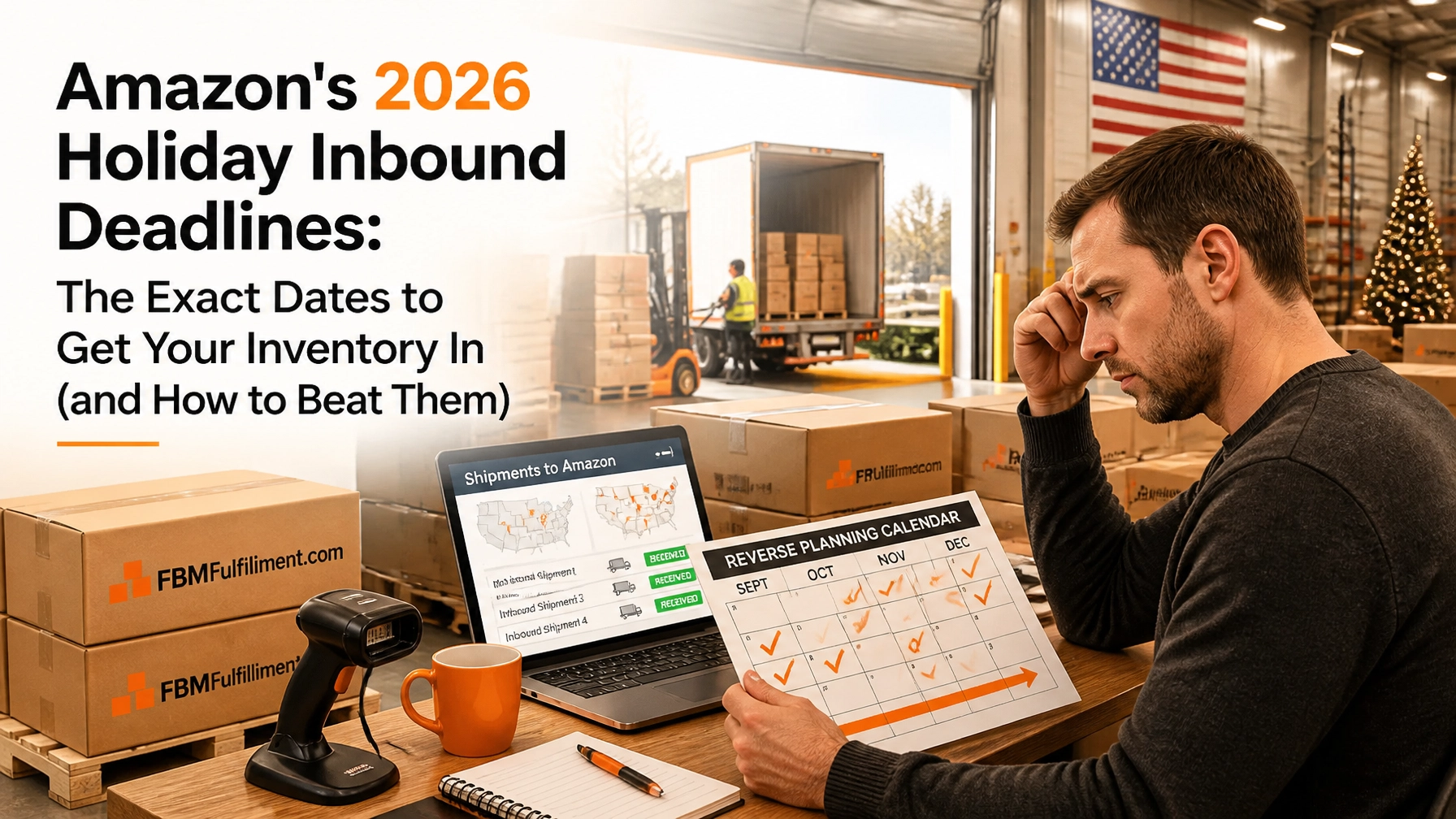
Your reverse calendar should include:
-
Production completion
Confirm when finished goods will be packed, labeled, and ready for pickup. -
Origin handling and export clearance
Add time for appointment scheduling, documentation, container loading, and export processing. -
Ocean or air transit
Use the carrier’s realistic transit range: not the best-case estimate from a freight quote. -
U.S. port handling and customs clearance
Customs exams, documentation issues, port congestion, and holds can add unexpected days. -
Drayage or domestic transportation
The shipment still needs to travel from the port or airport to the fulfillment destination. -
Receiving and inspection
Cartons must be unloaded, counted, inspected, labeled if required, and entered into the warehouse management system. -
Amazon check-in and processing
A shipment appointment or carrier delivery does not equal available FBA inventory.
If your target arrival date is October 28, your shipping plan must be completed well before October. Depending on product readiness, mode, origin, and prep requirements, the actual planning deadline may fall weeks or months earlier.
Treat the Amazon holiday inbound deadlines as hard operational cutoffs. Then add a buffer for customs delays, port congestion, appointment availability, and receiving exceptions.
Unfortunately, many sellers plan from the factory backward only to the vessel departure date. That is not reverse planning. It is a partial timeline that leaves the most unpredictable steps unprotected.
4. How can FBA Dripfeed protect your holiday inventory?
The strongest alternative to one large, late FBA shipment is a staged replenishment strategy.
With FBA Dripfeed, you keep bulk inventory in a U.S. 3PL warehouse and send controlled replenishment shipments to Amazon based on forecasted demand and available FBA capacity. This gives you a domestic buffer between your overseas supply chain and Amazon’s network.
That distinction matters. The factory to U.S. freight leg does not operate under Amazon’s inbound arrival deadlines. The deadline pressure begins on the domestic leg once your inventory is already in the United States and moving by SPD or LTL from your warehouse or 3PL to Amazon.
The problem
Sending all inventory directly to FBA can create several vulnerabilities:
- Inventory may arrive before demand and accumulate storage costs.
- A late shipment can miss the inbound window entirely.
- Amazon may distribute cartons across multiple destinations.
- A single receiving delay can affect your entire holiday launch.
- Inventory becomes harder to redirect to Shopify, Walmart, TikTok, eBay, or Etsy.
The solution
A 3PL fulfillment warehouse can receive and stage your bulk inventory in the United States before the critical deadlines. From there, your replenishment plan can be adjusted as sales data changes.
FBMFulfillment’s FBA Replenishment Module supports predictable 7 to 10 day replenishment cycles. Instead of waiting until FBA inventory is nearly depleted, you establish a repeatable flow:
- Receive bulk inventory domestically.
- Inspect and count products.
- Complete FBA compliant labeling and preparation.
- Monitor FBA inventory levels.
- Release replenishment shipments on schedule.
- Keep backup inventory available for other channels.

This is a strategic advantage during Q4. You can meet Amazon’s inbound requirements without committing every unit to Amazon months in advance.
It also protects your broader sales operation. A single inventory pool can support Amazon, Shopify, TikTok, Walmart, eBay, and Etsy. If one channel accelerates, you retain the ability to allocate stock where it produces the strongest return.
5. How does FBMFulfillment help you beat the calendar?
FBMFulfillment was built from an ecommerce seller’s perspective. We understand that holiday fulfillment is not only about storage. It is about landed cost, lead times, minimum order quantities, receiving accuracy, and the ability to react when demand changes.
Our Jacksonville operation gives sellers a practical Southeast logistics advantage.
As a fulfillment center in Florida, FBMFulfillment can receive ocean freight through the Jacksonville port area, inspect inbound inventory, complete 3PL fulfillment prep, and stage products for Amazon replenishment or direct-to-consumer orders.
Our support includes:
- 3PL Jacksonville receiving and inventory staging
- FBA compliant labeling, inspection, and carton preparation
- FBA Dripfeed and replenishment planning
- FBA Replenishment Module support
- Same day fulfillment for orders released within the operating cutoff
- FedEx 2Day delivery options
- Pick and pack fulfillment services for multichannel orders
- One inventory pool for Amazon and major ecommerce channels
You may search for an Amazon fulfillment center near me when planning Q4 inventory. However, proximity to Amazon alone does not solve the problem. You need a partner that can receive freight, control inventory, complete prep accurately, and move replenishment before Amazon’s network becomes constrained.
Learn more through our FBA fulfillment resources, customs and freight resources, and warehouse management system resources. For sellers comparing channel strategies, our Amazon multi channel fulfillment MCF resources explain how one inventory pool can serve multiple storefronts.

6. What should sellers do right now?
Use this checklist before the next shipment leaves your supplier.
Confirm your Amazon settings
- Verify whether your shipment uses AWD, minimal shipment splits, or Amazon-optimized shipment splits.
- Match each product and shipment plan to the correct deadline.
- Review Amazon’s Q4 peak readiness playbook.
- Confirm that product listings, labels, carton details, and shipment information are accurate.
Build a reverse calendar
- Start with September 2, September 9, or September 16 for Prime Big Deal Days.
- Start with October 14, October 21, or October 28 for Black Friday Week and Cyber Monday.
- Treat those dates as domestic arrival deadlines into Amazon, not overseas factory departure deadlines.
- Separate the timeline into two legs: factory to U.S. warehouse, then U.S. warehouse to Amazon by SPD or LTL.
- Work backward through production, freight, customs, domestic transportation, receiving, and Amazon check-in.
- Add a buffer for delays instead of planning to the final possible day.
Protect domestic availability
- Book ocean or air freight early.
- Stage a portion of your inventory with a 3PL warehouse in the United States.
- Separate launch inventory from replenishment inventory.
- Set reorder points before FBA reaches a critical level.
- Keep enough stock available for direct-to-consumer and wholesale orders.
Review the economics
- Compare peak FBA, MCF, and direct fulfillment rates.
- Include prep, storage, freight, fuel surcharges, and emergency shipping in your landed cost.
- Review minimum order quantities against realistic holiday demand.
- Avoid sending every unit into one network when a staged model gives you more control.
The Amazon holiday inbound deadlines are not suggestions for when to begin thinking about Q4. They are the dates your inventory needs to be in Amazon’s facilities for the strongest chance of Prime badge eligibility during key events.
The sellers who win the holiday season are not always the ones with the most inventory. They are the ones with the most reliable inventory plan.
If your products are still overseas or your FBA replenishment process is unpredictable, contact FBMFulfillment. We will be glad to review your arrival dates, freight timeline, prep requirements, and channel mix so you can build a faster, more controlled holiday fulfillment plan.
Key Takeaways
- Amazon holiday inbound deadlines are crucial for inventory to arrive on time, preventing sales losses and reduced visibility.
- Fulfillment by Amazon requires careful planning around arrival dates, not just shipping dates, with specific deadlines for Prime Big Deal Days and Black Friday/Cyber Monday.
- Staging inventory in a 3PL warehouse can provide flexibility, allowing for controlled replenishment rather than risking all inventory in one shipment.
- Sellers should create a reverse calendar, separating timelines for international shipping and domestic transportation to ensure compliance with Amazon’s deadlines.
- Using FBA Dripfeed can protect holiday inventory by managing inventory flow based on demand while decreasing the risk of stockouts.
Related Links
Frequently Asked Questions
For AWD shipments, the deadline is September 2, 2026. For minimal splits, it’s September 9, 2026. For Amazon-optimized splits, it’s September 16, 2026. Which deadline applies depends on how the shipment is split across Amazon’s network.
For AWD shipments, the deadline is October 14, 2026. For minimal splits, it’s October 21, 2026. For Amazon-optimized splits, it’s October 28, 2026.
They’re arrival dates, not ship-by dates. Inventory has to actually arrive at Amazon facilities and be received and processed by the deadline — a shipment that merely leaves the factory or port by that date isn’t compliant. These deadlines also apply specifically to domestic U.S. inbound shipments (SPD and LTL), not to international shipments coming directly from overseas factories.
The peak fee window runs October 15, 2026 through January 14, 2027. Fees increase by an average of $0.32 per unit, plus an additional 3.5% fuel and logistics surcharge. This applies across FBA, Remote Fulfillment with FBA, Multi-Channel Fulfillment (MCF), and Buy with Prime.
Because a factory ship date is only the first step in a seven-stage timeline: production completion, origin handling and export clearance, ocean or air transit, U.S. port handling and customs clearance, drayage or domestic transportation, receiving and inspection, and finally Amazon check-in and processing. Any delay at any of those steps pushes back the date inventory is actually usable, so working backward from the arrival deadline (not forward from the ship date) is what keeps a shipment on schedule.
Instead of sending all inventory directly to FBA — which creates risks like early arrival accumulation, missed inbound windows, and awkward distribution across multiple destinations — a dripfeed model stages bulk inventory at a U.S. warehouse and releases it to Amazon in controlled shipments (in FBMFulfillment’s case, on 7-10 day replenishment cycles) based on actual demand, while keeping stock simultaneously available for Amazon, Shopify, TikTok, Walmart, eBay, and Etsy.
Four things: confirm Amazon settings (verify your shipment type, match products to the correct deadline, review Amazon’s Q4 peak readiness playbook, and validate labels); build a reverse calendar that treats Amazon’s dates as domestic arrival deadlines and works backward through all seven timeline steps with buffer for delays; protect domestic availability by booking ocean/air freight early and staging a portion of inventory with a 3PL, with reorder points set before FBA stock depletes; and review the economics of FBA versus MCF versus direct fulfillment, including prep, storage, freight, and peak surcharges, rather than sending all units into a single network.