
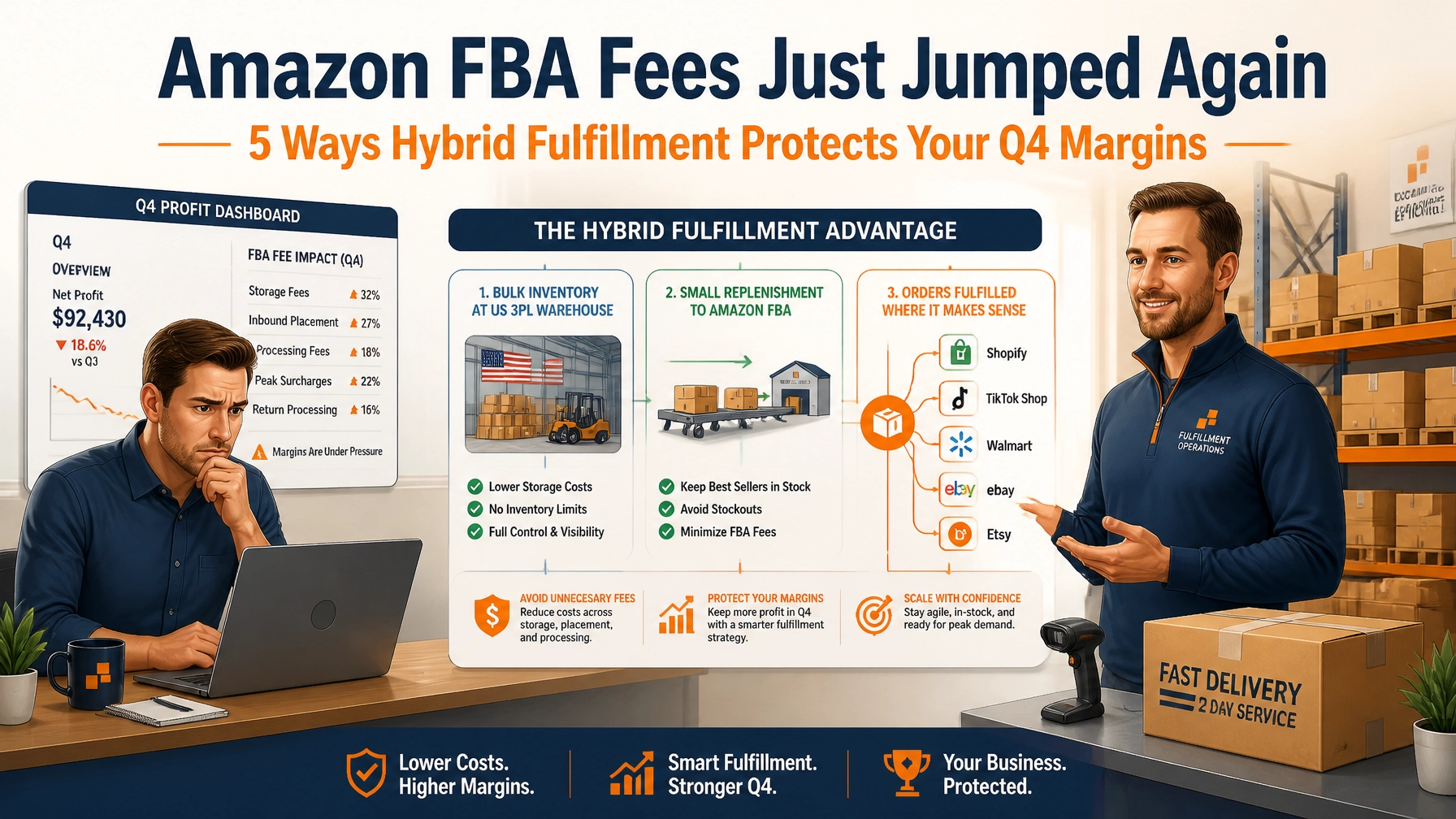
If your Q4 forecast still uses last year’s fulfillment assumptions, your margin model is already outdated. Amazon fulfillment fees now include a 3.5% fuel and logistics surcharge, higher holiday peak rates, and additional exposure through storage, aged inventory, low inventory, and inbound placement charges. The solution is not necessarily abandoning FBA. It is using hybrid fulfillment to place each unit where it creates the strongest operational and financial result.
Q4 planning is a timing exercise. Inventory positioned too early in FBA can become expensive inventory. Inventory positioned too late can create stockouts and low-inventory fees. You need a structure that protects availability without forcing your entire purchase order into Amazon’s network.
What Is Hybrid Fulfillment and Why Does It Matter Before Q4?
Hybrid fulfillment means dividing inventory between Amazon FBA and an independent US 3PL according to demand, channel, and cost.
The structure is straightforward:
- Store bulk inventory at a domestic 3PL.
- Send FBA only the quantity required to support Amazon demand.
- Replenish FBA on a predictable cycle through a dripfeed process.
- Fulfill Shopify, TikTok Shop, Walmart, eBay, Etsy, wholesale, and direct orders from the 3PL inventory pool.
- Keep slower-moving and seasonal products outside FBA until demand justifies moving them closer to Amazon customers.
The operating logic of hybrid fulfillment is simple: FBA handles the Amazon units that benefit from Amazon’s network, while your 3PL protects the rest of your inventory from unnecessary Amazon fees.
Amazon’s official 2026 FBA fee changes state that the 3.5% surcharge began April 17, 2026. Holiday peak fulfillment fees apply from October 15, 2026, through January 14, 2027, and the surcharge applies on top of those peak rates.
That creates a narrow planning window. You need to decide now which products belong in FBA and which should remain in your independent fulfillment center.
How Are Amazon Fulfillment Fees Compounding in 2026?
The per-unit fulfillment fee is only one part of your Amazon cost structure. Your effective Q4 cost can include:
- Monthly storage fees: FBA storage rates increase during the final quarter for many product categories and size tiers.
- Aged inventory surcharges: Inventory held too long can trigger additional charges, particularly when seasonal or slower-moving products remain in FBA for extended periods.
- Low-inventory fees: Amazon states that a low-inventory-level fee can apply when standard size inventory falls below approximately 28 days of supply relative to demand.
- Inbound placement fees: Amazon may charge for the placement strategy selected when sending inventory into its network.
- Peak season surcharges: Higher fulfillment rates apply to orders shipped during the holiday window.
- Fuel and logistics surcharge: The 3.5% surcharge applies to FBA fulfillment fees, including peak rates.
The impact varies by ASIN, size tier, selling price, shipping weight, inventory age, and sales velocity. For example, Amazon’s 2026 fee table lists a small standard product weighing between 2 and 4 ounces in the $10 to $50 price band at $3.42 during non-peak periods and $3.61 during peak periods, before the 3.5% surcharge.
Use Amazon’s Revenue Calculator, Profit Analytics dashboard, and Fee and Economics Preview reports to model each SKU. Then build your Q4 strategy around the total cost, not only the fulfillment fee displayed on the rate card.
5 Ways Hybrid Fulfillment Protects Your Q4 Margins
1. Can You Avoid Aged Inventory Surcharges by Keeping Slow Stock in a 3PL?
Yes, by changing where you hold inventory before it becomes aged inside FBA.
Your problem
You place four or six months of projected Q4 inventory into FBA because you do not want to risk a stockout. The product sells slower than expected. Amazon continues charging monthly storage, and the inventory moves closer to aged inventory surcharge thresholds.
The result is a double margin hit:
- You pay to store units before they sell.
- You pay an additional surcharge when those units remain too long.
This is especially damaging for seasonal products, long-tail SKUs, product variations, and items with uncertain demand.
Our solution
Store bulk inventory in a US 3PL and send Amazon smaller, demand-based replenishments. Your FBA inventory can remain focused on active sales velocity instead of carrying your entire purchase order.
A domestic 3PL does not eliminate storage cost. It changes the cost structure and preserves your flexibility. If demand accelerates, the inventory is available for replenishment. If demand slows, the stock remains accessible for Shopify, TikTok Shop, wholesale, or a promotional campaign.
Action step: Identify every FBA SKU projected to hold more than 60 to 90 days of supply after October 1. Review whether the full quantity belongs in Amazon or whether a portion should remain in your 3PL pool.

2. Can Predictable Replenishment Reduce Low-Inventory Fees?
It can reduce the risk by giving you a controlled domestic inventory buffer.
Your problem
Your FBA balance falls quickly during a promotion or unexpected demand spike. A replenishment shipment is created too late. Amazon sees insufficient days of supply, and the affected units may incur a low-inventory fee. Worse, the listing approaches a stockout, causing lost sales and weaker organic momentum.
In 2026, Amazon’s low-inventory-level fee is tied to inventory coverage relative to demand. A strong Q4 sales day can change your coverage calculation quickly.
Our solution
Use a replenishment cadence based on actual sales velocity, lead time, and receiving performance. The FBA Replenishment Module helps automate this process by connecting your domestic stock position with the quantities that need to move into FBA.
The process should include:
- A minimum FBA days-of-supply target.
- A reorder trigger based on units sold, not guesswork.
- A replenishment quantity that accounts for Amazon receiving time.
- A separate safety stock position at the 3PL.
- Exception alerts for unusual demand or delayed inbound appointments.
This is where hybrid fulfillment becomes a margin protection system rather than simply a storage arrangement. You are not choosing between “all FBA” and “all merchant fulfilled.” You are managing the right amount of inventory in each location.
Action step: Set replenishment triggers before the holiday sales period begins. Do not wait until FBA inventory reaches its final week of supply.

3. Can Consolidated Inbound Shipments Reduce Placement Fees?
They can reduce unnecessary shipment complexity and help control inbound placement exposure.
Your problem
You send multiple small shipments into FBA throughout Q4. Each shipment requires planning, carton compliance, labels, carrier coordination, and receiving follow-up. Small, fragmented shipments can also make it harder to manage the total cost of inbound placement.
A shipment that is technically accepted can still be inefficient when it creates excessive handling and transportation activity.
Our solution
Consolidate compliant cartons at your 3PL before sending replenishment inventory to Amazon. A disciplined outbound process should verify:
- FNSKU and carton labels.
- Case pack quantities.
- Carton dimensions and weights.
- Shipment plan requirements.
- Pallet configuration where applicable.
- Appointment and carrier documentation.
- Product quantities against the purchase order.
Consolidation does not guarantee that Amazon will eliminate every inbound placement fee. It gives you better control over shipment configuration and avoids sending rushed, incomplete, or poorly organized loads.
A fulfillment partner can also hold inventory until the replenishment quantity justifies a more efficient shipment. That is important when Q4 demand is uneven across SKUs.
Action step: Create a weekly or twice-weekly replenishment calendar instead of sending emergency cartons whenever a dashboard turns red.
4. Can the 3PL Pool Lower Multi-Unit Order Costs?
In many cases, yes. Multi-unit orders are one of the clearest places to compare FBA economics with direct 3PL fulfillment.
Your problem
Amazon generally calculates fulfillment charges on a per-unit basis. A customer purchasing three units in one order can generate three separate FBA fulfillment charges, even though the products may ship together in one carton.
That fee structure can damage promotions such as:
- Buy two, get a discount.
- Buy three and save.
- Subscribe and save quantities.
- Multipacks.
- Replenishment bundles.
- Wholesale case orders.
The more units your customer places in one cart, the more important it becomes to calculate the full order cost rather than the single-unit fee.
Our solution
Use the 3PL inventory pool for channels and orders where consolidated picking and packing produces a better landed fulfillment cost. A 3PL can pick multiple units into one shipment and apply a primary pick or pack charge with a smaller incremental charge for additional units, depending on the service agreement.
With hybrid fulfillment, Amazon can continue serving single-unit FBA orders while the 3PL handles multi-unit orders from Shopify, TikTok Shop, Walmart, eBay, and other channels.
Review your order data by:
- Units per order.
- Average carton count.
- Shipping zone.
- Package weight.
- Channel.
- Return rate.
- FBA fulfillment cost per order.
Do not assume the cheapest single-unit option is the cheapest multi-unit option. The economics change as the cart grows.
5. Can No Onboarding Fees or Minimums Preserve Q4 Cash Flow?
They can make a transition easier when cash is already committed to inventory, advertising, freight, and seasonal labor.
Your problem
Moving to a new fulfillment provider often creates upfront costs. Onboarding fees, integration fees, minimum monthly charges, and volume commitments can make sellers delay a needed operational change until after Q4.
That delay has a cost. You continue paying avoidable Amazon fees while waiting for a “perfect” time to move.
Our solution
FBMFulfillment offers no onboarding fees and no minimums, allowing sellers to test a controlled allocation of inventory without taking on a large fixed commitment. The goal is to begin with the SKUs where the fee avoidance case is clearest:
- Slow-moving FBA inventory.
- Multi-unit products.
- Products sold across several marketplaces.
- Seasonal inventory arriving ahead of demand.
- SKUs with frequent replenishment requirements.
- Products where delivery control and return inspection matter.
FBMFulfillment was built from an ecommerce seller’s viewpoint. That means the operation is designed around real seller problems: inventory limits, Amazon receiving delays, channel expansion, returns, and margin pressure.
Why FBMFulfillment Is Built for This Q4 Strategy
FBMFulfillment operates from Jacksonville, Florida, giving sellers a domestic position for controlled inventory storage, replenishment, and direct-to-consumer fulfillment.
As a 3pl jacksonville partner, we support a single inventory pool across Amazon, Shopify, TikTok Shop, Walmart, eBay, and Etsy. Your inventory does not need to be divided into disconnected channel silos.
Our operating advantages include:
- FBA Replenishment Module: Automates and improves visibility into FBA replenishment activity.
- Same-day shipping: Orders received within the operating cutoff can move through same day fulfillment workflows.
- FedEx 2Day service: Provides an actual two-business-day delivery option for eligible shipments.
- Multichannel support: One inventory pool supports B2C, wholesale, and FBA replenishment.
- Return control: Returned products can be inspected before they re-enter sellable inventory.
- Seller-focused operations: The warehouse was created after experiencing the service failures and cost problems that ecommerce sellers face.
If you are comparing 3rd party fulfillment services, evaluate the provider on more than storage rates. Ask how it handles SKU accuracy, replenishment timing, multi-unit orders, same-day shipping, returns, and Q4 exceptions.
What Should You Do Before October 15?
Complete a fee avoidance review before peak rates begin.
- Export the last 90 days of sales by SKU and channel.
- Separate fast, medium, and slow-moving products.
- Calculate current FBA days of supply.
- Identify inventory approaching aged thresholds.
- Compare single-unit and multi-unit order economics.
- Set a replenishment cycle with domestic safety stock.
- Confirm carton, label, and shipment compliance.
- Model non-peak and peak costs in Amazon’s Revenue Calculator.
- Select the SKUs that should remain in FBA.
- Move the balance into a controlled 3PL inventory pool.
A fulfillment center in florida can serve as the buffer between your inbound supply chain and Amazon’s fee environment. You retain access to inventory while reducing the amount exposed to Amazon storage and fulfillment charges.
The Q4 Margin Decision
Amazon FBA remains useful. It is not the only fulfillment tool your ecommerce business needs.
Hybrid fulfillment gives you a way to preserve Amazon availability while limiting the inventory, order types, and channels exposed to Amazon’s most expensive fee mechanics. Keep the right units in FBA. Keep the rest in a domestic 3PL. Replenish on a schedule. Fulfill multi-unit and multichannel demand from one pool.
That is the practical path to stronger Q4 margin control.
Contact FBMFulfillment to review your current inventory allocation and determine whether the FBA Replenishment Module can support your Q4 plan. We will be glad to help.

Sources and Further Reading
- Amazon: 2026 US FBA fulfillment fee changes
- Amazon: 2026 US Low Price FBA fulfillment fee
- Amazon Revenue Calculator
- Amazon Profit Analytics
- FBMFulfillment: 7 FBA inventory mistakes in 2026