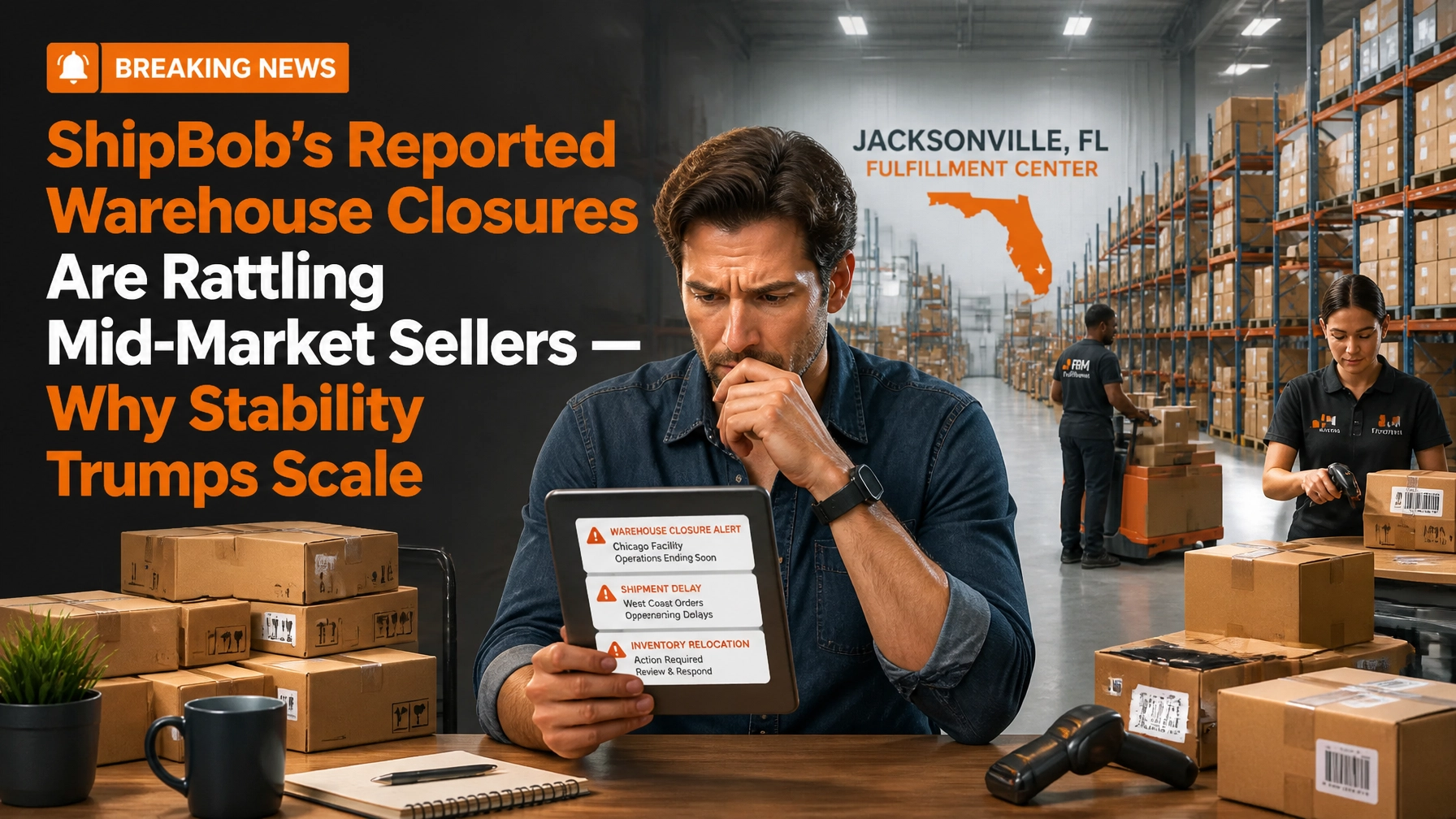
ShipBob’s reported warehouse closures and consolidations are creating fresh anxiety for mid-market ecommerce sellers heading into Q4. The reports remain unconfirmed by ShipBob, but merchants are already asking difficult questions about node assignments, inventory transfers, transit times, contracts, and operational continuity.
This is the central issue: 3pl warehouse stability matters more than a large network when your inventory is already committed to the season.
You have a problem. We have a solution.
A venture-backed 3PL can optimize its footprint to improve utilization, reduce costs, or strengthen its balance sheet. That may make financial sense for the provider. For a merchant, however, a mid-season warehouse move can create inventory delays, integration problems, new freight charges, and a sudden deterioration in delivery performance.
1. What is happening inside ShipBob’s network?
As of August 13, 2026, ShipBob has not publicly confirmed a broad U.S. warehouse closure program for Q4. Its public materials continue to promote a large fulfillment network across the United States and internationally.
However, recent reports from logistics publications and industry sources describe ongoing network optimization and potential consolidation involving several U.S. regions. Reports have referenced facilities and operations in areas including:
- Dallas-Fort Worth and the broader Southwest
- The Mid-Atlantic and Northeast
- Chicago and other Midwest markets
- Atlanta and parts of the Southeast
- Additional secondary or lower-throughput nodes
A May report from Ecommerce Times described a potential consolidation of up to six fulfillment nodes, while noting that ShipBob had not publicly confirmed the plan.

Network optimization is normal. The timing is the danger.
For a merchant, a warehouse is not simply a line on a map. It is the physical location of sellable inventory, receiving labor, barcode processes, pick paths, carrier pickups, system integrations, and customer delivery promises.
When that node changes, all of those elements must change with it.
2. Why can a warehouse consolidation become a Q4 crisis?
A 3PL can describe a relocation as an operational improvement. Your customers experience it as a delay.
Inventory may need to be:
- Picked from its current storage position.
- Counted and reconciled.
- Loaded for transfer.
- Received at the replacement facility.
- Re-slotted into new locations.
- Reconnected to warehouse and order systems.
- Made available for sale again.
Every step creates exposure.
A relocation can also affect the shipping economics behind your customer promise. If inventory moves from a regional node to a distant hub, your orders may travel through different carrier zones. A delivery that previously moved efficiently by ground may require more expensive service to maintain the same promised arrival date.
That creates three immediate risks:
- Higher freight and parcel costs
- Longer average transit times
- Temporary inventory unavailability
Adding to the complexity, merchants may face unexpected drayage, transfer, pallet handling, labeling, and re-receiving costs. Even when a provider covers direct transfer freight under a contract, the merchant can still absorb downstream costs through delayed orders, customer refunds, advertising waste, and lost conversion.
This is why 3pl warehouse stability is not an abstract operational preference. It is a margin, service, and revenue issue.
Is this just another “3PL might shut down” warning?
No.
This article is not a general solvency or bankruptcy guide. It responds specifically to the August 2026 reports of network shuffling and consolidation ahead of Q4.
A 3PL does not need to become insolvent to disrupt your business. It only needs to:
- Move your inventory to another node
- Change your regional allocation
- Reset an operational process
- Alter your carrier strategy
- Provide an inadequate transition window
That distinction matters. A financially healthy company can still make a network decision that creates unacceptable merchant risk.
3. What should ShipBob merchants check immediately?
If you use ShipBob, do not wait for a formal announcement before reviewing your exposure.
Start with your current inventory and contract data.
Request written answers
Ask your account team for written confirmation of:
- Your current fulfillment node or nodes
- Whether your inventory is classified as primary, secondary, or overflow stock
- Whether any relocation or reassignment is being considered
- The expected timeline for a potential move
- The projected impact on processing and transit times
- The expected changes to carrier zones and shipping costs
- Who pays transfer, re-receiving, and exception costs
Avoid relying on vague language such as “optimization” or “network balancing.” Ask for operational details.
Read the relocation clause
Pull your master service agreement and locate language concerning:
- Warehouse relocation
- Inventory transfers
- Notice periods
- Service-level resets
- Rate changes
- Dispute procedures
- Termination rights
- Liability for delays or inventory discrepancies
A 30-day notice period may sound reasonable until you calculate the time required to move thousands of units, validate the new inventory file, test integrations, and protect Q4 demand.
Model the shipping impact
Export at least 90 days of customer ZIP codes and compare your current fulfillment origin with the proposed replacement origin.
Measure:
- Average shipping zone
- Average delivery time
- Cost per order
- Percentage of orders requiring expedited service
- Orders at risk of missing a two-day promise
- Regional inventory requirements
Do not accept a network change based on a general statement that “delivery times will remain similar.” Your customer distribution determines the real result.
4. What does 3pl warehouse stability look like?
The solution is not always the largest network.
More nodes can create more points of failure. Every additional facility introduces inventory synchronization requirements, transfer decisions, labor variation, receiving differences, and another layer of management. Scale is valuable only when it produces consistent execution for the merchant.
Real 3pl warehouse stability means:
- The operating team is focused on long-term service rather than quarterly footprint changes.
- Inventory remains visible and controlled.
- Decisions are made by people who understand your business.
- Contracts are clear and practical.
- The provider can respond quickly when conditions change.
- Your fulfillment process does not depend on constant warehouse rebalancing.

This is where a founder-led, asset-based operation offers a meaningful advantage. FBMFulfillment operates from Jacksonville, Florida, with direct human decision-making and a focus on operational excellence rather than private-equity churn or constant network reshuffling.
The objective is simple: keep your inventory moving, your channels connected, and your customer promises intact.
5. Why choose a stable Jacksonville fulfillment partner?
FBMFulfillment is an ecommerce fulfillment center Florida sellers and nationwide brands can use when they need a dependable operational base.
Our Jacksonville operation supports a practical alternative to a sprawling network model:
- Same day fulfillment for orders received before the applicable cutoff
- Reliable FedEx 2Day delivery options
- No onboarding fees
- No minimums
- Contracts that can be closed within 24 hours
- Direct communication with decision-makers
- True single-pool inventory control
- Multichannel support from one inventory pool
Your Amazon, Shopify, Walmart, TikTok, eBay, Etsy, and website orders can be managed through the same controlled inventory position. That reduces the risk of inventory being fragmented across systems or trapped inside a provider’s network strategy.
For sellers searching for a 3pl jacksonville partner, the value is not simply geographic. It is operational access. You can speak with people who understand the inventory, the orders, the customer commitments, and the consequences of a missed shipment.

6. Why does stability beat venture-backed scale before Q4?
Venture-backed 3PLs often grow by expanding quickly, adding facilities, acquiring customers, and building a network large enough to support a future financial objective.
That strategy can produce impressive coverage. It can also create pressure to close, merge, or relocate underperforming nodes when margins tighten.
The merchant carries the operational risk.
A founder-led fulfillment warehouse has a different incentive structure. It does not need to constantly optimize the network for a liquidity event. It can prioritize long-term customer relationships, accurate inventory, responsive support, and consistent execution.
That is the difference between scale as a sales argument and stability as an operating discipline.
If your Q4 inventory is already in motion, now is the time to review your options. Request a written impact analysis from your current provider. Audit your contract. Model your zones. Then establish a backup plan before peak-season capacity disappears.
You have a problem. We have a solution.
FBMFulfillment can help you evaluate a transition, protect your single inventory pool, and establish reliable same day fulfillment without onboarding fees or minimums. Contact FBMFulfillment or call +1 (904) 530-9694 to discuss your operation.
Sources and related resources
- Ecommerce Times: ShipBob’s Rumored Warehouse Consolidation Plan
- ShipBob’s publicly listed U.S. fulfillment network
- Best 3PL Fulfillment Companies for Small Businesses in the U.S.
- Ecommerce Fulfillment Cost Guide for Sellers
- Contact FBMFulfillment
Key Takeaways
- ShipBob’s potential warehouse closures create concerns for mid-market ecommerce sellers, especially as Q4 approaches.
- 3pl warehouse stability is essential, as mid-season relocations can lead to inventory delays and increased shipping costs.
- Merchants should assess their current inventory positions and contracts to prepare for any disruptions.
- A stable 3PL partner, like FBMFulfillment, focuses on long-term service and operational continuity rather than constant network reshuffling.
- Choosing stability over scale can safeguard against unexpected risks during peak shipping seasons.