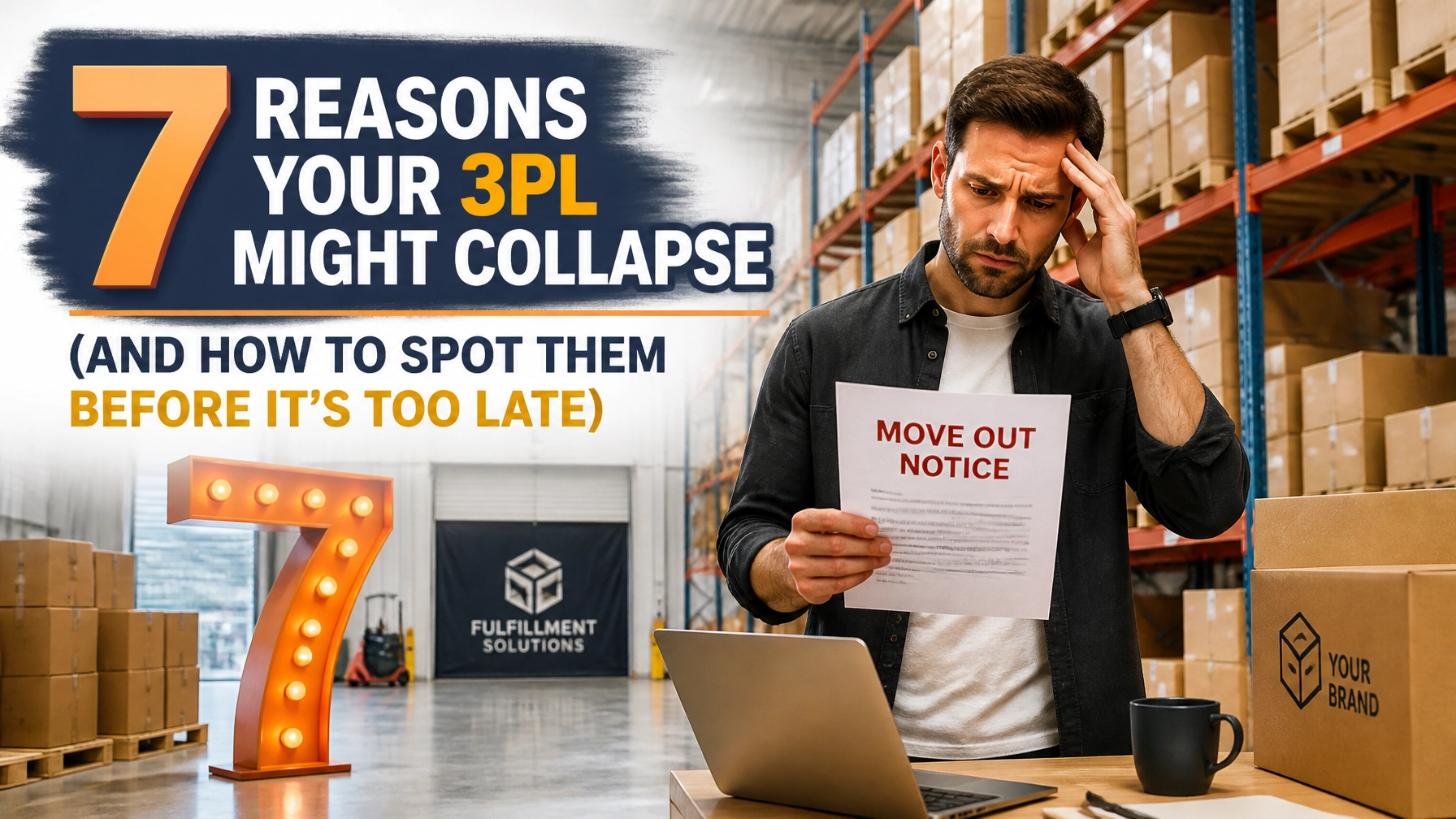
Imagine waking up to an email from your warehouse provider that simply says: “We are ceasing operations. You have 21 days to move your 500 pallets of inventory. Good luck.”
That is not a hypothetical. Dave Gulas recently shared a story on LinkedIn about a founder who got exactly that kind of notice. Twenty one days. Move everything out. Figure it out yourself. That founder’s 3rd party fulfillment services provider was shutting down, and the seller was left holding all the risk.
These are the real reasons warehouses die. Not the polished sales pitch. Not the warehouse tour with shiny floors and bright lights. The real reasons. And if you are using 3rd party fulfillment services, you need to know the 7 reasons to spot before your inventory gets trapped in someone else’s collapse.
The ecommerce boom created a wave of new operators, oversized facilities, and warehouse startups chasing growth. It also created a dangerous surge of unvetted 3PLs. Pop up operators. Warehouse startups with no real history. New entrants chasing ecommerce demand without the systems, discipline, or scar tissue to handle it. Unfortunately, a lot of them were built on fragile economics. When the numbers break, the operation breaks. Fast.
This lack of vetting is not a minor market issue. It is a direct danger to ecommerce sellers. Your 3PL touches your inventory, your order flow, your returns, your customer experience, and your cash conversion cycle. If the operator is unstable, your business is exposed immediately.
One of the biggest mistakes sellers make is confusing shiny tech with real operating stability. New entrants can look impressive. Nice dashboards. Smooth demos. Clean branding. But fulfillment is won in the trenches. It is won by surviving peak season, labor shortages, carrier disruptions, and inventory chaos without falling apart. Years in business matter. Operational scar tissue matters. Given the significant risks, established operators deserve a hard look over unproven startups.
1. LOST THEIR LEASE OR GOT HIT WITH A BRUTAL RENEWAL
One of the biggest hidden risks in 3rd party fulfillment services is real estate dependency.
If a 3PL does not own its building, or at least control it through a long, stable lease, it is operating at the mercy of a landlord. That is a precarious position. Warehousing margins are already thin. A major rent increase can wipe out profitability almost overnight.
Many operators sign short term leases because it gets them into a building quickly. It looks smart in the beginning. Lower commitment. Faster launch. More flexibility. Unfortunately, that flexibility can turn catastrophic when the lease expires and the landlord wants a 50% increase or simply wants the space back.
Here is what happens next:
- Margin disappears
- Prices to clients become unsustainable
- The warehouse starts cutting corners
- Or the entire business gets forced into a move or shutdown
This is one of the first questions sellers should ask. If you are evaluating 3rd party fulfillment services , do not stop at location. Ask who owns the building. Ask how long the lease runs. Ask whether the operator is secure in that space for years, not months.
2. TOO MUCH OVERHEAD
Big warehouses impress people. High ceilings. Bright lights. Endless rows of racking. Fancy office buildouts. It looks like success.
It also costs money every single day.
A bloated facility burns cash by the square foot. If the operation is not full, it is bleeding. Utilities, rent, labor, insurance, equipment, software, maintenance. The overhead does not care whether the racks are full or empty. Many 3PLs over-expand on spec because they want to look established, attract larger accounts, or chase valuation stories. Unfortunately, empty space does not pay invoices.
Some of the weakest operators are the ones trying hardest to look big.
From a seller’s viewpoint, lean matters. A disciplined ecommerce fulfillment center should be sized for operational excellence, not ego. If a warehouse is carrying too much unused space, your rates are either subsidizing that mistake or the business is quietly running out of cash.
This is also where the low price trap shows up. If a 3PL is aggressively undercutting the market to fill capacity, be cautious. They are not automatically efficient. They may be desperate to cover overhead and burn rate. That kind of pricing usually comes from pressure, not strength, and sellers often pay for it later through service failures, surprise fees, or outright instability.
Perhaps the most dangerous version is the bait and switch pricing trap. A warehouse with serious excess capacity offers sub market pricing just to get you in the door. It looks attractive. It feels like a win. Unfortunately, the real intent is often to hike prices (sometimes sneaky) shortly after onboarding once your inventory is in place and switching becomes painful. That is a massive red flag. Stable operators do not need gimmick pricing to survive.
This matters whether you need apparel fulfillment services, complex b2b order fulfillment services, or everyday DTC shipping. The economics have to work in the real world, not just on a tour.
3. OVER RELIANCE ON A FEW LARGE CLIENTS
Customer concentration kills more 3PLs than bad operations. Period.
If one client represents 30%+ of warehouse revenue, that client effectively controls the future of the business. If they leave, volumes collapse. If they demand lower rates, margins get crushed. If they delay payments, cash flow tightens immediately.
This is a devastating risk because the warehouse can look healthy from the outside right up until the moment it is not.
You might see trucks at the dock. You might hear about growth. You might assume the operation is stable. But if one anchor account walks, the whole picture changes. Fast.
When looking for ecommerce fulfillment near me, ask directly about concentration. You do not need names. You need structure. No serious seller should ignore this. A diversified client base is one of the clearest signs that 3rd party fulfillment services are built to survive normal business churn.
4. BANK LOAN ISSUES
Warehouses need equipment. Racking. Forklifts. Conveyors. WMS implementation. Dock infrastructure. Sometimes leasehold improvements. None of that is free.
A lot of operators finance growth with debt. That is not automatically bad. But in a thin margin business, too much debt creates a dangerous setup. When lending conditions tighten, when rates move, or when a bank gets nervous, a 3PL can suddenly find itself with no room to breathe.
Banks do not care that your products are sitting inside the building. They care about loan performance.
If loans get called or credit dries up, there is no magic backup plan. Payroll gets stressed. Repairs get delayed. Vendor relationships deteriorate. Then service slips. Then clients leave. Then the spiral speeds up.
If you are comparing a shopify fulfillment company, a fulfillment center in florida, or a modern provider supporting amazon multi channel fulfillment mcf, you need to think beyond software demos. No reputable 3PL is going to hand a prospective client private financial statements, loan documents, or bank balances. That is normal. Instead, look for signals of stability. Years in business. Clear client references. Consistent service performance. Transparent communication. Debt pressure has buried more than a few promising warehouse operations, and the warning signs usually show up operationally before anyone shares anything on paper.
5. POORLY RUN
Sometimes the simplest reason is the real one. The warehouse is just poorly run.
Bad management destroys 3PLs from the inside out. Weak receiving processes. Sloppy inventory control. No scanning discipline. Poor bin logic. Bad labor planning. No investment in technology. Terrible picking accuracy. Slow claim resolution. Confused returns handling. These failures compound.
At first, sellers tolerate the pain because switching is hard. Then the chargebacks start. Then the bad reviews start. Then the marketplace account health problems start. Eventually, clients leave. And when they leave, the revenue leaves with them.
This is where process separates real operators from pretenders. A capable ecommerce fulfillment center florida should have systems that reduce error, protect inventory, and maintain performance under pressure. If a provider still treats fulfillment like a manual hustle instead of a disciplined operation, be cautious of what comes next.
6. LABOR ISSUES — TURNOVER, COST, AVAILABILITY
Labor can break a fulfillment operation just as fast as bad management.
If a 3PL is operating in too high a labor cost market, margins get crushed. If they cannot actually staff the floor, service levels slip. If turnover is constant, accuracy gets destroyed because the warehouse is always retraining new people instead of building a stable, experienced team.
This is not a minor issue. It directly affects your orders, your returns, and your customer experience.
Here is how labor problems show up for sellers:
- Pick accuracy starts falling
- Receiving takes longer than promised
- Same day shipping gets missed
- Returns pile up
- Temporary labor becomes the norm instead of the exception
High turnover creates operational chaos. Expensive labor markets create financial pressure. Poor labor availability creates service instability. When all three hit at once, the warehouse starts failing in ways that sellers feel immediately.
A disciplined operator plans for this. They choose their market carefully. They build processes that support retention. They staff for the real workload, not the sales forecast. Given the significant risks, sellers should ask direct questions about staffing consistency, labor turnover, and whether the operation is built in a market that can support fulfillment at scale.
7. CLIENTS NOT PAYING THEIR BILLS / CREDIT EXPOSURE
This is one of the most hidden risks in warehousing. And one of the most dangerous.
Many 3PLs operate on thin receivables cycles. They are waiting on client payments to cover payroll, rent, carriers, and daily operating costs. If a major client delays payment, disputes invoices, or defaults entirely, cash flow can break fast. One large non payment can start a devastating cascade.
Unfortunately, sellers on the floor often never see this coming.
The warehouse may still be shipping. The racks may still look full. But behind the scenes, vendors are getting stretched, carrier balances are getting tight, and management is scrambling to plug a cash hole. That kind of pressure rarely stays hidden for long. Service deteriorates. Decision making gets reactive. Stability disappears.
This is why credit exposure matters. A healthy 3PL does not let a handful of slow paying clients put the entire operation at risk. Sellers should be cautious of operators that grow aggressively without disciplined collections, tight billing controls, and enough cash resilience to absorb client payment problems.
WHAT SHOULD SELLERS LOOK FOR INSTEAD?
This is the part that matters. If those are the real reasons warehouses fail, here is what to look for instead.
1. ASSET STABILITY
Look for a provider with real estate ownership or a long, secure lease. Stability matters more than a polished pitch. A serious fulfillment center in florida should be able to explain its facility position clearly and confidently.
2. LEAN OVERHEAD FROM A SELLER’S PERSPECTIVE
You do not need to fund someone else’s vanity expansion. You need disciplined operations. A strong fulfillment center southeast partner should be focused on throughput, utilization, and cost control, not empty square footage.
3. A DIVERSIFIED CLIENT BASE
Healthy 3rd party fulfillment services are not built around one whale account. They are built around a balanced portfolio of clients across channels and categories. That includes modern capabilities like tiktok shop fulfillment without becoming dependent on a single seller.
4. SIGNALS OF FINANCIAL STABILITY
You are not underwriting a bank loan. You are choosing an operator. No serious 3PL is going to share private financial statements or account balances with you, and they should not. What you can vet are the signals: operating tenure, client references, communication quality, pricing discipline, and whether the business behaves like a stable operator or a reactive one payment cycle from trouble.
5. OPERATIONAL EXCELLENCE
This is where the real moat is.
Look for proven systems. Look for scanning discipline. Look for inventory accuracy. Look for a warehouse that has invested in process, not just promises. At FBMFulfillment.com, we operate from a seller’s viewpoint with UOM technology, 2x scanning, and practical controls designed to protect your inventory and your customer experience.
That matters whether you need pick and pack fulfillment services, overflow support, wholesale prep, returns control, or a stable 3pl jacksonville partner who can actually perform.
THE RECOVERY PLAN: 3PL FULFILLMENT PREP
If you’ve received that dreaded notice, or if you simply suspect your current partner is on the brink, here is the immediate action plan for your 3rd party fulfillment services transition.
1. SECURE YOUR SKU DATA
Don’t wait for the warehouse to shut down their WMS. Export every bit of data you have: SKU names, dimensions, weights, and current inventory levels. You will need this for a shopify fulfillment company or any new partner to provide an accurate quote.
2. STOP INBOUND SHIPMENTS
Divert any containers or LTL shipments immediately. The last thing you want is more inventory entering a facility that is about to lock its doors. Have them rerouted to a stable ecommerce fulfillment center florida that can handle immediate 3pl fulfillment prep.
3. LOOK FOR “ZERO RED TAPE” PARTNERS
Avoid providers that require a 12-month minimum commitment or a $5,000 “onboarding fee.” In a crisis, you need flexibility. You also need a partner with the operational backbone to move quickly. If you are searching for a stable 3pl jacksonville option, speed and competence both matter.

THE VETTING CHECKLIST FOR 3PL STABILITY
Before you sign with your next provider, ask these pointed questions. If they hedge, run.
- Who owns the building? Do they own the real estate, or is it a short-term sublease? A sublease is a major red flag for 3rd party fulfillment services.
- How long is the lease term? If they do not own the building, they should still be able to show long-term facility stability.
- What is your customer concentration? If one client makes up 80% of their revenue and that client leaves, the warehouse might fold the next day.
- How long have you been in business? Prefer established operators that have weathered multiple peak seasons. Unproven startups may have polished tech, but they have not yet proven they can handle real operational stress.
- Are your rates suspiciously low? If they are aggressively undercutting the market, ask why. Low pricing can be a sign of desperation to fill space, not a sign of true efficiency.
- Is this a bait and switch pricing setup? Be cautious of operators with serious excess capacity offering sub market pricing just to get inventory in the building. If the plan is to raise rates shortly after onboarding, that is a major stability red flag.
- What stability signals can you share? You are not asking for private bank documents. Ask for references, tenure, communication standards, and evidence of operational discipline instead.
- What systems are in place for accuracy? Ask about scanning, inventory controls, and returns handling.
- Are there active complaints or patterns on the Better Business Bureau? Check the BBB for repeated issues, unresolved complaints, or a pattern of negative feedback.
- Do you offer TikTok Shop fulfillment? A provider that isn’t keeping up with modern channels like tiktok shop fulfillment is likely falling behind on the tech and capital required to stay competitive.
WHAT HAPPENS IF THEY GO DARK?
This is the nightmare scenario sellers do not think about enough.
If a warehouse goes dark, the consequences are immediate. Locked doors. Inaccessible inventory. Frozen order flow. Customer complaints start piling up while your team scrambles for answers. Your marketplaces do not pause expectations because your 3PL collapsed. They keep scoring your late shipments, cancellations, and service failures in real time.
Worse, your inventory is your working capital. If you cannot access and sell your own products, your cash flow gets hit from both directions. Revenue stops. Expenses do not. Ad spend, payroll, chargebacks, refunds, and replacement logistics costs keep moving while your sellable stock is trapped behind someone else’s operational failure. That is catastrophic for an ecommerce seller.
DON’T WAIT FOR THE GAVEL TO FALL
The story Dave Gulas shared is a warning for every multichannel seller. Your 3rd party fulfillment services are the backbone of your brand. If that backbone snaps, your Shopify store, your Amazon listings, and your TikTok Shop all go dark simultaneously.
We built FBMFulfillment.com to be the stable, high-performance alternative. Seller-minded. Lean. Operationally disciplined. And built for control.
We offer:
- Multi-channel fulfillment from a single inventory pool.
- Total inventory possession control so stock is never stuck in someone else’s system.
- Better return management so defective units do not go back out to new customers.
- Real operating discipline with UOM technology and 2x scanning.
- No long-term contracts.
If you’re feeling the precarious nature of your current logistics setup, or if you’ve already received a move-out notice, contact us at FBMFulfillment.com. We will be glad to help you transition your inventory quickly and safely.