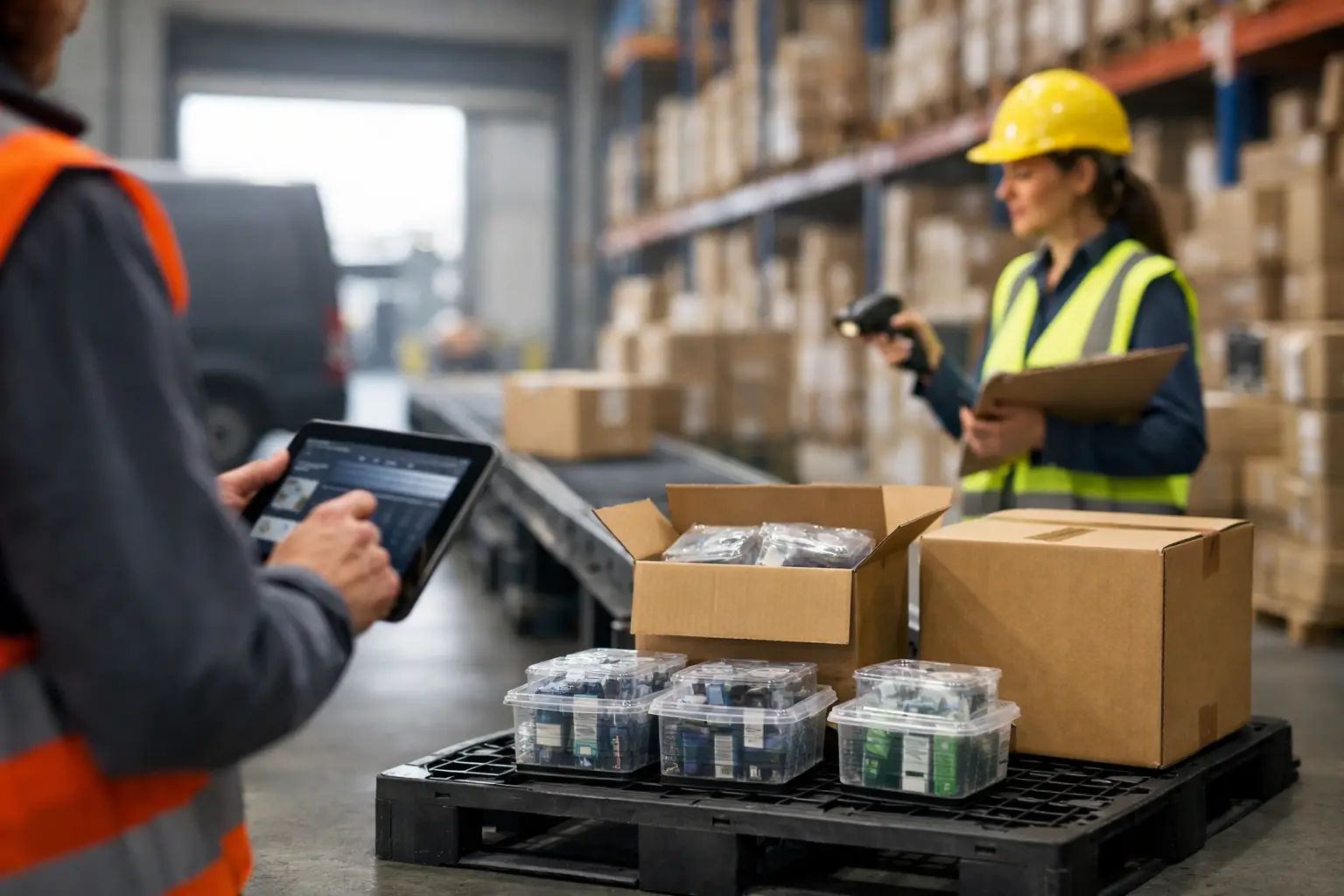
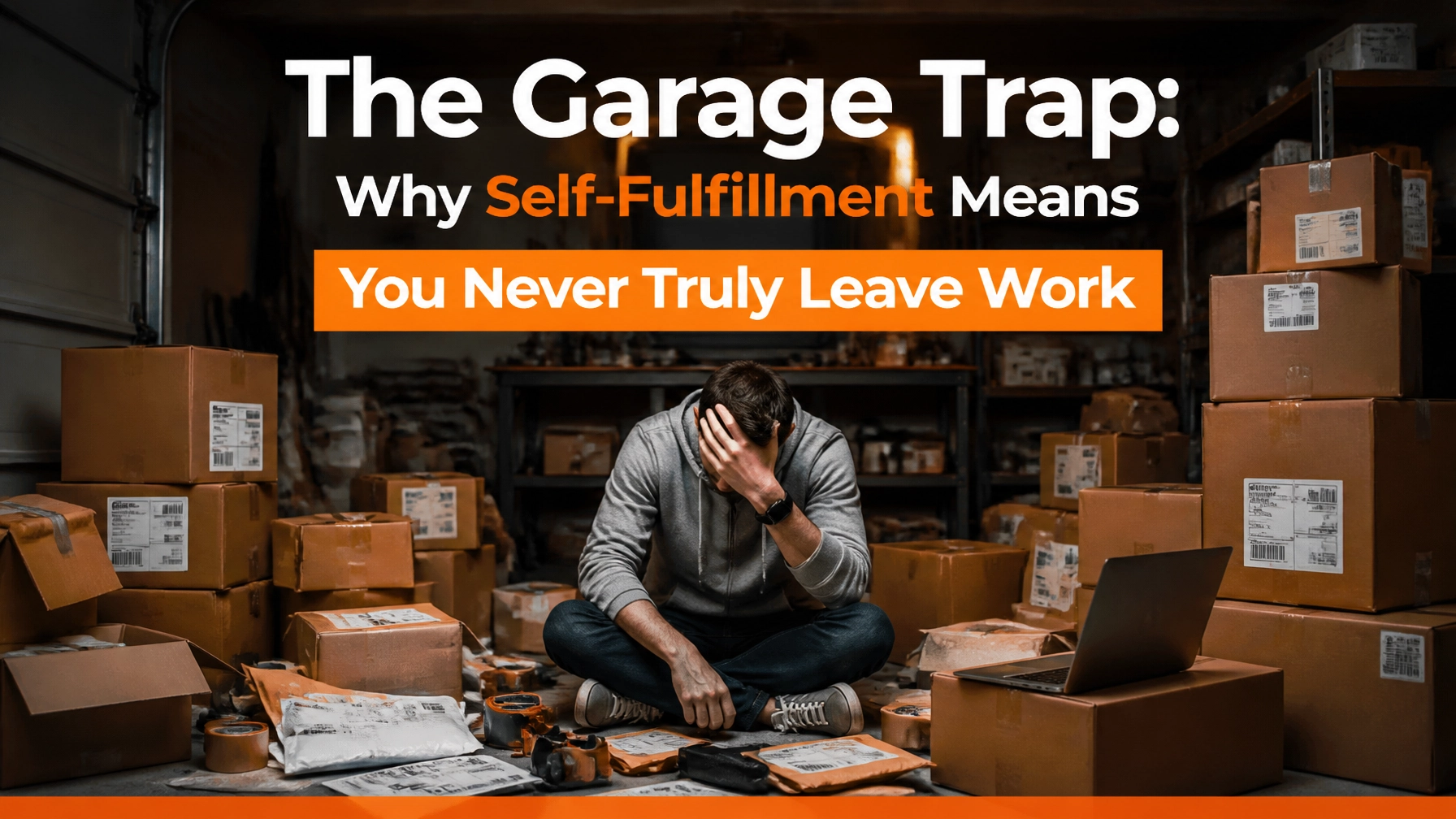
The “garage startup” is a romanticized legend in the world of business. We’ve all heard the stories of Jeff Bezos or Steve Jobs starting with nothing but a dream and a workbench. But for the modern seller, the reality is far less poetic. What starts as a way to save money and maintain control quickly becomes the Garage Trap. If you’re spending 20+ hours a week taping boxes and running to the post office, you haven’t built a scalable business, you’ve just built yourself a high-stress, low-paying manual labor job. Transitioning to a professional ecommerce fulfillment warehouse is often the only way to actually reclaim your life and your growth potential.
The problem is that fulfillment scales directly with your success. The more you sell, the more you have to pack. It is a linear relationship that eventually hits a wall. Once you reach that wall, you stop being a CEO and start being a shipping clerk.
THE 20-HOUR “TAX” ON YOUR GROWTH
Most self-fulfilling sellers don’t realize how much their time is actually worth. If you are doing $500k a year in revenue, your time should be valued at hundreds of dollars per hour. Instead, you are spending it performing tasks that a specialized ecommerce fulfillment warehouse can do for pennies.
Think about your typical Monday. You spend four hours just printing labels and packing weekend orders. By the time you’re done, you’re too exhausted to look at your PPC spend, source new products, or optimize your Shopify store. This is the “fulfillment tax.” It’s a hidden cost that keeps your business stagnant because the person responsible for growth, you, is stuck in the weeds of logistics.
WHY SELF-FULFILLMENT MEANS NO VACATIONS
Perhaps the most devastating consequence of self-fulfillment is the total loss of freedom. When you are the warehouse, the business cannot function without your physical presence.
- Want to take a week off for summer vacation? You have to put your store on “Vacation Mode,” effectively killing your sales and tanking your search rankings.
- Get sick? Shipments go out late, leading to negative reviews and account health warnings.
- Family emergency? Your business stops.
Voilà, you are trapped. A business that requires your physical hands on every package isn’t an asset; it’s a cage. By moving your inventory to a 3PL warehouse, you decouple your time from your revenue. You can be on a beach in Florida while your orders are being shipped from a professional center.

THE SCALING ROADBLOCK: NO ROOM TO GROW
Your garage has a finite amount of space. Once you have a house full of inventory and no walking space, you’ve reached your ceiling. You can’t take advantage of bulk discounts from suppliers because you have nowhere to put a full pallet. You can’t launch a new SKU because there’s no shelf space left between the lawnmower and the Christmas decorations.
Beyond physical space, there is the mental bandwidth issue. Scaling requires focus. It requires looking at the big picture. You cannot see the horizon when you are staring at a roll of packing tape. Many sellers find their “tipping point” at around 50 to 100 orders per day. At that volume, the complexity of managing inventory, returns, and shipping speeds becomes a full-time management role in itself.
IS YOUR GARAGE ACTUALLY “CHEAPER”?
Sellers often stay in the garage because they think they’re saving money. “I’m not paying rent,” they say. But have you factored in:
- The Opportunity Cost: What would your revenue look like if you spent those 20 packing hours on marketing instead?
- Shipping Rates: A high-volume ecommerce fulfillment warehouse like FBMFulfillment.com gets deep discounts on FedEx and UPS that you simply can’t access as a small-scale shipper.
- Supplies: Buying boxes, tape, and dunnage at retail prices adds up significantly.
- Errors: Packing mistakes, lost packages, and return shipping costs due to DIY errors are expensive.
When you do the math, the “savings” of self-fulfillment often evaporate. You are paying for a professional service with your own time and limited growth.

THE EXIT STRATEGY: HOW TO CHOOSE A WAREHOUSE
If you’re ready to escape the garage, you need a partner that understands the specific pain points of an ecommerce seller. Most “traditional” warehouses are built for B2B: moving big pallets to big retailers. They aren’t equipped for the fast-paced world of TikTok shops or Amazon FBM orders.
You need a partner that offers:
- Multichannel Fulfillment: One pool of inventory that feeds Shopify, Amazon, Walmart, and eBay simultaneously.
- Inventory Possession Control: Your stock should never be “stuck” or inaccessible.
- Actual 2-Day Delivery: Don’t settle for “maybe” shipping. Look for providers that use reliable services like FedEx 2Day to ensure your customers get their orders on time, every time.
At FBMFulfillment.com, we built our ecommerce fulfillment warehouse from the viewpoint of an actual seller. We know what it’s like to have 700 SKUs and no sleep. We’ve experienced the burnout of self-fulfillment firsthand, which is why we’ve built a system designed to handle the heavy lifting so you can get back to being a CEO.
MULTICHANNEL COMPLEXITY? NO PROBLEM.
The modern ecommerce landscape is fragmented. You might be selling on Facebook, Etsy, and Amazon all at once. Trying to sync that inventory manually from your garage is a recipe for overselling and account suspensions. A professional ecommerce fulfillment warehouse uses a Warehouse Management System (WMS) that integrates directly with your sales channels. When a unit sells on Etsy, it’s automatically deducted from your Shopify stock. No spreadsheets required.

THE TRANSITION: IT’S EASIER THAN YOU THINK
The biggest fear sellers have is “sending their baby away.” It feels like losing control. But in reality, you gain control. You gain control over your data, your time, and your scalability. The onboarding process for a modern 3PL is designed to be painless. You ship your inventory, we scan it in, and you go back to growing your brand.
Don’t let your business become a life sentence. The “garage trap” is a stage, not a destination. If you want to build a brand that lasts, you have to stop being the bottleneck.
Contact us at FBMFulfillment.com and we will be glad to help you plan your escape from the garage. Whether you need help with FBA dripfeed storage or full multichannel fulfillment, we have the operational excellence to take your business to the next level.