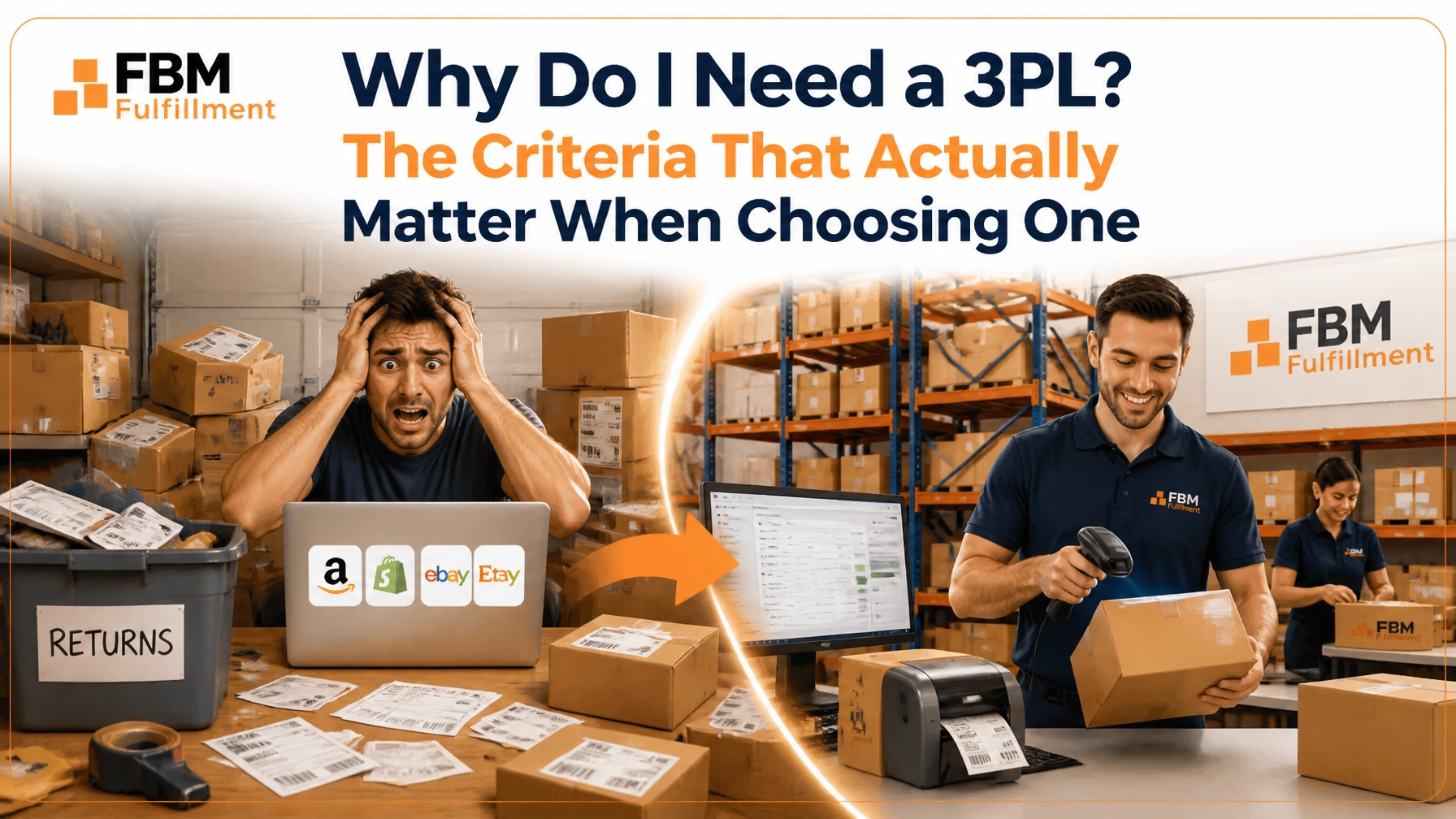
Are you still packing orders in a garage, spare room, or small warehouse? At first, self fulfillment gives you control. Then the orders increase. Channels multiply. Returns pile up. Your workday disappears into cartons, labels, and carrier pickups.
You do not need a 3PL simply because other sellers use one. You need one when self fulfillment starts costing you sales, customer satisfaction, margin, or the time required to grow. The right 3rd party fulfillment services partner should give you more than storage space. It should give you reliable execution, inventory control, scalable systems, and the ability to make delivery promises you can keep.
1. When does self fulfillment become a problem?
There is no universal order threshold that automatically means you need a 3PL. A seller shipping 50 simple orders per month can operate efficiently from home. Another seller shipping 50 multi-unit orders across six sales channels can already be overloaded.
The real question is this:
Is fulfillment still supporting your business, or has it become the business?
Research from Shopify and Finale Inventory identifies the same broad pattern: outsourcing becomes attractive when order volume, operational complexity, and opportunity cost begin rising faster than your internal capabilities.
You have a problem. We have a solution.
If you are spending evenings picking products, correcting inventory, buying packaging, and processing returns, a 3PL can move those repetitive tasks into a standardized warehouse operation.
You regain time. Your customers receive more consistent service. Your inventory becomes easier to manage across every channel.
2. What breaking points signal that you need a 3PL?
1. Has order volume outgrown your space and time?
Picking and packing a few orders is simple. Picking hundreds of orders with different SKUs, quantities, packaging requirements, and shipping services is an operational system.
Watch for these signals:
- Cartons occupy your living space or selling area.
- You are packing orders late at night or early in the morning.
- A family member or employee spends most of the day on shipping.
- Carrier pickups interrupt product, marketing, and customer service work.
- You are delaying product launches because your operation cannot absorb more volume.
The cost is not only labor. It is also the growth you are not pursuing while you are taping boxes.
2. Are multiple channels creating inventory chaos?
Selling through Amazon FBM, Shopify, TikTok Shop, Walmart, eBay, and Etsy creates opportunity. It also creates a serious synchronization problem when inventory is managed manually.
A spreadsheet or separate channel dashboard cannot reliably protect you from:
- Overselling the same SKU on multiple platforms
- Selling inventory that is already committed to another order
- Delayed stock updates
- Marketplace cancellations
- Incorrect channel availability
- Manual tracking uploads
A capable 3PL connects your channels to a warehouse management system, or WMS, and manages one inventory pool. Orders flow into the system. Warehouse staff pick and pack them. Tracking returns to the originating channel. Inventory updates by SKU.
That structure matters more as your catalog and order volume grow.
3. Can you consistently provide same day fulfillment?
Customers compare your delivery promise with Amazon Prime, even when you are a small brand. Slow handling creates abandoned carts, poor reviews, and support tickets.
You may need same day fulfillment if:
- Orders regularly wait until the next business day to be processed.
- You do not have a dependable carrier cutoff.
- You cannot ship during promotions or weekends after a volume spike.
- Your delivery estimate is longer than competitors offering similar products.
- You are losing marketplace visibility because of late shipment metrics.
A 3PL should not merely promise speed. It should show you the operational cutoff, staffing plan, scan process, and historical performance behind that promise.
4. Are returns and defects becoming a real problem?
Returns are not finished orders. They require inspection, classification, disposition, and inventory updates.
When returns come back to your home or small warehouse, they often sit in a box until someone has time to inspect them. That creates several risks:
- Resalable inventory remains unavailable.
- Defective products are accidentally returned to stock.
- Customers wait too long for refunds.
- Return reasons are not recorded consistently.
- The same product defect continues reaching new customers.
Professional return processing separates sellable, damaged, incomplete, and questionable units. That protects your customer experience and your inventory accuracy.
5. Is Q4 overwhelming you or is FBA storage damaging your margin?
Peak season exposes weak fulfillment operations. A process that works in March can collapse during Prime events, holiday promotions, or a successful social media campaign.
You need a scalable plan if:
- You hire temporary labor every peak season.
- You have no extra packing stations or storage capacity.
- Orders remain unshipped after a promotion.
- You are storing too much inventory at Amazon because you lack a replenishment option.
- Amazon storage fees are reducing your contribution margin.
A 3PL can support direct fulfillment while also holding inventory for controlled FBA replenishment. That gives you another option besides sending the entire manufacturing quantity directly into Amazon.

3. What does self fulfillment actually cost?
The mistake is comparing a 3PL’s pick fee with the cost of a shipping label. That is not an apples-to-apples comparison.
Your self fulfillment cost includes:
- Your labor or employee wages
- Rent, utilities, insurance, and equipment
- Shelving, printers, scales, and software
- Boxes, mailers, tape, labels, and inserts
- Time spent receiving and counting inventory
- Carrier rate differences
- Reshipments and refunds caused by errors
- Returns inspection and restocking
- Your own opportunity cost
Consider a simple example. If you spend 25 hours each week on fulfillment and value your time at $50 per hour, your monthly time cost is approximately:
25 hours × $50 × 4.33 weeks = $5,412.50 per month
At 800 orders per month, that is nearly $6.77 per order before packaging, postage, rent, software, or mistakes.
Now compare the fully loaded number with a 3PL quote. Industry pricing varies by product, SKU count, order complexity, storage volume, packaging, and shipping destination. Ryder’s self fulfillment analysis and Fulfillrite’s pricing guide both emphasize the need to compare total cost rather than headline rates.
What do 3rd party fulfillment services actually cost?
Request a quote that includes:
- Receiving
- Storage
- Pick and pack
- Packaging
- Shipping
- Returns
- Kitting or special handling
- Account or technology fees
- Peak surcharges
- Minimum monthly charges
- Onboarding and integration fees
A partner with no onboarding fees, no minimums, and no long-term contract reduces the risk of testing the relationship. You still need to evaluate service quality, but you are not committing your business to a costly structure before the operation proves itself.
Use a fulfillment cost guide and the provider’s shipping quote calculator to model your current volume and your expected volume at two or three times that level.
4. What is the number one criterion?
Does the 3PL have operational scar tissue?
Reliability and operational excellence matter more than a modern website or an attractive sales presentation.
A provider that has processed real ecommerce orders has experienced:
- Inventory discrepancies
- Damaged inbound cartons
- Incorrect barcodes
- Marketplace order spikes
- Carrier failures
- Returns surges
- New product launches
- Peak season staffing pressure
That experience creates operational scar tissue. The warehouse develops checklists, scan points, exception procedures, cycle counts, and escalation paths because those controls were earned through real problems.
Ask for evidence, not promises:
- What is the order accuracy rate?
- What percentage of orders ship on time?
- What is the daily cutoff for same day fulfillment?
- How are picking and packing errors verified?
- How are inventory adjustments approved?
- How are returns classified?
- Who is accountable when an order is wrong?
The best 3rd party fulfillment services provider can explain its process in detail. A mediocre provider relies on vague statements about “advanced technology” and “dedicated service.”
5. Which criteria actually matter when choosing a 3PL?
1. Accuracy and on time performance
Look for barcode-based receiving, scan verification during picking and packing, cycle counts, and documented quality control.
Red flags include manual picking without verification, unclear accuracy reporting, and no written service expectations.
2. Channel integrations and one inventory pool
Confirm direct support for Amazon, Shopify, TikTok Shop, Walmart, eBay, and Etsy. If you use Amazon Multi Channel Fulfillment MCF, ask how orders and inventory move between Amazon and your other channels.
Your provider should offer real time or near real time inventory synchronization, automatic tracking uploads, and clear exception reporting.
3. Delivery speed and warehouse location
Fast delivery depends on two separate factors: warehouse handling speed and carrier transit time.
Ask whether the provider offers FedEx 2Day service, what orders qualify, and which customer regions can realistically receive two business day delivery.
A search for an ecommerce fulfillment center florida should lead you to questions about transportation lanes, not just state borders. Jacksonville is a port city at the intersection of I-95 and I-10, making a 3PL Jacksonville operation strategically useful for Southeast and East Coast distribution.

4. Transparency and inventory control
Your inventory should remain visible and accessible. Ask for:
- Live inventory reporting
- SKU level transaction history
- Receiving and adjustment records
- Cycle count procedures
- Exportable reports
- Clear ownership terms
- A defined process for removing inventory
Inventory possession control is strategically important. Your stock should not become trapped in another company’s system or inaccessible during a dispute.
5. Returns management
Confirm whether the 3PL inspects each return, records the reason, separates defective products, and updates inventory correctly.
The goal is not merely to process returns quickly. The goal is to prevent defective items from reaching new customers.
6. FBA-compatible services
If you sell through Amazon, ask about 3PL fulfillment prep, FBA dripfeed storage, carton preparation, labeling, and replenishment planning.
A replenishment service lets you hold appropriate inventory outside Amazon and send smaller, better-timed shipments based on demand. That can reduce dependence on large minimum order quantities and help limit unnecessary FBA storage exposure.
7. Pricing clarity
Ask for a written rate sheet and a sample invoice. Confirm whether the provider charges:
- Setup or onboarding fees
- Monthly minimums
- Account management fees
- Receiving surcharges
- Returns fees
- Packaging markups
- Peak season fees
- Long-term storage charges
- Cancellation or removal fees
The cheapest quote is not necessarily the lowest landed cost. Compare total monthly cost, shipping, error exposure, lead times, and required inventory commitments.
8. Stability and direct accountability
Check the facility, operating history, customer references, public reviews, and BBB accreditation. You do not need a private company financial statement to perform useful due diligence. You do need evidence that the warehouse exists, operates consistently, and has accountable leadership.

6. Which red flags should you avoid?
Exercise extreme caution when a prospective provider:
- Brokers warehouse space instead of operating the facility
- Cannot give you the warehouse address
- Offers a low pick rate but hides storage and handling charges
- Requires a long contract before proving performance
- Uses complicated exit provisions
- Depends on one or two oversized accounts for most revenue
- Cannot identify the person responsible for your account
- Has no documented peak-season plan
- Refuses a facility tour or process demonstration
- Cannot show how inventory discrepancies are investigated
A search for ecommerce fulfillment near me can be a useful starting point, but proximity alone is not a qualification. The closest warehouse can still produce slow handling, poor communication, and unreliable inventory.
7. Why should you consider FBMFulfillment?
FBMFulfillment was built from an ecommerce seller’s viewpoint. The operation exists because the founders experienced the same problems sellers face: FBA storage pressure, inconsistent delivery, limited inventory control, and weak multichannel support.
The company provides:
- One inventory pool for Amazon, Shopify, TikTok, Walmart, eBay, Etsy, and other channels
- Same day shipping Monday through Friday for orders received by the stated cutoff
- FedEx 2Day service for dependable two business day delivery in supported regions
- Barcode-based warehouse processes and cloud WMS technology
- Returns inspection and disposition control
- FBA dripfeed and 3PL fulfillment prep
- No onboarding fee
- No minimum order requirement
- No long-term contract
- Direct access to senior management and owners
- A Jacksonville operation positioned for Southeast and East Coast distribution
For sellers evaluating an ecommerce fulfillment center florida, FBMFulfillment provides a direct-operated alternative to brokered warehouse arrangements. The company’s 3PL Jacksonville location also supports the broader needs of a fulfillment center southeast strategy, with the ability to scale into additional regional operations as demand requires.
So, do you need a 3PL?
You need a 3PL when fulfillment is limiting your growth, consuming leadership time, creating inventory risk, or preventing reliable delivery.
Start with the math. Calculate your true self fulfillment cost, including your time and error exposure. Then evaluate providers on accuracy, integrations, delivery speed, inventory control, returns, FBA support, pricing transparency, and stability.
The right 3rd party fulfillment services partner should not make you surrender control. It should give you better control through stronger systems and more reliable execution.
If you are ready to compare your current operation with a professional fulfillment model, contact FBMFulfillment. Share your SKU count, monthly shipments, channels, storage needs, and target growth. We will be glad to help you determine whether a 3PL is the right next step.
Key Takeaways
- Self fulfillment can hinder growth and customer satisfaction as order volume increases and operational complexity grows.
- A 3rd party fulfillment services partner can manage inventory, provide reliable execution, and support scalable operations.
- Recognize when to outsource based on order volume, channel complexity, delivery speed, and return management.
- Evaluate potential 3PL providers by checking for operational experience, accuracy, integrations, and pricing transparency.
- FBMFulfillment offers tailored solutions for ecommerce sellers, eliminating common pain points with no onboarding fees or minimum requirements.