
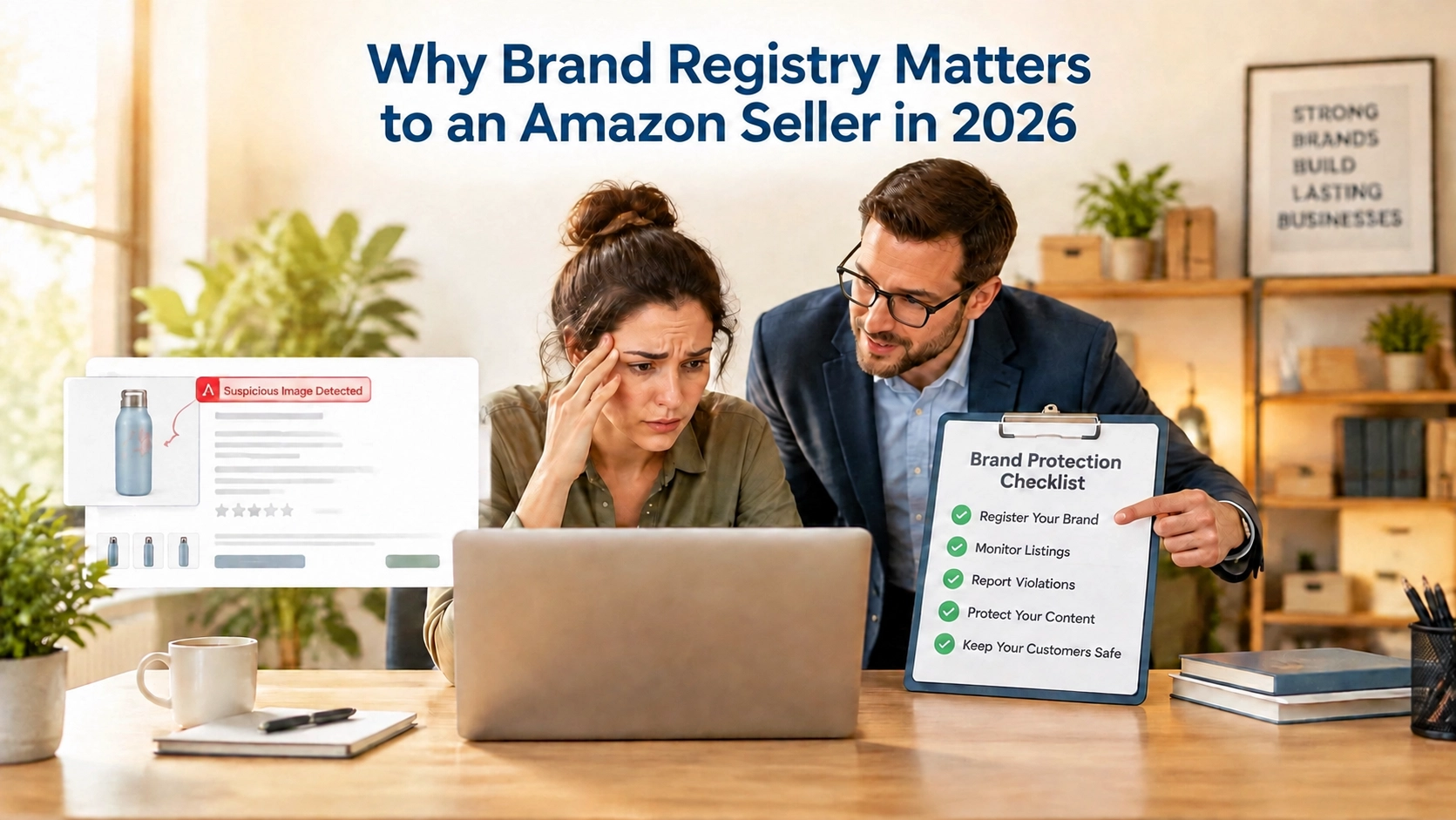
You built a brand, invested in inventory, and created listings customers recognize. But without amazon brand registry enrollment, you can miss valuable protection, data, and content tools, and an upcoming bundle policy change makes access more strategically important. Here’s what the program does, what it takes to qualify, whether starting without it and enrolling later makes sense, and where its limits are.
1. What is Amazon Brand Registry?
It’s a free Amazon program for sellers and manufacturers who own a trademarked brand. Enrollment can unlock tools for brand protection, product content, customer and search data, and other selling programs.
It is not Brand Central, and it is not a trademark. Your trademark comes from a government trademark office; the Amazon program is an enrollment that gives eligible brand owners access to Amazon tools. A seller searching “brand registry amazon” is usually trying to understand that distinction, and whether enrollment gives them practical control on the marketplace.
2. Why does Amazon Brand Registry matter more in 2026?
The amazon brand registry benefits now reach beyond listing content and counterfeit reporting. Changes to enrollment and bundle rules make timing matter.
On January 11, 2027, Amazon’s announced policy change will require most physical bundles listed as one ASIN to be packaged by the original manufacturer or brand. Virtual Bundles are a different format: they aren’t physically packaged together, and Amazon’s announcement identifies them as an option for brand owners and authorized resellers. Access depends on the seller’s brand relationship and Amazon’s eligibility rules. We explain the policy separately in our Amazon bundle policy change guide.
At the same time, Amazon has made enrollment evidence and role assignments important to accessing specific tools. And when unauthorized sellers alter a listing, misuse brand content, or offer counterfeit goods, the damage can extend beyond a single order. For an established seller, this is a matter of protecting accumulated brand equity, not just adding a logo to a product page.
3. What are the current Amazon brand registry requirements?
For U.S. sellers following the route described here, you need an active registered trademark, or an eligible pending application filed through Amazon’s IP Accelerator. A direct USPTO application that is still pending does not qualify for early enrollment under this route; wait until it is registered. Eligibility can vary by trademark office and marketplace, so confirm the current requirements before filing.
You’ll also need:
- A trademark from an approved government trademark office.
- A brand name or logo permanently affixed to the product or packaging, shown in clear product or packaging images.
- Trademark information and brand details that match your application.
One related point sellers trip over at enrollment and again at FBA inbound: after enrollment, Amazon may offer to convert eligible listings to your brand's GTIN barcodes instead of individual FNSKUs. That conversion has a direct cost angle worth pricing before you decide. Amazon discontinued its FBA Label Service in the United States as of January 1, 2026, so the labeling work now falls on you: applying FNSKU labels in-house runs roughly $0.03–$0.10 per unit in materials and labor, or $0.15–$0.60 per unit through a prep center. On a 10,000-unit inbound shipment, that is roughly $300–$1,000 of labeling you skip entirely when the manufacturer's GTIN barcode qualifies.
If you are already selling under FNSKUs, the conversion happens after enrollment, not during it: the labeled stock in FBA has to come out through a removal order, and the manufacturer barcode setting applies to the same ASIN going forward. Reviews and sales history survive because they attach to the ASIN, not the SKU. The full trade-off — including when an FNSKU is still the right call — is covered in Amazon Product Barcode Rules: FNSKUs vs GTINs.
If a pending trademark becomes registered, manually update its status in the portal. Don’t assume Amazon updates it automatically.
Books and media brands, patents, copyrights, business names, and unregistered marks do not meet the trademark requirement. Review Amazon’s current enrollment requirements before you apply.

4. How do you enroll, and what does IP Accelerator cost?
IP Accelerator connects sellers with vetted legal service providers. Amazon does not charge a connection or program fee; you choose and pay the provider directly. For a U.S. filing, Amazon lists a provider fee capped at $700 for one application in one class, plus government filing fees. As a planning estimate, the combined total is often around $950–$1,050, depending on the filing and fees.
Trademark registration commonly takes many months and can approach a year. The benefit of the IP Accelerator route is that, once the eligible application is pending, you can apply for enrollment before registration is complete.
- Review the provider options in Amazon IP Accelerator.
- Choose a provider and confirm scope, fees, and trademark ownership.
- File the application and keep its number and evidence.
- Submit your enrollment with matching brand and trademark information.
- Update the trademark status in the portal after registration.
If you plan to enroll, start now. Every month without enrollment is a month without the tools below.

5. What protection tools can help with hijackers and counterfeits?
Imagine opening your listing and finding a changed main image, inaccurate details, or an unfamiliar seller attached to your ASIN. Customers may blame your brand even when you did not make the change. Enrollment gives eligible brand users access to tools intended to address these problems:
- Report a Violation: Since the July 2026 update, reporting has a consolidated guided experience for IP infringement, store policy violations, and regulatory concerns. A Submission History tab tracks report status and outcomes.
- Project Zero: Eligible brands can use self-service tools to remove counterfeit listings. This is a separate program with additional qualification requirements, not an automatic enrollment benefit.
- Transparency: Unique unit-level codes help verify product authenticity. Serialization requires operational work and has a per-unit cost.
The program is Amazon’s access point for these tools, not a substitute for legal trademark registration, and no tool guarantees every hijacker or counterfeit listing will disappear. For details on Amazon’s July update, see its Report a Violation announcement.
6. What content and conversion tools come with enrollment?
Eligible sellers can build richer product pages using A+ Content, with enhanced images, text, comparison charts, and video. Premium A+ adds advanced interactive modules, but it is not guaranteed immediately upon enrollment; Amazon applies separate eligibility criteria. Check your A+ Content Manager for current access.
Other tools include:
- Brand Story content on product detail pages.
- A free, multi-page Brand Store inside Amazon.
- Sponsored Brands advertising access for eligible brand users.
- Amazon Vine, which can provide up to 30 Vine Voices for a parent ASIN. It costs $200 per parent ASIN under the standard fee structure; reviews are authentic, but sellers should not assume every review will be positive.

7. What data does Brand Analytics provide?
Brand Analytics offers aggregated Amazon search and purchase behavior that can inform listing and advertising decisions. Search Catalog Performance and Search Query Performance can show impressions, clicks, purchases, and your brand’s share of activity for relevant queries.
Use those signals to investigate whether customers find your ASIN but do not click, or click but do not convert. The information can help you prioritize keyword tests, listing changes, and PPC decisions. Brand Analytics access is role-dependent: Amazon says a Professional selling account and Brand Representative role are required. Not every enrolled user or reseller gets the same access. See Amazon’s Brand Analytics overview.
8. Why does enrollment matter for virtual bundles?
Virtual Bundles let eligible sellers present multiple products together without physically packaging them as a new unit. That makes them particularly relevant as the January 11, 2027 policy approaches and many sellers review physical bundle ASINs.
For a brand owner, the tool can help raise average order value or offer complementary products without creating new packaged inventory. But an Amazon role is not the same as brand permission. Being assigned an authorized reseller role does not mean the brand has signed an authorization letter for physical repackaging, or that it will. Read our overview of Amazon bundle options and check current eligibility in Seller Central.
9. What are the limits of the program?
Keep expectations realistic:
- Enrollment is not trademark registration; the government office handles the trademark.
- It does not prevent every listing hijack or counterfeit attempt. Project Zero and Transparency also require effort, and Transparency codes cost money per unit.
- A pending application filed directly with the USPTO does not provide early access under the IP Accelerator route described above; you must wait for registration.
- If trademark ownership changes or the mark lapses, your enrollment benefits may be affected.
- Many unregistered sellers still operate successfully. This is usually a leverage decision, though virtual bundle access makes enrollment more consequential for sellers who depend on that format.
- Starting without enrollment is viable, but the exposure window is real: hijack risk, no analytics history, and no Vine or A+ during your listing's most impressionable months.
- The strongest timing is to file the trademark in parallel with launch rather than choosing between selling and enrolling.
10. What are the pros and cons of starting without Brand Registry and enrolling later?
Most sellers do not start enrolled, and plenty of successful ones waited a year or more before they did. So the honest answer is that starting without it is a legitimate strategy, with a defined price attached.
The case for starting without it:
- Cash goes to inventory, not paperwork. A new seller's binding constraint is usually stock and ad budget. The $950–$1,050 trademark cost plus legal time buys nothing a customer can see in month one.
- You learn what your brand actually is first. Sellers who file a trademark before their product line settles sometimes discover the mark they registered doesn't match the brand they ended up building. Reworking a trademark application or rebranding after registration is more expensive than waiting a quarter to file correctly.
- Nothing blocks selling. An unregistered seller can list, fulfill, advertise with Sponsored Products, and build reviews. Some of Amazon's fastest-growing sellers operated unregistered for their first year.
- The tools scale with revenue. A+ Content and Brand Analytics matter most when you have traffic and conversion data worth analyzing. On a listing doing five orders a week, much of the toolset is dormant.
The cost of waiting, stated plainly:
- You are exposed during exactly the period you are most vulnerable. A new listing with no review base and no history is the easiest target on Amazon for hijackers and counterfeit listings, and without enrollment you have no Report a Violation workflow, no Project Zero, and no Transparency option. Recovery from an early hijack often costs more than the trademark did.
- The wait is measured in months, not weeks. Trademark registration commonly approaches a year, and under the current rules a direct USPTO application must fully register before enrollment. The clock starts when you file, so delaying the filing delays everything behind it.
- Every month unenrolled is a month of data you never get back. Brand Analytics shows search and conversion history as accumulated dashboards. You cannot retroactively see what your queries did in the months before enrollment.
- Vine, A+ Content and the Brand Store cannot compound early. Review velocity on a new ASIN and an enhanced page both have outsized effect on a young listing, which is precisely the stage where an unregistered seller cannot use them.
- The January 11, 2027 bundling policy raises the stakes. If your product line will ever rely on bundles to lift AOV, virtual bundle access runs through the Brand Representative or Authorized Reseller role, which runs through enrollment. Waiting now narrows your options later.
The practical middle path most sellers land on: start selling immediately, and start the trademark filing in parallel as soon as you have committed to the brand name — ideally through IP Accelerator, since an eligible pending application unlocks enrollment months before registration completes. That gets you selling with cash intact while putting the enrollment clock in motion, instead of choosing between the two.
11. Is enrollment worth it for a small seller?
If you own a brand, can secure a qualifying trademark, and sell under that brand, the combined value of protection, content, analytics, Vine, and eligible virtual bundles can justify the trademark expense. The amazon brand registry requirements and costs still deserve careful review; enrollment alone does not guarantee access to every feature.
If you resell other brands’ products, you generally cannot enroll in their name. Focus instead on operational control: dependable fulfillment, careful returns processing, and sales across multiple channels. FBMFulfillment supports a shared inventory pool for Amazon, Shopify, TikTok, Walmart, eBay, and Etsy, with same-day shipping, FedEx 2Day service, and returns inspection and quarantine. Learn more about in-house versus outsourced fulfillment.
Key takeaways
- Brand Registry is an Amazon program, not a trademark.
- Your mark must come from an approved government office.
- The trademark owner must apply, with brand evidence that matches the record.
- Under the route described here, pending direct USPTO filings must reach registration first.
- IP Accelerator can provide an eligible pending-application path; verify current country rules.
- Amazon does not charge a program fee, but legal and government filing costs apply.
- Report a Violation received a guided reporting experience and Submission History in July 2026.
- Project Zero and Premium A+ have additional eligibility requirements.
- GTIN eligibility can skip per-unit FNSKU labeling — about $0.03–$0.10 per unit in-house or $0.15–$0.60 at a prep center, since Amazon ended its FBA Label Service on January 1, 2026.
- Existing FNSKU-labeled stock cannot convert in place: a removal order clears it, and the GTIN setting applies to the same ASIN afterward.
- Reviews and sales history survive the FNSKU-to-GTIN conversion because they attach to the ASIN, not the SKU.
- Brand Analytics access depends on account and role requirements.
- Starting without enrollment is viable; the trade-off is hijack exposure and months of analytics history you cannot recover later.
- The strongest timing is launching and filing the trademark in parallel, since IP Accelerator's pending path can unlock enrollment months before registration.
- Virtual Bundles are an important option to assess before the January 11, 2027 bundle-policy change.
- A reseller role does not equal permission to repackage a brand’s products.
- Review live Seller Central eligibility and policy language before making inventory decisions.
FAQ
What is Amazon Brand Registry?
It’s a free program that gives eligible trademark owners access to Amazon brand protection, content, analytics, and selling tools.
What are the requirements in 2026?
Generally, you need an eligible registered trademark, or an eligible pending application, plus product or packaging evidence showing the brand permanently affixed. Check current requirements for your trademark office and marketplace.
Can I enroll with a pending trademark?
Under the U.S. route described in this article, an application filed through IP Accelerator may qualify while pending. A direct USPTO application must be registered first.
How much does IP Accelerator cost?
Amazon does not charge for the connection. Provider fees are capped at $700 for one U.S. application in one class, plus government fees; total cost often falls around $950–$1,050.
Does enrollment protect against hijackers?
It provides reporting and protection tools, but it cannot prevent or automatically resolve every violation.
Is a Brand Registry role the same as brand permission?
No. An account role controls Amazon tool access; it is not a letter authorizing physical repackaging.
Do resellers need to enroll?
They generally cannot enroll in a brand they do not own. A brand may assign an eligible reseller role, with more limited access.
How long does trademark registration take?
Many months, often close to a year. Timing depends on the trademark office and application.
Can I sell on Amazon without Brand Registry and enroll later?
Yes, and many sellers do. You can list, fulfill, run Sponsored Products and build reviews unregistered. The trade-offs are real though: hijacker exposure while your listing has no defenses, no Brand Analytics history for your early months, and no Vine or A+ Content while your new ASIN needs them most. Most sellers start selling immediately and file the trademark in parallel, ideally through IP Accelerator so an eligible pending application unlocks enrollment before registration completes.
Is it better to enroll before or after launch?
If the brand name is settled and the budget covers it, filing before or at launch avoids the exposure window and puts the enrollment clock in motion early. If cash is tight or the brand direction is unsettled, selling first is legitimate. The worst option is waiting indefinitely with no filing, because the trademark wait runs on its own clock regardless.
Does enrollment cost money?
Amazon’s program is free. Trademark filing, legal services, Vine, and serialization programs can involve separate costs.
Does Brand Registry change my barcode requirements?
It can, and it can cut real prep cost. Enrolled brands can be eligible to use manufacturer GTIN barcodes on eligible listings instead of applying FNSKUs to every unit. Since Amazon discontinued its FBA Label Service on January 1, 2026, FNSKU labeling falls on the seller — roughly $0.03–$0.10 per unit in-house or $0.15–$0.60 per unit at a prep center. Skipping that work on qualifying shipments is one of the quieter savings of enrollment. When an FNSKU is still the right call is covered in Amazon Product Barcode Rules: FNSKUs vs GTINs.
If I started with FNSKUs, can I convert that ASIN to a GTIN after Brand Registry?
Yes, but not instantly. Existing FNSKU-labeled inventory in FBA cannot be converted in place; you create a removal order to clear that stock from the fulfillment center, then set up the manufacturer barcode setting on the existing ASIN (via Add another condition in Manage Inventory) and send fresh inventory under it. That creates a new SKU while keeping the original ASIN. Eligibility rules still apply: the product must be in new condition and not restricted or hazardous.
Do reviews survive the FNSKU-to-GTIN conversion?
Yes. Reviews and sales history attach to the ASIN, not to the SKU, so keeping the original ASIN through the conversion preserves both. The cost is operational, not reputational: removal-order fees and the lag of pulling stock out and sending new stock in, during which the listing can be short on inventory. Plan the conversion around a restock cycle rather than in the middle of peak.
Related links
- Amazon bundle policy change for 2027
- Amazon bundle formats explained
- Amazon Product Barcode Rules: FNSKUs vs GTINs
- Amazon Brand Registry requirements
- Amazon IP Accelerator
- Amazon Report a Violation update
- Amazon Brand Analytics
SEO block
Keyword usage counts are approximate, case-insensitive counts in the article, excluding this SEO block.
- brand registry amazon: 1
- brand registry: 18
- what is amazon brand registry: 1
- amazon brand registry requirements: 1
- amazon brand registry benefits: 1
Focus keyphrase: amazon brand registry, 6 uses
Slug: amazon-brand-registry-benefits
Meta description: Amazon Brand Registry in 2026: requirements, IP Accelerator, FNSKU to GTIN conversion, reviews, and why the Jan 2027 bundle policy matters.
Excerpt: Amazon Brand Registry gives eligible trademark owners access to protection tools, enhanced content, Brand Analytics, and other selling programs. In 2026, enrollment matters even more as sellers prepare for Amazon’s January 11, 2027 bundle policy change, which makes Virtual Bundles a relevant alternative for eligible brand owners and resellers. Learn the current trademark and image requirements, how IP Accelerator may shorten the wait for access, what tools require separate eligibility, and where enrollment falls short. This guide also covers the pros and cons of starting without Brand Registry and enrolling later, why an Amazon account role does not equal brand permission, and how sellers who resell other brands can focus on operational control instead.