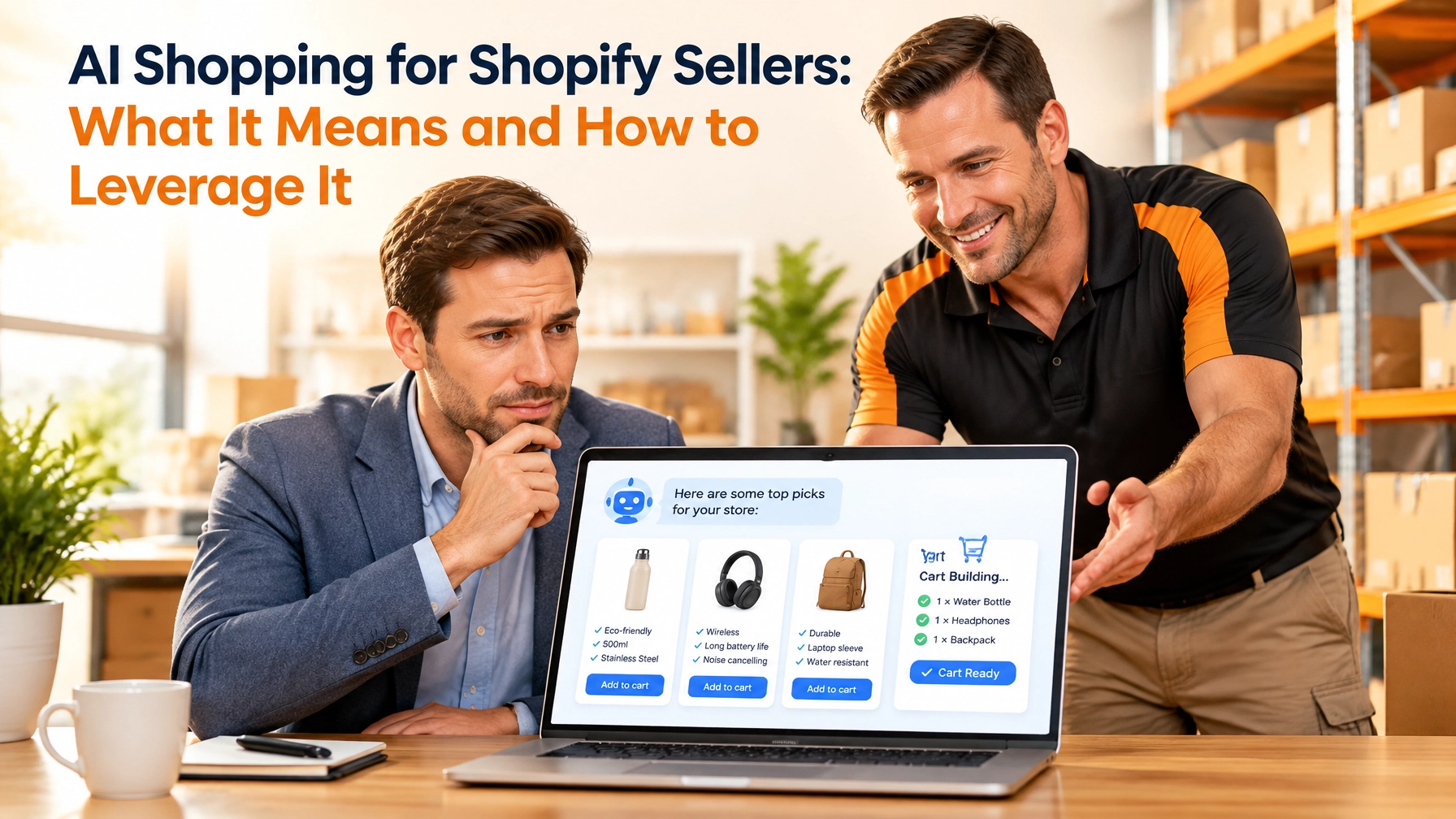
You built a Shopify store, learned Google SEO, improved your product pages, and started paying attention to conversion rate. Now you keep hearing that shoppers are buying inside ChatGPT and that software agents will shop for people. AI shopping sounds complicated, but the basic idea is simple: a shopper asks an AI assistant what to buy, and the assistant searches, compares, and sometimes acts on the shopper’s behalf.
The operating rules are changing. Your product data, inventory, shipping promise, and return policy must now be readable by software, not just persuasive to a human visitor.
1. What Does AI Shopping Actually Mean?
The old model was straightforward:
- A shopper opened Google or your Shopify store.
- The shopper searched, browsed, filtered, and compared products.
- The shopper added an item to the cart and completed checkout.
- Your job was to rank in search and convert a browsing human.
The new model begins with a plain-language request:
“Find me a waterproof hiking boot under $150 that can arrive by Friday.”
Where Do Shoppers Actually Type This?
There is no single starting point. In practice, the shopper types that request into whichever assistant they already have open. That fragmentation is exactly why Shopify built the plumbing at the platform level instead of asking merchants to integrate separately with every AI surface.
- Google AI Mode — the standard Google search box, toggled into AI Mode, on desktop or in the app
- Gemini — the Gemini app or gemini.google.com
- ChatGPT — the ChatGPT chat box
- Microsoft Copilot — the Copilot app or sidebar
- Perplexity — the Perplexity app
- Amazon — the main Amazon search bar, now powered by Alexa for Shopping (formerly Rufus)
- Browser agents via WebMCP — no query box at all; the shopper instructs their own agent, which acts directly inside the merchant’s storefront, searching the catalog and editing the cart in the shopper’s browser
- Grok — xAI’s Grok Bot browses product pages, adds items to a cart, and completes checkout through Stripe Link, but every purchase requires the shopper’s explicit approval before it executes. It is a general-purpose agent acting on the shopper’s own instructions rather than a merchant-integrated catalog channel.
- Claude — Anthropic’s assistant, which launched commerce agents on September 2, 2026 that let a merchant build a shopping agent directly on their own catalog, handling product search, cart building, and handoff to the merchant’s existing checkout
Because the entry points are fragmented and keep multiplying, merchants cannot win by picking the right channel. They win by having product data that every one of these assistants can read accurately. That is also why WebMCP matters more than any single chat interface: it does not require a query box or a merchant-side integration at all.
An AI shopping assistant can search products, filter by price and features, compare merchants, and present a short list. In some cases, it can build a cart or move the shopper toward checkout.
The critical shift is this: an agent does not browse your store the way a person does. It reads structured data: separate fields for price, availability, shipping speed, material, size, ratings, and return policy.
If a value is missing or wrong, your product is not simply ranked lower. It can be excluded from the comparison entirely.
Consider three merchants selling similar boots:
- Merchant A: The feed says
waterproof: true, the price matches the live site, and inventory is available. The product is surfaced. - Merchant B: The boot is genuinely waterproof, but that attribute appears only in descriptive copy. The product is excluded when the agent filters by waterproof construction.
- Merchant C: The feed shows a lower price than the live site and stale inventory. The product is flagged as unreliable or removed.
Same category. Same shopper intent. Three outcomes decided by feed hygiene.
What do the new terms mean?
- Agentic commerce: AI agents discover, compare, and purchase products for a shopper.
- AI shopping assistant: The consumer-facing tool that answers questions and helps make purchases.
- Product feed: Structured information describing your products, pricing, variants, availability, and policies.
- Structured data and schema: Tagged fields that machines can read consistently.
- WebMCP: A browser standard that allows an agent to search a catalog and modify a cart directly inside a web page.
- Generative engine optimization: Often called GEO, this is the practice of preparing product information for AI agents rather than only traditional search crawlers.
2. How Did We Get Here?
The history is short, but important. It is the story of artificial intelligence and retail converging faster than most merchants expected.
- 2024: Conversational shopping features appeared inside major platforms, including Amazon Rufus. Early tools answered product questions but generally could not complete transactions.
- September 29, 2025: OpenAI and Stripe announced the Agentic Commerce Protocol and Instant Checkout inside ChatGPT, beginning with United States Etsy sellers. More than one million Shopify merchants, including major brands, were expected to follow.
- Early 2026: Adoption was much smaller than the original promise. Only a few dozen Shopify merchants reportedly had true in-chat checkout. Product data was often collected through site scraping, which created stale prices, inventory errors, and shipping inaccuracies. Surveys also found that roughly two-thirds of shoppers were uncomfortable sharing payment details with an agent.
- March 2026: OpenAI ended native Instant Checkout and returned the transaction to the merchant’s own website or application, while keeping product discovery inside ChatGPT.
- January 11, 2026: Google and Shopify announced the Universal Commerce Protocol, co-developed with Etsy, Wayfair, Target, and Walmart. UCP covers discovery, checkout, and post-purchase activity so merchants can publish one capability profile rather than build a separate integration for every platform. Google AI Mode and Gemini became important discovery surfaces, with YouTube Shopping joining in May.
- May 2026: Amazon retired the Rufus brand and folded the technology into Alexa for Shopping, adding features such as target-price buying and “Buy for Me.”
- August 5, 2026: Shopify enabled WebMCP on Liquid storefronts. An agent operating in a shopper’s browser can search a catalog and edit the cart directly, without a merchant installing an app or building a custom integration.
- August 2026: The Ninth Circuit vacated an injunction involving a third-party shopping agent, leaving the case for further proceedings over how users and agents access retail systems.
The discovery half of AI shopping is real and growing. Agent-completed checkout remains unsettled. WebMCP is already practical because it needs no merchant-side setup. Sellers who fix their data are prepared for either outcome.
Recent measurements support that conclusion. Shopify reported AI-driven traffic up eight times year over year in Q1 2026, with orders from AI-powered searches up nearly 13 times. Adobe measured AI-referred retail traffic up 393% year over year and converting about 42% better than non-AI traffic. At the same time, AI agents still represented only about 3% of retail transactions in one June 2026 merchant survey.
Discovery is ahead of transaction delegation. That is where retail artificial intelligence stands today. Prepare for both.
3. What Did Shopify Actually Build?
Shopify took a platform-level approach instead of requiring each merchant to connect individually to every AI provider.
Shopify Catalog
Shopify Catalog is the structured data layer that standardizes eligible products, variants, prices, images, and availability. When you update inventory or pricing in Shopify Admin, those changes can propagate to connected AI channels.
You could submit a separate feed to each platform, but that means learning multiple taxonomies and repeating the work whenever another channel launches. Catalog reduces that duplication.
Agentic Storefronts
Agentic Storefronts is a Shopify sales channel connecting products to AI platforms without a custom app. In practical terms, it is Shopify’s platform version of an agentic storefront.
Supported channels include:
- ChatGPT for United States buyers, with checkout returning to the merchant’s store through an in-app browser.
- Microsoft Copilot through Shopify Catalog, with eligible merchants able to sell directly.
- Google AI Mode and Gemini for selected brands, with broader rollout underway.
Availability remains focused on United States buyers, but expansion is continuing.
WebMCP on Liquid storefronts
Shopify’s August 2026 WebMCP rollout makes the storefront itself callable by an agent. Agentic Storefronts supports discovery across AI surfaces. WebMCP allows an agent inside the shopper’s browser to search products and modify the active cart.
No theme redesign is required. No app is required.
The implication is significant: your design still matters to human shoppers, but the deciding factor for an agent is whether your product data is complete and accurate.
Who controls the customer relationship?
Merchants manage AI channels under Settings > Sales Channels > Agentic Storefronts. You can select participating partners and turn direct checkout on or off where supported.
You remain the merchant of record. Orders flow into Shopify Admin, and attribution identifies the AI channel that drove the sale. The agent does not automatically take ownership of your customer relationship or customer data.
Businesses using other commerce platforms can use the Agentic Plan to sync products to Shopify Catalog without fully replatforming. Amazon operates a separate closed system, so Amazon-dependent sellers need a different channel strategy.

4. How Can You Implement AI Shopping Today?
The highest-leverage work is not building a custom chatbot. It is fixing the boring operational details that agents depend on.
-
Audit your feed against the live site, field by field.
Check price, stock, return window, shipping speed, dimensions, materials, and variants. A stale feed was a major failure point in early in-chat checkout. With WebMCP, a mismatch can create a failed transaction rather than just a lost click. -
Make every important attribute structured.
If your copy says “breathable mesh upper” but your data has no material field, an agent filtering for mesh may never see the product. Add material, color, size, dimensions, weight, waterproof status, compatibility, care instructions, and other purchase-critical attributes. -
Clean your taxonomy and variants.
Use accurate categories and standardized variant names. Shopify can infer some information from clear source data, but it cannot reliably invent attributes you never supplied. -
Connect Google Merchant Center.
This is essential groundwork for UCP-based discovery through Google AI Mode and Gemini. -
Structure trust signals.
Make reviews, ratings, shipping policies, and return windows machine-readable. Image-based review widgets and on-page text alone are not enough. -
Confirm access and eligibility.
Verify that products qualify for Shopify Catalog, Agentic Storefronts is active, and product pages are not blocked by login walls or restrictive access rules. Reviewrobots.txtand other controls. -
Prioritize channels based on existing traffic.
Google-heavy sellers should focus on Merchant Center and UCP groundwork. Sellers in electronics, apparel, gifts, and home categories should prioritize conversational product discovery and feed quality. -
Do not build bespoke in-chat checkout yet.
One native checkout approach scaled back within six months. Clean, real-time product data remains valuable regardless of which protocol wins. -
Check attribution before blaming demand.
AI-referred sessions are sometimes classified as direct traffic. Correct analytics before deciding that the channel does not convert. -
Understand the concentration risk.
Open protocols make your pricing and stock easier for agents to compare. That also makes them easier for competitors to observe. Treat participation as a deliberate data-sharing decision.
5. What Is the Fulfillment Proof Behind the Promise?
An agent reads your delivery promise as a structured field. It compares your shipping speed, inventory count, and return window against competitors.
That creates a serious operational consequence. A stale inventory number can produce an out-of-stock recommendation, a cancellation, an order defect, and a negative review. With WebMCP, the agent may already have edited the cart before the mismatch appears.
The feed is the promise. The warehouse is the proof.
You have a problem. We have a solution.
Your problem is that agents now read delivery and inventory data and hold you to it. Many 3PL warehouses cannot provide accurate, real-time inventory across a modern multichannel stack.
FBMFulfillment provides:
- One inventory pool across Shopify, Amazon, TikTok Shop, Walmart, eBay, and Etsy.
- Real-time visibility through ShipHero WMS.
- Same day shipping for orders received before the cutoff.
- FedEx 2Day shipping from Jacksonville.
- Better control over inventory and returns.
For qualified startups, we offer waived minimums for 12 months, no onboarding fees, month-to-month contracts, enterprise-level pricing and shipping rates, free coaching through Ecommerce Academy and in person, a strategic location, world-class technology, and post-pay invoicing.
We remain selective. A reasonable plan and realistic expectations matter because a client’s operational failure costs both sides.
Choose your 3PL as a long-term business partner, not as a commodity vendor. It is closer to dating before marriage than ordering a one-time service. Move substantive conversations from email to a video call or an in-person meeting. Avoid gimmicks, hidden fees, and long-term contracts that prevent you from leaving.
For freight forwarding, FBMFulfillment sellers can also consider ExFreight.com. Accounts are available to businesses established in the United States, Canada, the European Union, Australia, Korea, and Japan, as well as businesses in other countries with a United States entity.

Key Takeaways
- AI agents let shoppers search, compare, and act using plain-language requests.
- Discovery is scaling faster than agent-completed checkout.
- OpenAI’s Instant Checkout proved that native checkout still has adoption and trust barriers.
- UCP gives merchants a standard for discovery, checkout, and post-purchase activity.
- Shopify Catalog standardizes product data for connected AI channels.
- Agentic Storefronts connects eligible merchants to AI discovery and selling surfaces.
- WebMCP lets agents search a Liquid storefront and modify a cart in the shopper’s browser.
- Feed accuracy is the highest-leverage improvement most Shopify sellers can make.
- Structured attributes, Merchant Center, reviews, ratings, shipping, and returns all matter.
- Do not invest heavily in bespoke checkout before the standards stabilize.
- Measure attribution carefully, then make sure your fulfillment operation can keep the promise.
Related Links
Frequently Asked Questions
A shopper tells an AI assistant what they want. The assistant searches product data, compares options, and may help build the cart or begin checkout.
Traditional search returns links for a shopper to inspect. An agent can interpret the request, filter products, compare merchants, and take actions for the shopper.
Agentic commerce is commerce conducted with software agents acting on a shopper’s instructions, including product discovery, comparison, cart management, and checkout.
WebMCP is a browser standard that exposes structured storefront actions to compatible agents. Shopify enabled it on Liquid storefronts without requiring merchants to install an app or pay a separate setup fee.
No custom integration is required for Shopify’s standard Agentic Storefronts and WebMCP capabilities. Custom development is only relevant if you are building a specialized agent or workflow.
Compare your live Shopify site with your product feed. Fix price, inventory, variant, shipping, and return mismatches before doing anything else.
Advertising can bring attention, but an agent still needs accurate fields to decide whether your product qualifies. Missing or unreliable data can remove the product from the comparison.
It can search products, modify a cart, and move the shopper toward checkout through WebMCP and related commerce protocols. The exact checkout experience depends on the channel, browser, merchant eligibility, and rollout status.
Shopify provides the platform layers, but merchants still need accurate product information, eligible products, connected channels, accessible pages, and reliable fulfillment.
An agent can recommend unavailable stock or add it to a cart. That creates cancellations, customer frustration, order defects, and avoidable reviews. Real-time inventory control is essential. This is why having a 3PL partner like FBMFulfillment is so important.