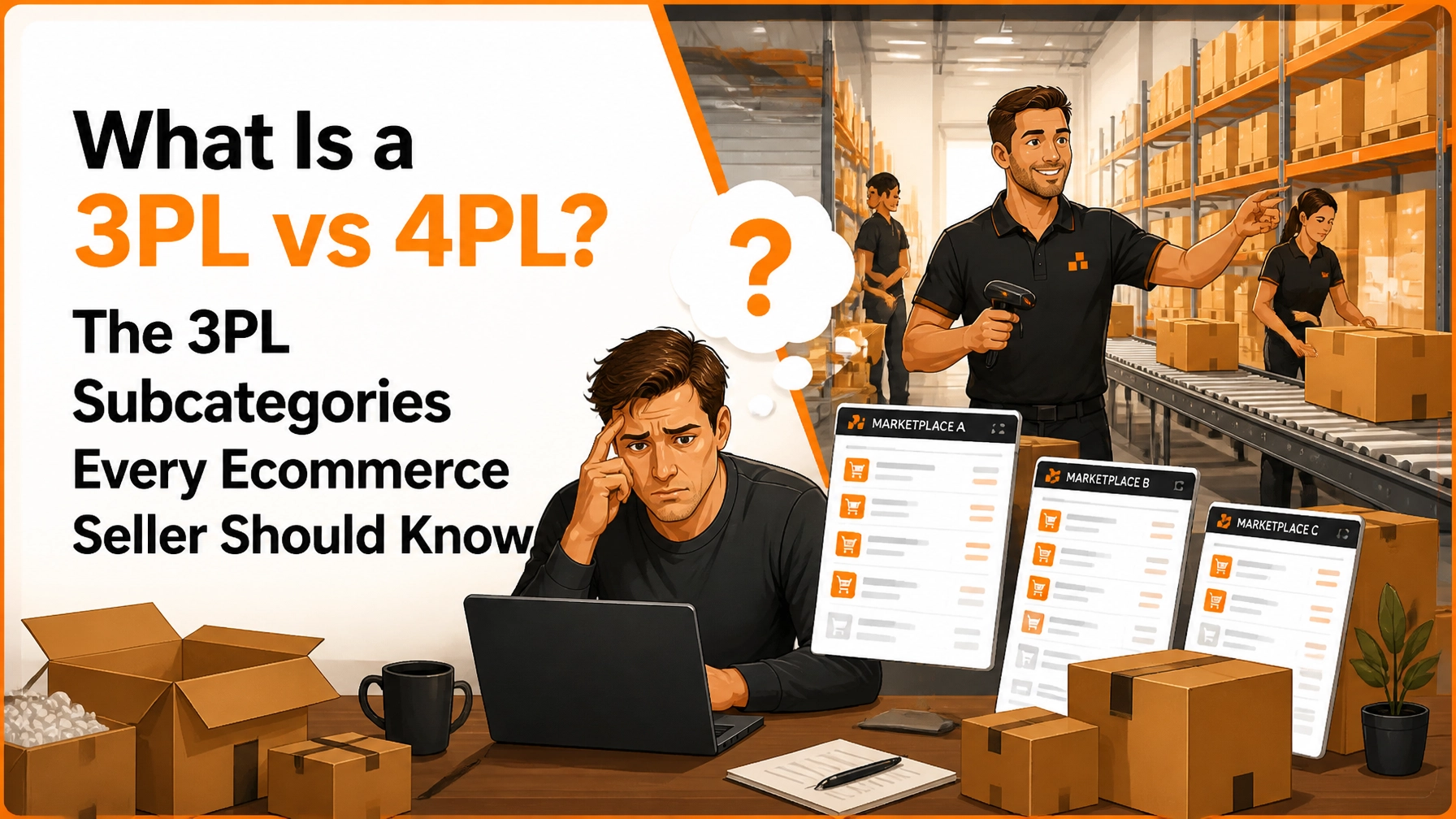
You have a problem: your ecommerce business is growing across Amazon, Shopify, TikTok Shop, Walmart, eBay, or Etsy, but fulfillment is becoming harder to control. Then providers start using terms such as 3PL and 4PL as if they mean the same thing.
They do not.
The simple answer to 3PL vs 4PL is this: a 3PL runs your fulfillment operations, while a 4PL manages your broader supply chain by coordinating multiple 3PLs, carriers, freight forwarders, customs brokers, and technology providers.
One executes. The other orchestrates.
For most mid market ecommerce sellers, choosing the right operating model comes down to control, cost, complexity, and accountability. This guide explains the difference and the 3PL subcategories that actually matter.
What is the one line difference between a 3PL and a 4PL?
A third party logistics provider, or 3PL, performs physical logistics work on your behalf. It receives inventory, stores products, picks orders, packs shipments, ships parcels, and processes returns.
A fourth party logistics provider, or 4PL, sits above those operators. It designs and manages the supply chain, often coordinating multiple 3PLs and transportation providers through one management layer.
Think of it this way:
- 3PL: Your warehouse execution partner.
- 4PL: Your supply chain general contractor.
- 3PL vs 4PL: Direct execution versus network orchestration.
A 3PL is usually closer to the inventory and the daily work. A 4PL is usually broader, more strategic, and more dependent on subcontracted partners.
What does a 3PL do every day?
A capable 3PL handles the physical and system based activities required to move your inventory from supplier to customer.
Typical 3rd party fulfillment services include:
- Receiving: Checking inbound cartons, counting units, inspecting shipments, and recording discrepancies.
- Storage: Placing products into pallet, shelf, bin, or case locations.
- Inventory control: Tracking quantities, locations, units of measure, and available inventory through a warehouse management system.
- Order processing: Importing orders from connected marketplaces and ecommerce stores.
- Picking: Selecting the correct SKU and quantity for each order.
- Packing: Choosing the appropriate packaging, adding inserts, applying labels, and confirming the shipment.
- Shipping: Buying or applying carrier labels, transmitting tracking numbers, and handing orders to the carrier.
- Kitting: Combining multiple products into a bundle, set, subscription box, or promotional package.
- Labeling and preparation: Applying marketplace labels, carton labels, barcodes, or retailer specific documentation.
- Returns: Receiving, inspecting, restocking, quarantining, refurbishing, or disposing of returned products according to your rules.
- Channel integration: Connecting with Amazon, Shopify, WooCommerce, Magento, Walmart, TikTok Shop, eBay, Etsy, and other selling channels.
The most important distinction is operational accountability. Your 3PL should be able to tell you where inventory is, what happened to an order, why a shipment missed its cutoff, and how a return was classified.
What does a 4PL actually do?
A 4PL manages the broader supply chain rather than focusing on one warehouse.
The 4PL may coordinate:
- Multiple 3PL warehouse locations
- Freight forwarders
- Ocean, air, parcel, LTL, and truckload carriers
- Customs brokers
- Transportation management systems
- Inventory planning tools
- Procurement and supplier coordination
- Network design and warehouse placement
- Performance reporting across all logistics partners
You generally work with the 4PL as your single point of contact. The 4PL then manages the underlying providers.
This can be valuable when your operation has several warehouses, international freight lanes, retail distribution requirements, complex transportation contracts, and multiple technology systems. Instead of managing six separate relationships, you manage one.
However, the convenience comes with a tradeoff. You are farther away from the warehouse floor. When a receiving error, inventory discrepancy, or missed shipping cutoff occurs, the 4PL may need to escalate the issue to another company.
That added distance can slow decisions and increase cost.
How does 3PL vs 4PL compare for ecommerce sellers?
| Decision factor | 3PL | 4PL |
|---|---|---|
| Primary role | Runs warehousing and fulfillment operations | Designs and coordinates the broader supply chain |
| Operational control | Direct visibility into the warehouse doing the work | Control through managed partners and reporting |
| Cost structure | Storage, receiving, pick and pack, shipping, returns, and value added fees | Management fees plus the costs charged by underlying providers |
| Complexity | Simpler relationship with direct operator accountability | More structured, but includes additional coordination layers |
| Scalability | Scales fulfillment within one or more facilities | Scales across multiple logistics providers and regions |
| Best fit | Ecommerce sellers seeking reliable execution and inventory control | Larger businesses managing a complex multi provider network |
| Main risk | Limited geographic coverage if the 3PL has one location | Less direct control and potential cost opacity |
| Seller relationship | You work directly with the company handling your inventory | You work through the company managing the network |
The right answer in 3PL vs 4PL is not determined by which term sounds more advanced. It is determined by whether your business needs direct warehouse execution or supply chain orchestration.
Which 3PL subcategories matter to ecommerce sellers?
Not every 3PL is built for the same order profile. These are the major categories you should understand before requesting a quote.
1. Standard DTC fulfillment
This is the traditional direct to consumer model: one or more units picked from warehouse locations, packed into a parcel, and shipped to an individual customer.
Look for:
- Reliable order imports
- Barcode scanning at pick and pack
- Clear same day shipping cutoffs
- Carrier rate optimization
- Accurate tracking transmission
- Transparent packaging charges
Strong pick and pack fulfillment services are the foundation of a dependable ecommerce operation.
2. B2B and wholesale fulfillment
Wholesale fulfillment is different from DTC fulfillment. A retailer may order full cases, mixed cases, pallets, or large quantities of individual units.
B2B requirements often include:
- Case pick and pallet pick
- Retailer routing guides
- EDI or API connections
- Purchase order management
- Advance shipping notices
- Pallet labels and packing lists
- LTL and truckload coordination
- Chargeback prevention
If wholesale is part of your growth plan, ask specifically about b2b order fulfillment services. A warehouse that only handles small parcel orders may struggle with retailer compliance.
Learn more about B2B fulfillment operations and how one inventory pool can support both wholesale and DTC orders.
3. Multichannel fulfillment
Multichannel fulfillment allows one inventory pool to serve multiple selling channels instead of splitting stock into isolated piles.
A single warehouse can support:
- Amazon FBM
- Shopify
- TikTok Shop
- Walmart
- eBay
- Etsy
- WooCommerce
- Wholesale orders
Some sellers also use amazon multi channel fulfillment mcf, but Amazon based inventory is not always the best solution for every channel. Sellers should compare fees, delivery promises, returns control, and inventory possession before placing all stock inside one marketplace network.
Multichannel inventory control is especially important when you carry many SKUs or experience unpredictable demand across channels.
4. FBA preparation and replenishment
FBA preparation involves getting inventory ready for Amazon. Services can include:
- FNSKU labeling
- Carton content preparation
- Polybagging
- Bundling
- Box content verification
- Carton labeling
- Shipment preparation
- Inbound transportation coordination
A capable provider should offer 3pl fulfillment prep as part of a broader inventory strategy, not just as a standalone labeling service.
The best setup often combines independent domestic inventory with controlled FBA replenishment. That protects you from sending every unit to Amazon before demand is proven.
5. Apparel fulfillment
Apparel creates SKU complexity because each style, color, and size may represent a separate SKU. A clothing brand can have hundreds or thousands of item variations.
Effective apparel fulfillment services may include:
- Polybagging
- Hang tag application
- Size and color verification
- Fold and pack procedures
- Kitting
- SKU relabeling
- Return inspection
- Repackaging
- Organized size runs
Your provider must make it difficult for a Medium Black shirt to be confused with a Large Navy shirt. Barcode discipline and location accuracy matter more than a polished sales presentation.
6. Returns management and reverse logistics
Returns are not simply packages moving in the opposite direction. They are inventory decisions.
A controlled process should classify each return as:
- Sellable and ready to restock
- Opened but usable
- Damaged
- Defective
- Missing components
- Requiring inspection or refurbishment
- Requiring disposal
Without this control, defective or used products can reach new customers and create repeat returns, negative reviews, and avoidable support costs.
7. Freight and customs oriented 3PLs
Some 3PLs focus heavily on inbound supply chain work. They may coordinate:
- Import documentation
- Freight forwarding
- Port drayage
- Customs brokerage
- Container unloading
- Foreign trade zone activity
- Domestic transfer freight
- Supplier consolidation
These providers can be valuable for sellers managing large international inbound shipments. Still, clarify where their responsibility ends. A freight specialist may not be the right company to handle daily DTC fulfillment.
8. Asset based versus non asset 3PLs
An asset based 3PL owns or directly operates physical resources such as warehouses, equipment, and sometimes transportation assets. This can provide greater control over labor, processes, and service standards.
A non asset 3PL typically arranges capacity through other warehouses, carriers, or logistics providers. This model can offer flexibility and broad geographic reach, but it may also introduce more handoffs.
Ask a direct question: Who physically owns and controls the inventory location where my orders will be processed?

How should you choose between a 3PL vs 4PL?
Start with your operational profile.
Choose a specialized 3PL when:
- You need direct warehouse accountability.
- Your inventory is concentrated in one or a few domestic locations.
- You want control over receiving, picking, packing, shipping, and returns.
- You operate several ecommerce channels from one inventory pool.
- You need same day fulfillment.
- You want to test a partner without a long term commitment.
- You prefer a direct relationship with the people handling your products.
Consider a 4PL when:
- You manage multiple 3PLs across regions.
- You need one organization to coordinate international freight, customs, warehousing, and transportation.
- Your supply chain requires network modeling and complex performance governance.
- Your internal team cannot manage several logistics relationships.
- The value of centralized coordination exceeds the added management cost.
Before deciding, calculate:
- Monthly order volume
- Average units per order
- Total SKU count
- Inventory cube and storage requirements
- Number of selling channels
- Return rate
- Seasonal volume swings
- Wholesale versus DTC order mix
- Required delivery windows
- Desired level of inventory control
For most mid market ecommerce sellers, a specialized 3PL is the better first step. A 4PL layer can add cost and distance from operations before the business actually needs a coordinated global network.
Where does FBMFulfillment fit?
FBMFulfillment is a true 3PL built from an ecommerce seller’s viewpoint.
The company was created after its founders experienced poor service, rising costs, fulfillment delays, and repeated marketplace performance problems while operating an ecommerce business. That experience created valuable operational scar tissue: practical knowledge earned by dealing with inventory errors, shipping deadlines, returns, integrations, and customer expectations firsthand.
FBMFulfillment provides:
- An owned warehouse operation
- Direct operational accountability
- No brokers or unnecessary middlemen
- Founder led decision making
- A single inventory pool for multiple channels
- Same day fulfillment
- FedEx 2Day service
- FBA preparation and replenishment support
- Controlled returns processing
- Wholesale and DTC fulfillment
- No onboarding fees
- No minimums
- No long term contracts
- A port city location in Jacksonville, Florida
For sellers searching for an ecommerce fulfillment center florida, 3pl jacksonville, or fulfillment center in florida, the Jacksonville location provides a Southeast based operating hub with access to major transportation routes and port infrastructure.
The goal is not to place another management layer between you and your products. The goal is to give you a reliable operator that understands your margins, lead times, minimum order quantities, channel requirements, and customer promises.
What is the practical answer to 3PL vs 4PL?
You have a problem: fulfillment is becoming too complex to manage alone, but adding a supply chain coordinator may create more distance and expense than your business needs.
We have a solution: match the provider model to your actual complexity.
Choose a 3PL when direct warehouse execution, inventory control, channel flexibility, and accountability are your priorities. Choose a 4PL when you truly need one organization to manage a network of logistics partners across multiple regions and transportation modes.
For many ecommerce sellers, the strongest next step is a specialized 3PL with proven systems, direct ownership, flexible commercial terms, and experience handling the problems sellers face every day.
Contact FBMFulfillment to discuss your inventory, channels, order profile, and fulfillment requirements.
Key Takeaways
- 3PL vs 4PL: a 3PL runs fulfillment operations, whereas a 4PL manages the entire supply chain by coordinating multiple 3PLs and providers.
- A 3PL offers daily physical logistics tasks, while a 4PL focuses on strategic supply chain management.
- Choosing between 3PL vs 4PL depends on your business needs for operational control, scalability, and complexity.
- For ecommerce sellers, specialized 3PLs suit those needing direct accountability and simpler relationships, while 4PLs benefit larger businesses managing complex networks.
- FBMFulfillment serves as a practical 3PL option, offering direct operational accountability and support for various ecommerce channels.