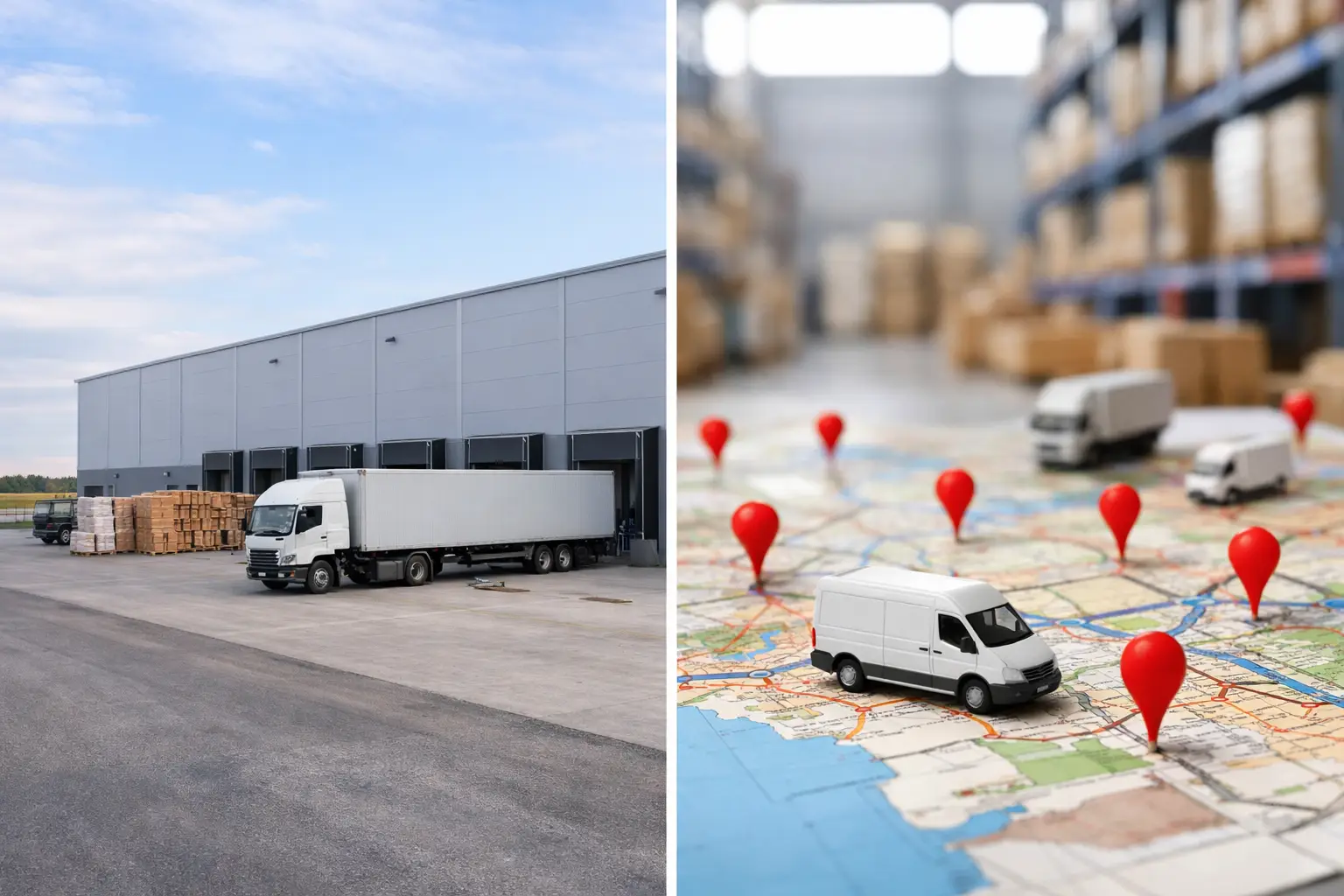
A two-day delivery promise can look like a shipping problem until you see the inventory behind it. The real choice in single warehouse vs distributed fulfillment is not simply one building versus several. It is a decision about where you carry risk: in parcel zones, inventory duplication, operating complexity, or customer expectations.
For ecommerce sellers, that distinction matters. A warehouse network can lower transit time while quietly increasing inventory fragmentation. One central facility can protect inventory control and margins while making West Coast orders more expensive to ship. The right model depends on order density, SKU behavior, channels, replenishment lead times, and how much operational complexity your team can actually manage.
What a Single Warehouse Model Does Well
A single-warehouse model holds the bulk of your inventory in one fulfillment center. Orders from Shopify, Amazon FBM, Walmart, eBay, TikTok Shop, and other channels are picked from the same inventory pool. It is usually the best starting point for brands that need accuracy, flexibility, and clear visibility more than they need to shave one transit day from every order.
The strongest advantage is inventory control. Every unit is in one place, which reduces the chance that 40 units sit idle in one region while another location runs out. That matters when a few top sellers drive most of your revenue, when demand moves unpredictably, or when suppliers have long lead times.
Centralization also keeps operations cleaner. You receive freight into one location, inspect and count it once, manage fewer transfers, and avoid splitting inbound inventory across multiple facilities before you know where demand will land. For Amazon sellers running a hybrid FBA and FBM strategy, one central reserve inventory position can make replenishment planning far more manageable.
A single location is often more cost-efficient at lower and mid-level order volume. You avoid duplicate safety stock, additional receiving fees, inter-warehouse transfers, and the management overhead that comes with multiple inventories. If your customers are concentrated in the East, Midwest, or a relatively tight regional footprint, a strategically placed central warehouse may provide service levels that are more than sufficient.
The trade-off is parcel cost and delivery speed at distance. A package shipping from the Midwest to a customer in California may travel through higher zones and take longer than a package dispatched from a West Coast facility. If your customer promise, competitive category, or marketplace performance depends on fast national coverage, those extra zones can become expensive.
Single Warehouse vs Distributed Fulfillment: The Real Trade-Off
Distributed fulfillment places inventory across two or more facilities, typically positioned to cover major customer regions. The goal is straightforward: place goods closer to demand so more orders ship through lower parcel zones and reach customers faster.
That model can be powerful for brands with consistent national volume. If meaningful order volume comes from both coasts, regional fulfillment can reduce average shipping distance, improve ground-service delivery times, and reduce the number of orders requiring air upgrades to meet a customer promise. For large, heavy, or dimensional products, parcel-zone savings can be material enough to justify the added network cost.
But faster shipping is not free. Distributed fulfillment requires intentional inventory allocation. Instead of holding 500 units of a SKU in one location, you may need to send 250 units east and 250 west, plus enough safety stock to absorb uneven demand. If the West Coast allocation sells faster than forecast, inventory may need to be transferred, replenished urgently, or shipped from the other facility at a higher cost.
That is the inventory-fragmentation problem. It is especially painful for sellers with broad catalogs, slow-moving variants, seasonal products, bundles, or volatile demand. A network may show plenty of total stock on paper while still producing regional stockouts that cost sales and force expensive exceptions.
Distributed fulfillment also adds more receiving events, more inventory counts, more potential shipping rules, and more points where a poor operating process can create a customer-facing failure. A multi-warehouse strategy only works when order routing, inventory data, cycle counting, and replenishment discipline are reliable. Adding buildings does not fix weak fulfillment execution. It spreads it out.
When a Single Warehouse Is the Better Business Decision
A central fulfillment model is usually the smarter choice when your catalog is SKU-heavy, your volume is still developing, or a large portion of sales comes from one region. It is also a strong fit when inventory availability is more important than national two-day delivery.
Consider a brand with 300 SKUs, uneven sell-through, and a few seasonal best sellers. Splitting every SKU across three locations could leave cash tied up in duplicate safety stock and make replenishment harder to forecast. Keeping inventory centralized lets the brand fulfill every saleable unit from one pool, react faster to demand changes, and reduce stranded stock.
The same logic applies to brands that are using FBM as a control layer around FBA. Amazon inventory limits, receiving delays, and stockout risk can make it dangerous to place too much sellable inventory inside Amazon’s network. A central 3PL can hold reserve inventory, fulfill Amazon FBM orders, process direct-to-consumer sales, and send FBA replenishment when the timing makes sense. The operation stays flexible without forcing every unit into multiple regional locations.
Centralization is not a compromise if your shipping strategy is engineered correctly. A reliable warehouse location, negotiated carrier rates, sensible free-shipping thresholds, and selective expedited options can often produce a strong customer experience without carrying the cost of a full distributed network.
When Distributed Fulfillment Starts to Make Sense
A distributed model earns its place when your order data supports it, not because competitors advertise two-day shipping. Start with the order map. Look at where customers live, the parcel zones you are paying for, average package weight and dimensions, delivery-time performance, and the percentage of orders requiring upgrades.
If a substantial share of orders consistently travels across the country, regional inventory can reduce cost and improve service at the same time. This is more likely for brands shipping heavy products, products with high average order values, repeat-purchase essentials, or products where delivery speed affects conversion and customer retention.
It also makes sense when demand is predictable enough to allocate inventory confidently. A seller moving the same core SKUs every week has a much easier time balancing stock across locations than a trend-driven brand whose demand changes with a social post or marketplace ranking shift.
A practical middle ground is to distribute only the products that justify it. Keep long-tail SKUs, slow movers, specialty bundles, and new products centralized. Position proven, high-velocity items in regional locations where the data shows repeat demand. This approach captures part of the shipping benefit without turning every SKU into a replenishment problem.
Do Not Use Delivery Speed as the Only Scorecard
The wrong comparison looks only at delivery days. The better comparison examines total fulfillment economics and operating risk.
A distributed model may lower average parcel costs but raise storage, receiving, transfer, and inventory-carrying costs. It may improve delivery speed but increase the chance of regional stockouts. A central model may raise shipping costs for distant orders but reduce dead stock, simplify returns, and preserve a more accurate view of available inventory.
Marketplace sellers should also separate customer delivery promises from their own internal assumptions. Amazon FBM performance depends on ship-confirmation discipline, valid tracking, cancellation control, on-time handling, and the ability to fulfill every order that is offered for sale. A wider network does not protect account health if inventory synchronization or warehouse execution is unreliable.
Returns deserve the same scrutiny. Multiple fulfillment locations can make reverse logistics more complicated, particularly when products need inspection, restocking, disposal, or return-to-vendor processing. For many brands, one accountable returns workflow is more valuable than a small theoretical transit-time improvement.
Build the Network From Your Data, Not a Map
Before adding locations, review at least several months of order history and model the decision by SKU, not only at the brand level. Your top 20 percent of products may create 80 percent of order volume, while the rest of the catalog behaves very differently.
Ask four operational questions. Where do orders actually ship? Which SKUs create the most parcel spend? How often do stockouts or late replenishment occur? Can the business afford to hold additional safety stock in more than one location?
Then stress-test the plan. What happens if one region exceeds forecast by 30 percent? What happens when an inbound container is delayed? What happens when a top SKU spikes after a promotion, or when Amazon limits inbound FBA shipments? A fulfillment design should work during normal weeks and protect the business during the weeks that create the most risk.
For many growing brands, the answer is not permanently central or permanently distributed. It is a staged approach: start with one well-run facility, use actual order data to identify costly lanes, then add regional capacity only when the savings and service gains clearly exceed the added inventory burden.
The best fulfillment footprint is the one that keeps sellable inventory available, orders moving accurately, and margin visible. FBMFulfillment approaches that decision from the seller’s side of the operation, where a late shipment, missed replenishment, or fragmented inventory position is never just a warehouse issue. It is revenue, account health, and customer trust on the line.
Key Takeaways
- The choice between single warehouse vs distributed fulfillment involves balancing risk, inventory control, and operational complexity.
- A single warehouse model centralizes inventory, improving control and reducing complexity but may increase shipping costs for distant orders.
- Distributed fulfillment speeds up delivery by positioning inventory closer to customers, but adds challenges in inventory management and potential regional stockouts.
- A strategic approach might involve a single warehouse for low-volume brands while selectively distributing high-velocity SKUs across regions.
- Evaluate fulfillment options based on actual order data, ensuring that the chosen model supports the business’s operational needs and customer expectations.
Related Links
- The Future of Amazon Fulfillment Is Hybrid
- Amazon: The 3.5% April Surcharge Survival Guide
- FBA vs FBM
- FBA vs FBM for Sellers: Which Wins?
- What a Seller Fulfilled Prime Warehouse Must Do