Look, we all knew the “temporary” surcharges of the pandemic era were never really going to stay away. But here we are, just eight days out from another margin-crunching update. Starting April 17, 2026, Amazon is slapping a 3.5% Fuel & Logistics Surcharge on fulfillment fees. If you’re currently relying on amazon multi channel fulfillment mcf to power your Shopify, Walmart, or eBay sales, you’ve got a ticking clock on your dashboard.
The global energy market is in a tailspin, with oil prices hovering north of $111 per barrel due to the ongoing regional conflicts. Amazon’s response? Pass those costs directly to the seller. While 3.5% might sound like a “small” adjustment on paper, the compounding effect on high-volume SKUs is a silent profit killer.
In this guide, we’re going to look at the cold, hard numbers, why your “Buy with Prime” strategy just got more expensive, and how moving to a dedicated 3PL like FBMFulfillment.com can shield your business from these marketplace-specific tax hikes.
The MCF Fee Hike: Why April 17 (and May 2) Matter
Amazon isn’t hitting everyone at once, but they are hitting everyone eventually. The rollout is phased, meaning you have a tiny window to pivot your strategy before the billing cycles catch up to you.
- April 17, 2026: The surcharge hits standard U.S. and Canada FBA orders.
- May 2, 2026: The surcharge extends to amazon multi channel fulfillment mcf and Buy with Prime orders.
For most sellers moving standard-size units, we’re looking at an average increase of about $0.17 per unit. If you’re moving 10,000 units a month, that’s an extra $1,700 vanishing from your bottom line every single month. Over a year, that’s $20,400. That’s not “fuel money”: that’s a new hire or a significant ad budget for a new product launch.
Is Your Brand in the “Vulnerability Zone”?
Not every product is affected equally. If you are selling high-ticket items with massive margins, a 17-cent hike is a rounding error. But for the vast majority of e-commerce sellers: especially those in competitive categories like apparel or small electronics: this is a “Vulnerability Zone” event.
If your net margins are currently sitting under 20%, this surcharge could effectively wipe out 2-5% of your actual take-home profit. Because this fee only applies to the fulfillment portion (not referral or storage), it disproportionately punishes sellers with low-priced, high-velocity items. When you use amazon multi channel fulfillment mcf, you’re already paying a premium to have Amazon ship your non-Amazon orders. Adding a percentage-based surcharge on top of an already expensive service makes the math for off-Amazon sales look increasingly grim.
The 3PL Pivot: Why Regional Shipping Beats Blanket Surcharges
One of the biggest frustrations with Amazon’s fee structure is its “blanket” nature. Amazon charges you based on their global logistics struggles, regardless of where your customers actually live.
At FBMFulfillment, we take a different approach. Instead of a flat surcharge on every single package, we leverage our Southeast Advantage. By fulfilling from a strategic hub like Jacksonville, Florida, you aren’t just a number in a massive algorithm. You get access to regional shipping rates that often bypass the heavy surcharges that “nationwide” carriers and marketplaces are forced to implement.
Daily vs. Monthly Storage: The Hidden Cost Saver
While the 3.5% surcharge is the headline today, don’t forget where the real money is made: Inventory Management. Amazon’s storage fees are notorious, but many 3PLs also play a “monthly” game where they charge you for the space you occupied at the start of the month, regardless of how much you sell.
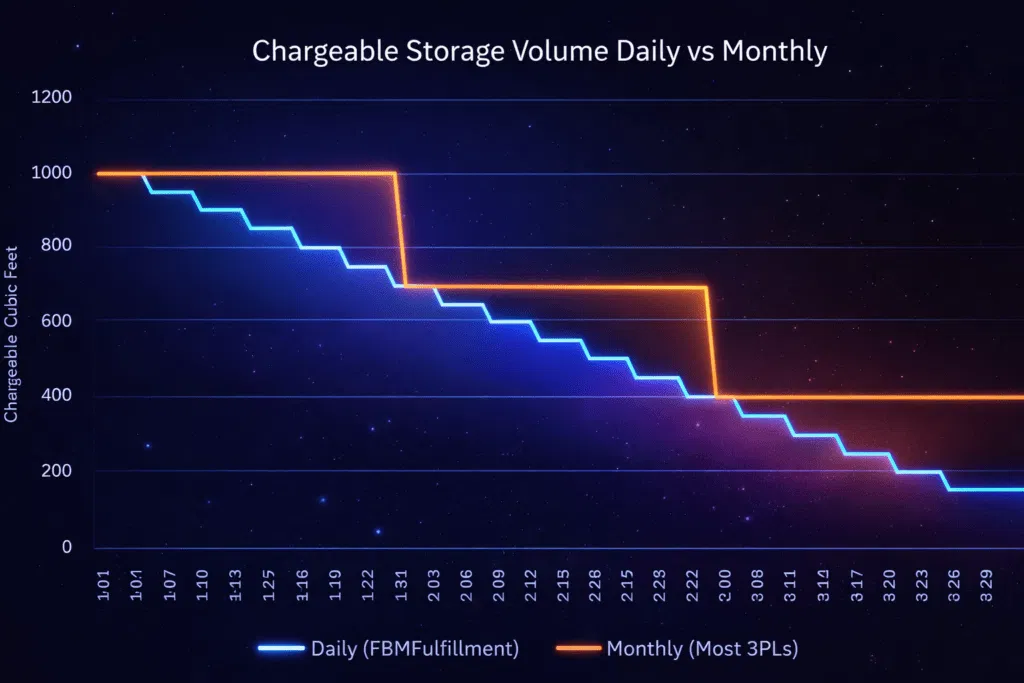
As you can see in the chart above, FBMFulfillment uses daily storage billing. When you sell an item, your storage cost drops that day. When you combine this with the rising costs of amazon multi channel fulfillment mcf, the “hidden” savings of a specialized 3PL start to outweigh the convenience of keeping everything in one Amazon-shaped basket.
Your April Action Plan: 3 Steps to Shield Your Margins
You have until April 17 (and May 2 for MCF) to get your house in order. Don’t wait for the first invoice to hit to start making changes.
1. Audit Your High-Volume SKUs
Open your Amazon Revenue Calculator and Profit Analytics reports today. Model the 3.5% increase across your top 10 SKUs. If you see a significant dip, those are the items you should consider moving to FBM (Fulfillment by Merchant). By moving your top sellers to a 3PL, you gain control over the shipping carrier and the packaging, allowing you to avoid the mandatory Amazon surcharges.
2. Strategic Repricing
You don’t necessarily have to eat this cost. A modest price increase of $0.25 to $0.50 on mid-size items can often offset the surcharge without hurting your conversion rates. The trick is to do this now, before the entire marketplace reacts. Being the “first mover” on a price adjustment allows you to test the waters while your competitors are still scratching their heads over their dwindling margins.
3. Diversify Away from the “Amazon Trap”
Relying entirely on amazon multi channel fulfillment mcf for your Shopify or TikTok Shop orders is a precarious position. When Amazon raises fees, your entire multi-channel ecosystem suffers. By splitting your inventory: keeping some in FBA for the Prime badge and the rest in an independent 3PL for Shopify, Walmart, and TikTok: you create a “firewall” for your business.
The Jacksonville Advantage: Logistics Made Simple
Based in Jacksonville, Florida, FBMFulfillment.com offers a unique logistics hub that is perfectly positioned for rapid East Coast distribution. While Amazon is dealing with global fuel crises and logistics blackouts, we focus on operational excellence and data-driven workflows.
Whether you need FBA Prep Services to get your goods into the warehouse correctly or a full-scale Wholesale Fulfillment solution, we provide the flexibility that Amazon simply cannot.
Final Thoughts: Adapt or Get Left Behind
The 3.5% surcharge is likely just the beginning. As global instability continues to impact fuel prices, marketplaces will continue to shift the burden onto sellers. The brands that survive 2026 will be the ones that stop viewing logistics as a “set it and forget it” cost and start treating it as a dynamic variable.
Using amazon multi channel fulfillment mcf was a great way to start, but as you scale, the lack of control becomes a liability. It’s time to look at your margins, look at your shipping zones, and decide if you’re okay with Amazon taking another 3.5% slice of your hard-earned pie.
Ready to shield your margins? Contact us at FBMFulfillment.com and let’s look at your shipping data. We’ll help you figure out exactly how much you could save by moving away from the “Surcharge Trap.”