Your inventory strategy is exposed.
Not because Amazon AWD disappears tomorrow. Because Amazon may be redefining what AWD is for, and sellers may be left to absorb the risk when their products fall outside that definition.
The new rule is only the visible warning. The deeper issue is amazon awd limitations are turning a convenient storage program into a narrower, more controlled lane for qualifying inventory. If your business depends on larger-format, heavier, or non-sortable products, waiting for Amazon to reverse course is a dangerous strategy.
You have a problem. We have a solution.
1. Is Amazon narrowing AWD on purpose?
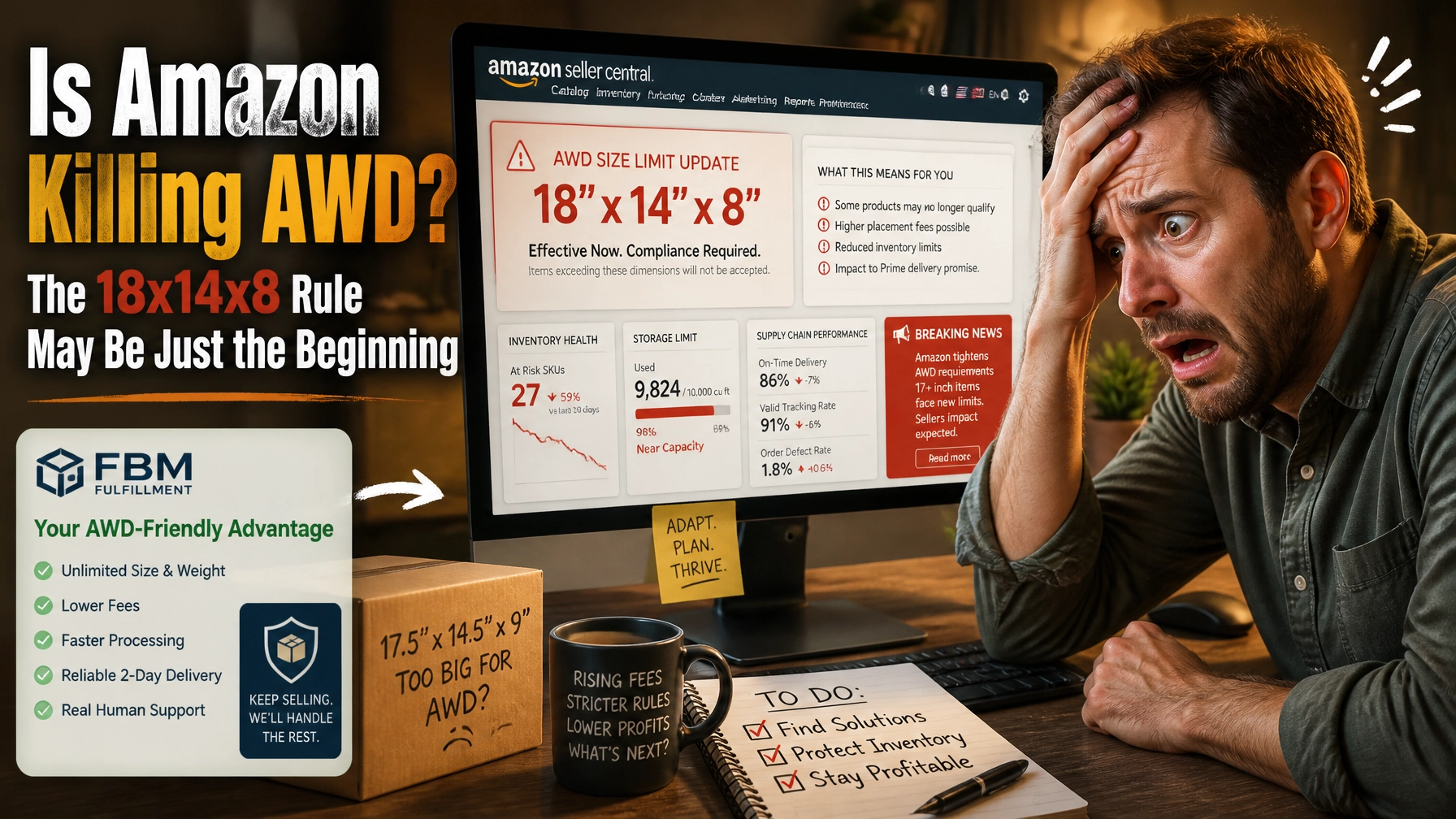
Amazon’s current policy says AWD will accept only sortable products below the stated unit thresholds beginning July 31, 2026. That change matters, but the strategic signal may matter even more.
Amazon appears to be optimizing its network around inventory that moves efficiently through automated facilities. Products that require different handling, more space, special routing, or additional labor create friction inside that model. This shift may signal that Amazon is transferring more of the inventory burden back to sellers.
That is the real meaning of amazon awd limitations.
AWD and FBA are not the same thing:
- AWD is an upstream storage and distribution program designed to hold inventory and replenish Amazon’s fulfillment network.
- FBA is the customer-facing fulfillment network that stores, picks, packs, and ships orders to Amazon customers.
When AWD becomes less available for your catalog, the fallback is not always simple. You may be pushed toward direct FBA inbound, higher storage exposure, shorter purchasing cycles, or a separate warehouse strategy.
Amazon still wants your sales. But these changes may indicate it does not want every type of inventory sitting in its upstream network.

2. What happens when your warehouse is controlled by one platform?
A single-platform inventory strategy looks efficient until the platform changes the rules.
Then the weaknesses become obvious:
- Your storage eligibility changes.
- Your inbound workflow changes.
- Your replenishment assumptions become inaccurate.
- Your cash becomes trapped in the wrong location.
- Your purchasing team has to react under pressure.
This is how supply chain fragility develops. Not through one dramatic shutdown, but through a series of policy changes that can make your original operating model less reliable.
The danger of amazon awd limitations is not limited to one shipment. It affects forecasting, working capital, SKU selection, packaging decisions, and your ability to respond when another sales channel grows unexpectedly.
Imagine your Shopify store has a strong month while Amazon demand slows. If your inventory is tied up inside an Amazon-controlled network, moving that stock to Shopify fulfillment is not as flexible as pulling units from an independent 3PL warehouse. You are forced to work within Amazon’s rules, systems, timelines, and fees.
That is not resilience.
That is dependency.
3. Why is waiting for Amazon to change course a losing strategy?
Because Amazon may have already shown you the direction.
Amazon’s official eligibility guidance confirms that products outside the current thresholds should be sent directly to the fulfillment network through the Send to Amazon workflow. Existing qualifying inventory can continue moving through the system under the stated transition rules, but future replenishment planning becomes more complicated for affected SKUs.
You can review the official guidance in Amazon’s AWD product eligibility documentation.
The breaking point comes when sellers wait until inventory is nearly depleted before building another route. By then, the damage is already underway:
-
Emergency freight costs rise.
You lose the ability to plan economical inbound movements and begin paying for speed. -
Stockout risk increases.
A delayed shipment can damage conversion, ranking, Buy Box performance, and advertising efficiency. -
FBA storage becomes more dangerous.
Sending too much inventory directly into FBA can create aged inventory exposure and unnecessary capital drag. -
Forecasting becomes reactive.
Your team is no longer planning replenishment based on demand. They are chasing policy changes. -
Other channels receive leftovers.
Amazon gets priority because your stock is already positioned there, while Shopify, Walmart, TikTok Shop, eBay, and Etsy compete for whatever remains.
The cost is not merely a storage invoice. It is lost flexibility.
4. Is your entire supply chain sitting inside a ticking time bomb?
Amazon is not the only marketplace that can change its rules. Walmart can alter compliance requirements. TikTok Shop can tighten shipping performance standards. eBay can scrutinize delivery metrics. Carrier rates can change. Import rules can shift.
That is why experienced sellers use 3rd party fulfillment services as an independent control point.
A neutral warehouse gives you:
- Possession control over your inventory.
- One inventory pool across every sales channel.
- A backup when a marketplace changes its policies.
- Greater control over returns, inspections, and disposition.
- The ability to redirect stock based on demand rather than platform restrictions.

The goal is not necessarily to abandon Amazon. Amazon remains a valuable channel. The goal is to stop treating Amazon as your only warehouse, transportation manager, replenishment engine, and inventory gatekeeper.
A strong strategy can still use FBA where it makes sense. It can also use an independent reserve to protect the business when amazon awd limitations suggest the Amazon-only model is becoming more precarious.
5. How does the FBA Replenishment Module solve the AWD problem?
This is where FBMFulfillment changes the equation.
The FBA Replenishment Module is a strategic advantage because it gives you an independent domestic reserve without forcing you to manually manage every replenishment shipment.
Instead of placing your entire supply inside Amazon’s ecosystem, you store inventory at FBMFulfillment. The module then supports a predictable replenishment cycle into FBA, typically every 7 to 10 days, based on your operating plan and inventory needs.
The FBA Replenishment Module helps solve the AWD dilemma by:
- Holding inventory that AWD will not accept.
- Maintaining a reliable domestic reserve outside Amazon.
- Automating FBA replenishment on a predictable schedule.
- Eliminating placement fees associated with the replenishment workflow.
- Reducing the need for emergency inbound decisions.
- Supporting a single inventory pool for Amazon, Shopify, TikTok Shop, Walmart, eBay, and Etsy.
This is not simply storage relocation. It is a redesign of your inventory control system.
The FBA Replenishment Module makes the warehouse your strategic buffer instead of leaving Amazon as your single point of failure. You retain access to your inventory, preserve channel flexibility, and keep your FBA stock lean enough to avoid unnecessary exposure.

Most importantly, the module is designed around the seller’s business: not Amazon’s preferred warehouse profile.
That difference matters when your products are larger-format, heavier, seasonal, or simply too important to leave inside one platform’s changing infrastructure.
6. Why does same day fulfillment matter after AWD changes?
A reserve only creates value when it moves quickly.
If your warehouse takes several days to process an order, you have replaced one dependency with another. FBMFulfillment is built around same day fulfillment for orders received by the applicable cutoff, giving sellers a faster way to respond to demand across channels.
That speed supports several critical outcomes:
- Faster FBA replenishment.
- Better protection against Amazon stockouts.
- Quicker response to TikTok Shop demand spikes.
- Reliable Shopify and Walmart order processing.
- Less emergency freight.
- Better customer delivery expectations.
This is also where a 3PL Jacksonville operation can provide a practical advantage. FBMFulfillment operates from Jacksonville, Florida, with access to domestic carrier networks and FedEx 2Day service for dependable delivery across the United States.
You are not just buying shelf space. You are building an operating layer between your inventory and the next platform decision.
7. What should you do before the next policy change?
Do not wait for another notification.
Use this action plan:
-
Classify every SKU by operational profile.
Identify which products are easily handled by Amazon’s automated network and which require independent storage or specialized handling. -
Calculate your Amazon concentration risk.
Measure what percentage of your total inventory value sits inside AWD or FBA. -
Create a reserve plan.
Determine how many weeks of inventory should remain outside Amazon to protect your highest-value products. -
Model replenishment frequency.
Compare emergency shipments with a predictable 7 to 10 day replenishment cycle. -
Unify your channels.
Build one inventory pool that can feed FBA, Shopify, TikTok Shop, Walmart, eBay, and Etsy without manual stock transfers. -
Audit your returns process.
Inventory control means more than storage. Returned products must be inspected before they can damage your brand or reach another customer. -
Test your backup route before you need it.
A supply chain backup is worthless if the warehouse, integrations, labels, and SOPs have not been validated.
The sellers who act now will have options. The sellers who wait will pay for urgency.
The solution: build outside Amazon before Amazon forces you to
Is Amazon killing AWD? Not completely.
But Amazon may be narrowing AWD’s role, and the current amazon awd limitations are a warning that your inventory strategy should not depend on one ecosystem’s definition of efficiency.
FBMFulfillment gives you an independent domestic reserve, controlled inventory possession, multi-channel fulfillment, and the FBA Replenishment Module to keep FBA supplied without surrendering your entire inventory position.
Our 3rd party fulfillment services are built for sellers who need control, speed, and operational reliability. We provide same day fulfillment, FedEx 2Day delivery options, no onboarding fees, and no minimums.
If you are searching for 3PL Jacksonville support, contact FBMFulfillment at sales@fbmfulfillment.com or call (904) 530-9694. We will be glad to review your current AWD, FBA, and multi-channel setup.
Do not wait for Amazon’s next restriction to reveal your supply chain weakness.
You have a problem. We have a solution.
Key Takeaways
- Amazon AWD limitations are reshaping how sellers manage inventory, pushing them toward stricter requirements for sortable products.
- Relying solely on Amazon creates vulnerabilities in your supply chain, affecting everything from cash flow to forecasting.
- Using the FBA Replenishment Module provides a strategic reserve and helps automate inventory management across multiple platforms.
- Sellers must prepare by assessing SKU profiles, calculating Amazon concentration risks, and establishing backup plans.
- A flexible inventory strategy reduces dependency on Amazon’s policies and enhances responsiveness to market demand.