A shipment can look profitable until Amazon rejects a carton, flags a missing suffocation warning, or delays receiving inventory that was supposed to prevent a stockout. That is why the FBA prep versus self prep decision is not simply about who applies labels. It determines how much operating risk your team carries, how quickly you can replenish, and whether your margin survives the exceptions.
For smaller sellers, self-prep can be the right move. For established brands with growing SKU counts, wholesale receipts, or multichannel demand, it can quietly become the bottleneck holding everything else back. The right model depends on the actual cost of your time, your error rate, inventory flow, and how much control you need outside Amazon’s network.
What FBA Prep Actually Includes
FBA prep is the work required to make inventory acceptable for Amazon fulfillment centers. Depending on the product and shipment, that can include inspection, FNSKU labeling, poly bagging, bubble wrapping, bundling, expiration-date labels, carton labeling, pallet preparation, and building outbound shipment plans.
The detail matters because Amazon’s rules are product-specific and can change. A generic process that works for one SKU may fail for a fragile item, a liquid, an apparel product, or a multipack. When prep is handled by a qualified 3PL or prep provider, the provider receives inventory, checks it against your instructions, prepares it to the applicable requirements, and sends it into Amazon on your schedule.
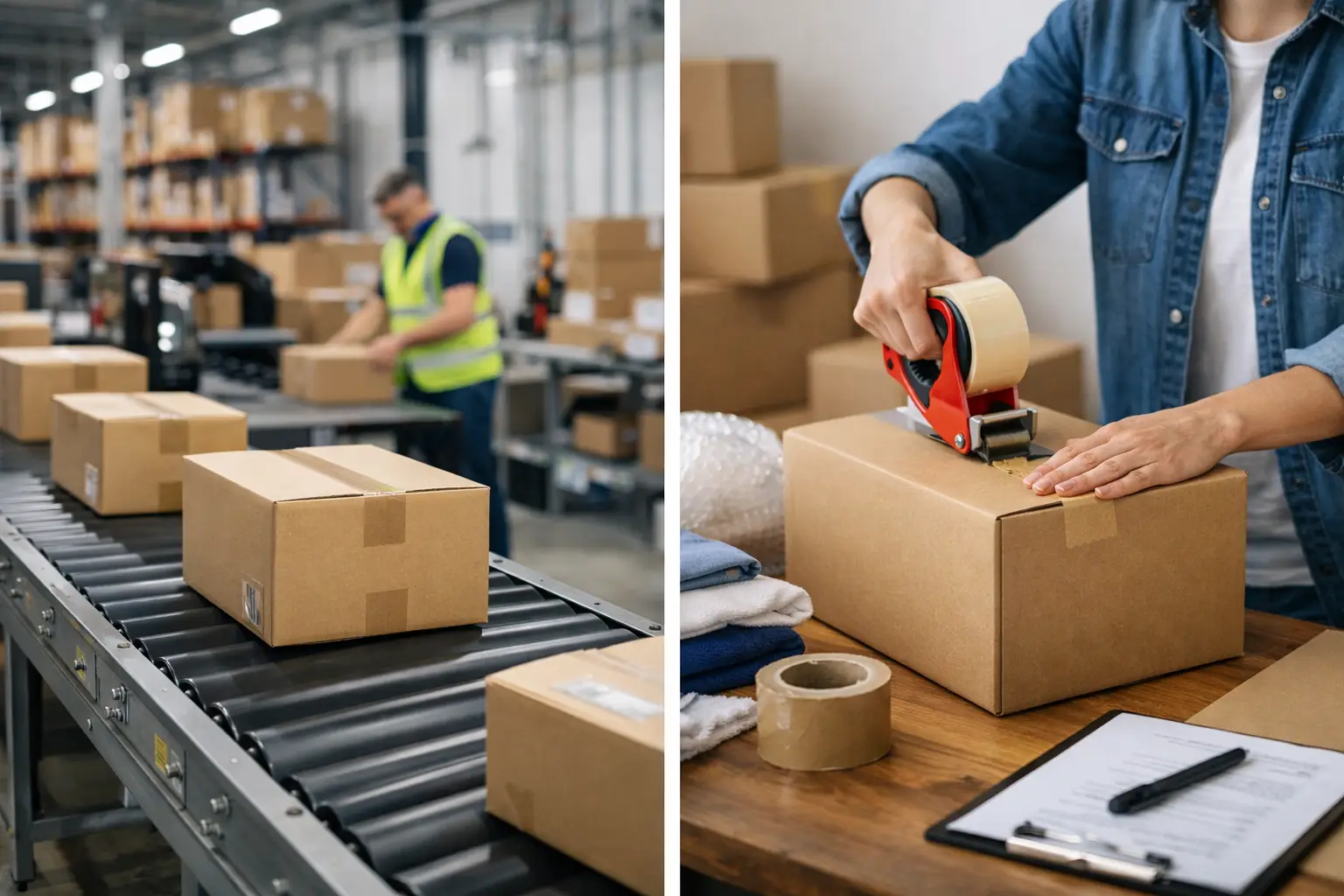
Self-prep means your own team performs those steps, whether that happens in a garage, office, leased warehouse, or dedicated fulfillment operation. You retain direct custody of the inventory and decide exactly how each unit is handled. That can be valuable. It also means every training gap, supply shortage, shipment-plan change, and mislabeled carton lands on your team.
FBA Prep Versus Self Prep: The Real Cost Comparison
The most common mistake is comparing a prep provider’s per-unit fee with the cost of a label or poly bag. That is not the comparison. The relevant question is what it costs to get an accurate, compliant shipment delivered and received in time to protect sales.
Self-prep has visible costs: labor, labels, tape, cartons, bags, void fill, shelving, rent, and inbound freight to your location. It also has less visible costs. Someone has to receive and count the goods, resolve damaged units, print labels, maintain supplies, train staff, monitor Amazon requirements, and troubleshoot when a shipment is rejected. If the owner is performing those jobs, the business is using high-value time on warehouse work instead of sourcing, pricing, advertising, or supplier negotiations.
Outsourced FBA prep is easier to price because it usually appears as receiving, storage, prep, and outbound fees. But the lower-cost option still depends on volume and complexity. A seller moving a few predictable cases per week may prepare units internally at a reasonable cost. A brand receiving mixed-SKU wholesale deliveries, building kits, or replenishing hundreds of SKUs can often reduce total cost by moving prep to a warehouse built for repeatable execution.
Error cost belongs in the math. One labeling mistake can create removal orders, stranded inventory, lost selling days, customer complaints, and rushed replacement shipments. If a stockout lowers a listing’s sales velocity, the impact may extend well beyond the missed orders during the outage. Cheap prep is expensive when it interrupts inventory availability.
Speed Is Usually the Deciding Factor
Amazon inventory limits and receiving delays have made replenishment planning less forgiving. Sellers cannot always send large amounts of stock into FBA and wait for it to be checked in. They need inventory staged elsewhere, prepared correctly, and ready to move when sell-through, capacity, or seasonality requires it.
Self-prep is fast when inventory is already in your facility, the team has capacity, and the shipment is straightforward. It slows down quickly when inbound deliveries arrive unpredictably or when the same staff must also pick direct-to-consumer and FBM orders. Prep work tends to lose priority the moment customer orders pile up.
A capable prep partner can create a more reliable flow: inventory arrives at the warehouse, is counted and stored, then is prepared and released in controlled replenishment batches. That model is particularly useful for sellers keeping reserve inventory outside Amazon while protecting Buy Box performance with FBM backup stock. The goal is not to send every unit to FBA. It is to have the right units ready before Amazon becomes the constraint.
Control Does Not Mean Doing Every Task Yourself
Sellers often choose self-prep because they do not want to lose control. That concern is valid. Inventory is cash, and a warehouse partner that cannot provide clear receiving, inventory, and shipment visibility creates a new problem rather than solving one.
But direct handling is not the only form of control. Operational control comes from accurate counts, documented prep instructions, usable inventory reports, defined turnaround times, and a clear escalation path when something does not match the purchase order. A seller who can see available stock, approved prep status, damaged units, and outbound shipment details has more practical control than a seller surrounded by cartons with no reliable process.
This is where generic warehouse service can fall short. Amazon prep requires an operator who understands that a delayed carton is not just a warehouse delay. It can affect in-stock rate, advertising efficiency, account metrics, and the ability to fulfill on more than one channel. FBMFulfillment approaches prep and replenishment from that seller perspective, with reserve inventory and multichannel fulfillment treated as risk-management tools rather than overflow storage.
When Self-Prep Still Makes Sense
Self-prep can be the stronger choice when your operation is simple and intentionally small. It works well if you sell a limited number of stable SKUs, receive inventory in manageable quantities, have trained staff and dedicated space, and can consistently prep without pulling attention from revenue-producing work.
It can also make sense for products requiring highly specialized handling that an outside partner cannot perform without extensive setup. If you produce custom bundles, insert handwritten materials, or inspect every unit for a quality issue known only to your team, keeping the work in-house may protect the customer experience.
The key is to be honest about capacity. If shipments are completed after hours, inventory is stacked in walkways, or Amazon replenishment is repeatedly delayed because no one is free to prep it, self-prep is no longer a low-cost system. It is an under-resourced fulfillment department.
When Outsourced FBA Prep Is the Better Operational Move
Outsourced prep earns its place when volume, SKU variety, or sales channels create variability. It is especially useful for wholesale sellers receiving supplier freight, brands with seasonal spikes, and operators using FBA alongside Shopify, Walmart, eBay, or Amazon FBM.
A prep partner is also valuable when you need a buffer between supplier deliveries and Amazon. Rather than routing every inbound shipment directly to FBA, you can receive goods into a US warehouse, inspect them, store reserve stock, and drip-feed inventory to Amazon based on demand. That gives you options if Amazon limits capacity, receiving slows down, or a listing needs FBM coverage.
Do not choose a provider solely on the lowest unit rate. Ask how they handle discrepancies, damaged inventory, urgent replenishment, bundles, expiration dates, and inventory reporting. Confirm where your inventory will be stored, whether they can support your non-Amazon orders, and how quickly they communicate when a shipment does not arrive as expected. A low rate does not offset a warehouse that leaves you guessing.
A Hybrid Model Often Protects the Most Margin
For many growing brands, the best answer is not self-prep or outsourced prep across the board. It is a deliberate hybrid. Keep highly customized, low-volume, or sensitive items in-house while moving repeatable wholesale prep and high-volume replenishment to a 3PL. Use the same reserve inventory to support both FBA replenishment and FBM or direct-to-consumer orders when Amazon inventory is constrained.
This approach separates work by its operational value. Your internal team handles the exceptions that genuinely need its product knowledge. Your fulfillment partner handles repeatable warehouse work that needs space, systems, labor, and consistency. That is often a cleaner path to scale than hiring around every temporary surge.
Before deciding, measure your last 60 to 90 days: labor hours per shipment, prep errors, stockout days, emergency freight, storage use, and the number of orders or strategic tasks delayed by warehouse work. The better choice will show up in those numbers. Choose the model that keeps your inventory moving, your listings in stock, and your team focused on the work only your business can do.
Key Takeaways
- FBA prep versus self prep impacts operational risk and margin; self-prep suits smaller sellers, while larger brands may face bottlenecks.
- FBA prep includes specific tasks from inspection to labeling, while self-prep retains direct control but adds unseen costs and risks.
- Fast replenishment drives efficiency; a capable prep partner streamlines inventory flow, reducing delays and stockouts.
- Outsourced prep aligns better with SKU variety and sales channels, particularly for businesses facing variability in demand.
- A hybrid model combines in-house handling for specialized tasks with outsourced prep for consistent, high-volume replenishment.
Related Links
- Why Do I Need a 3PL? The Criteria That Actually Matter When Choosing One
- Amazon Prep Requirements Guide for FBA Sellers
- How to Outsource Order Fulfillment Without Losing Control
- Amazon Killed FBA Prep: What Every Seller Needs Before Their Next Shipment
- In House vs Outsourced Fulfillment: What Pays?