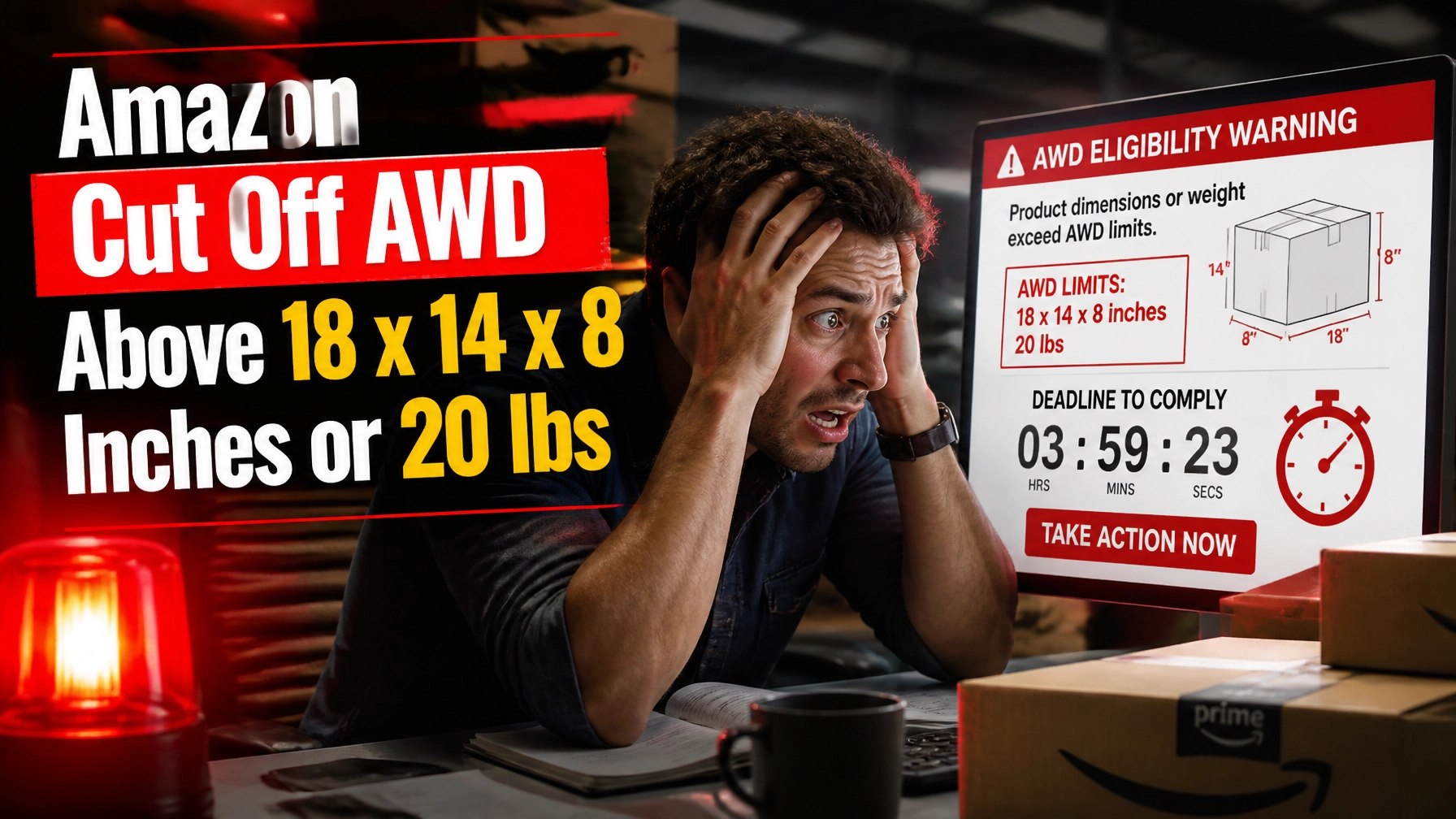
As of July 31, 2026, Amazon has cut off AWD eligibility for any sellable unit beyond a hard ceiling: 18 inches max length, 14 inches max width, 8 inches max height, and 20 pounds max weight. These are the new Amazon AWD size limits, and they are a hard stop.
This is immediate. This is strict. And if your unit exceeds any one of those limits, it is no longer eligible for Amazon Warehousing and Distribution (AWD).
Be crystal clear on one point: this cap applies to AWD only, not to FBA itself. Your FBA program is not being shut off by this rule. But if you were using AWD as your domestic buffer that automatically fed FBA, that buffer has now been cut off for any unit over 18 x 14 x 8 inches or 20 pounds.
That means sellers dealing with Amazon AWD oversize inventory need to act now, even though the rule applies to AWD rather than FBA itself. For many, that means finding reliable third party logistics 3PL services that can hold this inventory, prep it correctly, and keep Amazon replenished without the AWD cap. The pressure is immediate because the Amazon AWD size limits have changed the old replenishment playbook overnight.
What changed with the Amazon AWD size limits on July 31, 2026?
Amazon’s updated AWD eligibility rules are now a hard stop.
Beginning July 31, 2026, AWD accepts only sellable units that meet all four requirements under the updated Amazon AWD product requirements:
- Maximum length: less than 18 inches
- Maximum width: less than 14 inches
- Maximum height: less than 8 inches
- Maximum weight: less than 20 pounds per sellable unit
If a unit exceeds length, width, height, or weight by even a small amount, it is out.
The measurement applies to the individual sellable unit, including retail packaging. A product measuring exactly 18 inches on one side, exactly 8 inches high, or weighing exactly 20 pounds does not qualify.
And again, this is the critical distinction: this is an AWD restriction, not an FBA size restriction. Amazon is not saying those units cannot be sold through FBA. Amazon is saying they can no longer be stored in AWD and replenished into FBA from AWD.
The carton has separate limits. AWD carton size limits still require cartons to remain within 25 inches on any side and 50 pounds total. But a compliant carton does not override the rule. Every sellable unit inside must still stay under the unit level size and weight thresholds.
Amazon is also blocking new ineligible AWD shipments at the shipment creation stage. There is no workaround where you send it anyway and hope it gets received. If the ASIN fails the rule, the new AWD shipment is blocked and you are pushed toward direct shipment into the FBA network. This is exactly why sellers need to understand the updated Amazon AWD size limits and AWD max weight restrictions now, not later.

What is the grace period under the new Amazon AWD size limits?
There is a grace period for inventory already sitting in AWD. But it is limited.
Inventory already inside AWD that exceeds the new size or weight limits is effectively grandfathered. Amazon says that stock can continue replenishing into FBA through auto replenishment or manual replenishment until it is depleted. That is the key current stock reality under the new Amazon AWD size limits.
That is the current stock reality.
But do not misunderstand what this means:
- Existing ineligible AWD inventory can keep replenishing into FBA until depleted.
- That same inventory still accrues standard AWD storage fees the entire time it remains in AWD.
- There is no grace period for new inbound AWD shipments. Once you try to create a new AWD shipment for units that exceed the limits, the shipment is blocked at creation.
This is where the emergency starts.
If you relied on AWD as your low friction domestic buffer for these units, the clock is already running. Your current AWD stock is finite. It will run down. And when it does, you cannot refill AWD with the next batch.
That creates a dangerous transition gap for brands with long lead times, large purchase orders, seasonal swings, or products that need more handling before going into Amazon.
Why are the Amazon AWD product requirements now an emergency?
Amazon’s official explanation is that units exceeding the AWD thresholds will now be routed directly to parts of its fulfillment network designed for those products. That may help Amazon’s network.
But sellers need to focus on the real operational impact.
Amazon has narrowed AWD to a tighter dimensional and weight band. If you were using AWD to stage inventory domestically and let Amazon replenish FBA from that reserve, that workflow has now been cut off for any unit above 18 x 14 x 8 inches or 20 pounds.
And this is hitting after another major operational rollback. Effective January 1, 2026, Amazon stopped providing prep and item labeling services for US FBA shipments, including inventory moving through AWD. Sellers now have to complete prep, labeling, and compliance work before inventory arrives.
The combined impact is severe:
- Amazon no longer provides the same prep safety net.
- AWD now rejects any unit above 18 x 14 x 8 inches or 20 pounds.
- Existing AWD stock can drain down, but it cannot be replaced through AWD once depleted.
- New inbound AWD shipments for affected units are blocked at creation.
- Sellers now need a replacement domestic buffer for those SKUs immediately.
In other words, the updated Amazon AWD product requirements are no longer a minor policy note. They are an operational emergency.
This is exactly why third party logistics 3PL services are becoming strategic infrastructure rather than a simple outsourcing option.
Why are sellers with Amazon AWD oversize inventory exposed?
Products that exceed Amazon’s AWD unit thresholds create fulfillment requirements that smaller sortable inventory does not.
Examples include:
- Furniture and home goods
- Exercise equipment
- Large pet products
- Outdoor products
- Heavy tools
- Mid size boxed products that exceed 18 x 14 x 8 inches or 20 pounds
- Products with fragile retail packaging
- Bundles, kits, and prep intensive configurations
These products often require pallet storage, case management, special packaging, labeling, kitting, inspection, or customized outbound workflows.
Amazon’s new rules force sellers to send this inventory directly to fulfillment centers. That can increase the frequency of inbound shipments and reduce the flexibility of holding reserve stock in a lower cost distribution environment.
It also creates a serious channel problem. Inventory sent directly into FBA is positioned for Amazon orders. It is not automatically available for Shopify, TikTok, Walmart, eBay, or Etsy orders.
Your inventory becomes divided.
Some stock sits in FBA. Some remains with a manufacturer or freight forwarder. Some may be stored at a separate warehouse. Every additional inventory pool creates reconciliation work, transfer costs, and stockout risk.
What do sellers need to do right now?
1. Check every ASIN against the Amazon AWD size limits
Do not rely on old catalog data. Measure the final sellable unit, including retail packaging.
You need a live audit of:
- ASIN
- Length
- Width
- Height
- Unit weight
- Carton dimensions
- Carton weight
- Prep requirements
- Current AWD quantity
- Expected depletion date
Pay special attention to units near the cutoff. 18 x 14 x 8 inches and 20 pounds is not that big. A mid size box can fail this rule. Inserts, protective materials, packaging changes, and bad dimension data can push a unit out of AWD eligibility fast. This is where sellers get hit by the updated AWD max weight restrictions and dimensional thresholds without realizing it until shipment creation fails.
2. Separate your AWD grace inventory from your next inbound shipment
This is where sellers get trapped.
Existing AWD inventory that exceeds the limit can keep auto replenishing into FBA until depleted. But the next inbound shipment for that same ASIN cannot go back into AWD if the unit exceeds the threshold.
That means you need a depletion forecast now. Determine when current AWD stock will run out. Then decide where the replacement inventory will live before that date arrives.
If you wait until AWD inventory gets thin, you are already late.
3. Protect the distinction between AWD and FBA
Do not confuse this change.
FBA is not capped by this AWD rule. The issue is not whether you can continue selling through FBA. The issue is whether you still have a domestic buffer that can feed FBA the way AWD used to.
For affected units, that buffer now has to come from outside AWD.
4. Replace AWD with a domestic replenishment bridge
You need a new bridge between inbound inventory and FBA.
For many sellers, that means receiving inventory at an independent warehouse, completing prep and labeling there, storing it in a domestic reserve, and then sending controlled quantities into FBA on a predictable cycle through Send to Amazon. That is the practical answer when the Amazon AWD size limits cut off your old AWD buffer.
That workflow may include:
- Receiving product at an independent warehouse.
- Completing FBA prep and labeling.
- Inspecting dimensions and weights.
- Creating the Send to Amazon shipment.
- Applying carton and pallet labels.
- Delivering inventory directly to the assigned fulfillment centers.
- Monitoring receiving and available inventory.
This is exactly where a purpose built replenishment partner matters.

Why sellers need to talk to FBMFulfillment immediately
We are already seeing this happen in real time. A major prospect just contacted FBMFulfillment because it can no longer use AWD for inventory that exceeds the new limits.
That is not an isolated case. It is the next wave.
FBMFulfillment was built from an ecommerce seller’s viewpoint. We know exactly what happens when Amazon changes the rules and your old replenishment model stops working.
More importantly, we built the bridge sellers now need.
From our Jacksonville operation, we support:
- Inventory that exceeds the AWD size or weight ceiling
- FBA Replenishment Dripfeed
- Amazon FBM orders
- Shopify, TikTok, Walmart, eBay, and Etsy fulfillment
- Wholesale fulfillment by case or pallet
- Return inspection and processing
- Inventory tracking through a modern WMS
- Same day fulfillment for orders received before the applicable cutoff
- Actual two business day delivery through FedEx 2Day
Our exclusive FBA Replenishment Module is the direct replacement for what many sellers were using AWD to do. It lets you hold inventory domestically, outside Amazon’s dimensional caps, and feed FBA on a more predictable 7 to 10 day replenishment cycle from a single inventory pool. For sellers dealing with Amazon AWD oversize inventory, it is the bridge that replaces the lost AWD buffer without losing replenishment control.
That matters because you do not want one pool for Amazon, another for Shopify, another for TikTok, another for Walmart, and another for eBay or Etsy. That is how inventory gets divided, delayed, and misallocated.
With FBMFulfillment, you can hold one inventory pool and use it to feed:
- FBA
- Shopify
- TikTok
- Walmart
- eBay
- Etsy
And unlike the AWD model sellers are now losing for these units, our FBA replenishment workflow was built to reduce friction:
- No placement fees
- Reduced replenishment time
- Single inventory pool
- Automated FBA refill logic
- Built from an ecommerce seller’s viewpoint
As a fulfillment center in Florida, FBMFulfillment gives sellers an independent inventory position without forcing them to walk away from Amazon. We can hold the inventory AWD will no longer accept, complete compliant prep, and keep Amazon replenished while supporting every other sales channel from the same stock.
That is the advantage of an ecommerce fulfillment center in Florida built for multichannel sellers under pressure.

What should you demand from a replacement partner after the Amazon AWD size limits change?
Not every warehouse can replace the AWD function you just lost.
Ask direct questions:
- Can you accept units above the new AWD limits?
- Can you handle pallet, case, and each level inventory control?
- Can you complete FBA prep and labeling now that Amazon removed that support?
- Can you create and manage Send to Amazon shipments?
- Can you support a predictable FBA replenishment cycle?
- Can you keep one inventory pool feeding Amazon plus Shopify, TikTok, Walmart, eBay, and Etsy?
- Can you provide same day fulfillment cutoffs?
- Can you deliver actual two business day service?
- Do you charge onboarding fees or placement fees?
A capable third party logistics 3PL services partner should give you control over inventory movement, not force you into another black box.
FBMFulfillment has no onboarding fees and no minimums. Sellers looking for a 3PL Jacksonville solution also gain a Florida location, direct operational support, and a fulfillment model built around both Amazon and non Amazon demand.
What does this mean for sellers right now?
The message is simple.
If AWD was your domestic reserve for units above 18 x 14 x 8 inches or 20 pounds, that reserve is now on a countdown. Your current stock can keep replenishing into FBA until it runs out. After that, AWD is no longer your answer.
So what are you going to do?
Wait until your AWD quantity drops to a dangerous level? Wait until you are forced into rushed direct shipments? Wait until your Amazon inventory planning breaks apart across multiple disconnected pools?
That is the nightmare scenario.
The smarter move is immediate action. Audit the affected ASINs. Forecast depletion. Move the next production run into a replacement storage and replenishment model now.
Use FBA where it creates value. But do not leave your entire buffer strategy inside a system that has already changed the rules.
If Amazon AWD no longer fits your product profile, third party logistics 3PL services can provide the infrastructure to keep Amazon replenished while protecting your Shopify, TikTok, Walmart, eBay, and Etsy operations.
Contact FBMFulfillment at sales@fbmfulfillment.com or 904-530-9694 now, and we will be glad to help you evaluate your next fulfillment strategy.
Key takeaways
- The new Amazon AWD size limits require units to stay under 18 x 14 x 8 inches and under 20 pounds.
- These Amazon AWD product requirements apply to AWD only, not to FBA itself.
- New AWD shipments that exceed those limits are blocked during shipment creation.
- Existing AWD inventory that exceeds those limits is grandfathered and can keep auto replenishing into FBA until depleted.
- That grandfathered inventory still accrues standard AWD storage fees while it remains in AWD.
- AWD carton size limits still require cartons to stay within 25 inches on any side and 50 pounds total.
- Amazon stopped US FBA prep and labeling services on January 1, 2026.
- Sellers dealing with Amazon AWD oversize inventory now need a replacement channel immediately.
- FBMFulfillment can hold those units, prep them, and feed FBA through our exclusive FBA Replenishment Module from a single inventory pool.
- FBMFulfillment offers Jacksonville based storage, same day fulfillment, FedEx 2Day, no onboarding fees, and no minimums.
Sources
- Amazon AWD product eligibility
- Amazon AWD shipping requirements
- FBMFulfillment automated FBA replenishment module
- FBMFulfillment warehouse management technology
Key Takeaways
- Amazon AWD size limits enforce strict dimensions: max length 18 in, width 14 in, height 8 in, and weight 20 lbs.
- New shipments over these limits are blocked at creation, but existing inventory can still replenish into FBA until depleted.
- Sellers must act quickly to find alternative logistics solutions like third party logistics (3PL) services for oversize inventory.
- Current AWD inventory incurs standard storage fees and needs an immediate replenishment strategy to avoid stockouts.
- FBMFulfillment offers a solution to manage oversized inventory and maintain supply to FBA without interruption.
Related Links
Frequently Asked Questions
As of July 31, 2026, Amazon Warehousing & Distribution (AWD) restricts any individual sellable unit — including retail packaging — to less than 18 inches long, less than 14 inches wide, less than 8 inches high, and less than 20 pounds. A unit measuring exactly at any of those thresholds (18″, 8″, or 20 lbs) does not qualify; it has to be strictly under each limit.
It applies only to AWD, Amazon’s bulk-storage buffer service — not to FBA eligibility itself. New AWD shipments that exceed the limits are blocked at creation, but a product can still be sold through FBA; it just can’t use AWD as a staging buffer once it’s over these dimensions or weight.
It’s grandfathered in: existing AWD stock exceeding the new limits can keep auto-replenishing into FBA until it’s fully depleted. That stock still accrues standard AWD storage fees in the meantime, but no new inbound shipments can be created for those same SKUs once they exceed the limits.
Yes — cartons are still capped at 25 inches on any side and 50 pounds total, regardless of the new per-unit thresholds. The 18 x 14 x 8 inch and 20 lb rule is specifically about individual sellable units, on top of the existing carton-level limits.
Furniture and home goods, exercise equipment, large pet products, outdoor products, heavy tools, mid-size boxed products that exceed 18 x 14 x 8 inches or 20 lbs, fragile items in retail packaging, and bundles or kits that push a unit over the threshold once packaged together.
Yes — it follows Amazon’s January 1, 2026 decision to stop providing prep and labeling services for US FBA shipments, part of a broader pattern of Amazon tightening what it handles directly and pushing more prep and buffer responsibility onto sellers and their fulfillment partners.
Audit every ASIN against the new limits using actual measurements (not assumed dimensions), forecast when existing AWD inventory will deplete under the grandfathered allowance, separate that grace-period inventory from any new replacement shipments, and line up a replacement domestic replenishment source for affected SKUs — while confirming that the rule only affects the AWD buffer, not FBA eligibility itself.