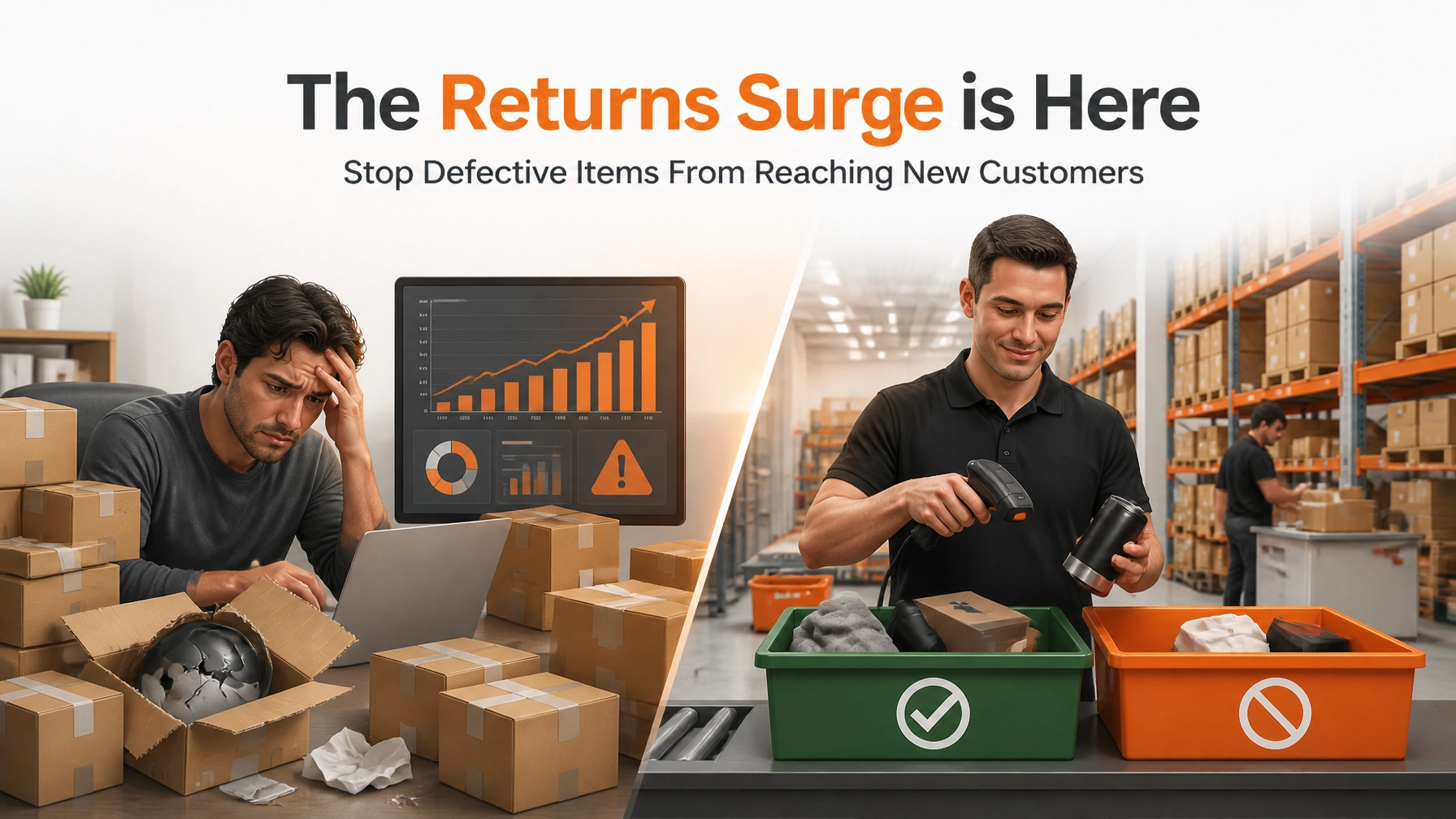
Ecommerce returns management is entering a high-pressure period. Returns are running approximately 18% to 24% above the same period last year, and Q4 peak season is approaching quickly. For multichannel sellers, that means more units moving backward through the supply chain at the exact moment fulfillment teams are preparing for holiday order volume.
Returns infrastructure is stretched.
The dangerous part is not simply the number of packages coming back. The bigger threat is what happens when returned inventory is handled without a consistent inspection and disposition process.
A damaged, defective, or mislabeled item can be placed back into available inventory. Another customer buys it. That customer receives a product that should never have shipped.
Then the financial damage compounds.
Why is ecommerce returns management becoming a margin problem?
Returns already carry several direct costs:
- Return shipping
- Customer service labor
- Warehouse receiving and inspection
- Refund processing
- Repackaging
- Inventory reconciliation
- Restocking or disposal
- Lost selling time while inventory status is unclear
Industry research from Shopify’s 2026 returns management guide notes that online returns affect margins, inventory accuracy, customer experience, and fraud exposure. The National Retail Federation’s returns research also shows that returns represent a substantial and recurring cost across retail.
But the most damaging scenario is not a normal buyer’s remorse return.
It is a defective item that recirculates.
Without disciplined ecommerce returns management, a unit can move from the customer’s return package to a picking shelf without anyone confirming its condition. The item may look acceptable from the outside while containing:
- A manufacturing defect
- Missing components
- Water or impact damage
- Incorrect labeling
- A used or previously opened product
- The wrong SKU inside the correct carton
- A safety or functionality issue
That item is then shipped to a new customer who assumes it is new and fully functional.
This is how one return becomes two returns, a chargeback, and a negative review.

What happens when defective items reach new customers?
The consequences spread across every channel.
Amazon seller performance suffers
Amazon customers expect accurate condition, complete products, and reliable resolutions. A defective or used item sold as new can create negative feedback, refund requests, A-to-Z claims, and account health concerns.
It also creates a second return. Your business pays for another shipment, another customer service interaction, and another inventory decision.
Shopify customer lifetime value declines
Shopify gives sellers control over the customer relationship. That control increases the importance of every post-purchase interaction.
A customer who receives a defective product does not separate your warehouse process from your brand. They blame the brand. If the refund is slow or the replacement is also defective, the customer may not return to your store.
The initial order may have produced revenue. The defective replacement process can destroy future customer lifetime value.
TikTok Shop disputes escalate quickly
TikTok Shop buyers often purchase after seeing a short video, demonstration, or creator recommendation. Expectations are high and the purchase cycle is fast.
When a returned item is mistakenly resold, the next buyer can quickly open a dispute, report the issue, or post a public complaint. A single poor experience can become highly visible.
Walmart and eBay metrics can take a hit
Walmart seller performance and eBay seller standards depend on accurate listings, product condition, fulfillment, and customer resolution. Defective items increase “not as described” complaints, item condition disputes, and refund activity.
Across every channel, the operational principle is the same:
A return is not available inventory until it has been inspected and approved for resale.
What is the right return management for ecommerce process?
A reliable process separates the customer-facing resolution from the inventory decision.
The customer may receive a refund or replacement quickly. That does not mean the returned unit should immediately return to stock.
Effective return management for ecommerce follows a controlled sequence.
1. Receive and identify every return
The warehouse should connect the return to the original order, SKU, customer, and return reason whenever possible.
Capture:
- Order number
- SKU and quantity
- Return authorization or tracking information
- Stated return reason
- Date received
- Packaging condition
- Product condition
This prevents unidentified returns from sitting in a general inventory area or being mixed with sellable units.
2. Inspect the product, packaging, and components
Inspection should go beyond a quick visual check.
Depending on the product, the warehouse team should verify:
- Product identity and barcode
- Packaging condition
- Accessories and components
- Signs of use
- Functionality
- Cosmetic damage
- Evidence of shipping damage
- Signs of tampering
- Correct labeling
For electronics, testing may be required. For apparel, condition, tags, stains, and wear should be documented. For kits or bundles, every component should be confirmed.
3. Assign a clear disposition
Every returned unit needs a defined outcome:
- Sellable: Restock as available inventory
- Open package: Repackage or assign an appropriate condition
- Repairable: Route for repair or refurbishment
- Defective: Quarantine for supplier review, replacement, or claim
- Unsellable: Dispose of responsibly or route to an approved recovery channel
- Incorrect item: Hold for investigation and inventory correction
The warehouse should not rely on memory or informal judgment. Use consistent reason codes and condition categories so you can identify recurring problems by SKU, supplier, batch, or shipping method.
4. Quarantine defects immediately
A defective item should never sit beside sellable inventory.
Use a physically separate quarantine location and a matching inventory status in the warehouse management system. A barcode scan, photo, inspection note, and disposition record create an audit trail.
Quarantine is not a delay. It is a protection mechanism.
5. Feed the data back into operations
Return information should reveal more than the number of refunds.
Review defect patterns weekly or monthly:
- Is one SKU generating repeated “does not work” returns?
- Are several units arriving with the same broken component?
- Did a packaging change increase transit damage?
- Are customers reporting that the product is mislabeled?
- Is one supplier or production lot creating a disproportionate number of defects?
This information can guide supplier negotiations, packaging changes, listing updates, and quality control decisions.

How do return policies protect ecommerce margins?
A return policy should protect the customer experience and define the economics clearly.
Your policy should explain:
- The return window
- Eligible and excluded products
- Product condition requirements
- Who pays return shipping
- Refund timing
- Exchange and store credit options
- Whether a restocking fee applies
- Holiday return extensions
- How defective items are handled
Do not apply a restocking fee to a legitimate defective-item return. That creates unnecessary friction and can increase disputes. Restocking fees are better suited to permitted categories of non-defective returns, such as opened products, missing components, or avoidable handling costs, subject to marketplace rules and applicable requirements.
Consider the economics of a $40 product:
- $6 original outbound shipping
- $7 return shipping
- $3 receiving and inspection labor
- $2 repackaging
- $2 payment or processing costs
- $40 product value at risk if the unit is defective and cannot be resold
That return can create more than $20 in direct expense before accounting for customer support, replacement shipping, lost advertising efficiency, or a chargeback.
Controlled ecommerce returns management protects margins in two ways:
- It recovers value from genuinely sellable units.
- It prevents defective units from creating additional losses.
The objective is not to make returns difficult. The objective is to make every return traceable and economically rational.
What should returns management services include?
Many sellers evaluate returns management services based only on whether a provider can receive a package. That is not enough.
A capable partner should provide:
- Return receiving tied to the original order
- Unit-level inspection
- Condition grading
- Sellable inventory restocking
- Defect quarantine
- Unsellable product disposal or recovery
- Inventory system updates
- Return reason reporting
- Marketplace and store integration
- Clear communication about exceptions
This is especially important when your inventory is distributed across Amazon, Shopify, TikTok Shop, Walmart, and eBay. Each channel has different customer expectations and performance measures, but your internal standard should remain consistent.
One inventory pool needs one dependable return standard.
A warehouse that simply receives a returned carton and places the contents back into stock is not providing true return management for ecommerce. It is creating inventory risk.
Why choose FBMFulfillment for return management?
FBMFulfillment was built from an ecommerce seller’s viewpoint. The company’s team experienced the operational pain of unreliable fulfillment, inventory constraints, and defective products reaching new customers before building its own warehouse operation.
The FBMFulfillment approach provides total control over return processing:
- Receive the return.
- Identify the order and SKU.
- Inspect the unit.
- Restock sellable items.
- Quarantine defective items.
- Dispose of unsellable units.
- Report the condition and disposition.
That workflow is part of a broader multichannel fulfillment model. Sellers can use FBMFulfillment’s 3PL services for orders from Amazon FBM, Shopify, Magento, WooCommerce, Walmart, eBay, TikTok, Facebook, Etsy, and other channels.
The Jacksonville operation also supports:
- Same day fulfillment
- Actual FedEx 2Day delivery
- Wholesale fulfillment
- FBA dripfeed storage and replenishment
- Inventory possession control
- Returns management services
- No onboarding fees
- No minimums
For sellers searching for a fulfillment center in Florida, Jacksonville offers a practical Southeast location with access to major transportation networks. FBMFulfillment also explains its regional logistics advantages in its guide to why Jacksonville is an ecommerce fulfillment hub.
This is the 3PL Jacksonville sellers need when they want fulfillment and returns handled with the urgency of an operating ecommerce business, not treated as disconnected warehouse tasks.

What should you do before the Q4 returns surge?
Do not wait until holiday returns begin stacking up.
Here are the key steps:
- Audit your current return flow. Identify where returns arrive, who inspects them, and how inventory status is updated.
- Create condition codes. Separate sellable, open package, repairable, defective, and unsellable units.
- Set a quarantine location. Make defective inventory physically and digitally unavailable for sale.
- Review return reasons by SKU. Look for supplier, packaging, labeling, and product quality patterns.
- Update your return policy. Clarify restocking fees, return shipping responsibility, refund timing, and defective-item handling.
- Test marketplace inventory synchronization. Confirm that quarantined units cannot be allocated to new orders.
- Plan additional Q4 capacity. Make sure receiving, inspection, customer service, and inventory teams can process the post-holiday surge.
The right 3rd party fulfillment services provider does more than ship orders. It protects the inventory and customer relationships behind those orders.
The goal of ecommerce returns management is not merely to move returned packages through a warehouse. It is to recover every sellable unit, isolate every defective unit, protect your margins, and ensure the next customer receives exactly what they ordered.
If your returns process is already stretched, contact FBMFulfillment. We will be glad to help you evaluate a controlled returns workflow before Q4 volume turns a manageable problem into a marketplace performance crisis.
Key Takeaways
- Ecommerce returns management faces increased pressure due to rising return rates and the approaching Q4 peak season.
- A lack of consistent inspection can lead to defective items being resold, damaging reputation and incurring additional costs.
- Effective ecommerce returns management requires clear processes: inspection, disposition, quarantine of defects, and data feedback.
- Return policies must clearly outline conditions, responsibilities, and handling of defective items to protect margins.
- FBMFulfillment offers comprehensive returns management services, ensuring inventory integrity and customer satisfaction across multiple channels.