Let’s be real for a second: Most 3PLs are great at moving boxes, but they’re absolutely terrible at math.
If you’re a high-growth e-commerce seller, you aren’t just selling one “unit” at a time. You’re playing a multi-dimensional game. One day you’re shipping a single bottle of vitamins to a customer on Shopify. The next, you’re “drip-feeding” 200 cases into Amazon FBA to avoid those nasty overstock fees. By the end of the week, you might be closing a massive wholesale deal that requires shipping 10 full pallets to a big-box retailer.
In the industry, we call this Unit of Measure (UOM). To most warehouse fulfillment providers, UOM is a nightmare. Their systems are rigid. They want one SKU to equal one physical object, and if you try to change the rules, their inventory counts go up in smoke.
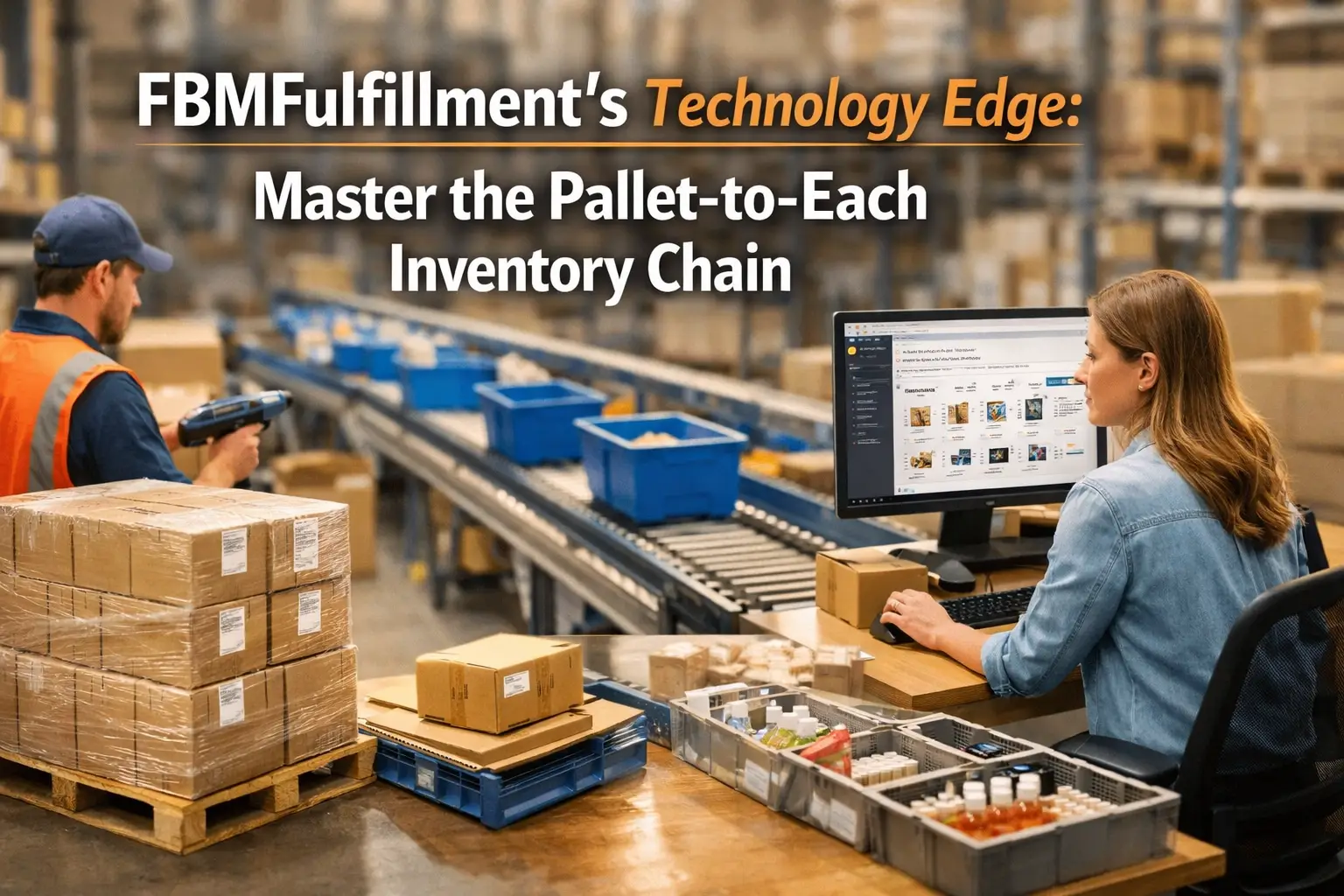
At FBMFulfillment.com, we built our technology platform differently. We don’t just “store” your stuff; we manage the logical flow of your inventory from the moment it hits our dock as a pallet to the moment it leaves as a single “each.”
Here is why mastering the pallet-to-each inventory chain is the secret weapon you didn’t know you needed.
The UOM Struggle: Why Traditional 3PLs Fail
Most 3PL fulfillment centers use legacy software that treats inventory as a static number. If you have 1,000 units, you have 1,000 units. But what happens when those 1,000 units are actually 100 cases of 10? Or 10 pallets of 100?
If your 3PL doesn’t support advanced UOM, you’re forced into “workarounds.” You end up creating three different SKU names that aren’t linked. You have to manually move inventory between them. It’s a recipe for overselling, stockouts, and massive administrative headaches.
Unfortunately, when the system isn’t configured properly, the human element takes over. That’s when the mistakes happen. You think you have stock, but it’s “trapped” in a case SKU that your Shopify store can’t see.

Visual Description: A professional infographic showing the hierarchy of inventory: A large pallet at the top, branching down into several master cartons, which then branch down into individual sellable units. Aspect ratio 1280×1024.
The FBMFulfillment Hierarchy: Pallet <-> Case <-> Each
Our technology platform uses a relational SKU system. We don’t just see items; we see the relationships between them. We link your SKUs in a logical chain that looks like this:
- Pallet SKU: (e.g.,
SKUNAME-Pallet) – 100 master cases on a pallet. - Case SKU: (e.g.,
SKUNAMEcs) – 10 sellable units in a carton. - Each SKU: (e.g.,
SKUNAME) – The individual unit sold to the end consumer.
By linking these, our system understands that these aren’t three different products: they are three different ways of looking at the same product.
The “Maximum Potential” Advantage
Let’s look at the math. If we receive 5 pallets of your product into our warehouse, our system doesn’t just sit there waiting for you to tell us what to do. It automatically calculates your inventory across all levels:
- SKUNAME-Pallet Inventory: 5 Pallets.
- SKUNAMEcs Inventory: 500 Cases (5 pallets x 100 cases).
- SKUNAME Inventory: 5,000 Eaches (500 cases x 10 units).
This is what we call Maximum Potential Inventory. Because our system knows the “DNA” of your packaging, it can show your connected stores (Shopify, Amazon, TikTok Shop) that you have 5,000 units available for sale, even if they are currently sitting on pallets in the back of the warehouse.
Saving Money: 1 Pick vs. 1,000 Picks
This isn’t just about clean spreadsheets; it’s about your bottom line. Proper UOM setup is one of the fastest ways to improve your profitability puzzle.
In the world of 3pl fulfillment, you are usually charged a “pick fee” for every item a warehouse worker grabs.
The Old Way (Expensive):
If you sell 1,000 units to a wholesale client and your 3PL doesn’t support Case or Pallet SKUs, they might charge you 1,000 individual pick fees. Even at a discounted rate, that is a massive hit to your margins.
The FBMFulfillment Way (Efficient):
Because we recognize the Pallet SKU, we don’t pick 1,000 items. We pick 1 pallet. You are charged for one single pick.
Think about that math for a second. Would you rather be charged for 1 pick or 1,000 picks? It’s a no-brainer. This logic applies to Case SKUs, too. If an FBA Dripfeed order requires 50 cases, we pick 50 cases: not 500 individual units. Receiving as pallets or cases on your PO saves you money on the way in, and shipping as pallets or cases saves you money on the way out.

Visual Description: A side-by-side comparison. On the left, a frustrated seller looking at a massive bill for “1,000 picks.” On the right, a happy seller looking at a much smaller bill for “1 pallet pick” at FBMFulfillment. Aspect ratio 1280×1024.
Logical Tracking of “Broken Cases”
One of the biggest mess-ups in warehouse fulfillment happens when a case is opened. Let’s say a customer buys 3 units. The warehouse worker opens a case of 10, takes out 3, and leaves 7 in the box.
Most systems lose track of those 7 “loose” units or, worse, they keep them listed as a “full case” until someone realizes the mistake during a manual cycle count.
Our technology platform tracks broken cases logically. The system knows exactly how many full, sealed cases are on the shelf versus how many “loose eaches” are available from a previously opened carton. This level of granularity ensures that your inventory levels are always accurate, preventing the dreaded “out of stock” notification when you actually have product sitting right there.
Syncing to Your Multichannel Empire
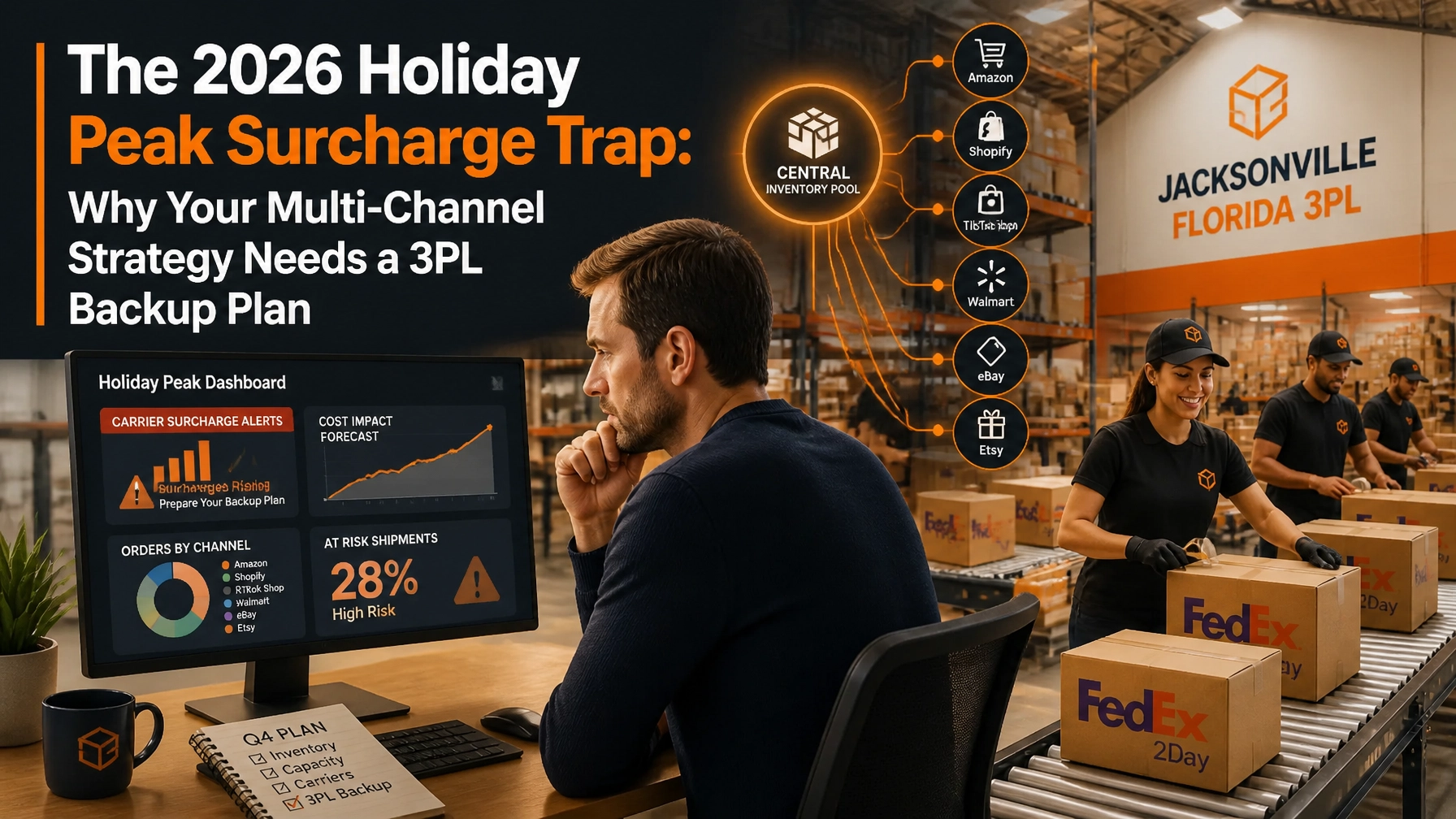
The real magic happens when we sync this data back to your sales channels. Whether you are scaling on Shopify or managing a viral hit on TikTok Shop, you need to know exactly how much you can sell.
FBMFulfillment’s system syncs the maximum potential inventory to your connected stores. If you have 5 pallets, we tell Shopify you have 5,000 units. As those units sell, the system “virtually” breaks down the pallets and cases in real-time.
This gives you:
- Better Cash Flow: You don’t have to keep all your inventory as “eaches” (which usually costs more in storage and prep).
- Protection Against Overselling: The system updates everywhere, instantly.
- Flexibility: You can pivot from B2C to B2B or FBA replenishment in a single afternoon without moving a single physical box in the warehouse.

Why This Matters for FBA Dripfeeding
Amazon is getting stricter (and more expensive) every year. With FBA fees jumping again in 2026, you can’t afford to keep all your stock in Amazon’s warehouses.
The “Dripfeed” strategy is the answer. You keep the bulk of your stock in our 3pl fulfillment center as pallets and cases. When your FBA levels dip, our system identifies the need and ships out exactly what’s required: by the case or pallet. This keeps your IPI score high and your storage fees low.
The FBMFulfillment Difference
We aren’t just another warehouse. We are a technology company that happens to be experts at logistics. We designed FBMFulfillment.com from the perspective of an e-commerce seller. We know that every cent counts and every SKU relationship matters.
If your current fulfillment services provider is treating your pallets like a pile of eaches: and charging you for it: it’s time to upgrade.
Stop fighting your inventory system. Let our technology do the heavy lifting so you can focus on growing your brand. Whether it’s pallets, cases, or eaches, we’ve got the logic to keep your business moving efficiently.
Ready to see how our UOM logic can save your margins? Contact us at FBMFulfillment.com and we will be glad to help you set up an inventory chain that actually works for you.
Amazon, TikTok, and Shopify walk into a warehouse: Why They All Need the Same SKU