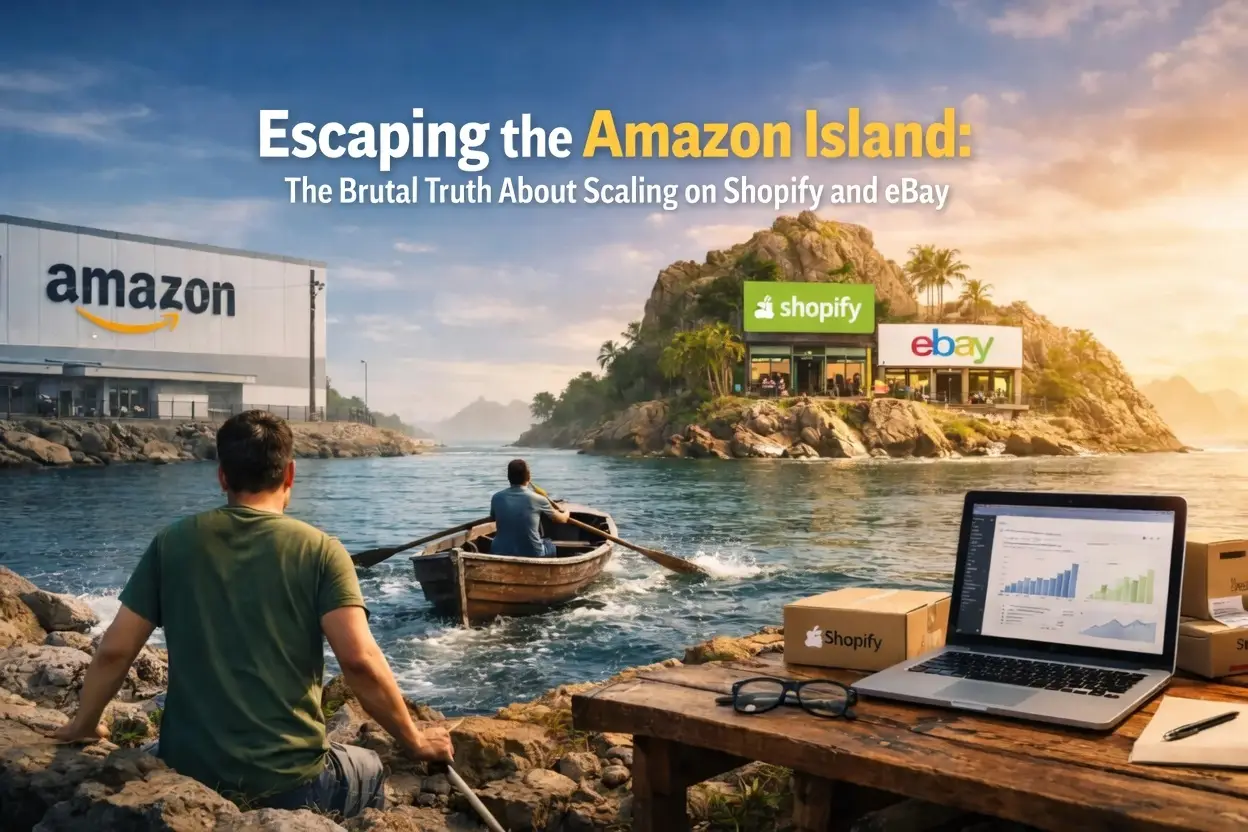
Let’s be real for a second. Selling on Amazon is like living on a tropical island where the fruit falls right into your lap. The customers are already there, credit cards out, Prime shipping expected. It’s easy. It’s lucrative.
But it’s also dangerous.
You don’t own the island. Jeff does. And if he decides to change the rules, hike the rent, or kick you off the island entirely? You’re left with a warehouse full of “dead” stock and zero ways to reach your customers.
That’s why you’re looking at Shopify. That’s why you’re eyeing eBay. You want to build your own continent. But here is the brutal truth: The “Amazon Bubble” has lied to you about how hard it is to actually sell products on the open web.
If you try to run a Shopify store exactly like you run an Amazon listing, you will go broke. Fast. Here is what you need to know to survive the transition.
1. THE TRAFFIC SHOCK: FROM SEARCH TO CREATION
On Amazon, people are “shopping.” They type “organic dog treats” into a search bar. If your SEO is decent and your reviews are high, you get a sale. You are capturing existing demand.
On Shopify? Nobody is looking for you.
You have to go out into the wild (Facebook, TikTok, Google) and interrupt someone’s day to tell them you exist. This changes your entire financial model.
The Metrics That Matter Now:
- Impressions: This isn’t just a “view” on a search page. This is how many times your ad appeared in a feed.
- Clicks (CTR): On Amazon, your click-through rate is driven by your main image and price. On Shopify, it’s driven by your “hook.” If your ad is boring, your CTR will be 0.1%, and your costs will skyrocket.
- Conversion Rate (CR): This is the biggest wake-up call. A “good” conversion rate on Amazon can be 15% to 20%. On a Shopify store? 2% to 3% is considered a win.
Think about that math. You have to pay for 100 people to visit your site just to get 2 or 3 sales. If your cost-per-click (CPC) is $1.50, you just spent $150 to get $100 in revenue.
The Lesson: You cannot survive on Shopify without a high Average Order Value (AOV) or a killer backend email strategy to bring customers back for free.

2. PRODUCT SELECTION: LIFESTYLE VS. UTILITY
Not every product that kills it on Amazon belongs on Shopify.
If you sell generic HDMI cables, stay on Amazon. Nobody wakes up and thinks, “I want to follow an HDMI cable brand on Instagram.” That is a utility product. People want it fast, cheap, and with one-click ordering.
Shopify thrives on Niche, Brand, and Lifestyle.
- Does your product tell a story? (e.g., sustainable materials, veteran-owned, handmade).
- Does it solve a deep emotional problem? (e.g., high-end skincare, specialized hobby gear).
- Is it “Giftable”?
If your product is a commodity, you’ll find that the cost to acquire a customer (CAC) on Shopify is higher than the profit you make on the sale. That is a quick way to go out of business. Use Amazon for the “boring” stuff that pays the bills; use Shopify for the brand you want to actually own.
3. DON’T SLEEP ON EBAY
While everyone is chasing the “glamour” of a custom Shopify store, many Amazon refugees overlook eBay.
eBay is the middle ground. Like Amazon, it has its own built-in traffic. But unlike Amazon, it is far more “FBM-friendly.” eBay buyers are often looking for deals, unique items, or older models that Amazon’s algorithm has buried.
If you have a large catalog of SKUs, eBay is a fantastic way to diversify your income without the massive ad spend required for Shopify. It’s also a great “liquidation” channel for stock that isn’t moving fast enough in FBA.

4. THE OPERATIONAL NIGHTMARE: MULTI-CHANNEL FULFILLMENT
Here is where the wheels usually fall off.
When you were just an Amazon seller, life was simple. You sent a truck to an FBA warehouse, and Jeff’s team handled the rest.
Once you add Shopify and eBay, you hit The Multi-Channel Trap.
- Siloed Inventory: You have 500 units at FBA, but your Shopify store just got a “TikTok Viral” spike and you have 0 units at home to ship. You’re out of stock on one platform while paying storage fees on another.
- Overselling: You sell your last item on eBay at 10:00 PM. A Shopify customer buys it at 10:05 PM. Now you have to send a “sorry” email, refund the money, and take a hit to your seller rating.
- Manual Entry: Spending your Saturday morning copy-pasting addresses from Shopify into a shipping label tool is not “scaling.” It’s a job. And a bad one at that.
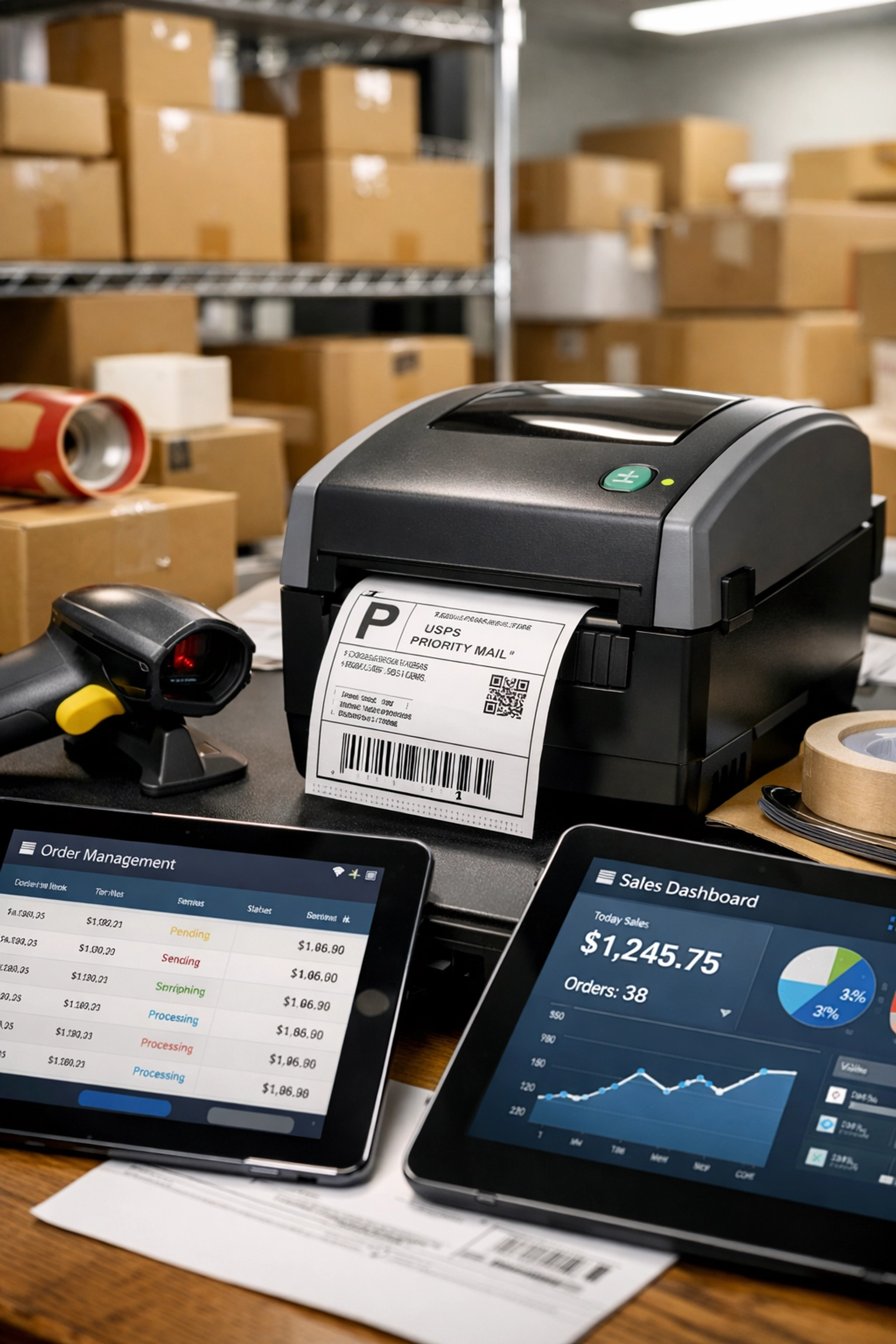
5. THE SOLUTION: THE SINGLE POOL OF TRUTH
The only way to scale off the Amazon Island without losing your mind is to centralize your fulfillment.
At FBMFulfillment.com, we see this every day. Sellers come to us because they are tired of the “split inventory” headache.
How it works: You send your inventory to us. We integrate directly with your Amazon (FBM), Shopify, and eBay stores. When an order comes in from any of those channels, our system sees it, picks it, and ships it from the same pool of inventory.
Why this is a game-changer:
- Inventory Efficiency: You don’t need to guess how many units to send to FBA vs. how many to keep for Shopify. 100% of your stock is available to 100% of your customers, 100% of the time.
- Brand Control: When we ship your Shopify orders, we can use your custom packaging. Amazon won’t do that. They want their “smile” box on your customer’s porch. We want your brand to shine.
- Risk Mitigation: If Amazon suspends your listing (it happens to the best of us), your business doesn’t die. We simply keep shipping your Shopify and eBay orders. Your cash flow stays alive.
6. FOCUS ON THE “ADDITIONAL” WORK
Expanding isn’t just about a new website. It’s about new responsibilities. When you move to Shopify, you are now responsible for:
- Customer Service: No more Amazon bots handling returns. You need a person (or a very good system) to handle “Where is my order?” emails.
- Site Speed: If your Shopify site takes 4 seconds to load, 50% of your paid traffic will bounce.
- Email Marketing: This is where the profit is. Abandoned cart sequences, post-purchase upsells, and monthly newsletters are the lifeblood of a non-Amazon business.
FINAL THOUGHTS FROM THE WAREHOUSE
Escaping the Amazon Island is the smartest move you can make for the long-term health of your brand. It gives you an asset you actually own and a customer list you can actually talk to.
But don’t go into it thinking it’s “Amazon Lite.” It’s a completely different beast that requires better marketing, better brand-building, and: most importantly: better logistics.
Don’t let your growth get choked by shipping labels and inventory counts. Focus on the traffic; let us focus on the boxes.
If you’re ready to stop juggling three different inventory piles and start scaling like a pro, contact us at FBMFulfillment.com. We’ll help you bridge the gap between “Amazon Seller” and “Global Brand.”
We’ve helped hundreds of sellers make this transition. It’s not easy, but with the right partner, it’s definitely worth it.
Let’s get to work.
FBA Fees Jumped Again in 2026: How Hybrid Fulfillment Protects Your Margins (And Your Sanity)
Hostage Inventory: Why Amazon Makes it Hard to Leave (and How to Take Control)
FBA Fees Jumped Again in 2026: How Hybrid Fulfillment Protects Your Margins (And Your Sanity)