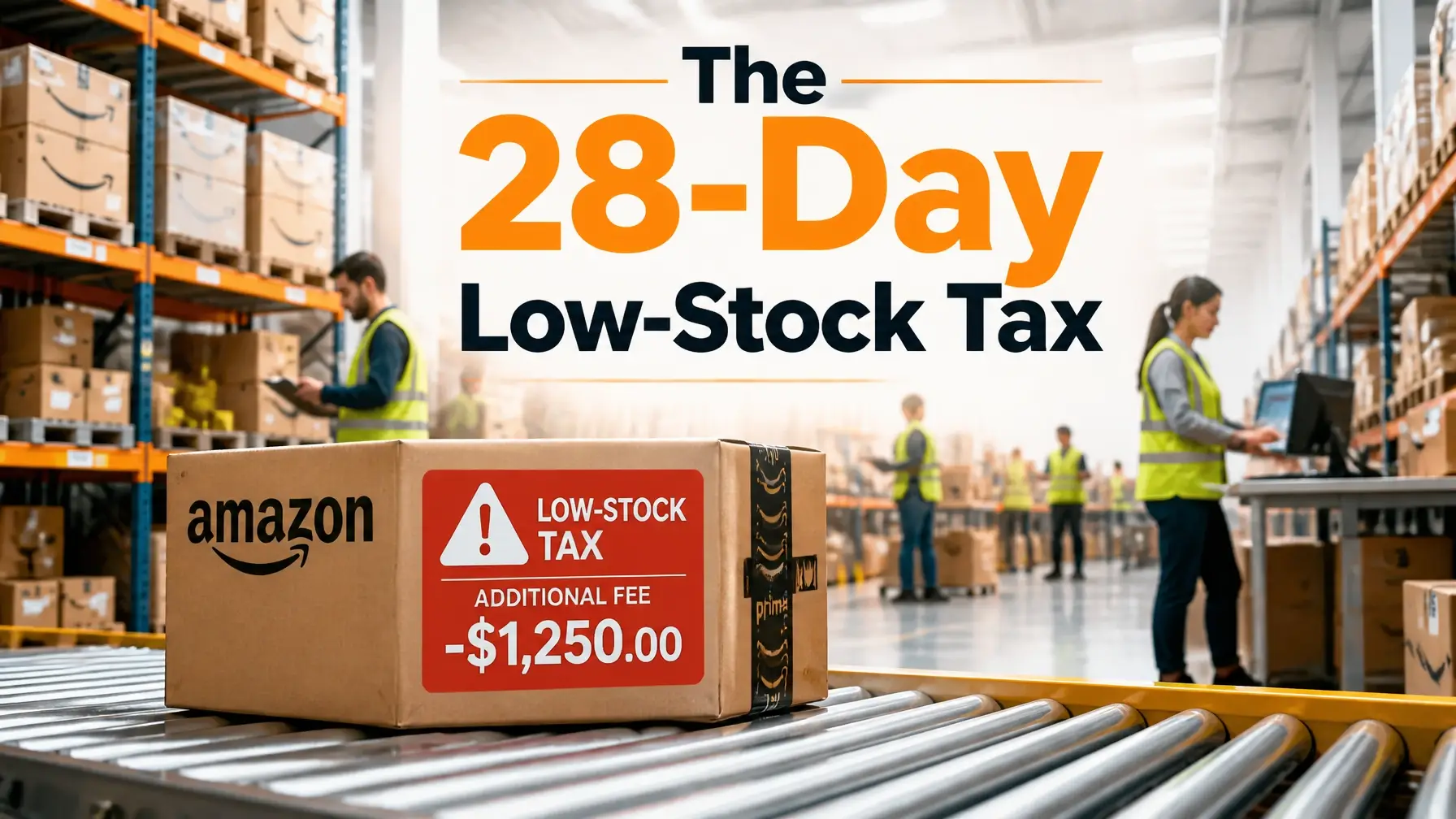
Let’s be honest: for years, the “Amazon Guru” advice was simple. Stay lean. Turn your inventory fast. Don’t let your cash get tied up in stagnant boxes at a fulfillment center. We all listened, and it worked: until it didn’t. Amazon just flipped the script on us. With the introduction of the Amazon low inventory level fee, being “too lean” is no longer a sign of efficiency; it’s a direct tax on your bottom line.
If you’ve been checking your settlement reports lately and noticed a mysterious surcharge eating your margins, you aren’t alone. This isn’t just another small fee; it’s a fundamental shift in how Amazon wants you to play the game. They want their warehouses to be “cross-docks,” not long-term storage, but they also want you to never, ever run out of stock. It’s a precarious balancing act that’s leaving many sellers stuck between a rock (high storage fees) and a hard place (low inventory fees).
In this post, I’m going to break down exactly how this “Low-Stock Tax” works and, more importantly, how you can use a hybrid fulfillment strategy to keep Amazon happy without handing over your entire profit margin.
THE MATH OF THE AMAZON LOW INVENTORY LEVEL FEE
Amazon didn’t just pull a random number out of a hat. They decided that 28 days is the magic threshold. If your historical days of supply drop below that mark across both their short-term (30-day) and long-term (90-day) windows, the fee kicks in.
Think about that for a second. To avoid the Amazon low inventory level fee, you have to maintain at least four weeks of stock at all times. But if you send in too much, you’re hit with the aged inventory surcharge. It’s a narrow “Goldilocks zone” that is incredibly difficult to hit if you are shipping everything directly from your manufacturer to FBA.

HOW THEY CALCULATE YOUR RISK
The fee is calculated based on “Historical Days of Supply.” Here is the reality of how it hits your account:
- Short-Term Window: Your average inventory divided by your average daily units sold over the last 30 days.
- Long-Term Window: The same calculation over the last 90 days.
- The Trigger: If both of these numbers are under 28 days, you are charged a per-unit fee on every single item shipped.
Starting in 2026, the complexity ramped up. Amazon moved from calculating this at the Parent ASIN level to the seller-FNSKU level. This means if you have a shirt in five sizes, and the “Medium” is flying off the shelves while the “Extra Large” is sluggish, you could be paying the fee on every Medium sold just because you couldn’t keep that specific SKU in stock.
WHY THE “ALL-IN” FBA MODEL IS DYING
For a long time, the dream was to be 100% FBA. Send the containers to Amazon, let them handle the rest, and sip margaritas while the “Buy Box” does the work. Unfortunately, that model is becoming a liability.
When you are “all-in” on FBA, you lose Inventory Possession Control. If Amazon decides to change their fee structure: like they did with this low-stock tax: or if they experience inbound delays during peak season, you are stuck. You can’t pivot. You can’t move that stock to TikTok Shop or Shopify easily without paying massive removal fees.
We’ve seen it happen too many times: a seller has a huge spike in sales (great news, right?), but because they didn’t have another 30 days of stock already sitting in Amazon’s system, they get slapped with a $0.97 per unit surcharge. On a $20 product, that is a devastating blow to the margin. This is exactly why avoiding common FBA inventory mistakes has become a full-time job for many founders.

THE SOLUTION: A ROBUST HYBRID FULFILLMENT STRATEGY
So, how do you beat a system designed to charge you for being both too lean and too heavy? You don’t play their game on their turf. You move the “storage” part of your business to a partner who actually understands ecommerce from a seller’s perspective.
The hybrid fulfillment strategy is the best solution for the modern multichannel seller. Instead of shipping your entire container to Amazon, you ship it to a specialized 3PL like FBMFulfillment.com. We act as your primary inventory hub.
From our warehouse, you “drip-feed” Amazon exactly what they need to stay in that 28-to-35-day window. This allows you to:
- Avoid the Amazon low inventory level fee by keeping enough stock at FBA to satisfy their metrics.
- Avoid aged inventory surcharges by not overstuffing their warehouses.
- Control your inventory so you can fulfill orders from Shopify, Walmart, or TikTok Shop from the same pool of stock.
THE POWER OF THE DRIP-FEED
Imagine your inventory is a water tank. Amazon FBA is a small bucket you use to serve customers. If the bucket is empty, you pay a fine. If the bucket overflows, you pay a fine. The hybrid model allows you to keep the main tank at FBMFulfillment and use a “drip” to keep that FBA bucket perfectly full.

This isn’t just about avoiding fees; it’s about operational excellence. By maintaining a hybrid approach, you are never held hostage by Amazon’s inbound receiving delays. If they take three weeks to check in a shipment (and yes, it happens), you can simply flip your listing to FBM (Fulfilled by Merchant) and keep selling. Our actual 2-day delivery via FedEx ensures your customers don’t even notice the difference.
THE HIDDEN COSTS OF IGNORING THE TREND
If you think you can just “manage” your way out of this with better spreadsheets, be careful. The Amazon low inventory level fee is just the beginning. Amazon is increasingly favoring sellers who have a diversified logistics footprint. They want you to use their “AWD” (Amazon Warehousing and Distribution), but as we’ve discussed before, AWD has its own set of risks and limitations compared to a true 3PL partner.
Beyond the literal dollars and cents of the fee, there is the opportunity cost. Every hour you spend calculating “historical days of supply” is an hour you aren’t spent developing new products, optimizing your ad spend, or building your brand.
As a 3PL built by sellers, we know exactly how much it hurts to see those “FBA Fulfillment Fee” lines on your statement grow every year. We built our warehouse specifically to solve the pain points we felt ourselves. We provide the same-day shipping and inventory accuracy that Amazon demands, but with the flexibility and support that Amazon simply cannot offer.

HOW TO TRANSITION TO HYBRID FULFILLMENT TODAY
If you’re tired of the “Low-Stock Tax” and want to take back control of your margins, the transition is simpler than you think. Here are the key steps:
- Audit Your SKUs: Identify which products are consistently hitting the low-stock threshold.
- Split Your Inbound: Ship your next shipment to FBMFulfillment.com instead of straight to an Amazon FC.
- Set Up Replenishment: Use our system to monitor your FBA levels. When you hit 30 days of supply, we trigger a “drip” shipment to Amazon.
- Enable Multi-Channel: Connect your Shopify and TikTok Shop to our warehouse so you can sell the same inventory across every platform.
The ecommerce landscape in 2026 is brutal. Amazon is a powerful tool, but they are not your partner: they are a platform with their own interests. By adopting a hybrid fulfillment model, you stop being a passenger in their logistics machine and start being the pilot of your own business.
Don’t let your hard-earned profits get eaten by avoidable fees. Contact us at FBMFulfillment.com and we will be glad to help you set up a replenishment strategy that keeps your stock levels perfect and your margins healthy.
Key Takeaways
- The Amazon low inventory level fee penalizes sellers for low stock, requiring at least 28 days’ worth of inventory to avoid charges.
- Sellers face a dilemma: maintain low stock to avoid high storage fees or risk low inventory fees and decreased margins.
- Transitioning to a hybrid fulfillment strategy allows control over inventory, prevents Amazon penalties, and enhances multichannel selling.
- Audit your SKUs, split inbound shipments, and set up replenishment through a partner like FBMFulfillment to improve efficiency.
- Adopting a hybrid fulfillment model helps sellers take back control and enhance profit margins against Amazon’s changing policies.
Related Links
Frequently Asked Questions
A per-unit surcharge Amazon charges when your “historical days of supply” drops below 28 days across both a 30-day and a 90-day window — a penalty for running FBA stock too lean, on top of the existing aged-inventory penalty for running it too heavy.
Amazon calculates your average inventory divided by average daily units sold, over both the last 30 days and the last 90 days. If both windows fall under 28 days of supply, the fee applies on every unit shipped for that listing.
As of 2026, per seller-FNSKU (effectively per SKU), not per parent ASIN. That means one fast-moving variation — like a specific size or color — can trigger the fee even while the parent listing overall looks adequately stocked.
This is exactly what hybrid fulfillment solves: keep your primary inventory at a 3PL and drip-feed smaller, more frequent replenishment shipments into FBA, so you stay above the 28-day threshold without holding months of stock inside Amazon’s expensive storage.
It means splitting inventory between Amazon FBA and an outside warehouse partner, replenishing FBA on a short cycle instead of sending everything in one large shipment. That keeps FBA stock levels in Amazon’s “Goldilocks zone” while the bulk of your inventory sits somewhere cheaper.
Article: FBMFulfillment Launches First Automated FBA Replenishment Module
Article: Amazon Inbound Placement Secrets Revealed: How to Eliminate Fees & Slash Replenishment Time with FBMFulfillment