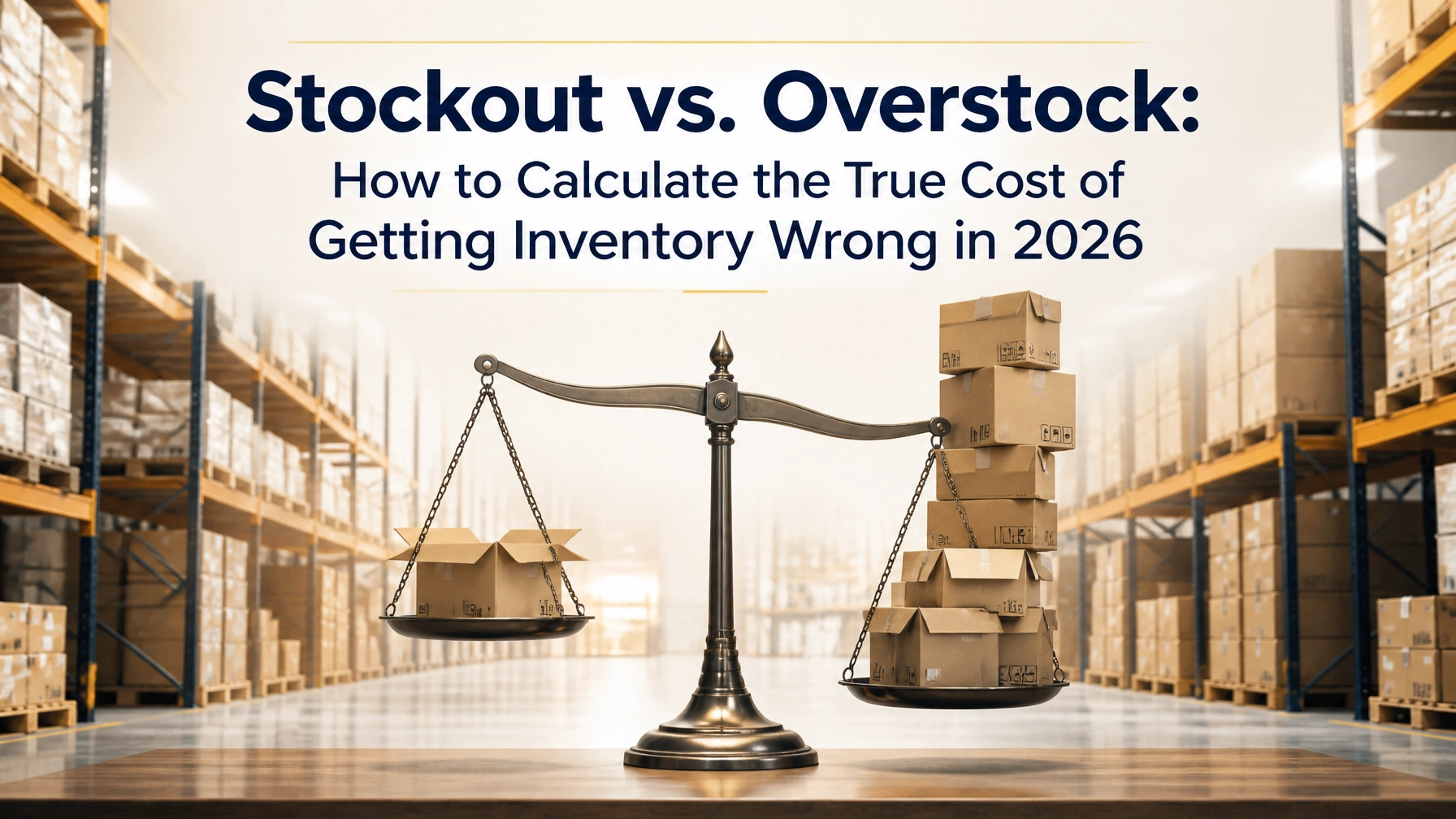
Maintaining the perfect balance of inventory has always been the “holy grail” of e-commerce. In 2026, however, the stakes have shifted from “minor inconvenience” to “catastrophic risk.” With Amazon introducing aggressive new fee structures and global supply chains becoming increasingly volatile, getting your inventory levels wrong can wipe out a year’s worth of profit in a single quarter. Whether you are using pick and pack fulfillment services or managing stock yourself, the safety stock formula is now a key tool, and understanding the math behind your inventory is no longer optional.
The modern seller operates in a precarious environment. On one hand, overstocking leads to soul-crushing storage surcharges and tied-up capital. On the other, a stockout triggers a ranking death spiral on Amazon and pushes your loyal customers directly into the arms of competitors. This guide breaks down the data-driven formulas you need to survive and the hidden costs of the inventory tug-of-war. If you have been searching for safetystock tips online, this is where the real numbers start to matter.
1. DETERMINING THE “GOLDILOCKS” ZONE: INVENTORY FORMULAS
You can’t manage what you can’t measure. To find the right inventory levels, you need to account for demand variability, supplier reliability, and the actual time it takes for a product to hit the shelf. This is where pick and pack fulfillment services become critical, as they provide the data visibility needed for these calculations.
The Safety Stock Formula: A Deep Dive
Safety stock is your insurance policy against the unknown. It’s the extra inventory held to mitigate the risk of stockouts during replenishment. If you want a dependable safety stock calculation formula, you need a model grounded in operational reality. The safety stock formula we use here accounts for both demand and lead time variability. In 2026, we use a more robust formula to account for both demand and lead time variability:
Safety Stock (SS) = Z × √(L × σd² + d² × σL²)
- Z: Your service level factor (typically 1.65 for a 95% service level).
- L: Average lead time in days.
- d: Average daily demand.
- σd: Standard deviation of daily demand (variability).
- σL: Standard deviation of lead time (how often your supplier is late).
The Reorder Point (ROP)
Once you have your safety stock, you need to know exactly when to pull the trigger on a new purchase order.
Reorder Point (ROP) = (Average Daily Demand × Lead Time) + Safety Stock
If your supplier takes 30 days to deliver and you sell 10 units a day with a safety stock of 100 units, your ROP is 400. The moment your inventory hits 400, you must reorder.

2. THE CARRY COST OF EXCESS INVENTORY
Overstocking is often seen as the “safer” bet, but the financial leak is massive. In 2026, the ecommerce fulfillment near me search might lead you to a local warehouse, but the costs remain the same:
- Storage Fees: Beyond the base rent, you’re paying for the physical space.
- Working Capital: Every dollar tied up in a box sitting on a shelf is a dollar you can’t spend on PPC, new product development, or expansion.
- Obsolescence and Damage: The longer an item sits, the higher the risk of it becoming “dead stock,” especially in fast-moving categories like apparel or electronics.
- Opportunity Cost: If you have $50k sitting in slow-moving inventory, you lose the ability to jump on trending opportunities.
3. THE DEVASTATING PRICE OF A STOCKOUT
While overstocking drains your wallet slowly, a stockout is a blunt-force trauma to your business. When you run out of stock, you lose more than just the immediate sale.
- Lost Customer Lifetime Value (LTV): A customer who finds you “Out of Stock” will go to a competitor. If they like that competitor’s product, you haven’t just lost $20; you’ve lost their business for the next five years.
- Competitor Acquisition: You are essentially paying for your competitor’s customer acquisition by driving your traffic to their listings.
- The Amazon Ranking Trap: This is perhaps the most significant risk. When you stock out on Amazon, you lose the Buy Box immediately. Your organic ranking drops, your PPC history resets, and your “In-Stock Rate” (a key IPI metric) plummets. Recovery often takes weeks or months of aggressive (and expensive) discounting and advertising.
4. STORAGE FEE SHOWDOWN: AMAZON FBA VS. 3PL
One of the biggest mistakes sellers make is assuming all storage is created equal. In 2026, the gap between Amazon’s “hotel for products” and a dedicated 3PL fulfillment prep center has widened into a canyon.
Amazon’s Punishment Model
Amazon doesn’t want to be your warehouse; they want to be a cross-docking station. To enforce this, they’ve implemented a complex web of fees:
- Peak vs. Off-Peak: From October to December, Amazon standard-size storage fees jump from $0.78 to $2.40 per cubic foot. That is a 3x increase just for the privilege of being there during the holidays.
- Aged Inventory Surcharges: Once inventory hits 181 days, fees spike. By 365 days, you could be paying up to $7.90 per cubic foot.
- Low-Inventory Level Fee: Introduced to prevent sellers from running too lean, this fee penalizes you if you don’t maintain at least 28 days of supply. It’s a classic “damned if you do, damned if you don’t” scenario.
The FBMFulfillment Advantage
Contrast this with a professional fulfillment center in florida like FBMFulfillment.com. We built our system from an e-commerce seller’s perspective.
- Daily Proration: You only pay for what you use, day by day. No monthly snapshots that catch you at your highest inventory point.
- Aggregate Volume Model: We don’t punish you for having multiple SKUs; we look at your total footprint.
- No Long-Term Traps: No contracts, no onboarding fees, and no “low-inventory” penalties. You control your stock.
5. REGULAR VS. OVERAGE STORAGE: KNOW THE DIFFERENCE
Amazon utilizes a “Capacity Limit” system. If you exceed your assigned volume, you are hit with overage fees: usually $10 per cubic foot for the excess. This is on top of your regular storage fees.
In a traditional 3PL model, “overage” doesn’t really exist in the same punitive way. If you need more space, you simply pay the standard rate for that additional space. This flexibility is vital for businesses using amazon multi channel fulfillment mcf, where you need to balance stock across different platforms like TikTok Shop and Shopify.
6. REPLENISHMENT TIME IS THE VARIABLE THAT CHANGES EVERYTHING
The time from clicking “order” to the product being available for sale is your true replenishment time. This is the variable too many sellers underestimate. And it has devastating consequences.
The shorter your replenishment cycle, the less safety stock you need. Period. That is exactly why the same SKU can require radically different inventory levels depending on whether you are waiting on a factory overseas or replenishing Amazon from domestic 3PL stock.
Here is the critical point too many sellers miss: Factory → 3PL and 3PL → FBA are 2 completely separate calculations. They are not the same timeline. They are not the same assumptions. They are not the same math problem. If you combine them into one blended number, you distort your safety stock calculation formula and make bad replenishment decisions.
1. Factory → 3PL Replenishment
This is the long cycle. The volatile one. The precarious one.
Factory → 3PL replenishment usually takes weeks or even months, and the variability is high. Your lead time is exposed to:
- Production delays at the factory
- Port congestion at origin or destination
- Customs exams and clearance delays
- Ocean freight schedule changes
- Seasonal shutdowns like Chinese New Year
- Weather events and labor disruptions
This is where the bullwhip effect gets brutal. A small delay at the factory can snowball into a catastrophic stockout weeks later. Given the significant risks, this leg of the supply chain is where you need your largest safety buffer.
In plain English, your Factory → 3PL calculation is built around long lead time plus high variability. That means a bigger buffer, a larger reorder window, and much more caution.
2. 3PL → FBA Replenishment
This is the short cycle. The controlled one. The predictable one.
Once your inventory is already sitting at a domestic 3PL, the replenishment math changes dramatically. 3PL → FBA replenishment is typically a 7–10 day cycle with far less variation than international inbound freight. That predictability matters.
And this is exactly why using a 3PL like FBMFulfillment for FBA dripfeed is so important. You are no longer forcing Amazon replenishment decisions to depend on factory production, ocean transit, customs, and port congestion every single time you need stock at FBA. You separate the risk. You isolate the long lead time upstream and preserve a short, repeatable downstream replenishment cycle into Amazon.
A 3PL like FBMFulfillment acts as a buffer between slow factory lead times and fast Amazon fulfillment. Instead of betting your in-stock rate on overseas timelines every time you need more inventory at FBA, you are replenishing from nearby reserve stock. Voilà you are covered AUTOMATICALLY.
That advantage becomes even stronger with our exclusive FBA Replenishment Module technology. This is where FBA dripfeed gets even better:
- Automates replenishment so inventory can be pushed into Amazon based on a faster, controlled domestic cycle
- Eliminates placement fees by using Amazon’s new replenishment workflow more efficiently
- Reduces replenishment time by streamlining how shipments are prepared and routed into FBA
- Improves consistency because you are working from domestic 3PL inventory instead of waiting on another overseas cycle
There is another major advantage. A professional 3PL can ship direct to multiple Amazon fulfillment centers simultaneously, which helps bypass Amazon’s internal redistribution process. That means:
- Less time stuck in Amazon’s cross dock network
- Faster availability across regions
- Lower risk of inventory being delayed after delivery
- More predictable FBA receiving outcomes
If you ship factory-to-FBA, your lead time includes ocean freight plus the 14–21 days Amazon often takes to check in a shipment during Q4. If you ship factory-to-3PL first, your 3PL can often have your stock ready for pick and pack fulfillment services within 24–48 hours of arrival, and then turn around FBA replenishment on a short, repeatable cycle. With FBMFulfillment’s exclusive FBA Replenishment Module, that short domestic cycle becomes even tighter because the replenishment process is automated and designed specifically for FBA dripfeed execution. This compressed replenishment structure allows you to hold less safety stock while still protecting availability.
Best solution: separate the long, high-variability factory timeline from the short, low-variability Amazon replenishment timeline. Run separate calculations for each. Do not use the same assumptions. Do not use the same lead time. Do not use the same safety buffer. Factory → 3PL and 3PL → FBA are not the same math problem, and lead time is the key variable that changes everything.

7. SEASONAL SHUTDOWNS: THE SILENT KILLERS
Your inventory planning must account for global events that halt production.
- Chinese New Year (CNY) 2026: Falling on February 17, 2026, factories in China will shut down for 2–4 weeks. Production halts, and port congestion spikes both before and after. If you haven’t accounted for this in your November/December orders, you will stock out in March.
- Diwali 2026: For those sourcing from India, Diwali (November 8, 2026) brings similar slowdowns in manufacturing and local transport.
- Unplanned Events: Port strikes, weather events, or raw material shortages create a “bullwhip effect.” A small delay at the factory results in a massive stockout at the fulfillment center.
8. WHY THE “DRIP FEED” STRATEGY WINS
The most successful sellers in 2026 use a hybrid approach. They use a shopify fulfillment company or a fulfillment center in florida to hold their bulk inventory and “drip feed” small amounts into Amazon FBA.
This strategy works because it turns replenishment into a controlled domestic process instead of a constant international gamble. More importantly, it lets you calculate Factory → 3PL inventory separately from 3PL → FBA inventory, which is exactly how a sound safety stock calculation formula should be applied.
This strategy:
- Avoids Amazon’s low-inventory fees.
- Mitigates high Q4 storage rates.
- Ensures you have inventory ready for amazon multi channel fulfillment mcf orders from other channels like eBay or Walmart, even if FBA is experiencing delays.
- Makes FBA dripfeed faster and more accurate because replenishment is based on short domestic lead times.
- Gets even stronger when paired with FBMFulfillment’s exclusive FBA Replenishment Module, which automates replenishment, eliminates placement fees, and reduces replenishment time.

BEST SOLUTION: CHOOSE A PARTNER WHO UNDERSTANDS THE PAIN
Inventory management is a balancing act that requires a partner, not just a service provider. At FBMFulfillment.com, we’ve been in your shoes. We know the sting of a $5,000 Amazon storage bill and the frustration of a stockout during a viral TikTok trend.
Whether you need 3pl fulfillment prep or a reliable fulfillment center in florida to handle your multi-channel growth, we are here to help. Our Jacksonville facility is perfectly positioned for fast shipping across the East Coast and beyond.
Contact us at fbmfulfillment.com/contact-us and we will be glad to help you optimize your inventory levels for 2026.
Key Takeaways
- In 2026, using the safety stock calculation formula is crucial due to unstable supply chains and aggressive Amazon fees.
- Overstocking leads to high costs, while stockouts can decimate customer loyalty and rankings on Amazon.
- A professional fulfillment center can streamline inventory management, particularly between Factory and FBA replenishment.
- Seasonal shutdowns like Chinese New Year can lead to stockouts if not planned for adequately.
- Employing a drip feed strategy helps manage inventory across different sales channels and optimizes your supply chain.