
Amazon FBM is often treated as the backup plan when FBA is unavailable, expensive, or capped. That is a mistake. For the right seller, fulfilling Amazon orders from your own operation or a qualified 3PL is a deliberate margin and risk-management strategy – one that keeps inventory accessible, protects multichannel sales, and reduces dependence on Amazon’s warehouse network.
FBM does not mean shipping orders from a garage forever. It means the seller, rather than Amazon, owns the fulfillment operation and its results. You choose where inventory sits, how orders are packed, which carrier services are used, and how quickly exceptions are fixed. That control can be valuable, but only when the operation behind it is disciplined enough to meet Amazon’s performance standards.
What Amazon FBM Actually Changes
With Fulfillment by Amazon, inventory is sent into Amazon’s network. Amazon stores it, picks and packs each order, ships it, and generally handles customer service and returns related to fulfillment. The trade-off is clear: convenience comes with fulfillment fees, storage fees, inbound shipping requirements, receiving delays, inventory limits, and less direct access to your stock.
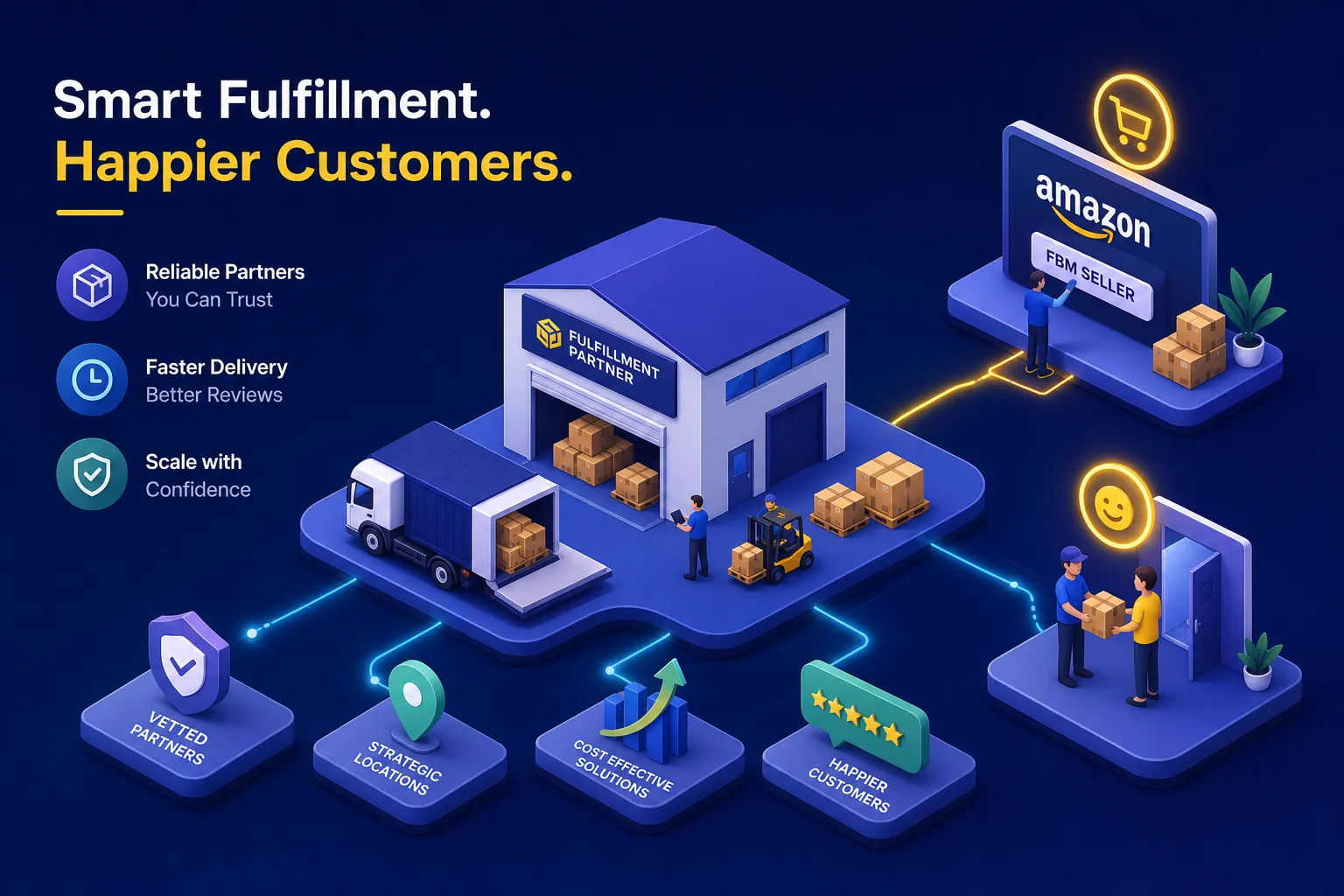
With Amazon FBM, you list products on Amazon but fulfill each order yourself or through a third-party warehouse. You remain responsible for inventory accuracy, shipping on time, valid tracking, packaging quality, customer communication, and return handling. Amazon is still the marketplace, but it is no longer the operator of your order flow.
That distinction matters most when Amazon inventory is only one part of a larger business. A brand selling through Shopify, Walmart, eBay, TikTok Shop, wholesale accounts, and Amazon cannot afford to let one channel trap too much of its available inventory. FBM allows a shared inventory pool to serve multiple sales channels, provided the stock counts and order routing are reliable.
When Amazon FBM Makes Financial Sense
FBM is not automatically cheaper than FBA. A lightweight, fast-moving item with predictable demand may be difficult to fulfill for less than Amazon’s per-unit cost, especially when Prime conversion is a major factor. The real question is not which fee looks lower on a single order. It is which model produces stronger contribution margin and lower operating risk across the business.
FBM becomes more compelling when products are oversized, slow-moving, high-value, fragile, bundled, customized, or subject to seasonal demand swings. These products can attract substantial FBA storage and fulfillment costs, while long-term storage exposure can turn a profitable SKU into dead inventory. Keeping those units in a flexible warehouse gives the seller more time and more options.
It also makes sense when inbound inventory is delayed or restricted. If an FBA shipment takes longer than expected to receive, the listing may show as out of stock even while sellable units are sitting in transit or waiting at an Amazon facility. An active FBM offer can keep the product available during that gap. For brands with a meaningful ranking position or an expensive advertising program, protecting continuity can be worth far more than the difference in a single fulfillment fee.
Consider a seller carrying 15 SKUs across Amazon and a direct-to-consumer store. If all inventory is committed to FBA, a sudden surge in Shopify demand may force an emergency transfer or create a stockout on the brand’s own site. With a central fulfillment partner, inventory can be allocated based on actual demand rather than locked inside one network.
The Operational Standards That Make or Break FBM
Amazon does not grade FBM sellers on good intentions. Late shipments, order cancellations, missing tracking, and delivery issues can damage account health and reduce a listing’s ability to compete. The seller needs a process that works during normal volume and during the days when order volume doubles, a carrier misses a pickup, or a top SKU suddenly runs low.
Inventory accuracy is the foundation. An FBM offer should never be used to sell inventory that has already been reserved for wholesale, a different marketplace, damaged stock, or an inbound transfer. Overselling creates cancellations, and cancellations are an account-level problem, not merely a customer-service inconvenience. Real-time or tightly managed inventory synchronization is essential when the same units are offered on several channels.
Cutoff times matter just as much. A warehouse must know which orders require same-day processing, what happens after cutoff, and how weekends and holidays affect promised handling time. Sellers should not publish aggressive delivery promises simply because they look competitive. Set handling and transit expectations that the operation can consistently achieve, then improve them only after performance data supports the change.
Tracking discipline is another non-negotiable. Every shipment needs a valid carrier method, a trackable number, and a label created in time to meet the stated ship date. Buying labels early without physically moving orders is a short-term shortcut that creates delivery and compliance risk. The operation has to be built around actual handoff to the carrier.
Returns require the same level of attention. A returned FBM order should be inspected, categorized, and dispositioned quickly. Sellable units need to return to available inventory. Damaged or opened items need a defined path. Without a returns process, inventory records drift, recovery opportunities disappear, and sellers start making replenishment decisions based on bad numbers.
Amazon FBM Is Strongest in a Hybrid Strategy
The best fulfillment model for many established brands is not FBA versus FBM. It is FBA and FBM, with each channel serving a defined purpose.
FBA can support high-velocity products where Prime eligibility, fast delivery, and Amazon conversion justify the fees. FBM can cover oversized products, slow movers, bundles, replacement inventory, or SKUs that need more careful handling. It can also act as a pressure-release valve when Amazon storage limits tighten or inbound receiving slows down.
A hybrid approach reduces single-point failure. If an FBA SKU goes unavailable, an FBM offer can preserve sales history and customer access. If FBM demand spikes beyond a planned threshold, inventory can be replenished into FBA for products where that move makes economic sense. The key is to avoid running both models as disconnected silos. Inventory allocation, replenishment triggers, and margin reporting must be managed as one operating plan.
Seller Fulfilled Prime can add another layer for qualified merchants, but it should not be pursued casually. Prime-level performance is demanding, and the seller or 3PL must sustain strict shipping, delivery, and service metrics. It can be a powerful option for the right catalog and geography, but standard FBM is often the better starting point for brands that first need dependable execution and clean performance data.
How to Build an FBM Operation That Can Scale
Start with the catalog, not the warehouse. Review each SKU’s dimensions, weight, average order value, order frequency, seasonality, return rate, packaging needs, and FBA fee profile. This identifies which items belong in FBA, which should remain FBM, and which need both offers for protection.
Next, map the order flow from the moment an Amazon order is placed to the moment the carrier receives it. Identify who owns inventory updates, label generation, pick confirmation, packing quality checks, carrier cutoff, tracking upload, customer exceptions, and returns. If any step depends on a person remembering to check a spreadsheet, it will eventually fail at volume.
Then measure the metrics that reveal risk early: cancellation rate, late shipment rate, valid tracking rate, delivery performance, order-to-ship time, inventory variance, and return disposition time. Do not wait for an account warning to discover that a process is slipping. Daily exception reporting is far less expensive than a suspended listing or an account-health emergency.
The right fulfillment partner should understand that an Amazon order is not just a box leaving a warehouse. It is a promise tied to listing visibility, ad spend, customer feedback, and account standing. FBMFulfillment supports sellers that need that level of operational ownership across Amazon and other channels, with inventory positioned to serve FBM orders, DTC demand, FBA replenishment, and returns from one coordinated operation.
The Decision Is About Control You Can Execute
Amazon FBM gives sellers a way to retain access to their inventory and respond faster when FBA restrictions, receiving delays, or storage costs start cutting into margin. But it transfers responsibility as well. Weak inventory control, inconsistent shipping, and poor exception management can make FBM more costly than the fees it was meant to avoid.
The practical move is to use FBM where control creates a measurable advantage, then support it with a fulfillment operation capable of meeting every promise shown on the listing. When your warehouse process is strong enough to protect customer experience and account health, FBM stops being a fallback and becomes a useful lever for growth.