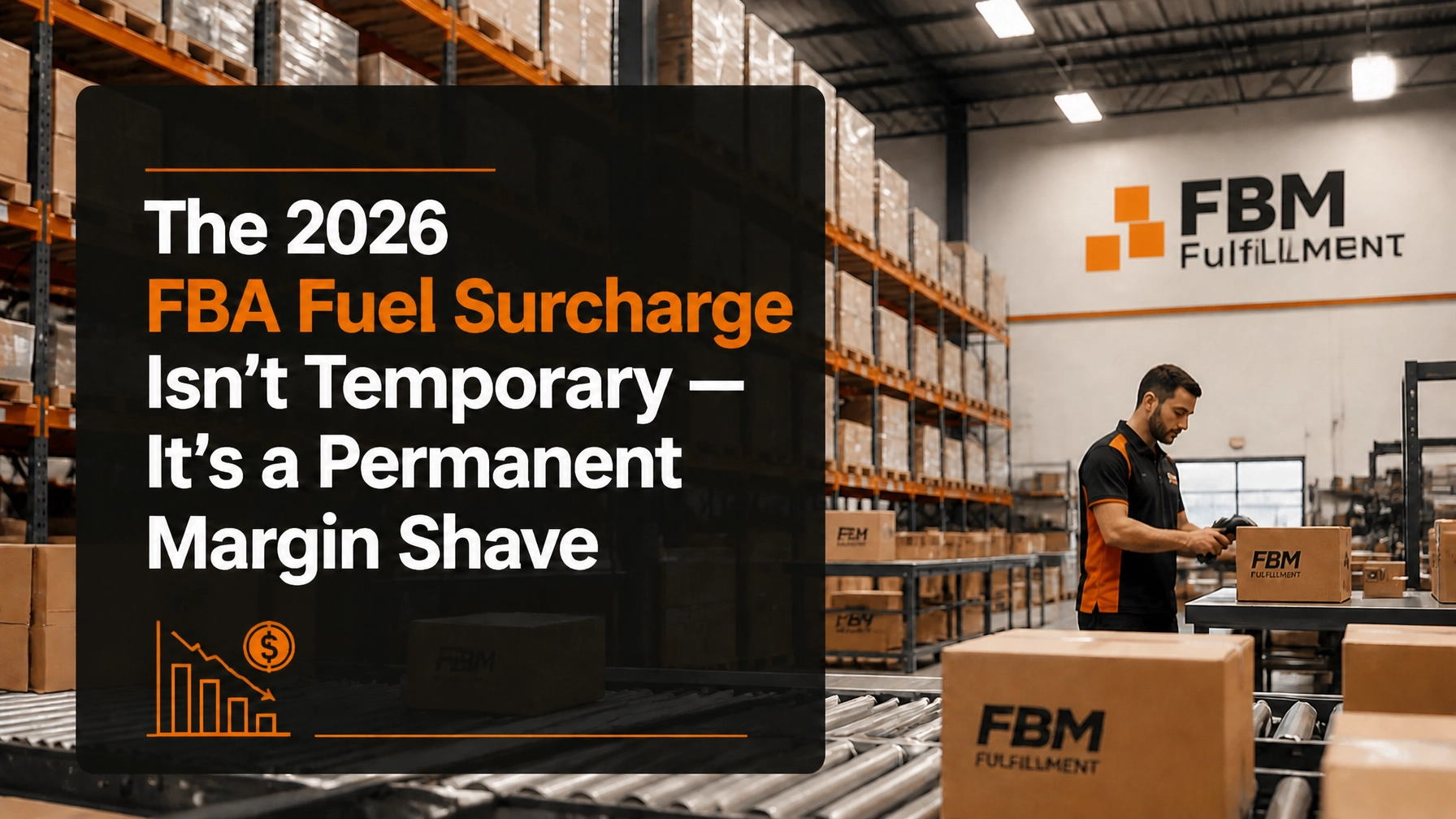
Starting April 17, 2026, Amazon introduced a new hurdle for every seller on the platform: a 3.5% FBA fuel surcharge applied to all fulfillment fees. While the corporate announcement frames this as a “temporary” response to fluctuating energy costs, seasoned sellers know the truth. In the world of Amazon logistics, a “temporary” fee is often just a test balloon for a permanent price floor. This new charge doesn’t exist in a vacuum; it sits squarely on top of the base fee increases implemented just months prior in January. For the average brand, this isn’t just a minor adjustment, it’s a calculated, permanent margin shave that threatens the viability of low-margin SKUs and multi-channel strategies.
If you are running an ecommerce business in 2026, you cannot afford to ignore the math. The cumulative effect of the FBA fuel surcharge and rising base Amazon FBA fees is creating a precarious environment where your profitability is being chipped away by cents that quickly turn into thousands of dollars.
The Math of the Double Stacking
To understand the gravity of the situation, you have to look at the sequence of events. In January 2026, Amazon adjusted its base fulfillment fees, resulting in an average increase of approximately $0.08 per unit for standard-sized items. While $0.08 sounds negligible to a casual observer, for a high-volume seller moving 50,000 units a month, that was a $4,000 hit to the monthly bottom line right out of the gate.
Then came April 17th. The 3.5% FBA fuel surcharge was applied not to the product price, but to the fulfillment fee itself.
Breaking Down a Standard Unit:
- January Base Fee: $4.75 per unit (post-increase).
- April Surcharge: 3.5% of $4.75 = $0.166 (rounded to $0.17).
- Total Increase Since 2025: $0.08 (Jan) + $0.17 (April) = $0.25 per unit.
A quarter per unit might not seem like a “catastrophic risk” initially, but it represents a massive percentage of your net profit margin. If your net profit per unit was $2.00, Amazon just took 12.5% of your take-home pay. Voilà, you are covered AUTOMATICALLY in fees you didn’t budget for.

Why “Temporary” is a Logistics Trap
Amazon has a history of introducing “temporary” surcharges during peak seasons or periods of economic volatility. However, even when fuel prices stabilize, these fees rarely disappear; they are usually folded into the following year’s “simplified” base fee structure. By calling it an FBA fuel surcharge, Amazon gives itself the flexibility to adjust the number up or down without having to republish the entire fee schedule every month.
Given the significant risks to your margin, treating this as a permanent cost of doing business is the only responsible way to manage your P&L. If you wait for the “temporary” fee to vanish, you are essentially gambling with your company’s survival. Unfortunately, many sellers will realize too late that their 2026 projections were built on a fee structure that no longer exists.
The Devastating Impact on Multi-Channel Sellers
Perhaps the most punishing aspect of this update is its reach. On May 2, 2026, the surcharge was extended to include Buy with Prime and Multi-Channel Fulfillment (MCF) orders.
If you use Amazon to fulfill orders for your Shopify, TikTok Shop, or Walmart stores, your costs just spiked across your entire ecosystem. This is a strategic move by Amazon to capture more revenue from your off-platform sales. By increasing the cost of MCF, they are effectively making it more expensive for you to diversify away from their marketplace.
This is where the 3PL services offered by independent providers like FBMFulfillment.com become a critical lifeline. Unlike the rigid and ever-increasing costs of FBA, an independent partner provides stability and control over your fulfillment expenses.
FBMFulfillment.com vs. The FBA Margin Shave
When you look at the landscape of ecommerce fulfillment, the choice often feels like a choice between Prime-badging and profitability. But it doesn’t have to be. At FBMFulfillment.com, we were built from an ecommerce seller’s viewpoint because we’ve felt the same “pain points” you are feeling right now.

Here are the key reasons why moving your non-Prime or multi-channel inventory to our FBM fulfillment model is the best solution for the 2026 fee crisis:
- Actual 2-Day Delivery: While FBA Prime delivery times have become increasingly inconsistent, we utilize FedEx 2Day service for our fulfillment. This ensures your customers get their orders on time without the hidden surcharge baggage.
- Inventory Possession Control: One of the biggest risks of FBA is the loss of control. When your stock is in Amazon’s system, it can be “lost,” misplaced, or subject to aggressive Amazon storage fees and removal headaches. With us, your stock is never stuck in a black box.
- Multi-Channel from a Single Pool: Instead of paying an inflated FBA fuel surcharge on every MCF order, you can fulfill your Shopify, eBay, and TikTok orders from a single inventory pool at a predictable, competitive rate.
- Better Return Management: Amazon’s return processing is notorious for putting defective items back into “sellable” inventory, leading to negative reviews. We provide total control over return processing, protecting your brand’s reputation.
The Reality of Amazon Storage Fees and Removal Headaches
Adding to the complexity are the 2026 Amazon storage fees. Amazon has become more aggressive in penalizing “slow-moving” inventory. If your inventory isn’t turning over rapidly, the storage costs combined with the fuel surcharge can turn a profitable SKU into a liability within weeks.
Trying to get your inventory out of FBA is another nightmare. Removal orders are often delayed, items arrive damaged, or they simply “disappear” during the transition. By utilizing a hybrid model: keeping only what you need for Prime at FBA and the rest at FBMFulfillment.com: you avoid the trap of being held hostage by removal costs. Check out our FBA/FBM Hybrid Listing Secret to see how to balance these two worlds effectively.
Steps to Protect Your Business
You cannot control Amazon, but you can control your logistics strategy. Here are the steps you should take immediately:
- Audit Your SKUs: Calculate the exact impact of the 3.5% FBA fuel surcharge on every product. Identify which SKUs are no longer profitable under the new regime.
- Diversify Your Fulfillment: Don’t leave all your eggs in the FBA basket. Use a 3PL fulfillment center like FBMFulfillment.com to handle your multi-channel orders.
- Leverage 2-Day Shipping Alternatives: You don’t need a Prime badge to offer 2-day shipping. Reliable FBM shipping via FedEx can maintain customer satisfaction while protecting your margins.
- Review Your 3PL Options: Not all warehouses are created equal. Read our guide on what to look for in a 3PL to ensure your partner has the operational excellence required to support your growth.
The ecommerce boom has fueled a surge in “fly-by-night” fulfillment centers, but you need a partner with a proven track record. FBMFulfillment.com offers nationwide coverage and specialized support for high-SKU counts and multi-unit orders.
Conclusion
The April 17, 2026 FBA fuel surcharge is a wake-up call. It is a clear signal that Amazon will continue to prioritize its own logistics margins over the profitability of its third-party sellers. By treating this surcharge as a permanent shave on your margins, you can proactively adjust your strategy before the damage becomes irreversible.
Whether you are looking to escape the “FBA trap” or simply looking for a more reliable partner for your Shopify and TikTok Shop orders, we are here to help. Contact us at FBMFulfillment.com and we will be glad to help you audit your current fulfillment costs and find a path back to profitability.